Creative Writing: Skill vs. Talent

skill vs talent

Is effective and compelling creative writing borne of skill or talent?

There has always been much debate about whether artistically inclined trades are a matter of learned skill or inherent talent.

On the one hand, there is the belief that some are born with an active and imaginative right brain and are therefore better able to manifest creativity. On the other hand, some argue that creative skills can be learned and mastered.

When it comes to creative writing, I believe that skill and talent work together. In fact, I would argue that almost every writer whose work is worth reading has some combination of both acquired writing skill and natural talent.

Creative Writing: Developing Skills

We are taught basic grammar and comprehensive writing in school, and each of us learns how to form a coherent sentence or paragraphs by applying these teachings. We must learn our letters, and there is no artistic talent required to memorize a set of symbols that represent sounds. Throughout our formative years, we are educated in language, including reading, writing, and comprehension.

Some of us loved those classes. We were drawn to the written word, to novels and short stories, poetry, and thought-provoking articles and essays. We welcomed the opportunity to build better writing skills. We trudged over to the school library during recess and experienced glee when the Scholastic newsletters arrived. Books! Stories! We absorbed them, and they etched into our psyches until we too yearned to spin tales and dreamed of the day when our own names would appear under a feature story headline or on the spine of a best selling — or dare I say — Pulitzer Prize-winning novel.

Yet there were those who balked at the thought of opening, let alone reading, an entire book. They preferred math or science, or perhaps art, or maybe they’d rather park themselves in front of a TV or video game console. Their reports and essays came back with low marks and someone said they lacked talent, something we aspiring writers had in droves. But what is talent if not love of one’s craft?

Developing Talent

When I graduated high school and was faced with the dilemma of what to study in college, I shunned the idea of majoring in English, because I was already a voracious reader and several teachers had called me a gifted writer as well. Why study something I already had a knack for?

But a few years later, when no other major felt quite right, I finally checked off the box for English with a concentration in creative writing. Skill and talent combined to drive this choice. I finally realized that the very reason I should study writing was because I was already good at it. By majoring in English, maybe I could become great.

It was one of the best decisions I’ve ever made. In the semesters that followed, I studied the classics and learned writing nuances from my instructors and peers, discovering subtleties that never would have come to my attention otherwise. I learned the value of editing and revising, and I learned the merits of voice and style. Thankfully, I was given opportunities to explore areas of writing I never would have touched on my own: proposals, screenplays, and chapbooks. I even learned how to master the creative writing process.

It’s Not Skill vs. Talent; It’s Skill and Talent

I suppose artists, musicians, and other creative persons follow a similar path — a passion honed through years of learning and practice. When people suggest that writing cannot be learned, that grammar is unimportant, and storytelling or character development is the end-all-be-all of great writing, or that a writer’s creativity is magically manifested at birth, I am given great pause. For it is pride in one’s craft and true dedication that will result in truly wonderful writing: a seamless integration of love and passion, talent, and yes, all those mechanical writing skills that must be learned.

So what’s more important in creative writing — skill or talent? I say we need a healthy balance of both. What do you think?

Source: writingforward.com

Visit us at First Edition Design Publishing

How to Empower Your Writing With a Brilliant Epigraph

empower

Frankly, I didn’t know much about epigraphs until Amanda Forbes Silva, a gifted essayist who gave a little talk about them at a writing workshop, brought them to life for me. Had I been asked, I would have likely confused epigraphs with epitaphs and epigrams, and maybe even the epiglottis, which is apparently some kind of valve that covers the glottis during swallowing, and once malfunctioned somewhere in my throat a few years ago, nearly taking me out.

After a short primer, just to get us on the same page with a working understanding of the epigraph, and a little confessional angst, you will have a couple of practice challenges to engage your new friends.

An Introduction to the Epigraph

The epigraph is simply a well-chosen quotation, set at the beginning of a text. Epigraphs can open essays, books, chapters of a book, or even each story in a book—any writing, really, which suggests its theme.

They can, however, do so much more.

Chosen well, an epigraph offers the writer a kind of “power” to grab the reader quickly, and efficiently. If editors give the writer just a few opening paragraphs to “sell” their work, it seems to me that the perfect epigraph—short, surgical, brilliant, the very first thing seen in the work—is a terrific first contact.

Someone (and I believe it was Toby Lichtig, in The Guardian) put it this way: a good epigraph will make the reader want to “open the door” to the writing inside. It will act as a kind of “shadowy third figure,” somewhere between the author and the reader, drawing the reader in by raising interest, expectations, even questions as to what lies ahead.

One of my favorite authors does just that.

In his Bright Lights, Bright City, Jay McInerney writes the story of the dissipation of a young man in Manhattan. Here is the epigraph that opens the work, from Hemingway’s The Sun Also Rises:

“How did you go bankrupt?” Bill asked. “Two ways,” Mike said.
“Gradually and then suddenly.”

In her book, The Art of the Epigraph: How Great Books Begin, Rosemary Ahern finds that many authors seem to follow at least one fairly common strategy in deploying epigraphs, and often all three together: be brief, be funny, be wise. I think McInerney hits all three. His epigraph is brief (and sets the text in motion), it is funny (darkly) and it is insightful (ask any bankruptcy attorney).

Epigraphs With Creative Twists

There are many very interesting, and even tricky, deployments of an epigraph. One of my favorites is F. Scott Fitzgerald in The Great Gatsby. He takes a fictional character named D’Invilliers from his first novel, This Side of Paradise, and then quotes that fictional character as the author of the poem he then uses as the epigraph at the beginning of The Great Gatsby.

It sounds complicated, but here it is:

Then wear the gold hat, if that will move her;
If you can bounce high, bounce for her too.
Till she cry “Lover, gold-hatted, high-bouncing lover,
I must have you!”
—THOMAS PARKE D’INVILLIERS

As Dennis Johnson, co-founder of Melville House publishers, put it, there is something “devastatingly mischievous” about the subverted power and authority of the fictional epigraph.

Very cool. And while there are certain conventions, even “rules,” which the writer should understand, the larger point is simply how much fun a writer can have with the epigraph.

But they can also serve important structural needs, as I discovered in my recent writing. Here’s the angst part of the story, the dreaded roadblock along the way, and how we tried to break through.

Epigraphic Choices: A Case Study

I recently collaborated with two other authors to write a series of short stories. Although we had more than enough material for the collection, we soon had a problem.

Our collection of “mostly, mostly true” short stories is about the haphazard misadventures of a bunch of boys, the collection stuffed, as we say in our introduction, with “too much fun.” Although we added some language in our forward warning the readers that “too much” is a concept we didn’t understand then, or even now, we felt we needed something else—something to bring a little more order to the collection.

After all, one of our early readers suggested we might want to sell the book by the pound. Ouch.

So we did a little trimming, then more. That was necessary, but, as they say, not sufficient.

We next set out to organize the stories into several sections, or logical groupings, like disciplined courses in a fine restaurant. This was good, too.

But the book still cried out for a little creative “epigraphic power.” Something to ease the way into lots of stories.

Finding the Perfect Epigraphs

We began by asking the kind of questions which, when calling on the epigraph, you should, too. A single, book-wide epigraph? Or how about section epigraphs? Or maybe an epigraph for each story?

The answer for us was pretty easy: we needed to harness our epigraphic power to build focus, so we chose to flag each of our six sections with an epigraph. After all, the whole idea was to build a little focus, and not continue our tradition of “too much.”

We thought six a good balance: a single epigraph better suited a novel, which this wasn’t, and an epigraph per story seemed (once again) too much. But we also thought our very first epigraph, which flags our “By Way of Introduction” section, would really do the heaviest lifting, as would any “solo” epigraph. Here it is:

“It was an especially wonderful time to be a noisy moron.”

Bill Bryson said this in his wonderful book about growing up in the 1950’s and 1960’s (which is our setting) called The Life and Times of the Thunderbolt Kid. We thought it really hit the mark.

Brief, funny, and a great thematic gateway, this epigraph lets the reader know that this will not be a book about boy geniuses. It served, we think, as a pretty good overall “thematic gatekeeper” for the book, giving the reader an honest hint as to what this journey would be all about, but still leaving room for a few more in succeeding sections. And it also seemed to give the reader another clue: the “feel” of the book would be pretty PG-13, a signal we wanted.

I will share just one more epigraph from the book. School was a target-rich place for us to find stupid, and our stories in this section prove it. Of course, rather than actually reading things which would make us smarter, we figured MAD Magazine would be the better ticket. This seemed a good epigraphic sectional choice:

“MAD has been a chronicler of American life unlike any other publication. In fact, I would argue that you can use this book as the text for teaching 20th Century American history—providing, of course, you were being home-schooled by circus clowns.”

Well, we thought that was just about perfect. This quote is from John Facarra in his introduction to MAD for Decades.

Did These Choices Work?

Take a few minutes, and think about our choices critically. Did they draw you in, and make you want to “open the door” to our stories? Did they create interest? In short, were they an effective “gatekeeper?”

In your own work, you may be dealing with story ideas similar to ours, stories about the everyday “writ small” which could use a little boost from a few well-chosen epigraphs. Or maybe you’re working on the next great American novel, and just one muscular epigraphic gem, well-chosen for the beginning of your book, will do the trick.

Whatever your writing, try a few out, and see what they can do for you. In our case, the book was effectively “a done deal,” the epigraphs conscripted to save the day, after the fact. But a powerful quote can also serve at the beginning of a writer’s journey, as an epigraphic inspiration.

However (and whenever) epigraphs come to your writing desk, just have fun with these little miracles. Maybe these two practice challenges will stir your interest.

Have you ever used epigraphs in your writing? How did you choose the perfect ones? Let us know in the comments.

Source: thewritepractice.com

Visit us at First Edition Design Publishing
What Not to Do When NaNoWriMo Ends

Writers across the globe spent a frenzied month neglecting their laundry, sneaking writing time at lunch, and compulsively checking their word counts. Whether you won, lost, or didn’t participate at all, here’s what NOT to do the day after NaNoWriMo ends.

Ends

I always sign up for NaNoWriMo, even when that nagging voice in my head (or the reality on my calendar) says that there is little chance I’ll finish 50K this month because of other deadlines, illness, travel, or family commitments. I’ve finished 50K several years, but not this one. It’s okay. Any new words, revised words, or learning that has moved me toward my writing goals are wins.

3 Things NOT to Do When NaNoWriMo Ends

If you find yourself exhausted from the NaNoWriMo frenzy, here are a few things NOT to do in the aftermath today.

1. Don’t give up

I often finish a thirty-day challenge and think, “I’ve earned a day off. I’ll start again tomorrow or next week.” Then I wake up six years later and wonder where the time has gone.

In a Paris Review interview, author Haruki Murakami described the importance of a daily routine for writers when he said, “The repetition itself becomes the important thing.”

Small daily progress yields a large increase over time. Open your current project or a new one and write today, even if it’s only a hundred words. Keep your momentum going.

2. Don’t ignore the lessons learned

The first time I completed NaNoWriMo, I wrote a terrible, sprawling YA time-travel-coming-of-age-mystery-thriller novel (No, that’s not a marketable genre). I pantsed the whole thing and it was a mess. I tried to straighten out the story several times in revision, and I even paid for help from a editor.

We ended up scrapping the existing structure and nearly 40,000 words. I emerged with a cast of terrific characters, two scenes, and a ton of knowledge about what did and didn’t work for me as a writer. It was painful, but probably necessary to learn what I needed to learn.

Take a minute to reflect on your experience. Consider the act of writing as well as the story you produced. When you were most energized? What obstacles slowed you down?

Think about which scenes worked and which ones sagged. Notice patterns and plan to practice intentionally to reach your goals this week.

3. Don’t crawl back into the cave

My favorite part of NaNoWriMo is the community spirit it engenders. Keep in contact with those who inspire you to keep following your dream. Find a group that will cheer you, challenge you, and hold you accountable.

Encourage a writer to keep going, and you’ll find you’re inspired as well.

The Secret of NaNoWriMo

Here’s the thing: the last day of NaNoWriMo isn’t the end. It’s the beginning.

Back to the quills and keyboards!

Did you participate in NaNoWriMo? What are you planning to do today to progress toward your goals? Share in the comments!

By Sue Weems
Source: thewritepractice.com

Visit us at First Edition Design Publishing
How to Use Allusion Like a Master Storyteller

Don’t write “on the nose.” Writing doesn’t have to be direct. You don’t have to make it easy for your reader to understand what is happening. Instead, use allusion: make a suggestion or a hint of your meaning. Let your reader think.

Allusion

The only thing you need to do with your nose is blow it if you have a cold.

The Problem With Writing on the Nose

“What are you talking about? What is writing on the nose? I write on paper or use my computer. I don’t write on my nose.”

“Writing on-the-nose means putting a character’s fullest thoughts and deepest emotions directly and fully into what she say’s out loud.”

— Robert McKee

Real life is often not direct. There is subtlety and hidden meaning in people’s words and actions. There is what is said, and there is subtext, what they really mean.

Direct writing eliminates subtext, and the unsaid is said directly.

On the nose writing is boring as there is no suspense. If I can tell how the story will end, I will stop reading or stop watching a movie.

A writer might write directly in a first draft. However, it enriches a story to allude to meaning, as it is natural in real life and gives your reader a chance to think.

Allusion, the Solution

Wait. What is allusion?

Allude: suggest or call attention to indirectly; hint at, refer to, touch on, suggestimply, mention (in passing), make an allusion to

Allusion is the solution to writing on the nose. Rather than telling your reader exactly what is happening and what they should think about it, allusion allows you to give your reader hints so they can draw their own conclusions.

Not sure you should use allusion in your writing? Here are five reasons that might convince you:

  1. Allusion creates suspense because readers gather information gradually rather than learning it all at once.
  2. It is not boring because readers get to think through what’s happening rather than being handed all the answers.
  3. It is realistic because real life is not usually direct.
  4. It gives dialogue and action hidden meaning.
  5. It is fun! Readers love mystery!

Have you ever NOT been able to put a book down when you started reading it? Was it because you HAD TO FIND OUT WHAT HAPPENED? (I wasn’t really yelling there, at not least at you.) Finding out what happened is in all capital letters to show you the URGENCY of wanting to know WHAT HAPPENS NEXT?

If you are writing on the nose, the reader won’t have to keep reading, because you told them everything directly. But if you use allusion in your writing, your readers will have to keep reading to find out what the story means.

An Exception to Allusion

Robert McKee in his book Dialogue says that nonrealism is the exception, a place where writing on-the-nose is a good thing.

“Nonrealism employs on-the-nose dialogue in all its genres and subgenres . . . as characters become more archetypical and less dimensional.”

If you are writing nonrealism, write your story as on the nose as you like. If you are writing in most other genres, though, practice allusion so you can convey your meaning with subtlety.

Catch the Meaning in This Example

I recently wrote a story about a friendship. In this excerpt, what am I alluding to about the friendship? Read it and then I will ask questions after you read it.

When my coffee mug had a slimy film on the bottom from the soured milk, she said, “You can’t teach this year. Someone complained.” She pulled out a piece of paper folded in half to fit into her handbag that was too small. She put the paper on the table between our empty coffee mugs.

The milk had a slimy film on the bottom. The milk was soured. What do you think this meant?

What do you think the reference to the handbag being too small meant?

What do you think it meant that she put the piece of paper between the coffee mugs?

The soured milk was hinting at a friendship that had soured. The handbag being too small referred to her thoughts being too small. The piece of paper that was placed between the coffee cups meant that what was written on the piece of paper had become between the friendship.

I could have written. “My friendship wasn’t the same anymore after she showed me the paper.” But the imagery makes a stronger impression because it creates mood and feeling.

Hinting at meaning in a story brings depth and strong images. It gives the reader a chance to think about what has happened or is about to happen.

Another Kind of Allusion

In a creative writing class I took at college, the professor asked if we thought the protagonist, the woman in the story, thought about her husband. I raised my hand and shared over five references in the story where she professed her love for her husband. I took her proclamations literally and missed the references to her being in love with someone else. She kept professing her love to hide her affair.

Allusion can involve saying one thing and meaning another. I read the story literally, though. I took the protagonist’s professions of love literally and missed the hidden meaning.

The author was hinting at the affair by having her proclaim her love so many times.

The Story Beneath Your Story

When you write a story, there is the story you are telling and there is the hidden meaning.

“A story must be like life, but not so verbatim that it has no depth or meaning beyond what’s obvious to everyone on the street.”

—Robert McKee

Write your stories to be like life, but give them depth and meaning by alluding to the truth. Trust that your readers are smart people who will catch your clues. Keep the readers turning the page.

When you write, do you try to write directly, or do you hint at meaning through subtext? Let me know in the comments.

By Pamela Hodges
Source: thewritepractice.com

Visit us at First Edition Design Publishing
Literary Crisis: Why a Crisis Will Make Your GOOD Story GREAT

So you wrote a story or a novel or a book. You’re proud. You’re excited. Visions of publishing dance in your head. Then you go back and read your story or novel or book, and you think, “Well, this is good and I feel proud of it. But it doesn’t match up to the stories/novels/books I know and love.”

You wrote a GOOD story, but not a GREAT one. Worse, you don’t know why. In this post, I’ll explain exactly what to look for to make your good story great.

crisis

How I Wrote a GOOD but not GREAT Book

Last October, I finished the book I had been working on for over two years. After I finished, I read it, and while I thought it was ok in some parts and really good in others, there was something missing. It was GOOD but definitely not GREAT.

And I had no idea why my book wasn’t working. I spent a month trying to figure it out. That month turned into two, which turned into four. I still hadn’t figured out what was wrong.

Honestly, there were moments when I thought I would never figure it out. I worried the book would never be published, that the years of work would be wasted. I thought about all the readers waiting for the book, how flaky I would look when I told them that I had decided not to publish the book because it wasn’t any good. I was sinking into depression over it.

My author friends couldn’t understand why I didn’t just publish it. “You’ll write another book that will be better. Just publish this and get started with your next one.” It was good advice. I knew that if I were in their shoes, I would say something similar. But even as I didn’t know how to fix the book, I couldn’t let it go either.

The Secret to Great Books

I had a breakthrough in February when I went to the Story Grid workshop in New York City led by Shawn Coyne. He’s Steven Pressfield’s editor, the author of The Story Grid, and the creator of the Story Grid podcast.

I went to the workshop skeptically—attending mostly because my friend Tim Grahl was helping to run it. I had read the book before and listened to a few podcast episodes, but I honestly wasn’t expecting to be radically transformed by the workshop. I’ve been studying writing and storytelling for over a decade. I thought I might get a few good tips, but I didn’t believe Coyne or anyone else would have that much to teach me that I hadn’t heard before.

I was wrong. The workshop completely changed my writing and editing process. Since then, the Story Grid has become my go-to framework for story.

I also finally knew why my good book wasn’t great. I finally understood why my story wasn’t working.

My story lacked a literary crisis.

Why Literary Crisis Is the Foundation to Your Story

You may have heard that in a good story your protagonist must make a decision. I knew this, but what I was lacking was how to set up that decision. The story crisis is the moment where your protagonist is placed into such a tight spot that he or she has to choose, and importantly, that decision carries so much weight that there is no turning back from it.

In other words, a story crisis is drama.

Have you ever been reading a book when you find yourself thinking, “There’s no possible way this character can get out of this situation! This is just too bad. They’re in way over their head, and there is no getting out of it.”

THAT is a literary crisis. And readers love this moment. Why? Because we want to know what happens next!

A crisis sets up a knowledge gap, and readers become desperate to fill that gap. It’s in moments like this that readers are tempted to skip to the last page in the book just to find out if everything turns out ok (not that I’ve ever done that, of course).

Where Crises Happen in Your Story

Every scene must have a crisis. Every act must have a crisis. And every book must have a crisis.

Crises are the foundation of your story.

Crises are questions, they’re dilemmas, and since they’re happening in a character’s head, they usually occur “off screen.” In other words, they’re implied but not specified. BUT you the writer still need to know what the literary crisis is in every story you write.

Where does the literary crisis occur? Coyne puts the crisis directly in the middle of your story. In the Story Grid framework, it goes:

  • Inciting incident. There’s a problem.
  • Progressive complication. The problem gets worse.
  • Crisis. The problem gets so bad that the character has no choice but to deal with it. Again, usually this happens off screen.
  • Climax. The character makes his or her choice and the climax is the action that follows.
  • Resolution. The problem is resolved (for now at least).

A good example of this is the film Gravity (which is amazing, if you haven’t seen it). Sandra Bullock’s character’s problem is that everything is trying to kill her. The progressive complications get worse and worse until *spoiler alert* everyone is dead except for her.

This is where many writers would stop. They would show her struggle to survive and resolve it by eventually getting to a place where she does, in fact, survive.

But what makes this story GREAT rather than good is that her character reaches a crisis. Finally, it becomes clear that she is definitely going to die. She is faced with a best bad choice situation: take her life into her own hands and end her own life OR keep fighting to survive even though she will suffer and almost certainly die anyway. (If you’ve seen the film, this is that moment when George Clooney reappears.)

This crisis is so important because it gives the character the chance to make a choice. Fighting for survival isn’t a choice. Who wouldn’t fight to survive? But when it becomes easier to stop fighting than it is to just die, then it leads to the crisis.

The Two Types of Story Crisis

In The Story Grid, Coyne says crises are always a choice that your protagonist faces, and they come in two easy-to-follow formulas:

  • Best Bad Choice. The best bad choice crisis is easy to understand. Just think of that game “would you rather.” You’re given a choice between two horrible things. Which do you choose? For example, would you rather leave the love of your life at a party with another guy, or let her humiliate you as she flirts with him? See? Drama, right?
  • Irreconcilable Goods. There is another, somewhat less stressful way to create a crisis. Irreconcilable goods are two values that don’t work together. For example, love vs. money. Both are good, but like oil and water, they don’t mix. Another example: you get into your dream college, but if you go you have to leave your high school love. Other examples: comfort vs. adventure, personal happiness vs. the happiness of others, and success vs. family.

You can recognize these situations in your own life, right? We’ve all been through these crisis moments, and the choices we make in the midst of them carry outsized consequences when compared to most of the little decisions we make in our lives.

In my own writing, I use these two formulas to write great scenes, but also to audit scenes, stories, and even whole books I’ve already written to make sure I’m setting up a big enough story crisis.

For example, in the memoir I’m working on, I realized it wasn’t working because I didn’t have any clear crises. Things just happen. I didn’t set up clear literary crises, and therefore the choices my character was making didn’t matter. Since the book is a memoir, I couldn’t manufacture story crises, and so I had to pull them out of my actual experience.

One that I discovered in the first act of my story was a Best Bad Choice story crisis. In Paris, I wanted to live the “writer’s life,” where I hung out in cafés, drank coffee and wine, soaked up the atmosphere, people-watched, and wrote my book. But when my readers gave thousands of dollars to make me take on crowdsourced adventures, I had to choose between either refunding them money and being embarrassed or giving up my comfortable, “writerly” trip for an uncomfortable (but maybe more interesting) one.

I was able to take a dilemma that I was experiencing privately and turn it into a literary crisis that centered my story.

Want to see a crisis in action? Watch this. (My favorite is the woman at 7:06.)

Make Your Story Great

Is your story risky enough? Is your protagonist making life and death decisions? Is he or she making decisions at all?

How can you heighten the risk of those decisions? How can you put him or her into a best bad choice or irreconcilable goods situation?

If your character is just going along with everything, your story might be good, but it will never be great.

Have you ever faced a best bad choice or irreconcilable goods crisis? Tell us about it in the comments.

By Joe Bunting
Source: thewritepractice.com

Visit us at First Edition Design Publishing

There’s Hope For You, Struggling Writers (And Here’s Proof)

Let me tell you, sometimes there is drama in the world of publishing. This week, that drama was not only jaw-dropping, but it proved this powerful truth for all of us struggling writers: if you keep reading and keep writing, there is hope for you as a writer. Read on for more.

Fair warning: I am about to let you in on how absolutely bizarre the world of publishing can be.

proof

I always knew that if you didn’t give up, if you kept reading and kept writing, you could make it.

Every single one of my favorite authors tell stories of being horrible writers in their youth, of penning tales they would rather burn than see made public, of learning through blood, sweat, and tears to tell a decent tale.

But all my favorite authors are a bit older than I am. This is the first time I’ve actually seen the transformation from struggling writer to successful author in real life.

Drama in Three Parts

One: The NYT Bestseller Drama

You may have heard about the YA book that was pulled from the NYT bestseller’s list last week. Here’s how that happened: a whole bunch of people got together and placed so many orders for a book that wasn’t even released that it spiked to the top of the bestseller lists, artificially inflating numbers when no readers had actually seen it at all.

That’s known as “cheating,” FYI.

Happily, it was discovered, and the New York Times re-released its list with that book removed, though a weirder storm of underhanded deals and near-forgotten entertainers from the 90s has ne’er been dreamed. (What did I tell you? Drama! Which you can read more about here and here and here and here.)

This had an interesting side effect which I’ll get to in a moment. Allow me to veer into a seemingly unrelated subject: a Harry Potter fanfiction called My Immortal.

Two: The Fanfiction Drama

My Immortal is infamous. It has its own Wikipedia page. It’s the most glorious mess of badly written, strangely stereotyped, and improbably characterized behaviors the world has ever seen.  (Buzzfeed even did an article on it, though fair warning: the language is Not Safe For Work.)

Anything containing a line like this was bound to inspire a few giggles:

“I MAY BE A HOGWARTS STUDENT….” Hargirid paused angrily. “BUT I AM ALSO A SATANIST!”

Anyway.

This fanfiction has been the subject of jokes for more than ten years, and it’s often waved like a flag of warning at potential struggling writers, as if to say you, too, could be made mockery of if you are not careful. For obvious reasons, the author stayed in the shadows, anonymous.

Until now.

Three: The Big Reveal

After the NYT pulled that book, rumors flew that the author of My Immortal wrote it. As a matter of fact, that book is written so very badly that the author of My Immortal came out of the shadows to declare she most definitely was not the author. 

Drama!

Why am I telling you all this? Because that reveal is when this insane tale actually became beautiful.

The Journey

Rose Christo is the author of My Immortal. And do you know what happened? She kept writing. She kept reading. AND SHE’S GOOD.

I am so serious. Here’s a list of her books on Goodreads and here she is on Amazon. But there’s more: here’s her upcoming book from St. Martin’s Press, a division of MacMillan.

She made it. She’s represented by Natanya Wheeler at Nancy Yost Literary Agency, one of the best in the business. On top of that, her work is relatable, powerful, and very well-written. Here’s an expert from one of her many books, Gives Light:

My father always told me, If I’m gone for three days, call the police.

He liked to drink with his friends every night. Sometimes he’d be gone for the whole next day and I wouldn’t catch a glimpse of him until the following afternoon, bleary-eyed, popping aspirin on the sagging sofa.

He was never gone for three days.

He had been gone for five days when I realized he wasn’t coming back, and I had better do something about it. But I definitely wasn’t going to call the police.

That’s a long way from “Hargirid” screaming about being a Satanist.

Yes, You Can

I told you this bizarre tale because I need you to see what we’re preaching here is not crazy.

There’s hope for you as a writer if you don’t give up. EVERYONE starts out with a learning curve (though not all of us are “lucky” enough for our first efforts to become an internet-wide joke).

There’s hope for you as a writer if you don’t give up. There was hope for Rose Christo (boy, was there), hope for me, and hope for you. If you keep writing, if you don’t give up, you can make it.

There’s hope for you as a writer if you don’t give up. 

Even if people make fun of what you’ve written.

Even if others snicker at your first efforts.

Even if what you wrote today will embarrass you tomorrow.

Even if what you wrote yesterday makes you want to cry today.

Even if your work somehow becomes an internet joke, you can still become a writer.

There’s hope for you, struggling writers

How? Stephen King nailed it:

“If you want to be a writer, you must do two things above all others: read a lot and write a lot. There’s no way around these two things that I’m aware of, no shortcut.”
—Stephen King

So did Ray Bradbury:

“You fail only if you stop writing.”
—Ray Bradbury

I believe I’m proving this every day that I choose not to quit. I believe you’re proving it, too. You can do this. There’s hope for you as a writer, if only you don’t give up.

And now you know how drama-filled the publishing world can be, so if you don’t quit, be sure you’re in for quite a ride.

Who are your favorite authors? Do you know how they were struggling writers when starting out? Share in the comments.

By Ruthanne Reid
Source: thewritepractice.com

Visit us at First Edition Design Publishing
How to “Tell” When You Can’t “Show”

The standard rule is this: “show, don’t tell.” Instead of telling your reader that Jane is “sad,” show the reader by describing Jane’s demeanor, her tears, etc. You’re supposed to allow the reader to experience Jane’s sadness with her.

How to tell

But in a 80,000 word manuscript, chances are you’ll do at least some telling. The temptation to “tell” usually arises when you need to share background information, summarize events, or provide context for what’s happening.

4 Ways to Tell, Not Show

I think there’s a way to break the “show, don’t tell” rule (occasionally!) without taking away from the reader experience. Here are four techniques you can try:

1. Do it in the third person

Originally my manuscript alternated between the points of view of two characters, each speaking in the first person. As a result, my characters would sometimes randomly start explaining the history of a place or providing the context for a decision he or she made.

My editor labeled these sections as “too expositiony” and said that real people don’t talk that way. Knowing that it was important to me to include the information, she suggested writing a few chapters in the third person.

It worked! In addition to enabling me to provide important context and background to the reader, the occasional third-person chapters provided a welcome change of pace. I enjoyed writing them, and I enjoy keeping the reader on his or her toes.

2. Or, do it in the character’s voice

If you’re sticking to a first-person point of view, and are dying to “tell” something, at least do it in your character’s voice/from your character’s perspective.

For example, one character may describe a town with nostalgia, focusing on smells or specific places that trigger childhood memories. Meanwhile, another character, who is more of an outsider, may describe the same town by telling the reader what he’s “heard” about the place or focus more on what she’s seeing right in front of her.

Just make sure to do it in a way that is authentic to the character.

3. Keep it brief

Set the scene in a paragraph. Provide background in a sentence, or even a clause. Or, if you plan to dedicate a chapter to “telling,” keep that chapter to a page or two.

Remember, “telling” should be the exception, not the rule.

4. Have fun with it!

Just because you’re explaining something to the reader doesn’t mean you have to be boring. Hint at a mystery. Share something with the reader the characters don’t know. Tell a story.

Show, Don’t Tell . . . But Sometimes, Tell

You’ll find that a lot of writing “rules” are more like helpful guidelines. Don’t be afraid to play around with them and discover what works for your story. When will you choose to tell rather than show?

Do you always adhere to “show, don’t tell,” or are you ever tempted to “tell” instead of “show”? Let us know in the comments.

By Monica M. Clark
Source: thewritepractice.com

Visit us at First Edition Design Publishing

3 Essential Questions for Every Author

3 Essential Questions for Every Author

How many times have you spoken with authors and asked them about their book … and they go on and on, not really connecting with you or your question? How many times have you met a new author and asked them about their book marketing and receive a blah response? How many times have you asked an author who they are writing for and your sense is that they don’t know?

There are plenty of components that go into a successful book; a successful roll out; and certainly, success as an author.

My three essential questions to authors and writers are:

  1. Who are you writing or did you write your book for? (the target reader)
  2. Where do they hang out on the internet and in person? (book marketing focus)
  3. Can you summarize your book in less than 30 seconds? (your pitch to lure and hook the listener/buyer)

For me, not a day goes by that I don’t get the “deer in the highlight” response. Stumbling with words and descriptions; not being able to respond with clarity, or quickly.

Who are your writing for?

Oh, they loved the idea and the art of writing. But, really, “You want me to tell you who is supposed to be reading, buying my book? Me?”

Why yes, that’s exactly what was being asked … and expected to be answered with a quick and clear response.

Yet so many fail.

Do you know, really know:

  • Who you are writing your book for?
  • What their needs are?
  • What their pain is?

Can you state them and follow up with a line or two that offers “relief” to it?

And if you have book in hand, write your book for? (the target reader)

The very first step toward author success is to be clear and succinct about who, and what, your reading audience is. The kiss of book death is the response: everybody. It is not everybody.

For example:
Are you writing about women? For women? It’s a basic category, but it is not just all women (or men or children, etc.)—that’s a huge ding. It may be for women … but which women?

  • Young women?
  • Women over 50?
  • Women who have the child-bearing clock ticking?
  • Divorced women?
  • Working women?
  • Women who homeschool their children?
  • Women who work at nickel and dime jobs?
  • Women who have had cancer?
  • Women who have had a specific type of cancer?
  • Women who are single and loving it?
  • Women who are single and hating it?
  • Women who are serial lovers?
  • Women who have affairs (or want to)?
  • Women who work in health care?
  • Women who were wild in college?
  • Women who were abused?
  • Women who have deep secrets?
  • Women who are getting married?
  • Women who want to get married?
  • Women who don’t want to marry?
  • Women who want to be kept?
  • Women who are addicted … and to what?
  • Women who were raised in cults?
  • Women who just want to have fun?
  • Women who are hoarders?
  • Women who hate cooking?
  • Women who credit card binge?
  • Women who love animals?
  • Women who run?
  • Women who …

You get the picture. Dive down. Drill deeply. Know who you are writing for to the core of his, her, their fiber. What nuances; what hiccups; what the beliefs are.

Imagine spending time with them. Being at a restaurant and ordering your favorite beverage. Selecting a new movie to watch together. Who are they; what are they; what are they hopes, dreams, fears; what is their background; what brings them to your topic; what will your book do for them?

Where does your reader and book buyer hang out?

  • What is his or her social media platform of choice?
  • What about groups that membership might be a part of as a career necessity or social preference?
  • What blogs would they be following that you should also be following and making comments on so you become visible?
  • How about your book competitors and bestselling authors in your genre—who are they and what social media platforms are they using?

Don’t be a bore … Pitch fast with the right lure to hook

In March, I shared a column on pitching to the media. It’s no different in pitching to a potential reader or book buyer. Keep it short … don’t go on and on. Remember the scene in E.T. where Reese’s candies were dribble in a trail leading the kids to him? Your pitch needs the right mix and timing of dribble to lure in your reader and book buyer.

I’m not a reader of horror, but I am a huge fan of Stephen King. His book, On Writing: A Memoir of the Craft, is one that I routinely recommend to all of my clients. Some of my favorite words that’s I’ve saved over the years that he wrote:

”If a book is not alive in the writer’s mind, it is as dead as year-old horse-shit.”

Here’s my take:

“If the reader for the book is not alive in the author’s mind, it’s yesterday’s poop.”

Know exactly who you are writing for; where they hang out so you can deliver focused marketing; and be able to say what your book is about in a succinct way within 30 seconds.

With clarity, your writing, and your marketing, is so much easier. And that’s a very good thing.

By Judith Briles
Source: thebookdesigner.com

Visit us at First Edition Design Publishing
 

NaNoWriMo: The endurance test that may lead to a bestseller

nano

November is National Novel Writing Month, better known as NaNoWriMo, when Great American Novelists scramble to write 50,000-word manuscripts in 30 days. What began as a 21-person contest in 1999 is now led by an Executive Director (Grant Faulkner, no relation to William) and has become a literary success, with nearly half a million people daring to take the plunge in 2015.

Since there are so many applicants, NaNoWriMo has strict rules:

  • Writing starts at 12:00: a.m. on November 1 and ends 11:59:59 p.m. on November 30, local time.
  • No one is allowed to start early and finish 30 days from that start point.
  • Novels must reach a minimum of 50,000 words before the end of November. These words can either be a complete novel of 50,000 words or the first 50,000 words of a novel to be completed later.
  • Planning and extensive notes are permitted, but no material written before the November 1 start date can go into the body of the novel.
  • Participants’ novels can be on any fiction genre of fiction, including fan fiction and metafiction.

The goal is not to become the next Faulkner but, like Rocky, just to go the distance. If you make it to 50,000 words by 11:59:59 p.m on November 30th, you’ve won. It’s that easy. Or not—the organizers say that participants must write at least 1,667 words every day to reach the finish line. That can be daunting if you miss a day … or two … and then find yourself, like in high school, scrambling to write page after page at the last minute.

That’s not to say all the effort isn’t worth it. Laura Apperson, an editor at St. Martin’s Press, told Publishers Weekly, “It’s been wonderful for the publishing industry.” Three St. Martin’s novels: Lydia Netzer’s “Shine Shine Shine,” Rainbow Rowell’s “Fangirl,” and Nora Zelevansky’s “Semi-Charmed Life,” were all published by St. Martin’s, but began as NaNoWriMo projects. “If you have a community, you’re a lot more motivated to write; you’re a lot more motivated to start shopping your book around.” And, like a Spin Cycle trainer, NaNoWriMo keeps its authors constantly moving with pep talks, in-person events, and online communities, where people cheer each other on while taking their 10th coffee break of the day.

So now that you’ve done reading this article, why not try your hand at writing a novel? You only need to write 5,001 words by the end of today to catch up. May those with the most endurance win. (Oh wait, they will!)

By Heather Quinlan
Source: slushpile.net

Visit us at First Edition Design Publishing
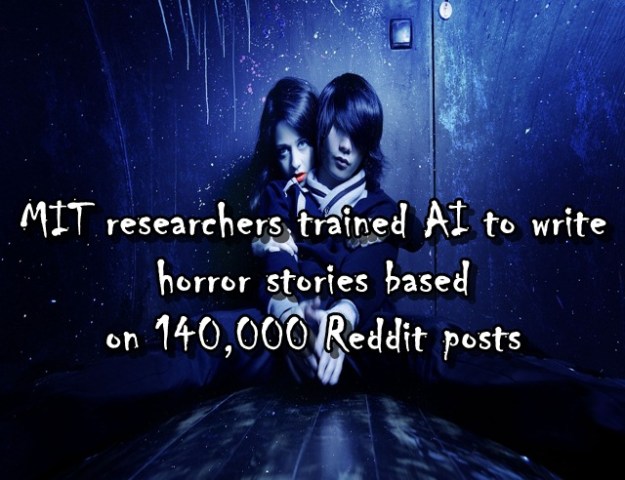
MIT researchers trained AI to write horror stories based on 140,000 Reddit posts

mit

Sometimes the scariest place to be is your own mind. Or Reddit at night.

Shelley is an AI program that generates the beginnings of horror stories, and it’s trained by original horror fiction posted to Reddit. Designed by researchers from MIT Media Lab, Shelley launched on Twitter on Oct. 21.

The team behind Shelley is hoping to learn more about how machines can evoke emotional responses in humans. “The rapid progress in the field of Artificial Intelligence (AI) has people worried about everything from mass unemployment to the annihilation of the human race at the hand of evil robots,” writes researcher Iyad Rahwan by email. “We know that AI terrifies us in the abstract sense. But can AI scare us in the immediate, visceral sense?”

Shelley, named after Frankenstein author Mary Shelley, is interactive. After the program tweets a few opening lines, it asks people on Twitter to continue the story, and if the story is popular, it responds to those responses.

Using information from 140,000 stories from Reddit’s r/nosleep, Shelley produces story beginnings that range in creepiness, and in quality. There’s some classic “scary stuff,” like a narrator who thinks she’s alone and then sees eyes in the dark, but also premises one can only imagine are Reddit-user-inspired, like family porn.

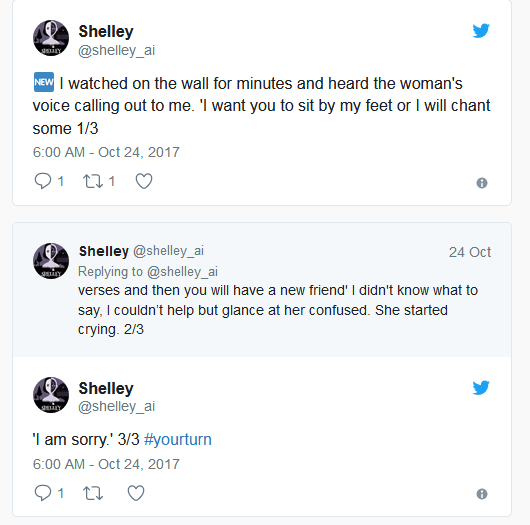
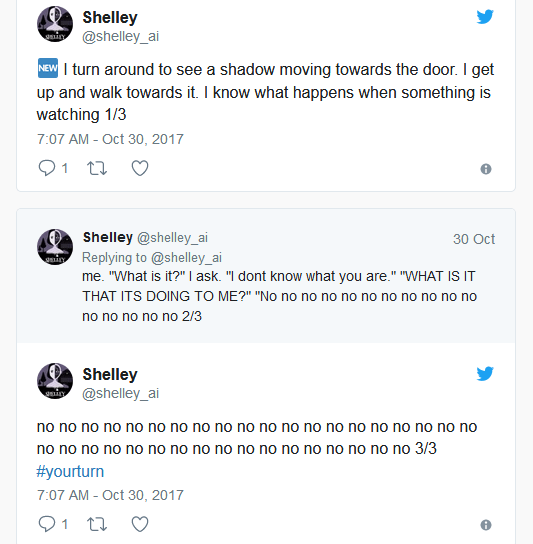
t 1

Others are silly:

t 2

There are some unimaginative ones:

I was standing right across the street, when a ghost stood behind me. I was so scared I couldn’t move. I couldn’t move. I wasn’t able to move my eyes, I was screaming. I was so scared.

And:

She fell to the floor from her cries and muttered a soft ‘Come to meeeeeeeeeeeeeeeeeeeeeeeeeeeeeeeeeeeeeeeeeeeeeeeeeeeeeeeeeeeeeeeeeeeeeeeeeeeeeee’.

And some of Shelley’s stories contain dread of a more existential sort:

I started breathing heavily, and waited for whatever it was to happen. I never saw it, because it drove me insane, I couldn’t move. All I could do was stand there, wide eyed, and stared at the wall, screaming at the top of my lungs, but the words were loud and I couldn’t take it anymore.

Source: qz.com

Visit us at First Edition Design Publishing