
Creativity grows by blending, breaking, bending

920x920

Neuroscientist by day, David Eagleman’s work of fiction, Sum, was an international bestseller.

1024x1024

Anthony Brandt, Professor of Composition and Theory and Chair of Composition and Theory at the Rice University Shepherd School of Music.
1024x10242

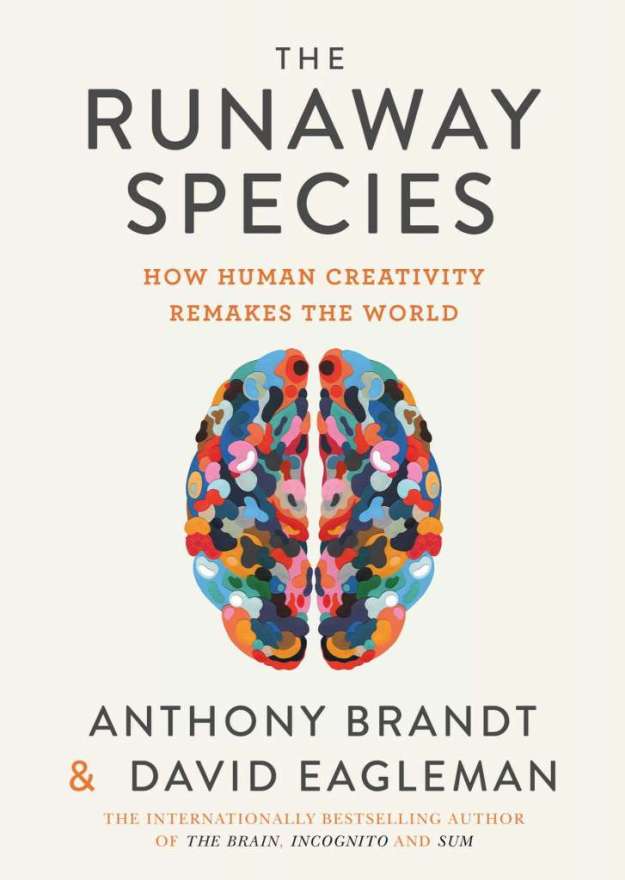
“Runaway Species” by Anthony Brandt and David Eagleman

David Eagleman is a neuroscientist and an adjunct professor at Stanford University, best known for his work on brain plasticity, which has led to television appearances and programs, and, of course, best-selling books. He’s also a Rice University alum and former neuroscientist at the Baylor College of Medicine.

Anthony Brandt is a composer and music professor at Rice University, the recipient of a Koussevitzky Commission from the Library of Congress and a grant from the National Endowment for the Arts. He’s also the founder of Musiqa, Houston’s contemporary music ensemble.

They combine their interests and talents in the book “The Runaway Species,” a fascinating look at creativity across diverse disciplines. The pair will discuss the book at 7:30 p.m. Thursday in the Christ Church Cathedral, but in advance of that appearance they took some time to talk about how they connected, the future of creativity and a dog that glows red under ultraviolet light.

Q: How did a music professor and neuroscientist come to collaborate?

David Eagleman: Anthony and I have known each other for a while. He’s a music professor, but he’s been interested in how music interacts with the brain, and we met at a conference. We had coffee one day, began discussing creativity, and we decided to write a book on this topic. Three and a half years later, this is the result.


Q: You use a framework for creativity in your book, and you discuss the concepts of “bending,” “breaking” and “blending.” Can you discuss these?

Anthony Brandt: “Bending” is taking a source and messing with it in some way, as when a jazz band plays the same song they played every other night, but they do it in some other way. It’s a variation on a theme. “Breaking” is when you take a whole, break it apart and assemble something new out of the fragments. In the book, we use the example of Picasso’s “Guernica,” in which the artist used bits and pieces of animals, soldiers and civilians to illustrate the brutality of war. And “blending” is any time you are marrying two or more ideas. In the book, we have an example of “Ruppy the Puppy,” the world’s first transgenic dog. He has a gene from a sea anemone, and he turns a fluorescent red under ultraviolet light.


Q: Writing can be hard work, but it seemed as if you had fun researching examples from all disciplines – art, music, science, marketing – to illustrate this three-part framework.

Eagleman: Yes, that was one of the great things about the book. We make the argument that in the arts, there is overt creativity, the bending, breaking and blending is right there for you to see. We think the same cognitive operations occur in science, but it occurs under the hood. When you hold your cellphone, it’s just a rectangle, and there’s no way to see all of the creativity that went into making it. What we do in the book is surf between the sciences and the arts and illustrate how the same processes are at work.

Q: Speaking of cellphones, you point out in the book that it’s a product of “blending” creativity.

Brandt: Phones used to be for making phone calls, but the smartphone now blends many functions. Now you have a device on which you can watch movies, surf the web, use GPS, listen to music and check your emails. All of these functions are married together in one instrument.


Q: The book also describes tension in the human brain between being drawn to the familiar and the lure of exploration. Can you elaborate on that?

Brandt: People aren’t the same in the way they balance novelty and familiarity, but everybody has creative software running in their brain, and they are all capable of aligning themselves on that creative spectrum and being participants in it. But the diversity in this tension, between exploration and familiarity, is healthy. We want a range of people, some of whom are pushing the envelopes, others who are holding back. We don’t want to rush headlong into every wild idea, but we also don’t want to stay rooted in one spot, never improving our lot.

Q: One animal highlighted in the book is the seasquirt, which embodies both of those tendencies over the course of its lifetime. Early in its life, it commits to exploration, but later in life, it adopts familiarity.

Eagleman: (laughs) The seasquirt, early on, uses its brain to explore and to find a suitable habitat. But when it finds that habitat, it eats its own brain for nutritional value.


Q: That’s an extreme case.

Eagleman: Yes. The lesson is not to eat your own brain. It doesn’t promote creativity.

Brandt: But it’s also a good distinction between lower-order animals and humans. Humans have a special neural architecture, one that seeks exploration, and creativity is a way to make that manifest – to take what’s going on in our minds and bring it out to the world. Creativity is the exploration of unknown territory. And whether it’s creating a recipe, a musical rift or a patent, humans are exploring all the time.


Q: This tension is also captured by a “skeuomorph,” which you discuss in the book.

Eagleman: It’s a graphical object that represents a real-world object. They keep a hand on the past, while introducing something new. One of the examples we use in the book is that computers still use an icon of a floppy disk to save documents, even though floppy disks haven’t been used for 20 years. The skeuomorph illustrates this tension between the novel and the familiar. We want to see something familiar, but we also want computers to lead us into the next century.


Q: Can we create computers that are creative?

Eagleman: I think it will be possible. The human brain is a machine, it’s a vast and complex machine, so there’s no reason, in theory, why we couldn’t make creative computers. What humans do is to try to surprise and impress others. If you want to build good artificial intelligence, build a society of AI agents that are all trying to surprise and impress one another.


Q: Will we become redundant?

Brandt: I think the good news on that front is that most of the AI right now is gobbling up repetitive tasks. The things that computers love to do are things where the same input leads to the same output. The jobs that are most at risk right now, are the jobs that involve repetitive tasks. Creativity is a social enterprise, and humans are social, and it is this quality that has fueled our creativity over the ages. It will be interesting to see what happens when you bring a machine into that social sphere and whether we even accept the computers’ incursion in that way. It’s an open question.

By Mike Yawn
Source: houstonchronicle

Visit us at First Edition Design Publishing


5 Gripping Ways to Revive the Messy Middle of Your Story

I’m not gonna lie: I hate writing the Middle.

For many writers, there is nothing worse than coming up with the Middle of the story.

5 gripping

If you’re anything like me, the Beginning is easy. It’s fun to come up with a cool premise for a story. The conflict is there. The goals are plain as day. And getting your protagonist into trouble shouldn’t be too difficult.

The End can seem easy, too. The End of a story is like the candy center of the lollipop — you can’t wait to get to it! Of course you can’t write it yet because you haven’t gotten there, but with each moment of drafting, your heart is dead-set on reaching the end so you can reveal a great twist, kill off a beloved character, or teach a remarkable life lesson.

But for some reason, there’s something about a story’s Middle that’s a pain in the neck.

And like many of you, I’m dealing with it right now.

Stuck in the Middle of the Story

If you haven’t heard, the Winter Writing Contest is happening right now.

Like many of you, I’m hard at work on my story’s first draft. I’m having a blast planning it and sketching out the characters and scenes. I absolutely love this part of the journey.

But that love withers to a weed when I get to that point, about 900 words in, when I realize I’m over-budget on word count and nowhere near the dramatic End I have planned.

I’m stuck in the Middle of the story.

I’m not kidding. As I write this, I’ve decided to put down the draft for a day or two, let it marinate, and write this post instead. I’ve got to write something — so I might as well try and help us all with a problem that can’t be afflicting me alone!

My biggest fear is creating a Mediocre Middle — a trough in the story that merely fills the gap between the Beginning and End that I’ve cooked up. And believe me: As a former writing contest judge, I can testify that stories with Mediocre Middles rarely make it to the winner’s circle. They simply don’t deliver.

So how can we craft something better, something that drives the story forward and propels us to storytelling greatness?

The answer is in creating a Middle That Moves.

5 Strategies to Craft a Middle That Moves

A year back, I wrote a post arguing that Writer’s Block is just a myth, and that what really afflicts us is bad planning.

In hindsight, I wish I had done more then to provide practical tools. The ideas behind it were solid, but we need tangible actions to take when we get hung up in the Middle of our stories, unsure how to bridge the Beginning and the End.

So after a year of growth, I’ve come up with five things you can try today that will breathe life into your story’s Middle. I recommend using just one or two to get the Middle of the story going, so don’t feel any pressure to try them all.

But before we get to those, one rule:

Your End is not sacred.

If you write your story with a sacred, unchangeable End in mind, you will be paralyzed. Your creative freedom and gleeful risk-taking will vanish, all because you’re too afraid to alter the precious End you’ve dreamed up.

Trust me. It’s worth the risk. Let that End go away for a while, and just create.

Let’s look at five ways you can draft an awesome Middle That Moves.

1. Introduce a new character

This is a risky move. And it’s essential that the character be relevant to the protagonist’s goals.

This is a trick I used to elevate the Middle of my entry to the Summer Contest back in June. By adding a new character, preferably one who will resist the protagonist’s goal, you will add tension and stakes to the story in numerous ways.

Just make sure that character is highly relevant to the protagonist’s pursuit, and will either help or hurt that pursuit. Especially in a short story, you don’t have room for any extra personas.

2. Reveal a hidden piece of information

Key Point: It MUST be information that conflicts with the protagonist’s motivation and goals. Otherwise it’s just fluff.

Make sure it’s a brief, easily consumed piece of information. Don’t dump a massive life story on the reader. Just the essentials.

And make sure it’s something that is revealed for a very good reason, and deeply changes how the characters and the reader will view the protagonist’s goal. Preferably, it alters the motivation and increases the conflict, making the protagonist (and therefore the reader) question him or herself.

3. Let the protagonist fail

Nothing keeps a story going like failure.

This may sound like backward logic, but readers secretly LOVE when protagonist crash and burn. It raises the stakes. It builds suspense.

So let the protagonist fail, and then have to recover in time for a second or third try. Just make sure you don’t write yourself into such an impossible corner that you have to cheat (deus ex machina) to get out of it.

4. Let a side character make a choice that hurts the protagonist

In essence, introduce betrayal.

Two of the most poignant moments in the story of Christ’s passion are the betrayals of Judas and Peter. When a close friend or a treasured ally chooses the wrong side, it adds conflict. The protagonist may be abandoned or further blocked from his/her goal, making the quest for success even more difficult.

Make sure there is a good reason for the character’s choice — you may have to go back to the Beginning and add a line or two that establishes the basis for this motivation.

5. (“Countdown” Contest Special!) Decrease the amount of time left

The Winter Contest’s theme is “Countdown,” and a great way to add conflict and tension is to have the clock suddenly start counting down at double-speed!

This is a common trick in action movies. Depending on the countdown you’ve chosen, it can take many forms: an antagonist changes his plans and arrives earlier; a deadline is pushed up; a major character suddenly has to depart, forcing an early decision.

When time is short, stakes are high. And since you always want to raise the stakes, the Middle is a great place to do it.

Why the Ending Can’t Be Sacred

It’s easy to see how any of these choices can, and will, permanently change the End you have planned.

But it’s important to realize that the End you had in mind never really existed, except as an idea. Any experienced writer will tell you that translating ideas into the written word never works according to plan. Besides, you’ll often find that the original End you had in mind wasn’t so great after all, and that the new one is better!

Writing a story with a riveting Middle is the only way to produce an authentic Ending. I think you’ll be surprised by the End that comes when you bravely write a Middle That Moves. It will be an End that is true to the conflict and believable to the reader.

And heck, you might even find a way to reconcile your plan with reality if you’re willing to think outside the box.

Writing is never easy, and the Middle is where the challenges are often hardest.

But if you create a Middle That Moves, you’ll find those challenges melting away and yielding a story that reaches your audience in powerful, authentic ways.

Do you have any other strategies to add drama and movement to the middle of the story? Let us know in the comments.

By David Safford

Source: thewritepractice

Visit us at First Edition Design Publishing
Character Voice: 5 Insightful Questions to Discover Your Character’s Unique Voice

One of the key signs of a well-written character is when the reader is able to identify them with a single line of dialogue. It’s that feeling of I’d know that character anywhere. How are authors able to perfect this art? By finding their character voice.

charac

5 Ways to Discover Your Character’s Voice

“Voice” is a relatively broad term, so let’s break it down a little. By finding your character’s voice, you’re finding that spark that makes them unique. Specifically, you’re able to figure out in what unique ways they speak, think, and write. If you pay attention to the way your friends and family communicate, they all have different voices.

This should be the same for your characters, and there are five questions you can ask to discover their voices.

1. What level of education do they have?

Generally speaking, a recent high school graduate shouldn’t be tossing around the words “acumen” or “parsimonious” in everyday conversation. Similarly, a woman with a PhD probably isn’t going to use text speak.

This doesn’t mean high schoolers can’t use big words or somebody with a doctorate won’t ever change “you” to “u” in a text, but it’s something to keep in mind when figuring out who your characters are and what they sound like.

2. Where did they grow up?

Not only will accents change depending on where they grew up, but certain words altogether will, too. If they’re from a northern state, they’ll push a “shopping cart” when getting their groceries. But if they’re from the south, they’ll push a “buggy.” “Water fountains” could also turn into “drinking fountains” or “bubblers.”

Do a little research about local lingo. Not only is it interesting, but it adds a whole new layer of authenticity to your character.

3. When did they grow up?

The early 1800s? The ‘80s? ‘90s? The future? What sort of slang would they have used when they were young? How do they address adults?

If your character grew up in a decade you’re unfamiliar with, you might want to talk to people you know who are the same age. Pay attention to what words they use and what their speaking pattern is like.

4. Who influenced them?

People have a tendency to start to sound like those they’re around often. Who does your character spend time with? Their teachers? Their mom? Teammates from football? Their elderly neighbor? Whoever they talk to most, that person should influence the way your character speaks.

Maybe their best friend has a sort of catchphrase. Your character could say it once or twice, out of habit. Most people are a blend of their closest friends.

5. What languages do they speak?

If your character is bilingual, that will change the way they speak in both languages. Idioms hardly ever translate well into another language. They might forget a word for something in English, but remember it in Spanish. When they’re mad, they’re likely to revert to their native language to rant and curse. If they’re talking to someone who knows both languages, they might switch back and forth without even realizing it.

Make sure you know which characters speak what so everyone communicates in a language they have in common!

Find Their Voice by Writing It

In the end, the best way to find your character’s voice is . . . to write. Try writing in your character’s voice and see where it takes you. What words do you find them using? What unique patterns of speech develop?

This process of discovery will lead to a character voice we’d recognize anywhere.

How do you find your character’s voice? Let us know in the comments!

By The Magic Violinist

Source: thewritepractice

Visit us at First Edition Design Publishing
Why You Need to Write a Book Review Today (and How to Do It)

You finally reach the last page of a book that kept you up all night and close it with the afterglow of satisfaction and a tinge of regret that it’s over. If you enjoyed the book enough to stay up reading it way past your bedtime, consider writing a review. It is one of the best gifts you can give an author. Regardless of how much you know about how to write a book review, the author will appreciate hearing how their words touched you.

book review

But as you face the five shaded stars and empty box, a blank mind strikes. What do I say? I mean, is this a book really deserving of five stars? How did it compare to Dostoevsky or Dickens?

Maybe there’s an easier way to write a book review.

The Fallacy of Book Reviews

Once you’ve decided to give a review, you are faced with the task of deciding how many stars to give a book.

When I first started giving reviews, I made the mistake of trying to compare a book to ALL BOOKS OF ALL TIME. (Sorry for the all caps, but that’s how it felt, like a James Earl Jones voice was asking me where to put this book in the queue of all books.)

This is honestly why I didn’t give reviews of books for a long time. How can I compare a sweet romance with Dostoevsky? I can’t, and I shouldn’t.

I realized my mistake one day as I was watching (of all things) a dog show. In the final round, they trotted out dogs of all shapes, colors, and sizes. I thought, “How can a Yorkshire Terrier compete with a Basset Hound?” The announcer explained that each is judged by the standards for its breed.

This was my “Aha!” moment. I have to take a book on its own terms. The question is not, “How does this book compare to all books I’ve read?” but “How well did this book deliver what it promised?”

How to Write a Book Review: Consider a Book’s Promise

A book makes a promise with its cover, blurb, and first pages. It begins to set expectations the minute a reader views the thumbnail or cover.

If a book cover has a picture of a lip-locked beautiful couple in flowing linen on a beach, and I open to the first page to read about a pimpled vampire in a trench coat speaking like Mr. Knightly about his plan for revenge on the entire human race, there’s been a breach of contract before I even get to page two. These are the books we put down immediately (unless a mixed-message beachy cover combined with an Austen vampire story is your thing).

But what if the cover, blurb, and first pages are cohesive and perk our interest enough to keep reading? Then we have to think about what the book has promised us, which revolves around one key idea: What is the core story question and how well is it resolved?

Sometimes genre expectations help us answer this question: a romance will end with a couple who finds their way, a murder mystery ends with a solved case, a thriller’s protagonist beats the clock and saves the country or planet.

The stories we love most do those expected things in a fresh or surprising way with characters we root for from the first page. Even (and especially!) when a book doesn’t fit neatly in a genre category, we need to consider what the book promises on those first pages and decide how well it succeeds on the terms it sets for itself.

When I Don’t Know What to Write

About a month ago, I realized I was overthinking how to write a book review. Here at the Write Practice we have a longstanding tradition of giving critiques using the Oreo method: point out something that was a strength, then something we wondered about or that confused us, followed by another positive.

We can use this same structure to write a simple review when we finish books.

[Book Title] by [book author] is about ___[plot in a sentence—no spoilers!]___.

I chose this book based on ________.

I really enjoyed ________.

I wondered how ___________.

Anyone who likes ____ will love this book.

Following this basic template can help you write an honest review about most any book, and it will give the author or publisher good information about what worked (and possibly what didn’t). You might write about the characters, the conflict, the setting, or anything else that captured you and kept you reading.

As an added bonus, you will be a stronger reader when you are able to express why you enjoyed parts of a book (just like when you critique!). After you complete a few, you’ll find it gets easier, and you won’t need the template anymore.

What if I Didn’t Like It?

You will have to make the call about when to leave a low review. If I can’t give a book at least three stars, I don’t review it. Why? If I don’t like a book after a couple chapters, I put it down. I don’t review anything that I haven’t read all the way through.

Also, it may be that I’m not the intended market. The book might be well-written and well-reviewed with a great cover, and it just doesn’t capture me. Every book is not meant for every reader.

If a book kept me reading all the way to the end and I didn’t like the ending? I would probably still review it, since there had to be enough good things going on to keep me reading to the end. I might mention in my review that the ending was less satisfying than I hoped, but I would still end with a positive.

As writers, we know how difficult it is to put down the words day after day. We are typically voracious readers. Let’s send some love back out to our fellow writers this week and review the most recent title we enjoyed.

What was the last book you read or reviewed? Do you ever find it hard to review a book? Share in the comments.

By Sue Weems
Source: thewritepractice

Visit us at First Edition Design Publishing
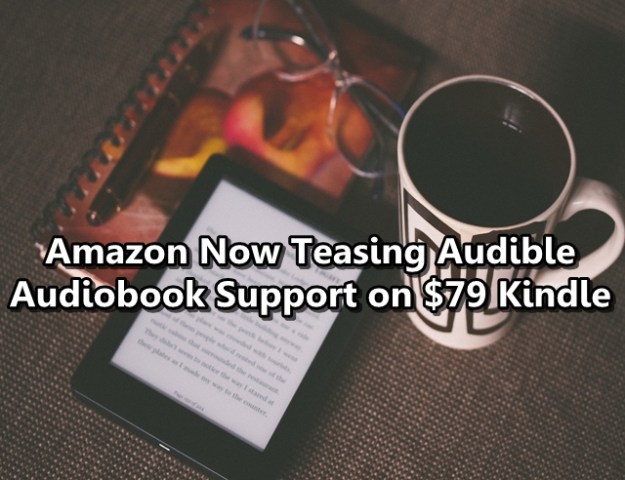
Amazon Now Teasing Audible Audiobook Support on $79 Kindle

amazon

When the original Kindle launched in 2007, it could play audiobooks sold by Amazon’s (then) recently-acquired  Audible. This feature was dropped from later models as they lost support for audio, but now Amazon is bringing it back.

The new Kindle Oasis will play Audible audiobooks (the feature is coming in an update after it ships) and now Amazon is teasing that support will be coming to the $79 Kindle.

Amazon has updated the listing for the basic Kindle with this nugget of detail:

  • With built-in Audible, access the world’s largest library of audiobooks. Easily switch between reading and listening on Bluetooth-enabled speakers or headphones. Available in the coming months.

Amazon hasn’t mentioned Audible support on the listings for the Voyage or Paperwhite, and there’s no specific date on when the basic Kindle will get the feature, so it might not arrive until next year.

But the feature will arrive eventually, at which time you are better off not using it.

The thing about the Kindle is that it has a small battery. When used as an ereader, the Kindle will last for weeks, but streaming audio over Bluetooth will drain the battery quickly. Said Kindle also has limited storage – 4GB (3GB is user accessible). So even if you didn’t run out of battery life, you’re still run out of storage after a handful of audiobooks.

So while the basic Kindle could certainly function as an audiobook player, you would be better off using some other device.

By Nate Hoffelder

Source: the-digital-reader

Visit us at First Edition Design Publishing
Borrowing, Stealing, and Building Upon Other People’s Writing Ideas

borrowing

From epic romances to fantastical adventures, stories have been captivating audiences for centuries, and they have been inspiring writers (and other artists) for just as long.

There is a longstanding tradition among storytellers of re-imagining or expanding the greatest legends, myths, and fairy tales ever told, from the Greek classics to last summer’s blockbuster films.

Certainly, many derivative works are frowned upon. You can find lists of authors who do not allow (and pursue legal action against) stories written in their worlds. You can find reviews that call such stories rip-offs or refer to authors as hacks who have done nothing more than steal someone else’s writing ideas.

But you can also find some impressive and respectable derivative works in films, novels, and television. In fact, many derivative works are embraced, beloved, and achieve critical and commercial success, plus massive fan followings.

So, when is it acceptable to use other people’s writing ideas? Why do some of these stories get heavily criticized while others are widely celebrated?

Once Upon a Story…

There are many sources of inspiration for storytellers. Some writers rely on their own life experiences while others rip stories from the headlines. Existing stories, both true and fictional, have always had a heavy influence on the tales we tell and retell. How many variations of Little Red Riding Hood have been written? How many fictional movies have been set during World War II? Let’s take a look at the different techniques writers use to tell stories that are built on other stories.

Formulas

Plenty of writing ideas are culled from great tales that have been told throughout history. Some of these have been converted into formulas that writers can use as storytelling guidelines.

In 1929, Joseph Campbell told the world about the monomyth (or hero’s journey), a universal pattern in storytelling that he found across cultures and throughout history. Writers turned the pattern into a formula, but perhaps nobody did so as effectively or famously as George Lucas, who used it to write Star Wars.

From the three-act structure to the hero’s journey, formulas have been criticized as making stories dull and predictable, yet they have also been credited with providing writers with a framework in which to create.

Historical Fiction

Historical fiction takes factual events from true stories of the past and overlays them with made-up characters or plots.

In James Cameron’s film, Titanic, two fictional characters fall in love on the historic ship that sank into the icy waters of the Atlantic Ocean back in 1912. Countless novels, short stories, poems, movies, television shows, and video games have taken a bite out of history and used it as the setting for their stories.

While this practice is widely accepted as legitimate, it’s worth noting that in 2011 China banned time travel stories because they retell history untruthfully (for the record, I think this is a violation of free speech, which is a basic human right). There is an argument to be made about the dangers of retelling history incorrectly (take the holocaust deniers, for example) and a much stronger argument to made about making art that examines history. Often, the truth is not found in the accuracy of a story’s plot but in the emotional reality that a story conveys.

Fan Fiction

Fan fiction is a favorite pastime for hobby writers who are loyal fans to their favorite franchises. Google “fan fiction” and you’ll find loads of stories set in the worlds of Lord of the Rings, Star Wars, Star Trek, Harry Potter, and Twilight — all critically and commercially successful science fiction and fantasy franchises. But that’s not all. Fans are also writing fiction from TV shows like Bones, Glee, and 80s nighttime soap Dynasty (yes, Dynasty! I couldn’t believe it either).

Some authors strictly prohibit writers from publishing material set in the worlds they’ve created (although they certainly can’t stop you from writing stories in your notebook). They feel these works will negatively impact the integrity of their stories or compromise them in some way. Other creators either look the other way or encourage fans to play in their worlds. The television show Lost spewed a veritable onslaught of fan fiction and artwork, and the showrunners enjoyed the homages all the way to the bank. This relationship between creators and fans proved to be mutually beneficial. Lost became a worldwide phenomenon and one of the most-talked-about shows in history.

Generally speaking, writing fan fiction is not the best path to becoming a respectable or published author. The work is copyrighted by someone else, so you can’t publish a book or short story and get paid for it (there may be some exceptions, as with contests or other programs by the few authors who are extremely supportive of fan fiction). I think fan fiction is actually a good training ground for young or new writers. It’s an ideal place to practice storytelling; all the elements are provided, so amateur writers can focus on specific aspects of their work, such as characters or plot. And who knows? Maybe someday you’ll be hired as an official writer for your favorite franchise (it happened to J.J. Abrams, who got to write and direct Star Wars: The Force Awakens).

Public Domain

In 2010, Tim Burton brought us Alice in Wonderland (3-D). This film told the story of a 20-something Alice revisiting Wonderland, so it’s essentially a sequel to Lewis Carroll’s original Alice stories. In their 1951 animated film, Disney took Carroll’s work to the screen, combining elements from various stories and poems that Carroll had written to create a timeless classic that secured Carroll’s heroine a permanent place in our collective, cultural mythology.

This is basically fan fiction breeding fan fiction, but we categorize it differently because Lewis Carroll’s works are all in the public domain, which means anyone can take them and do whatever they want with them. You too can write an Alice story, publish it, and be safe from copyright infringement or intellectual property lawsuits.

When we take our writing ideas from the public domain, the work is generally referred to (not as fan fiction, but) as a re-imagining, re-purposing, retelling, or recycled story. Why are stories based on public domain works viewed and treated so differently from fan fiction? In these projects, writers are using material that is decades (or centuries) old, and the new work basically keeps the old work alive and makes it accessible to future generations.

Where Do You Get Your Writing Ideas?

All around us, there are stories being told and retold, revised and re-imagined, stretched and skewed. Today, we have such easy access to stories (they’re all right at our fingertips) that it’s almost impossible not to be influenced by our favorite works. Consciously or unconsciously, many of our writing ideas come from other writers. The only question that remains is this: where do you think you get your writing ideas?

By Melissa Donovan

Source: writingforward

Visit us at First Edition Design Publishing

How to Find Writing Inspiration When Your Muse is on Vacation

ins

Have you ever sat down to start a new writing project and then realized an hour later you were still sitting there, staring idly at the blank page?

Sometimes writing inspiration doesn’t come easy.

In a writer’s ideal world, the blank page is something we always look forward to, a fresh canvas we can color with ideas and texture with language. When our muse is dancing around, we feel motivated and inspired, so the blank page feels like the start of an exciting adventure.

But if our mind isn’t in the right place, if our muse is on vacation, that same page is nothing but a source of frustration.

When I became a professional copywriter, I had to learn how to write whether the muse was present or not. You know how muses are, fleeting little hooligans. I couldn’t rely on mine all the time. So I learned how to get along without her. That meant coming up with my own writing inspiration.

Outsmarting the Missing Muse

Yes, you can get along without your muse. I won’t lie to you and tell you that writing without your muse is the same. It’s less pleasant, more time consuming, and makes you feel like a struggling hack rather than the brilliant writer that you are. Still, life (and work and writing) goes on whether the muse is at your beck and call or not.

First you have to figure out why your muse failed to show up. Here are some reasons mine runs off and hides:

  • I’m not into this particular project and neither is she.
  • The muse’s secret entrance is blocked by my stress, fatigue, or hunger.
  • She’s put her time in for the day and has clocked out (the well’s run dry).

Once I recognize the problem, it’s a little easier to cope with the muse’s absence. I still miss her, but now that I know why she’s a no-show, I’m ready to forge ahead without her.

Forget the Muse, Discover Willpower

You see, the secret to facing the blank page without the muse is sheer determination. You achieve this by getting into the right frame of mind and using clever tricks to convince your brain that it can, in fact, function without the muse. I do this by telling myself any or all of the following:

  • Once I get the first sentence out, the piece will start to flow.
  • I don’t have to get it right (this is a rough draft, after all). I just have to get it written.
  • If I hurry up and get this done, I can do something else.

Sometimes these simple reminders are all it takes to get your word machine in good working order. By forcing yourself to push ahead or promising yourself a little reward, you can actually convince your brain to become productive without its mischievous little friend. That would be your muse, for anyone who hasn’t been paying attention.

Try a New Approach for Coming up with Writing Inspiration

What? You say your brain is smarter than you are, and these tricks don’t work for you? Don’t worry, I have more magic up my sleeve. After all, I’ve been outsmarting the muse for years.

  • Take a break and work on a different writing project.
  • Take a break and do something fun for a limited time, and then force yourself to spend twenty minutes writing.
  • Take a break and get your blood pumping. Exercise for twenty minutes, take a quick shower, and then write for fifteen minutes.

Be careful when it comes to taking breaks. You don’t want to stare at that blank page for five minutes, take a twenty minute break and then just repeat that cycle all the livelong day. That won’t do you any good and your absent muse will have won.

There’s a good chance your brain just needs to do a little stretching. Do you ever wake up in the morning and your muscles are all stiff? You yawn and stretch (and try to come alive). Sometimes your brain needs to do that too.

When you switch gears and get your wheels turning on a different project, you can build momentum for when you return to the one that’s giving you a hard time. Or you could just be overworked and need to pamper yourself by having some fun. Play with the dog or the kids, watch some hilarious YouTube videos, or turn up the music and dance around in your underwear.

That brings us to getting the old blood pumping. I’m not a doctor and I don’t play one on TV, so I can’t give you the biological, physiological diatribe about how blood flow and oxygen getting to your brain can make you more alert and get those creative juices flowing. But take my word for it. A little workout can do wonders for encouraging the word current. (Yes, dancing around in your underwear to really loud obnoxious music counts as a workout. Plus it’s fun, so you get two for the price of one.)

When the Muse Returns

When your muse gets back and discovers all the work you’ve done without her, you might want to gloat. This could discourage her from taking any sabbaticals in the future. Maybe you don’t want to hurt her feelings. If she’s sensitive, then gloating might only encourage her to take off more frequently. All muses are different, and I can only suggest you learn how to deal with yours through trial and error. But be sure to feed her plenty of cream puffs and chocolate éclairs.

You know what’s coming next, don’t you? Of course, because I’m so predictable. I want you to tell us all about your muse. How often does she take a vacation? How do you cope with her absence? Have you found ways to write without your muse, or are you totally dependent on her for writing inspiration? Is your muse a dude?

Do you have any tips for how to outsmart the muse and come up with your own writing inspiration? Leave a comment, but don’t tell the muses we’re talking about them…we wouldn’t want it to go to their heads.

By Melissa Donovan
Source: writingforward

Visit us at First Edition Design Publishing

3 Brilliant Writing Tips I Learned From a Genius

Currently I’m reading a collection of essays by the National Book Award winner and genius grant recipient Ta-Nehisi Coates. Many people view Coates, a writer for The Atlantic, as political, but I’ve heard him speak, and he repeatedly emphasizes that he is a writer above all else. He is an observer and he shares his observations with the world, and we can draw valuable writing tips from his work.

3 tips

3 Writing Tips Culled From the Reflections of a Genius

Coates’s book We Were Eight Years in Power consists of articles he wrote during the Obama years, each of which are preceded by Coates’s retrospective reflections on those essays.

As a fellow writer, I was enthralled by those reflections. Here was an anointed “genius” expressing his doubts and self-critiques. There’s something fascinating about watching a successful writer still cringe at the very works that gave him that success.

Given all that, I had to share some of my takeaways, writing tips drawn from Coates’s self-reflections. Here they are:

1. Blog

Before anyone knew who Coates was, he blogged. And he did so solely because he had many ideas and no where to put them. He posted four or five times a day, and over time people (besides his Dad) started reading it. They offered comments and suggested other books and philosophers for him to check out. Eventually the blog drew the attention of The Atlantic.

Writers write. But they also allow others to read and critique what they have written—because it’s the only way to get better.

That’s where blogs (or even the comments of The Write Practice articles) come in.

Coates used his blog to get out ideas out of his head and heart, and was open to the comments of others. Many of these posts even served as the starting points for articles he later published in The Atlantic and elsewhere.

Try blogging (or commenting) to test out new techniques, attempt to write in new genres, or to simply workshop certain pieces or ideas. Who knows? You may get the attention of a prominent magazine. 😉

2. Reflect on past work

It was really, really, really interesting for me to see Coates look at an essay he wrote three years ago, think about where he was in his life, and then consider whether he successfully executed his idea or not.

For example, Coates describes a 2004 article he wrote about Bill Cosby as an “attempt”: “I felt myself trying to write a feeling, something dreamlike and intangible that lived in my head, and in my head is where at least half of it remained.” He also admits that he heard about the accusations against the comedian, but chose not to go there. He says that decision made the article less true.

Nine times out of ten when I publish something, I’m done with it forever. I rarely return to past work. But maybe I should. In preparing Eight Years, Coates was able to both reflect upon his weakness in a dispassionate way and appreciate his growth.

As writers, we constantly question ourselves and think our work could be better. But perhaps this self-critique would be more useful to us if we allowed some time to pass first.

3. Seize your moment

Coates says he’s know as a “black writer.” Yes, he’s black, but he also writes about black American issues, specifically. So the election of Barack Obama was directly life changing for him. In other words, it was his moment. Coates writes:

“The fact of Barack Obama, of Michelle Obama, changed our lives. Their very existence opened a market. It is important to say this, to say it in this ugly, inelegant way. It is important to remember the inconsequence of one’s talent and hard work and the incredible and unmatched sway of luck and fate.”

If you find that, after years of setbacks and failure, the world is suddenly ready to hear your voice—speak. Write.

More importantly, pay attention so that you don’t miss the opportunity. As Coates “inelegantly” points out—timing can be just as important as talent and hard work.

What is your unique market? What hole do you fill with your writing?

Your Ideas Can Change the World

Writing is our opportunity to share our observations with the world. Want to influence others with your stories and ideas? Share your work boldly and invite response and critique. Reflect on past work after a few months or years have passed so you can view it through the lens of your personal growth.

Then, when your moment of recognition comes, you’ll be ready to seize it.

And your words will change the world.

Have you read Coates’s writing or heard him speak? What other writing tips can you draw from his work? Let us know in the comments.

By Monica M. Clark
Source: thewritepractice

Visit us at First Edition Design Publishing

The Editor-Writer, Part II

the editor writer

More lessons on making what you write and edit for others more useful and meaningful.

By Peter P. Jacobi

In Part I, I covered a number of lessons for those who both write and edit. Items included being clear, self-editing, leaving no questions, and adding interest. Now, here are the remaining points:

Follow Policy

Often, the editing involves handling of opinionated copy that may or may not be appropriate. Be careful to follow policy. And remember there’s a great difference between using other people’s opinion in your copy, which, when used fairly, is proper, and using your own, which may not be unless labeled “opinion.” That can all become quite sticky and become a significant part of your duty to handle as editor.

Know Your Limits

Personally, I have experience handling professional copy for magazines, newspapers, radio, and television. As teacher, I’ve edited student copy of all those journalistic sorts for more than 50 years. I’ve done utilitarian editing and the others.

Let me emphasize, however, that we cannot, as individuals, handle all sorts of editing. I cannot. I’ve been asked to edit book manuscripts, for instance. Nonfiction I probably could do but avoid because a work of such length makes me nervous (not to read, mind you, but to edit). Fiction is out of the question. Fixing plot and character development and made-up dialogue and arcs of climaxes and such matters is not my thing. I say “no” to such requests. Consequently, working for a book publisher is not on my list of credits. That’s a very different sort of editing animal. Remind yourself of personal limits. Most of us who write cannot write everything. Ditto, when it comes to editing.

Which brings me back to Barbara Baig’s Spellbinding Sentences, mentioned in Part I. She uses the perfection of sentences to preach the series of lessons we need to be reminded of in seeking to write and edit better.

Her lessons are extremely well presented and developed. I think you would benefit from reading and using the book. Its coverage is grammar-deep, oriented toward showing how — when you use the language accurately and briefly and correctly — you are on the way to making what you write and edit for others more useful and meaningful.

Practice Visionary Editing

Which also brings me back to the Highlights Foundation Workshop mentioned in Part I and my friend’s address to the students. He is a dear friend, Jan Cheripko, a deeply thoughtful and kind man, a former working journalist, a retired teacher in a residential school for children with emotional problems, and a successful author of books for children. He titled his talk “Literature, Lessons, and Life: How the Desire to Write One Good Sentence Pursued Me.”

He did discuss working toward perfection of a sentence through just the right language. But the aim of his discussion reached wider. One heard him deliver a number of sentences from a number of sources, some of them from literature, others among them from lessons and life. Out of events from his own life, that of his family, and of his troubled but beloved students, from the lessons Jan learned, he arrived at sentences, perfect ones, that in content and verbal style and personal voice and spirit wrapped up a spiritual journey or a lifesaving moment or a mind-opener that altered the course of someone’s life, including Jan’s own.

Jan was arguing that as writer and editor, when we can spot such in someone’s writing or discover it in our own, the editorial wisdom to leave that alone and pass it on is a gift to every reader. That becomes visionary editing, editing on another, higher level. Whenever you sit down to write or edit, keep your heart and brain on the lookout for such copy, potentially a gift beyond all measure.

Peter P. Jacobi is a Professor Emeritus at Indiana University. He is a writing and editing consultant for numerous associations and magazines, speech coach, and workshop leader for various institutions and corporations. He can be reached at 812-334-0063.

Source: publishinghelp

Visit us at First Edition Design Publishing

Australian retail’s ‘calamitous’ ecommerce failure sets stage for Amazon’s rise

'Your margin is my opportunity' - Amazon founder Jeff Bezos has his sights on Australia.
‘Your margin is my opportunity’ – Amazon founder Jeff Bezos has his sights on Australia. Photo: Getty

One in two Australian retailers has failed to develop mobile shopping capabilities, despite massive and growing demand from consumers, a new report from online payment service PayPal Australia has revealed.

The figures come ahead of US ecommerce giant Amazon’s imminent Australian launch, and do not bode well for the domestic retail sector.

One expert went so far as to say the sluggish efforts to modernise reflected in the figures were “calamitous” for the industry, and would allow Amazon to “steal business” from both online and physical retailers.

In its survey of more than 1000 consumers, PayPal found almost three quarters (72 per cent) were now shopping or making payments on a smartphone or tablet.

And a growing number – 48 per cent – were doing so at least once a week. That’s a huge rise on last year, when just 36 per cent were shopping on their mobile devices more than once a week.

For younger Australians the figures were much higher.

In the 18 to 34 age group, a massive 89 per cent of consumers were shopping and making payments on mobile devices. That compared with 77 per cent of 35- to 49-year-olds, and 52 per cent of over-50s.

And while desktops remained the dominant platform for online purchases, the trend had mobile devices rapidly gaining ground.

But despite the overwhelming move towards mobile shopping, the report found that Australian retailers had been slow to adapt.

Of the more than 400 businesses surveyed, just over half (51 per cent) had built the capacity to receive mobile payments – a 21 percentage point mismatch with consumer demand.

The survey revealed businesses consistently underestimated the extent to which poor online or mobile shopping experiences put their customers off.

For example, 37 per cent of consumers said they were put off by slow page loading. Conversely, just 21 per cent of businesses thought this would be a problem for customers.

Scott Kilmartin, an ecommerce adviser from Online Offline, pointed out that, of those businesses that did have some sort of mobile capability, many would be slow, clunky or difficult to use.

“To do mobile commerce well, brands need a stripped back mobile site, top-selling product on the home page, fast load speed, great and fast search function and a frictionless path-to-purchase and checkout purchase,” he told The New Daily. 

He said potential customers were increasingly coming via social media platforms like Instagram – a channel that encouraged “impulse purchases”.

“For impulse purchases, you might only get one shot that’s blown if the site has too many hurdles to buy from, especially for customers under 30,” he said.

Failing to develop this would result in retailers losing out to competitors with slicker mobile sites.

Mr Kilmartin said a number of Australian businesses were doing mobile retail well. But he said the real threat – the “elephant across the water” – was Amazon, which is set to launch its Australian operation within the next few months, possibly in time for Christmas.

Mr Kilmartin, who works as an ecommerce consultant to local retailers, said whenever he meets with retailers, the conversation inevitably “gets skewed into Amazon”. And he said retailers were right to be worried.

“I definitely think they [Amazon] are going to open with a bang. They have that Apple-like buzz, and that will drag customers over,” he said.

“Amazon’s site might not be pretty but it’s easy to buy from and gets to know you better with each search and purchase. That algorithm is tough to compete against especially for retailers selling mid-market products.”

He said it was “inexcusable” that some middle- to larger-sized Australian businesses had failed to build competitive mobile sites, and they would pay the price.

Last week, Amazon revealed it had increased sales by 34 per cent in the three months to September – an announcement that saw the company’s share price bounce more than 13 per cent, making founder and CEO Jeff Bezos the richest person in the world.

Source: thenewdaily.com.au

Visit us at First Edition Design Publishing