Monthly Archives: October 2017

How to Stay Inspired

how to stay

Writer’s block is probably the most frustrating experience any writer faces. You feel creative and you want to create, but you’re just not inspired.

It happens to most artists from time to time, this disconnect from the muse. Yet there are creative people who seem to have overcome artistic roadblocks — authors who publish multiple novels every year, filmmakers who produce annual blockbusters, and musicians who are on the top-ten list week after week. They know how to stay inspired, but how do they do it? Have they tapped into a secret, endless stream of ideas?

How can you tap into that stream?

I always say look to the source. When I see successful artists and innovators who are consistently producing creative work, I find myself wanting to learn more about where they get their inspiration.

Inspired People

It makes sense that as a writer, you would look first to other writers to find out how they keep their creativity flowing. So go ahead and do that. Read biographies of your favorite authors and listen to interviews with writers to see where they got some of their best ideas. If you look hard enough (or listen closely enough), these writers will explain how to stay inspired.

But don’t limit yourself to writers. Inspiration is similar across all the arts. So check in with folks from other disciplines too. And don’t limit yourself to only those artists whose work you enjoy and appreciate. You might find that a movie director whose films you don’t care for has a creativity technique that works perfectly for you.

I recently heard a musician talking about inspiration, and he said it was like the music came through him rather than to him. He explained that his source is unknown and outside of himself. Other artists will talk about “the zone,” a state of mind in which concentration and focus are absolute and intense. In this zen-like state, inspiration can reach an all-time high. In fact, in this state, creativity is the high.

The Idea Zone

How do artists get into the zone? Some meditate; others use rituals, which might include working out or listening to music. Some read. Others do writing exercises to get warmed up. There are countless ways to get into the zone. At times, you might find yourself slipping into it by sheer coincidence or by accident.

There does seem to be this space that all creative people share. It’s not a physical place; it’s a place in our minds (though some believe it’s outside of ourselves, and that is certainly worth contemplating).

The point is that by stretching your boundaries and experimenting with various techniques, you can find what works best for you.

Do you have any tips for how to stay inspired? How often do you think about the source of your creativity? Share your thoughts and experiences by leaving a comment.

Source: writingforward

Visit us at First Edition Design Publishing

How to Engage Readers with Emotionally Charged Writing

creative-writing-prompts-3

In fiction and poetry, one of the greatest skills that a writer can possess is the ability to make the reader feel. If you can engage readers on an emotional level, you’ll have them hooked.

Think about it. Most of the books, poems, movies, and TV shows that you love best are the ones with which you forged an emotional connection. You felt like the characters were your friends, so you felt for them. You felt with them.

Sounds easy, but emotionally effective writing can be a complex and difficult endeavor. Let’s look at a few simple guidelines you can use to produce emotionally compelling creative writing.

Rules of the Road

To engage a reader, we have to create scenes that are so vivid they seem real, even if they are not. Through scenes, imagery, and dialogue, writers can emotionally engage readers with what’s happening on the page:

Show, Don’t Tell

The best writing shows readers what’s going on instead of telling them. If a character is sad, you don’t write, Kate was sad. You write, Kate lowered her eyes and swallowed hard, choking back a sob and blinking away the tears that were welling up in her eyes.

Use Imagery

Using imagery goes hand in hand with showing rather than telling. Instead of writing something like Jack’s heart was broken, use a compelling image to show the reader that Jack has a broken heart: Jack stood in the street with his hands clenched at his sides, and he watched her walk away. She didn’t care anymore. His entire body shook as tears streamed down his face. She had betrayed him and now he was all alone. It was over.

Try Dialogue

Feelings can be revealed through dialogue, and dialogue can also incorporate imagery. When you use imagery and dialogue together to show (rather than tell) the reader what is happening and to reveal the emotional aspect of the situation, the reader visualizes the action and becomes a part of it, often experiencing the characters’ emotions right along with them:

“Jack, stop talking. I’m not going with you,” Kate said.

“What do you mean you’re not going with me? We’re supposed to go together.”

“We’re not together, Jack. We were, but not anymore.”

Jack couldn’t believe his ears. “You’re leaving me?” he asked.

“That’s right,” she said. “You and me — it would never work.” She started to turn and paused briefly. Jack thought she had changed her mind. He saw her hand flicker, and for an instant, he knew she was about to reach for him, but then she pulled her hand back, turned on her heels, and walked off.

“That’s it? You’re just going to walk away?” he screamed. She didn’t stop, didn’t even flinch. Jack hung his head. “You’re just going to walk away,” he whispered.

It’s a lot easier to tell readers what’s happening. Kate’s sad. Jack has a broken heart because Kate left him. But when you show readers what’s happening through imagery and dialogue, they can enter the scene and become part of it. This makes reading an experience, and it helps readers connect on an emotional level.

Getting Emotional

Readers who are emotionally invested in a piece of writing are more likely to keep turning pages, to tell their friends about it, and to read more of your work. It doesn’t matter which emotions you engage; make readers feel something — anything — and they will reward you, because the experience you gave them was rewarded.

Do you incorporate emotions into your writing? Do you use imagery and dialogue to do it? What techniques and methods have you used to help readers connect emotionally with your work? Share your thoughts and experiences by leaving a comment, and keep writing.

Source: writingforward

Visit us at First Edition Design Publishing

You Can Win Without Cheating FFS

ffs

Most self-publishers will agree: it’s getting tougher out there.

If you are in KU, then you’re pretty much dependent on one income stream and if Amazon sales dip or you run afoul of the Hall of Spinning Knives for whatever reason then you are totally boned. And it’s getting so competitive in KU that it seems to take more titles and quicker releases, along with multi-pronged marketing campaigns – which can be complex and/or expensive – to get any real traction or stickiness.

If you’re not in KU, hitting the charts on Amazon is increasingly difficult and holding on to position is near-impossible – especially when your book is being leapfrogged every hour by thousands of borrow-boosted KU salmon running all that mad marketing. And you can’t even advertise to the same level because they are getting reads on top of those sales to make ROI easier.

Getting visible at all is much trickier now too. The days are long gone when putting your book at 99c was enough to hit the genre charts, and when one small, cheap reader-site ad could put you in the overall Top 100.

But that’s only half the picture.

The rewards are much, much greater now also. The amount of money to be made at the top of the charts, and the upper end of KU, is incredible. I know authors who are regularly banking $10,000 to $50,000 a month from KU page reads alone. And they aren’t even close to what the top tier guys are making.

So, yes, it’s harder. But the prizes are bigger. You might even say it’s getting harder *because* the prizes are bigger. If the money was declining I’m sure many people would find another line of work.

Certainly, the scammers and cheaters would move on to an easier mark, just as most of them have done every few years since they started with their bullshit internet marketing scams and MLM pyramid schemes back in the 90s. WarriorForum is always ready to sell them the next “turnkey solution” and “passive income stream” – whether that’s real estate ads or importing pool noodles from China or selling bad boy romance by the ton.

But that doesn’t mean you must cheat.

Whenever an argument erupts in indieworld about some new skeavy tactic, there are always a bunch of writers ready to justify it, whether that’s review purchasing, bonus-stuffing, title-keyword-stuffing, click here inducements, or even clickfarming/botting – there’s always a group of vocal defenders. (Often anonymous.)

The defenses always involve the same fallacies. One being that all is fair in love and war – it’s all one big sales game, and whoever gets people to click on the buy buttons wins. These charming amoralists usually undercut that argument quite severely by whining how unfair it is on the rare occasions that Amazon takes action and strips rank from their books or boots them from Select.

The most popular defense is the old dopers’ one: everyone else is doing it, why shouldn’t we? Obviously, these cheap justifications are really for the cheaters and scammers themselves, so they can sleep at night.

Some of these guys have openly claimed that it’s “impossible” to succeed without engaging in things like bonus stuffing. In case you don’t know what that is, this is the practice of taking four or five other books you have written, and stuffing them in the back of your books – and then doing that across your whole catalog.

Book A might have Books B, C, D and E in the back. Book B will have Books A, C, D and E in the back… and so on.

This artificially inflates the book’s page count, so that when it is borrowed the author will get paid for 2,000 pages instead of 400. Historically, this practice has been accompanied with a Click Here inducement, often by adding a bonus or exclusive short story to the very end of the book, and encouraging readers to click same. Recently, these bonus stuffers have been getting more artful – no doubt trying to avoid Amazon’s radar – by working these Click Here inducements directly into the text of the novel.

And when readers skipped to the end, these authors got a full payout for all 2,000 pages, no matter how little was actually read.

Obviously, this practice has a number of awful effects. These cheaters are taking four or five times the KU payout that they should from the pool. That’s money directly taken from more deserving authors who are all paid from a communal pot, an amount fixed by Amazon. In addition, as these skipped pages don’t represent actual reading by readers, this must be exerting downward pressure on KU payout rates. Meaning that we all suffer further. And it’s also a terrible experience for readers – which is why there are explicit KDP rules banning this practice, despite the continual denials of the practitioners.

For those authors engaging in review purchasing or various “street team” shenanigans, they are undermining the credibility of the whole review system, leading readers to question whether any reviews are real – including those that hard-working authors organically received from happy readers.

And of course those clickfarmers and botters and mass-gifters undermine the trust readers have in the charts, diminishing its value as a crucial discovery tool for authors and readers, while they simultaneously deny crucial visibility oxygen to books that should be there on merit.

But that doesn’t mean you have to cheat.

The idea that you can only get ahead by cheating is especially pernicious because it creates more cheaters. It’s like that old cliché about the underworld where you can only join the inner circle after your first kill. You have skin in the game now, and it’s attached to your own ass.

However, it’s a lie.

While competition is greater now, the tools we have to reach readers have improved immeasurably: Kindle Countdown Deals, reader magnets, BookBub CPM ads, permafree, Facebook Carousel ads, cross-promo, RobinReads, free runs (now gold again in KU btw), Kobo promos, BookFunnel, iBooks First Free in a Series, BookBarbarian, merchandizing opportunities, mailing list automation – this is just a tiny sample of the powerful options we have at our disposal today.

When you put them together, it’s a heady mix. Incredible marketing campaigns that catapult books into the charts, bringing in thousands of dollars a month, or even tens of thousands of dollars a month. And all cleanly.

If all that sounds too hard, you’re just going to have to pull on your big boy pants and get stuck in. No one owes you a chart position, a readership, or a living. You have to build it yourself. Okay, sometimes you do work hard and don’t get the reward you deserve. That sucks, but that’s life. You must persevere.

Don’t be fooled by the scammers and the cheaters. They just want everyone pissing in the pool to cover their tracks.

Source: davidgaughran.wordpress

Visit us at First Edition Design Publishing

What the (New) Book People Won’t Tell You: There Will Always be Publishers

new book

A couple weeks back I got on a tear about things Book People won’t say, including that B&N has been doomed by its senior management and digital is killing print.

Today I would like to turn it around and share something that isn’t said enough in self-publishing circles.

There will always be book publishers.

It is axiomatic in certain circles that in 2017 that authors have all the power.  Authors can hire they help they need and take their work direct to market, thus removing any need for a publisher.

While all of that is true, it does not automatically follow that book publishers are going the way of the dodo.

One detail that is often overlooked is that not all authors are equally imbued with the business skills – or the interest – required to publish their work and maximize revenues. There will always be some author who would rather focus on writing and hire someone else to do the packaging and selling.

I use the word “hire” in this situation because authors do have a lot of power, and they can easily walk away from the traditional publishing contracts that took all rights forever and ever, including rights for formats didn’t even exist yet (cough Julie of the Wolves cough).

Instead, indie authors are looking for publishers who have skills and abilities authors lack. For example, most indie authors can’t effectively access the print market, which is why some authors like Joe Konrath are signing print-only deals with publishers like Kensington.

So yes, ten years from now we’re going to be able to point to something and call it a publisher. We’re probably going to even have many of the same names then as now – after all, there is value in a publishing brand – but that’s no guarantee that the future publishers will be the corporate descendants of the present publishers.

In the same way that the major publishers have killed themselves by ignoring ebooks, other publishers are rendering themselves irrelevant by refusing to adapt to the times.

In 2017, publishers need to be nimble and responsive. The most successful publishers are going to be the ones that find out what readers want and try to provide it ASAP.

One way to do that is through reader analytics – understanding what readers are actually doing with their ebooks. Unfortunately, publishers just aren’t willing to change their processes in order to use the data.

Micah Bowers, founder of Bluefire Reader, pointed this out yesterday when he tweeted that Bluefire was shutting down its analytics platform:


Analytics is not a magic wand; it is a tool that can be used to identify and respond to market demand.

The publishers who learn how to use this tool are going to run rings around the ones that do not.

The same is true for authors. If you’re not using analytics then you need to learn, because those who don’t learn this (or can’t, or won’t) will end up paying those who do.

If you’re lucky, you’re just going to be paying for their webinar. If you’re unlucky, you’re going to be paying them a percentage of your revenues.

Which would you choose?

By Nate Hoffelder
Source: digital-reader

Visit us at First Edition Design Publishing

Eight Characteristics of Good Writing

eight

How important is it for a writer to be able to discern the difference between good writing and bad writing?

Pretty important, if you ask me.

I know some writers aren’t concerned with quality. In today’s do-it-yourself and get-it-done-fast world, quality plays second fiddle to quantity. Who cares if your books are full of typos, bad grammar, and poor logic as long as you have published lots and made a bunch of money?

Readers care. Agents, publishers, and reviewers also care. And while you can still make a million with a bunch of badly written books and a stellar marketing scheme, your work won’t be taken seriously. Also (and this is critical), while it’s possible to make it big by writing badly, it’s not likely. It happens, but it doesn’t happen often. The better your writing, the better your chances for securing a readership and building a career.

The Characteristics of Good Writing

So, what constitutes good writing? Opinions on the matter vary widely. There will be different traits that make good fiction versus good poetry or good nonfiction. However, we can cull together a general list of the characteristics of good writing (in no particular order):

  1. Clarity and focus: In good writing, everything makes sense and readers don’t get lost or have to reread passages to figure out what’s going on. Focused writing sticks with the plot or core idea without running off on too many tangents.
  2. Organization: A well organized piece of writing is not only clear, it’s presented in a way that is logical and aesthetically pleasing. You can tell non-linear stories or place your thesis at the end of an essay and get away with it as long as your scenes or ideas are well ordered.
  3. Ideas and themes: Is the topic of your paper relevant? Does your story come complete with themes? Can the reader visualize your poem? For a piece of writing to be considered well crafted, it has to contain clearly identifiable ideas and themes.
  4. Voice: This is what sets you apart from all other writers. It’s your unique way of stringing words together, formulating ideas, and relating scenes or images to the reader. In any piece of writing, the voice should be consistent and identifiable.
  5. Language (word choice): We writers can never underestimate or fail to appreciate our most valuable tools: words. Good writing includes precise and accurate word choices and well crafted sentences.
  6. Grammar and style: Many writers would wish this one away, but for a piece of writing to be considered good (let alone great), it has to follow the rules of grammar (and break those rules only when there’s a good reason). Style is also important in ensuring that a piece of writing is clear and consistent. Make sure you keep a grammar book and style guide handy.
  7. Credibility or believability: Nothing says bad writing like getting the facts wrong or misrepresenting oneself. In fiction, the story must be believable (even if it’s impossible), and in nonfiction, accurate research can make or break a writer.
  8. Thought-provoking or emotionally inspiring: Perhaps the most important quality of good writing is how the reader responds to it. Does she come away with a fresh perspective and new ideas? Does he close the cover with tears in his eyes or a sense of victory? How readers react to your work will fully determine your success as a writer.

I want to add an honorable mention for originality. Everything has been done before, so originality is somewhat arbitrary. However, putting old ideas together in new ways and creating remixes of the best that literature has to offer is a skill worth developing.

Why You Need to Know the Difference Between Good and Bad Writing

To write well, a writer must be able to recognize quality in a piece of writing. How can you assess or improve your own work if you can’t tell the difference between mediocre and better writing in others’ work?

Writing is also an art form and therefore subject to personal taste. Can you read a book and dislike it but acknowledge that the writing was good? Have you ever read a book and loved the story but felt that the writing was weak?

A writer should be able to articulate why a piece of writing succeeds or fails, and a writer should also be able to recognize the qualities in a piece of writing even when it doesn’t appeal to personal taste. These skills are especially necessary when writers are reviewing or critiquing other writers’ work and when revising, editing, and proofreading their own work.

Where do you stand? Do you rate other people’s writing? Do you worry about whether your own writing is any good? Would you add or remove any characteristics of good writing from this list? Share your thoughts by leaving a comment, and keep writing.

Source: writingforward

Visit us at First Edition Design Publishing


“If Animals Could Talk” is the Next Great NSFW Kid’s Book

Remember a few year’s back when Samuel L Jackson delighted parents everywhere with his narration of the NSFW humor book Go the F*** to Sleep?

I think I just found his next project.

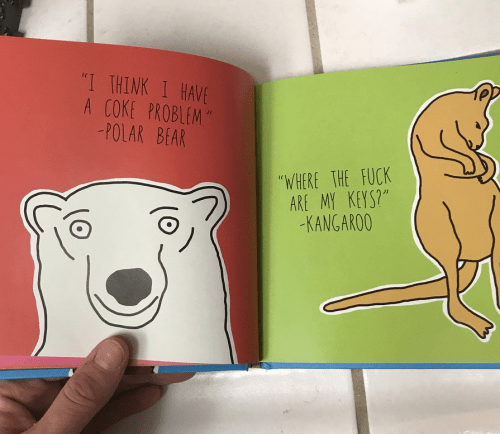
If Animals Could Talk is a 96-page book that, at first glance, looks like it was written for beginning readers and contains innocuous sayings. But looks can be deceiving, as one parent found out recently.

Twitter blew up yesterday when a mother started posting photos of a book that had been recently given to her daughter.  “I’m dying. My mom bought this book for my 6 year old and I just called to ask if she had actually opened the book. She hadn’t,” the mom, Tiffany, tweeted when sharing this photo:

if-anumals-coould-talk-5-500x434

You can find more photo’s on Tiffany’s Twitter account.

The book is filled with similar illustrations, including these screenshots from Amazon’s “Look Inside” option:

Unfortunately, Tiffany didn’t realize this until after hr daughter was reading the book. “6 year old was reading with Dad and said ‘I don’t even know what this means”, she tweeted.

The book was published last April, and can be ordered on Amazon for around $7, where it is out of stock in Amazon’s warehouses (but still available from 3rd-party sellers at $30 and up).

if you want one, you would be better off waiting for the next print run or heading to BookFinder to find another seller (this title is still cheap in B&N’s marketplace).

There is no Kindle or audiobook edition, but I would expect that to change soon.

Image Source: https://twitter.com/Tiffany1985B/status/915400202789326848

By Nate Hoffelder

Source: the-digital-reader

Visit us at First Edition Design Publishing

How to Use Big Words Without Making a Fool of Yourself

This guest post is by Sarah Moore. Sarah is a freelance copywriter and the founder of New Leaf Writing, where she blogs about building quirky, high-paying, and meaningful copywriting careers. She is also a writing coach, helping others start their businesses and make the jump to full-time writing. She reviews books and offers tips o’ the trade on Instagram (@newleafwriter).

Have you ever used a word for years — like, maybe during your thesis defense or in a high-profile report for work — then realized one day that you had it totally wrong? Those big words you thought were making you look so erudite were, in fact, working against you. Turns out, coif is not the same as coiffure, and you never even realized it.

big words

No one is immune from this, neither journalists nor poets, essayists nor novelists. The problem often stems from our natural inclination as writers to grab hold of an exciting new word and just run with it. Not only do we end up using big words just plain wrong, our enthusiasm leads to overuse as well.

By slowing down just a little bit, recognizing common pitfalls, and inserting some deliberate practice into your vocabulary usage, you can turn this trend around.

6 Big Word Sins You Can Learn to Avoid

We love those flashy mots, but in the pursuit of better craft, we often make our writing worse. Here are five common slipups writers make with big words:

Sin 1: Confusing Similar Words

You’ve probably come across the idea that only the first and last letters of a word are really important, while those between can be jumbled without losing meaning. This idea seems to contain the seeds of truth, which is bad for us writers who don’t parse vocab carefully enough.

At first glance, enervate and energize may look and sound the same, and seem to mean the same thing. Same with meretricious and meritorious. Unfortunately, these word pairs are opposites. To enervate is to drain energy; to energize is to add it. Meretricious means cheap or tawdry; meritorious means worthy or deserving of praise.

If you’re not careful to examine all of a word, you may end up using it wrong. Once you misapply it a few times, it gets cemented in your brain and will be hard to change. No Bueno.

Sin 2: Assuming You Know What Words Mean From Context

As writers, we’re used to absorbing vocabulary from what we read. That’s great, but only if you monitor the process. Otherwise, you can easily become confused. Take the above example of coif and coiffure. To coif is a verb; a coiffure is a hairstyle. You do the first; you have the second.

Luxuriant and luxurious are also frequently confused. Luxuriant doesn’t mean plush; it means lots of it. You have luxuriant hair; you get luxurious haircuts at expensive salons. If you’re not sure, follow my mom’s oft-repeated advice: Look it up.

Sin 3: Using the Word Multiple Times in Close Proximity

This … annoys me … so much. If you use a distinctive word too many times, I promise you readers will notice.

I’ll give you an example. Of late, fantasy authors have fallen in luuuuurve with the word “eldritch,” meaning bizarre or sinister. Now, this is a great word, but it’s not good enough to justify using more than once in a novel. There are other words for “weird and sinister,” starting with either “weird” or “sinister.” Just sayin’.

This can occur with phrases too. I love the Throne of Glass series, but my pet peeve is Sarah J. Maas’ use of “killing fields.” Yes, it’s a cool, if dark, term. But it’s so distinctive that at ten uses per novel, each new reference begins to grate. No matter how excited you are, keep your shiny new word to one instance.

Sin 4: Using Too Many DIFFERENT Words in Close Proximity

Like the above advice, readers notice when your prose or copy is suddenly crammed with four-syllable words. Keeping the big guys to a minimum is a good way to make those you do use stand out, so stick with one or two per page, at a maximum.

If it’s a word most people don’t know (eyeballing you, “eldritch”), give it even more space. Otherwise your readers will find your writing taxing, and they will get tired of it. You’re not James Joyce. Sorry.

Sin 5: Integrating More Than One Word into Your Vocab at a Time

I’m stoked you like the great authors. I do too. But while reading classic lit is a great way to expand our vocab, it’s also a great way to cram our brains full of words with which we’re only half conversant … and biff it in that thesis defense.

When you read a new word, dog-ear that page or write it down. Don’t just absorb it and conclude you “know” what it means. Then look words up carefully and practice (below) to be sure you know how to use them. If you come across many new words in a short amount of time, write them down in a document and reference it when you have some free writing time.

Sin 6: Using the Word in Dialogue When It’s Out of Character

The occasional professor or lair-bound scientist can fairly employ flowery phrasing, but chances are good your medieval heroines and subversive Nazi soldiers don’t have overflowing vocabularies. You can use that fancy five-syllable exclamation, but they probably won’t. Of course, you know your characters better than anyone else, but for the most part, you should keep their language simpler than your prose.

Choose Your Words

Phew, that was a lot of don’ts.

Luckily there is also a DO! Do use deliberate practice to improve your command of new words you stumble across. If you haven’t stumbled in a while, feel free to head to your favorite writing blog or dictionary, both of which commonly suggest new words to use. Stuck for ideas? Check out some of our favorite big words here.

When you encounter a new word you love the sound of, look it up and absorb its meaning. To deepen your understanding, check out a few examples of it in use — dictionary and encyclopedia sites are a handy way to do this, as they often offer sample sentences.

Big and uncommon words can be the perfect things to make your prose sizzle. By avoiding these egregious sins, you’ll ensure each one packs a punch. Don’t stop using your fancy vocabulary! Just make sure it’s working for you, not against you.

What’s your favorite uncommon word to use in your writing? What’s a word you often see overused or misused? Let us know in the comments.

Source: thewritepractice

Visit us at First Edition Design Publishing

Creating Worthy Side Characters Sub Characters Need a Purpose

I was recently asked about what makes a good, solid side character. I happened to be reading this debut novel with excellent examples. As a writing mentor, I find it helpful to pick apart worthy published works as examples, and this book, Picking Daisy, by Kimberly Miller, fits the bill nicely.

In general, your side characters need a purpose and a personality without being able to disappear or take over a story.

It’s not a bad idea to set up a general background for these characters like you do for main characters, but it certainly doesn’t have to be as involved. At least figure out why you’re making up this character at all. “Comic relief” and “expendable” aren’t sole worthy reasons.

The importance to the plot line and main character development must be obvious–as obvious as any other aspect of story. If your main character’s pants will fall down without the sidekick to hold them up, the sidekick is necessary. If your main character wears a belt and the sidekick is merely an ankle-biter, ditch ’em. They’re not necessary.

Side characters must be memorable and unique without disappearing at any time without notice, or taking over the story. Even one interesting thing, such as fashion sense, accent, tattoo, does the job.

How many are too many? Well, if Harry Potter and the Sorcerer’s Stone was a standalone, there would be too many characters. Sometimes one is enough; sometimes a larger cast, as long as they’re necessary and unique enough to keep separated, is fine. In Picking Daisy, each main character basically had two sidekicks (though I put together an engaged couple as one sidekick, since they acted as a unit). One other sidekick character was essential to both of them.

I recommend getting out a book you like a lot that has a fairly large cast and pick it apart. Think Wonderful Wizard of Oz, or A Man Called Ove, or Gone With the Wind. These are the questions to ask for a good Side Character study. The questions may seem obvious, but think about it carefully and seriously. We authors tend to love our people, and the thought of them not be important to someone else is heart-breaking. I’ve been there. I understand. But I have learned to wield an ax.

ASK THESE QUESTIONS OF EACH CHARACTER

Why is (this person) in the book?

What role do they play?

Will the story still make sense if this person/setting/object/quest is not in the story? (What would happen if they/it weren’t in the book?

Alert readers noticed that a side character does not have to be a person. It can be a setting (think Tara or Oz), an object (think sorting hat in the Harry Potter books or A in Scarlet Letter), or a quest (think revenge in Moby Dick).

So, to show you an example of how to analyze characters and think about them in your own work in progress, I give you the following study from Picking Daisy. First, here’s the blurb about the book. You’ll note there is absolutely no information at all about side characters in this teaser. You’ll note in my analysis I considered this book might birth other stories with these characters, though along with being expendable and humorous, potential serial fodder is not reason enough for a character’s presence. You don’t need to read the book to get something out of my analysis, though the book is a pretty sweet read.

From the publisher about Picking Daisy:

Daisy Parker isn’t the woman that rock star Robby Grant would have imagined himself falling for. She’s soft-spoken, sweet, and lives by a strange code the struggling musician is recognizing as Biblical. And he’s helpless against it. Even if Daisy is hard-pressed to believe that a man like Robby would see her—a woman long forgotten by the rest of the world—as anything more than a step back to his career. But Robby challenges Daisy in ways she’d long avoided. With their mutual love of music, it seems nothing can separate them—not Daisy’s wheelchair or Robby’s ego. As Robby grows into the man he’s long dreamed of being, Daisy dares to trust again. But will this sweet melody last?

We learn that Daisy is in a wheel chair, and Robby is a rock star, that Daisy has trust issues and Robby a giant ego They both love music. What we learn provides ample excuse for side characters.

Uncle Nick – he was the catalyst to getting Robby and Daisy together. He’s an older man in his seventies, widower, romantically inclined toward Daisy mostly to give her security though he also wants her to meet up with Robby because of their mutual love of music. His accident brings Robby into the setting. If he wasn’t in the book, there would have to be some other set-up to bring the main characters together.

My reaction: I knew him, could picture him, he had a personality with a manner of speech and character that showed stubborn and big-hearted, quirky humor. He would marry Daisy just to help her out; slightly creeped out that Robby accused them of being intimate and then kissed her.

Sadie – Daisy’s single friend, café owner; was in the book to provide aid to Daisy and provide a place for her to perform; also to provide some toughness and dose of reality. She also served as the love interest for Jazz and later brought Robby and Daisy back together. If she wasn’t in the book, Jennifer, Daisy’s other friend, could act alone, or even Nick could take on the role of caregiver or hire someone; they could find a place for Daisy to perform.

My reaction: I probably read too fast and missed knowing she was the café owner who brought Daisy coffee regularly – by the end I knew she was the owner. She had a feisty personality who wanted to challenge Daisy more, but was softened by the quieter Jen. I loved that she and Jazz were working on a relationship and were role models for Robby.

Jennifer and Steve – Daisy’s engaged friends. Jennifer was a longtime friend who stuck by Daisy through the ups and downs, and Steve helped look after Daisy and Nick. They were good sounding boards, and Steve challenged Robby, the famous rock star, to be good to Daisy. Their wedding helped Sadie and Jazz grown closer. Jennifer seemed more quiet. I didn’t know her as well as Sadie, though they were good role models for Robby to watch and learn about relationships. Jen provided activities for Daisy to help her and keep her busy. She also loaned Daisy money. If they weren’t in the book, Daisy, to be realistic, would need some kind of aide on a regular basis due to her health status. She could talk more to Nick, but there should be someone to challenge her and listen to her woes.

My reaction: I thought they were necessary to show both Daisy and Robby hope for a good, solid, serious faith-based relationship. Steve was a mature contemporary for Robby to look up to, since the other men in his life (Nick, Warren) were relatives or hired men (Jazz).

Warren – the perfect big brother for Robby, stable, mature, yet needing to grow. The nicknames they used and actions toward each other were great natural examples of how they came to be the way they were, and needed each other. His role was to shame Robby into going to check in on Uncle Nick after his accident. If he wasn’t in the book, a lot of good example for background would be lost. He provided some hard-nosed touches in not letting Robby continue to be such a jerk, and was also a role model for Robby. He was unique in personality—tough military—and used clever nicknames that kept Robby grounded. Robby admired his physique and relied on his brother to get him out of messes. He was a man of faith. Was he necessary? If he wasn’t in the book, Nick could have called Robby to come, and they might have shared some of the background, but it would have been forced.

My reaction: I liked him; he had good personality and was one of those people who helped me see that Robby was redeemable. He and Jazz were somewhat alike in build and temperament; whereas Jazz was a hired employee and a friend who took a lot of guff from Robby, Warren didn’t have to take anything and kept challenging Robby.

Jazz (Jason) – Robby’s best friend and hired body guard. He was in the book to provide a little bit of “realism” in the life of an international celebrity, and to serve as a reality check. He also became a love interest for Sadie. It’s possible more “companion” books will come out with the stories of Jazz and Sadie, and perhaps Warren (who got engaged to an unseen woman, Daphne, who has a child), and Uncle Nick, who developed an interest in his nurse, an unseen woman, by the end of the book. In that case, these people perform necessary plants for future books while still being necessary in this book naturally. He had a definite personality by letting Robby know of his concern; he escaped being cliché by challenging his boss and talking to Daisy, and by falling for Sadie.

My reaction: If he wasn’t in the book, I would need some healthy realism from another source. The author already made too light of the female protagonist’s wheelchair-bound life in not sharing any intimate details of life as a paraplegic, so making some of the problems Robby faces as an international celeb are more focused. I wouldn’t believe in Robby as much without Jazz.

By Lisa Lickel
Source: authorculture.blogspot

Visit us at First Edition Design Publishing
12 Places to Find Awesome Writing Ideas

12

We look high. We look low. Sometimes it feels like we’ve been looking forever and will keep looking forever more.

Ideas. They’re out there and we know it. But where are they hiding? Why do they keep escaping us? How can we catch them?

Writing ideas are not always easy to come by. Most ideas get tossed aside because they’re not original or interesting enough. So we constantly search for ideas that will capture our imaginations and keep us happily tapping away on our keyboards.

Not every writer is on this quest. Some writers are overwhelmed with inspiration and can’t find enough time to realize every brilliant idea. The rest of us are always on the lookout for exciting writing ideas to add to our inspiration archives.

Writing Ideas are in the Palm of Your Hand

By simply living on this earth, you’re surrounded by air and water and writing ideas. Isn’t it funny how sometimes we don’t see what’s right under our noses?

Creative writing is a funny thing. If you look too hard for writing ideas, they’ll elude you. But if you go about your business with an open mind, they’ll suddenly start turning up everywhere.

The list below is nothing new — just some reminders that in your everyday life, there are endless streams of sources from which you can draw inspiration. After you read the list, go about your business and try to forget about coming up with new writing ideas. Let them come to you.

This is Where They’re Hiding

  1. In your journal or notebook: How often do you go through and look at all the notes and ideas you’ve jotted down?
  2. In your diary: You may not want to write your memoir or biography, but you might find some bits of dialogue or ideas for character traits buried in your diaries.
  3. Family: Who do you know better than your own family? They can give you ideas for characters, plots, and themes.
  4. Friends: Everyone has a friend or two who have had some wild experiences. Borrow those experiences and give them to your characters.
  5. Coworkers: You have just enough exposure to them to write a character sketch, and there’s just enough mystery that your imagination can fill in the blanks.
  6. Neighbors: Why is their garage light always on? What’s in that enormous shed in their backyard? And who’s that weird looking visitor who’s always stopping by? You watch them and wonder about them. Now make up their story and write it down.
  7. Nature: You’re on a walk and pick up a pretty leaf or unusual rock and stare at it. Instead of taking it home and putting it on a shelf, start asking yourself some “what if” questions. Like, what if this isn’t a rock, but a planet? Or what if this leaf is sentient?
  8. Space: Lie under a starry night sky, and how can you not get filled up with writing ideas? What’s out there? Who’s out there? How far does it go?
  9. Books and movies: We’ve all read books and seen movies that were clearly spawned from other, more original books and movies. But that doesn’t mean there aren’t some great writing ideas in them. What if the character had made a different choice at the beginning of the film? What if the novel had a similar plot but a completely different cast of characters?
  10. Music and poetry: Don’t ask me how this works or why. Just know that it does. Reading poetry and listening to music relaxes your mind and opens it to countless creative possibilities.
  11. Writing exercises and prompts: That’s what they’re for — generating writing ideas. You can buy books of them, search them out online.
  12. Dreams: Before you fall asleep, ask your dreaming self to come up with some new writing ideas. Get some books on dreams (lucid dreaming, for example) and before you know it, your dreams will become the reality of your writing world.

Where Do You Get Your Writing Ideas?

Do you have any favorite places to look for writing ideas? When you’re stuck with plot or character or can’t come up with the last line of your latest poem, how do you resolve your creative block?

Source: writingforward

Visit us at First Edition Design Publishing

7 Ways To Create Buzz For Your Book

This is the third installment in a series on how authors can get free publicity for their books by novelist Diana Forbes.

An old boss of mine once commented to me that I “wouldn’t be there” to sell my work to each and every person who sees it. With all due respect to my former boss, I do not agree!

I honestly feel that I am the best advertisement for my novel. If I can’t sell it, no one can. That’s my attitude.

These are some of the approaches I’ve used while becoming an “ambassador” for my novel, Mistress Suffragette.

Book Buzz Tip 1: Reviews. 

I ask anyone who I know for a fact has read my novel to write an honest review for Amazon. When readers specifically write to me about the book to ask me questions, I also ask them to write a review for Amazon. All that said, some readers just don’t want to write reviews for a novel, even when they’ve read it and loved it. Still, it never hurts to ask.

Book Buzz Tip 2: Friends and Acquaintances. 

I threw not just one, but several book-launch parties and invited family, friends, neighbors and acquaintances. When I hear that an acquaintance is about to travel to one of the three cities in my novel, I ask them to consider purchasing my novel for their vacation reading. When I go out for dinner with friends, I ask them, “Have you read my novel?” A lot of friends will think nothing of dropping $100 for dinner, but don’t think to buy their friends’ books. I remind them.

Book Buzz Tip 3: Awards.

One of my writing buddies from a writing group I was in recommended that I submit Mistress Suffragette to competitions, and for those I’ve pursued, my novel has done very well.

Novel-writing competitions have three advantages:

  1. Some award shows will offer you feedback on your work
  2. You can win awards, making it easier to find an agent and ultimately an editor
  3. Some publicity often comes with the award

Of course, if you’ve set up strong social media channels, you can make even more of any publicity that you do receive through your own posts and tweets.

I pursue two kinds of awards. The first is the type that gives feedback on my writing. I submit to these to hear the opinions of people whom I don’t know. To me, this is honest feedback, and I try to use it to improve my work. It’s like hearing what the man or woman on the street thinks about my prose. The other kind of award I pursue is the kind that will provide publicity if my novel does well in the competition. It does feel good when my novel wins an award, but it’s not really an ego thing. It’s more the feeling of, “Now my novel will get the recognition it deserves.”

Book Buzz Tip 4: Book Clubs.

Several friends of mine are in book clubs, and I’m trying now to crack this market. Currently I’m working on getting my book into three book clubs, but it’s a bit slow going. I love to speak to readers, and I’ve offered to make a personal appearance in all three cases. This is a wait-and-see endeavor. Please wish me luck!

Book Buzz Tip 5: Libraries. 

I was able to get my book picked up by four libraries, and I’m trying right now for a fifth. In some cases I directly asked the library to order my novel. In other cases, readers asked their library to order my novel.

Book Buzz Tip 6: Become an expert in a topic related to your novel.

Positioning yourself as an expert in your novel’s time period (or subject matter) will make you a more attractive candidate to be interviewed on radio shows and talk shows. Reach out to community venues, local or national media outlets, associations, podcasts and other places for speaking or interview opportunities.

My novel is a 19th century comedy of manners that partly takes place in New York. I also grew up in New York and have ancestors stretching back to the time when my novel takes place, so I’ve positioned myself as an historian on all things New York.

Book Buzz Tip 7: Develop guest posts. 

Elaborate on themes or subject matter in your novel in 500 to 700-word blog posts and pitch them to the right contacts at the right outlets. Leverage your relationships with decision makers and influencers.

  1. Pitch them with a short message describing the big idea, the “so what,” or what the post is about or why they should care
  2. Link your messages to the real world if possible, making them practical and actionable
  3. Connect your piece to the day’s hot topics and or emerging issues and current events if possible
  4. Make your posts interesting

I wish you the best of luck with your marketing of your book. Pace yourself. Remember that it’s not a sprint but a marathon. And do your best to have fun with it.

By: Diana Forbes

Source: digitalbookworld

Visit us at First Edition Design Publishing