Tag Archives: apple

Sweet Deals for New Apple Stores #FED_ebooks, #Apple #ebooks

 The lure of the Store: Why authorities are sweetening deals for new Apple Stores

Source: thenextweb.com

By Matt Brian  –  19 May 2012

First Edition Design Publishing

The lure of an Apple Store can be so great that local authorities are doing all they can to sweeten the deal for the world’s biggest technology company, waiving rents and taxes in order to have it set up an Apple Store in their area.

New York’s Grand Central Terminal wanted Apple so bad it dropped its leasing fees and in Salt Lake City, authorities are rumoured to have dropped rents completely, to incentivise the opening of a new Apple Store.

Apple’s retail dominance

As a business, Apple’s retail stores are booming. In its second financial quarter (ending March 2012), the company saw sales rise by some 90 percent, breaking records with a $24.67 billion in quarterly revenue and $5.99 billion in profits.

A staggering 71 million customers visited Apple’s retail stores between January and March, an increase of 28 million from a year earlier. Apple’s impressive footfall is proving to be a catalyst for retail spending in the areas in which they are located, pushing the money spent back into the local economy.

A recent ABC News report states that Apple is going to open a new store in Salt Lake City, located in City Creek. The company already has one store in the the Utah city but thanks to what appears to be a massive retail incentive, it may open a new store before the end of the year.

What is the big incentive? According to ABC’s sources, City Creek has offered a “major concession package” that is thought to include five years free rent.

What makes Apple so special?

The truth is, realtors and local authorities know that when an Apple Store is opened in an area, tech savvy consumers come from surrounding areas to view products, seek help and spend money on luxury electronics. Put simply, spending will flow into City Creek.

The rental deal isn’t a one-off either.

While authorities will never confirm it — even City Creek’s Marketing Director said it “does not release the terms of its leases” — Apple’s lease for its impressive store in New York’s Grand Central Terminal is a third of that paid by other retailers and restaurants in the area.

In fact, the lease is costing Apple $60 per-square-foot, where other retailers are expected to pay $200 for the same area, and it has escaped having to share any of its revenue with Grand Central’s operator, the Metropolitan Transportation Authority, according to papers obtained by the New York Post.

Apple’s success was directly benefitted other companies in the Terminal. In just seven weeks, Apple’s newest New York store helped one restaurant boost sales by 7 percent — impressive as it’s already co-owned by basketball legend Michael Jordan.

That restaurant – The Steakhouse — directly attributes its increased footfall to the nearby Apple Store with its other co-owner stating: “The jump only happened after Apple opened.”

Moving Forward

Apple is showing no signs of slowing its retail expansion, it’s already seeing an average of 22,000 customers, per store, per week. Of course, it wants to further increase that figure.

As of January 2012, Apple operated 363 stores and has opened a small number since then. In 2012, it has plans to open 40 new stores, including a handful in China, perhaps its most important market.

In order to facilitate this, Apple has allocated $900 million for its new stores, some of which have been confirmed in Germany, Spain, France and Australia.

Apple’s retail success is down in part to its customer service, ease of purchasing, level of detail in its stores — and the quality of its products. However, the company isn’t completely satisfied with its operations, and has brought aboard former Dixons CEO John Browett to drive its retail business forward.

Tim Cook has said that the Dixons exec will bring “Apple to an even higher level of customer service and satisfaction.”

Part of this plan apparently involves automating its sales processes, which includes investment in its ‘Personal Pickup’ service, which allows customers to buy products online and pick them up from their local Apple Store.

Apple also launched a new iOS payment service called EasyPay, providing a simple way for customers to enter an Apple Store and pay for their purchase using their iPhone, without having to seek assistance from a sales clerk.


The company is set to release a new iPhone and update its range of Mac computers in the coming months, no doubt incentivising Apple fans to return to their local store to check them out.

As it stands, the company is setting the standard for retail, with other technology companies — including Microsoft — rushing to open similar stores and build rapport and most importantly gain trust from their customers.

Apple might be benefitting from its success, in terms of the money it saves from leases, but companies in the vicinity of an Apple Store don’t seem to mind. It’s difficult to complain that a company is getting preferential treatment when it helps boost your own revenues and increase the number of people coming to the area.

First Edition Design PublishingFirst Edition Design Publishing, based in Sarasota, Florida, USA leads the industry in eBook distribution.They convert, format and submit eBooks to Amazon, Apple, Barnes and Noble, Sony, Google, Kobo, Diesel, 3M, Ingram, Baker and Taylor, Nielsen, EBSCO, scores of additional on-line retailers and libraries, schools, colleges and universities. The company also has a POD (Print On Demand) division, which creates printed books and makes them available worldwide through their distribution network.

First Edition Design Publishing

#Apple Tablet Sales to Soar #iPad #ebook #Author #Writer #FED_ebooks

Tablet Sales Expected to Soar with Apple (Mostly) Dominating

Source: WSJ.com

CIO Journal.  May 15, 2012

By Thomas Loftus, News Editor

Tablet sales are echoing the “wild exuberance” of the cellphone industry in its early years, market watcher IHS iSuppli  said in a report issued on Tuesday, predicting that unit growth will soar 85% to 126 million in 2012 and 63% to 205 million in 2013. Apple’s iPad is expected to dominate sales, capturing 61% of 2012 market share. But IHS iSuppli predicts that things could get more interesting for the industry (and CIOs) in late 2012 with the launch of a new generation of tablets that use the forthcoming Windows 8 operating system.

Apple’s iPad

IHS iSuppli predicts that these ‘PC-type’ tablets will generate 8 million unit sales next year, a 160% increase over expected 2012 figures. By comparison, what IHS Suppli calls “media tablets,” such as Apple’s iPad, will boast a more modest—but still impressive—60% increase in sales with 197 million units in 2013. PC tablets will appeal to business users looking for desktop-like features such as opening multiple windows and access to traditional desktop applications. As CIO Journal reported, Lenovo is among the enterprise PC makers hoping to tap  this demand, with a Windows 8 tablet.

Despite hopes for the PC tablet, Apple remains the vendor to beat inside and out of the enterprise. After dipping to 55.1 percent share of the tablet market  in late 2011 owing to the launch of Amazon’s Kindle Fire, the company is on track to claim 61%, the same portion it had in 2011. IHS Suppli director Rhoda Alexander cited the Apple platform’s “complete hardware-plus-content ecosystem,” first forged with the creation of the iPod and the iTunes music store, as a significant obstacle for any rival to overcome.

IHS Suppli cited rumors concerning the possible deployment of a smaller 7.8 inch display version of the Apple iPad. If Apple does release such a version, IHS iSuppli writes, the emphasis will be on playing up the quality of the overall tablet experience, and not on a substantially lower price.

First Edition Design Publishing

First Edition Design Publishing, based in Sarasota, Florida, USA leads the industry in eBook distribution. They convert, format and submit eBooks to Amazon, Apple, Barnes and Noble, Sony, Google, Kobo, Diesel, 3M, Ingram, Baker and Taylor, Nielsen, EBSCO, scores of additional on-line retailers and libraries, schools, colleges and universities. The company also has a POD (Print On Demand) division, which creates printed books and makes them available worldwide through their distribution network.

First Edition Design eBook Publishing

Target to stop selling Amazon Kindles #ebooks #Author #Writer #FED_ebooks

First Edition Design Publishing

Target to stop selling Amazon Kindles in its stores

Even if it loses offline Kindle sales elsewhere, impact on Amazon is minimal, analysts say

By Matt Hamblen

Computerworld – Target plans to stop selling Kindle e-readers in its brick-and-mortar stores after seeing buyers test the devices in its showrooms only to later buy them online from Amazon.

Target’s decision was reported this week in The New York Times, after analysts reported in January that the company wasn’t willing to let online-only retailers use its 1,800 stores to showcase their products while undercutting Target’s prices.

Target’s decision could influence other retailers that sell Kindles, including

Wal-Mart, Staples and Best Buy, analysts said. Amazon and the other physical retailers didn’t respond to a request for comment.

“Target’s problem is a common problem for brick-and-mortar companies,” said Rob Enderle, an analyst at Enderle Group. “Customers will find what they want at the store, then leave and shop for the best price online.”

Smartphone apps now available allow customers to scan a barcode on a product in a store and instantly look for better prices at other stores in the area and online, Enderle noted.

First Edition Design Publishing

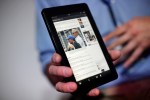
Amazon’s Kindle Fire

What has made matters worse at Target is that Amazon’s Kindle Fire tablet also serves as Amazon’s online storefront to everything Amazon sells, Enderle added. “So that’s like Target is promoting all of Amazon, and Target’s not a fan of doing that,” Enderle said.

Enderle said if other brick-and-mortar retailers stopped selling Kindles, Amazon’s physical shelf space could dry up and Amazon would have to find shelf space by opening stores in malls or kiosks. Barnes & Noble has one advantage in selling Nook e-readers and tablets because it can offer a place for users to test out the devices before buying them, analysts said.

Jack Gold, an analyst at J. Gold Associates, said he would not be surprised to see Best Buy or Staples, among others, “push back on selling Amazon Kindles as a result of this frustration with Amazon.”

However, even if large retailers stop selling Kindles in their stores, Gold sees a “minimal effect on Amazon and Kindle sales” simply because most of their devices are sold directly.

Also, offline retailers wouldn’t see much material impact if they stopped selling the devices, since there was probably only a small mark-up for them, Gold added.

Amazon has sold its Kindles at a loss, primarily to encourage purchases of books and other merchandise with the device where it can make a profit, Gold noted. “It’s not a real penalty to Amazon to only have direct sales of the device,” he said.

 covers mobile and wireless, smartphones and other handhelds, and wireless networking for Computerworld. Follow Matt on Twitter at Twitter @matthamblen or subscribe to Hamblen RSSMatt’s RSS feed. His email address is mhamblen@computerworld.com.

First Edition Design Publishing

First Edition Design Publishing http:www.firsteditiondesignpublishing.com, based in Sarasota, Florida, USA leads the industry in eBook distribution. They convert, format and submit eBooks to Amazon, Apple, Barnes and Noble, Sony, Google, Kobo, Diesel, 3M, Ingram, Baker and Taylor, Nielsen, EBSCO, scores of additional on-line retailers and libraries, schools, colleges and universities. The company also has a POD (Print On Demand) division, which creates printed books and makes them available worldwide through their distribution network.

First Edition Design eBook Publishing

Microsoft Squares Off Against Amazon & Apple in #eBooks #FED_ebooks #Author #Writer

Source: Forbes.com

Microsoft Squares Off Against Amazon & Apple in eBooks

Microsoft has invested $300 million in a new subsidiary floated by Barnes & Noble, which will include its Nook business and its educational College business.  Microsoft’s cash infusion will get it a 17.6% equity stake, valuing the subsidiary at $1.7 billion. With this move, Microsoft is jumping into the e-books business, in which it will compete with the likes of AmazonApple and Google.

Barnes & Noble is the second largest player in the e-book space, but much smaller than Amazon, which completely dominates the market. Apple has been trying to get a foothold in the space and recently found itself in the middle of an antitrust investigation by the DoJ against major book publishers.

#     #     #

First Edition Design Publishing http:www.firsteditiondesignpublishing.com, based in Sarasota, Florida, USA leads the industry in eBook distribution. They convert, format and submit eBooks to Amazon, Apple, Barnes and Noble, Sony, Google, Kobo, Diesel, 3M, Ingram, Baker and Taylor, Nielsen, EBSCO, scores of additional on-line retailers and libraries, schools, colleges and universities. The company also has a POD (Print On Demand) division, which creates printed books and makes them available worldwide through their distribution network.

More…

First Edition Design eBook Publishing

Digital Assets Help eBook Distributor Become Global Leader #FED_ebooks #ebook #Author

Digital Assets Help eBook Distributor Become Global Leader

First Edition Design Publishing continues expansion of their worldwide distribution list.

Sarasota, FL, USA                                                             May 1, 2012

First Edition Design Publishing’s background as licensed Apple Developers and Microsoft Solution Providers, as well as our extensive technical digital assets, puts us in a perfect position as the leading Master Distributors for eBooks.  We are unequaled in the number of distribution points that we submit books to and the speed in which we can do it.  We are at well over 100,000 distribution points reaching over 100 countries,” First Edition Design Publishing’s CEO, Deborah E. Gordon said. “Efficiency is crucial and that is just one of our strong points.”

This week Ms. Gordon’s company added MBS Books, Textbooks.com, Feedbooks, OnlineBookPlace, SmartEbook.com, Starland Books and Eguidebooks to their distribution list along with three more Christian book outlets, Mardel, Parable, and Berean. They also further expanded eBook distribution in, Japan, Australia, Canada, Germany, France, Italy and Spain through Google Play.

First Edition Design Publishing

First Edition Design Publishing

First Edition Design Publishing http:www.firsteditiondesignpublishing.com, based in Sarasota, Florida, USA leads the industry in eBook distribution. They convert, format and submit eBooks to Amazon, Apple, Barnes and Noble, Sony, Google, Kobo, Diesel, 3M, Ingram, Baker and Taylor, Nielsen, EBSCO, scores of additional on-line retailers and libraries, schools, colleges and universities. The company also has a POD (Print On Demand) division, which creates printed books and makes them available worldwide through their distribution network.


First Edition Design Publishing

Don’t Believe the eBook Monopoly Ploy #FED_ebooks #ebook #author RT

Don’t Believe the eBook Monopoly Ploy

SOURCE: Huffingtonpost.com

By: Warren Adler

Don’t believe all that hype about government interference that is designed to foster an Amazon monopoly of the ebook business. What the six major publishers were alleged to have done was collude in fixing prices that, if true, was a desperate act that they must have known would fall afoul of anti-trust laws.

The new ploy by book publishers is to characterize Amazon as a monopoly poised to take over and dictate terms and run rampant over those who create ebook content. That is like saying Starbucks is a monopoly because it currently dominates the coffee retail business.

As an author who introduced the SONY reader, the very first reading device at the 2007 Las Vegas Consumer Electronics show to what was then an indifferent audience, I felt certain that one day e-readers would dominate the marketplace. I thought SONY was really on to something and would one day be the imaginative leader of the ebook industry.

Soon after the SONY launch, Amazon introduced the Kindle and followed through with verve and imagination to become, as we speak, the dominant force in ebook content and sales. I was an evangelist for these devices largely because of the ease of purchase, clarity and wide variety of available content and, above all, convenience, especially for those of us to whom reading is an important part of our lives.

Barnes and Noble, a super successful big-box book chain, apparently saw the advantages of getting into the ebook business early on, created an infrastructure and then, in an act of counter-productive bean cutting, abandoned its ebook business entirely. I remember meeting Steve Riggio, Barnes and Noble’s chief honcho, at the home of the late Bill Riley, one of his board members, and politely chastising him for getting out of that business.

Sure, it was light cocktail chatter, but I could tell that he was contemplating getting back into ebooks. It must have soon become apparent that in order to survive, Riggio had to get into that business, and Barnes and Noble did indeed with its excellent reader, the Nook. Unfortunately, they were late and are now playing catch-up. But to dismiss the Nook as a competitor to the Kindle is to sell Barnes and Noble short. Early on, they revolutionized the book business with their big-box stores and merchandising techniques and will undoubtedly ratchet up the ebook competition.

Then there is Kobo, a Canadian company trying to earn its bones in the business. They have to be counted as a future factor in the competition. There are others, as well, trying to crack into the coming e-reader bonanza.

The introduction of Apple’s iPad gave the publishers, as they might have seen it, leverage to fix their ebook prices. You couldn’t blame them since the challenges posed by ebooks are a very real threat to the profitable print publishing business. I have a feeling they believed that Apple would, like everything they touched, eventually dominate the e-book business as well, hence their alleged collusion.

Although I am an Apple guy and a great admirer and loyal user of their products, I did not think that the iPad would dominate the book business. It doesn’t and, in my opinion, will not. My opinion is based on the fact that the tablet concept is too distractive for the customer, to whom reading is a centerpiece of their leisure activities.

Marketers use a cute term called “immersive reading.” It is redundant. All book reading is immersive and requires from its devotees time and, above all, mental concentration.

Somewhere I read that the great Steve Jobs thought that reading, meaning the content that is defined as “books,” would decline against the onslaught of other cyber activities, which he seemed to deem more important. Indeed, he must have fashioned his foray into the book business with that in mind. With a million distractions now available on the iPad, the so-called “immersive reader” is relegated to be merely one of the pack, with “book” content hardly in the same exclusive domain of a solo device.

I am well aware that Amazon is having great success with its “Fire” tablet. My sense is that it will have exceptional value to Apps Aficionados but might not to book content readers. In my view, those who are repetitive “immersive” readers of all ages will stick with the solo reading device.

What could be a worry for Amazon, Nook, and Kobo would be if Apple decides to come out with its own solo reading device.

I have not dealt with the plight of the author, the creator of the content without which the traditional publishing business would have to close its doors. What could happen is that authors might find it more advantageous to create their own self-publishing business models, which has been my choice, join together to create cooperative ventures, or throw their oar in with numerous enterprises serving authors who have the means to self-publish with all the bells and whistles of traditional publishers.

As it stands now, the publishers are busy scratching their heads and trying to come up with measures to assure their future viability. Someone, perhaps far outside the publishing box or an enterprising author might come up with a business plan that will make economic sense. We shall see.

Fear not. Readers must read. Writers must write. It has always been thus. And creative minds will prevail to eventually figure out ways to bring the two together in ways profitable to each.

Warren Adler is the author of 32 novels and short story collections. His books are published in 25 languages worldwide and several have been adapted to movies, including “The War of the Roses” and “Random Hearts.”

Download a free copy of Warren Adler’s The Children of the Roses.

First Edition Design Publishing, the industry’s largest distributor of eBooks, submits eBook titles to Amazon, Barnes and Noble, SONY, Kobo and to over 100,000 distribution points and booksellers in more than 100 countries. They format eBooks for every type of ereader device on the market.

www.firsteditiondesignpublishing.com

Half of all pupils will use #eBooks in two years #FED_ebooks #Author #Android #Apple

First Edition Design Publishing

HALF of all pupils starting secondary school in two years’ time will be using eBooks as the classroom goes digital, writes Breda Heffernan.

Book publishers Folens yesterday unveiled its first range of eBooks which will

First Edition Design Publishing

Apple's iPad

be available to download by students on all digital platforms, including AndroidApple and Windows.

The Folens App, which is free to download, will have 26 Junior Cert and 16 Leaving Cert titles which will be available to buy in June. More books will be added on an on-going basis and trial chapters are now available for downloading.

The eBooks will be on average 15 to 20pc cheaper to purchase than traditional textbooks.

However, Folens said this reduction could be more if the Government closed a loophole whereby textbooks were exempt from VAT but digital education material was not.

The publisher said the new app was developed following demand from parents, teachers and students and after a pilot study carried out last year in a selection of schools received a great response.

Irish Independent ~ April 24. 2012

www.firsteditiondesignpublishing.co.uk

EBrary Reveals Reams of Relevant eReader Data.

First Edition Design Publishing

We wanted to address a few points about the free downloadable report mentioned in our last post, courtesy of the good people at eBrary. It was based on a paper by Allen M. McKiel, Ph.D., Dean of Library Services, Western Oregon University.

The report shows a clear preference for libraries to provide access for patrons
to mobile offline reading. Interestingly, the reader of choice is the Apple  iPad for offline reading (the seemingly popular Amazon Kindle ranked fifth), while Windows based desktop/ laptops led the tethered (on-line) category and the Kindle ranked sixth.

The study was primarily answered by academic librarians, which may have influenced the numbers in that the iPad is popular among students.

Amazon Kindle’s massive sales numbers are not reflected in the survey. With just 7% of the responses coming from public libraries, the report may not be representative of what the general public is reading eBooks on.  Over 70% of the answers came from the United States. Again, it may show trends among American academic libraries, but not necessarily the world-view of accessing information.

It was shocking to see no replies from Japan, while there where 2 from Afghanistan.  Norway (9 responses) outdid Brazil and Argentina that combined for a total of 2.  It is not known if the survey was only offered in English.

Overall, the 27 question survey does provide an outstanding look at trends. It is well worth downloading and taking a look… whether you are tethered or offline.


About First Edition Design Publishing:

Ebook Publishing Design Edition First Graphic Aggregators Ebooks Publishers Distribution POD Designing Approved Aggregator How Services Academic Distributor Chapter Submission Professional Firsteditiondesignpublishing.com published book market First Edition Design Publishing is the world’s largest eBook and POD (Print On Demand) book distributor. Ranked first in the industry, First Edition Design Publishing converts and formats manuscripts for every type of platform (e-reader). They submit Fiction, Non-Fiction, Academic and Children’s Books to Amazon, Apple, Barnes and Noble, Sony, Google, Kobo, Diesel, 3M, Ingram, Baker and Taylor, Nielsen, EBSCO, and over 100,000 additional on-line locations including retailers, libraries, schools, colleges and universities. The company’s POD division creates printed books and makes them available worldwide through their distribution network. First Edition Design Publishing is a licensed and approved Aggregator and holds licenses with Apple and Microsoft.
Visit: www.firsteditiondesignpublishing.com

Ebook Publishing Design Edition First Graphic Aggregators Ebooks Publishers Distribution POD Designing Approved Aggregator How Services Academic Distributor Chapter Submission Professional Firsteditiondesignpublishing.com published book market

First Edition Design eBook Publisher Aggregator Master Distrbutor