By Lucy V Hay
Lots of writers enjoy mystery, horror and thriller novels … but are not too sure what differentiates them. As a result, when they attempt their own, they might get stuck.
As a script editor in the UK who’s worked on predominantly horror and thriller, plus as an author myself who has written mystery, I am in a position to advise!
First up, let’s take a look at mystery.
Mystery
I had one of those English Literature teachers who’d bellow ‘To know a word is to define a word!’ This means I always look first at the dictionary. Here’s what it says about mystery:
A novel, play, or film dealing with a puzzling crime, especially a murder.
“the 1920s murder mystery, The Ghost Train”
This is an okay definition. Whilst mystery typically involves a crime – Agatha Christie is STILL the queen of the genre – it’s the ‘puzzling’ nature that is most important.
Typically there will be a BIG REVEAL at the end when the person BEHIND IT ALL is unveiled. Mysteries tend to be cerebral on this basis.
Horror
Here’s what the dictionary says about this one:
A literary or film genre concerned with arousing feelings of horror.
“a horror film”
In other words, we want to be SCARED by Horror. That tracks! So far, so good.

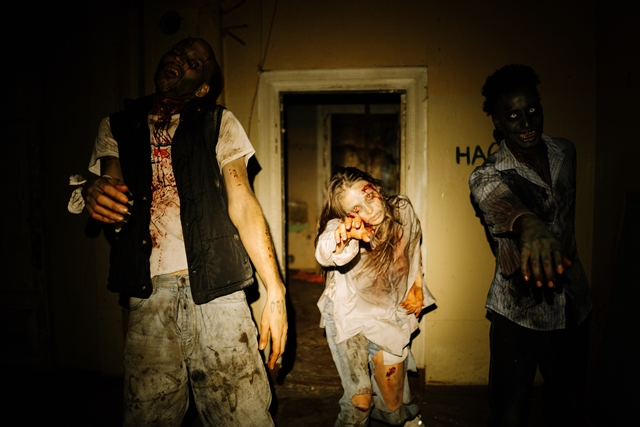
Horrors tend to lay out the potential threat from the beginning: a creature, a serial killer, a haunted house, etc. This means in a Horror we are principally VOYEURS. We sign up to watch terrible things happen to people.
In certain subgenres, this is obvious. So-called ‘torture porn’ movies like the SAW franchise invite us to witness murder and mayhem in ever-increasingly spattering ways.
But even in less grotesquely flamboyant horror, the story will relate to a cultural, base fear most of us have.
Fears for our children (especially them dying); fears of being taken away/sent into a hell-like place; fears of being out of control; about sex, rape, pregnancy or other violations; of being eaten alive, being dismembered, or burned alive.
What’s more, these types of story feel unstable and make us worry FOR the characters in it … And yes, maybe even freak out when said characters are attacked and/or killed. This is why groups of characters picked off one by one can be so popular in horror stories.
Thriller
A novel, play, or film with an exciting plot, typically involving crime or espionage.
“a tense thriller about a diamond heist that goes badly wrong”
This is less illuminating. After all, mystery can involve crime or espionage too … Plus there’s lots of thrillers that do neither of these things. Now what??
Wait! The keyword in this definition is ‘exciting’. As the name ‘thriller’ suggests, our story just needs to THRILL. This usually happens with some kind of deadline as a ‘race against time’: a chase, if you will.
In contrast to Horror, the Thriller invites the viewer to put themselves in the protagonist’s place. The story will ask, ‘What would YOU do?’.
*Something* is happening – but the characters in the center often don’t know exactly what and/or why. They will chase after this mystery in order to solve it – whether it’s a conspiracy, a supernatural occurrence, an abduction, or something else.
Thrillers typically relate to a more intellectual fear most of us have, such as our children being kidnapped; of abduction/being held hostage; of living in an unsafe home; having our identities stolen; being watched or persecuted in some way; of authorities who cannot be trusted, such as governments, teachers, or medical staff. This is why the lone protagonist in a Thriller is so popular.
So what’s the breakdown here?
- A Mystery needs a BIG REVEAL of whom is BEHIND IT ALL (usually at the ending, but not always)
- Mysteries tend to be puzzles that need to be solved
- In Horror, we sign up for the SCARES
- Horrors tend to be voyeuristic
- Horrors often focus on groups of people, picked off one by one
- Thrillers don’t tend to be Horrors (since Horrors lay out the threat from the beginning)
- In a Thriller, we sign up for the CHASE
- Thrillers often focus on lone protagonists who are ‘up against it’
- Thrillers tend to be ‘races against time’
- Mysteries may be Thrillers as well, or they may not
A Big Question
I believe we can decide what our novels are by asking one BIG question …
‘… Do I want to keep my antagonist hidden until the ending or not?’
If you don’t want to keep the antagonist hidden, you’re probably writing a horror. This is because you need to establish the threat from the outset.
If you DO want to keep your antagonist hidden for that BIG REVEAL, then you’re probably writing a mystery or thriller.
(Of course this will depend on the story, we’re talking generalizations here … but from my work with writers, it’s surprising how often this question works!).
Learn the Conventions
So, if you’re writing a Horror, obviously your novel needs to be scary. A good way of studying the conventions of Horror is by considering why your favorite Horror novels scared *you*.
In my case, Heart-Shaped Box by Joe Hill scared me so much it took me a whopping three weeks to read it because I kept getting creeped out!
The story of a washed-up rock star who buys a ghost on the internet he then can’t get rid of, the threat in Heart-Shaped Box is established early on. Hill piles of dread by the ton, making even the smallest moments seem frightening. As the chapters build towards a bloody, crescendo ending, we can’t be sure anyone will get out alive.
If you’re writing a thriller or mystery, it’s slightly different. Personally, I favor mystery elements in Thriller (if not a full-blown mystery) because I love twists. This may – or may not – feed your BIG REVEAL, it’s up to you.
But if you’re hiding your antagonist’s true intentions, you need to be careful. One of the biggest issues B2W sees when writers try this is they hold the antagonist back BUT don’t replace that role function with another. This then means there’s a big fat hole where ‘nothing happens’.
Devices such as red herrings, misdirection, working theories, a stooge antagonist, etc. will help you write a satisfying plot AND compelling characters in your thriller or mystery.
In other words, stuff that **stands in for the perp** … ’til we get to the actual perp.
You can do this no matter what genre or type of story you are writing. Immerse yourself in the mystery genre via mystery novels, movies, & police procedurals to guide you.
Good luck!
Source: writershelpingwriters.net
Follow us on Facebook and Twitter
Visit us at First Edition Design Publishing

 First Edition Design Publishing - a hybrid publisher