Tag Archives: Writers Write

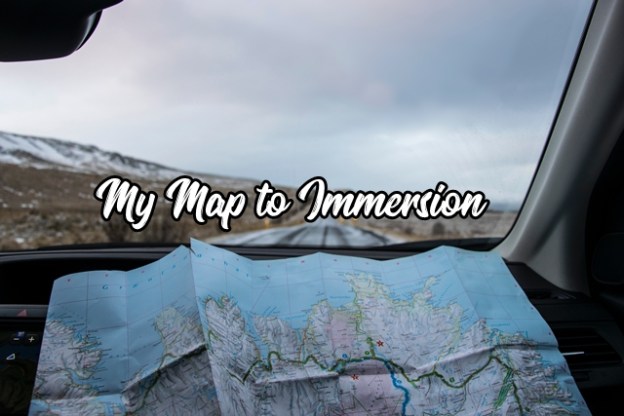
My Map to Immersion

I’ve always loved maps. My earliest memories of map-reading are from family car-trips. My dad would reach into the (gigantic!) glove compartment of our ’68 Chevy Bel Air, and hand back the newest neatly folded roadmap of Michigan from his (gigantic!) pile of maps to my sister and me (hey, anything that quiets backseat rowdiness). He religiously picked up the AAA’s latest version from his insurance agent, whose office was a stone’s throw from his barbershop. (In his defense, those were days of growth for American infrastructure.)

My sister and I would pore over the map, pointing out the odd town names of the Mighty Mitten, and giggling over the absurd trips one could make between them: from Bellevue to Belleville (in our Bel Air!); Pontiac to Cadillac; Bad Axe to Hell; Podunk to Jugville; and even Colon to Climax (a very pleasant 30 minute ride, I swear).

Beyond the giggles, I found it all enthralling. I mean, let’s face it, Michigan has an alluring shape. Not to mention her 3,288 miles of shoreline (second only to Alaska). I remember studying the coasts, the islands, and the towns at the extreme tips of peninsulas—places like Northport, Mackinac, Copper Harbor, and Whitefish Point, and wondering how it would feel there—to be surrounded by nothing but water and forest. I’ve since been to most of the places I wondered about. And though a rare few failed to live up to the expectations of youth, most have exceeded them, and several have become favorite getaways.

My love of maps has undoubtedly contributed to my enduring love of my home state. But I can see that my love of maps also provided a natural lead-in to my love of reading.

And I’ve also become convinced that a line can be drawn from my love of maps to my current life as a writer. Allow me to diagram my case.

A Tolkien of My Affection

As some of you may know, I write epic fantasy, and cite Tolkien as a guiding star among the constellation of my inspirations. Before reading Tolkien, I’d been captivated by a middle-grade book by Dirk Gringhuis called The Young Voyageur. My parents bought it for me in the gift shop of the restored Fort Mackinac, on Mackinac Island (one of those intriguing map dots I mention above). The entire inside cover of the book is a map of the Great Lakes, marked with all of the French and British forts along the shores, and charting the protagonist Danny’s travels, covering hundreds of miles of shoreline and rivers… in a canoe!

Many of the places Danny found himself were places I had visited (thank you, history-buff parents). As I read I found myself referring to the map often. I also remember going to our family encyclopedias to look up French Voyageurs (thank you, “go-look-it-up-yourself, kid” parents). And I clearly recall finding an image of an early French map of the Great Lakes much like the one at the top of this post. I was predictably fascinated, trying to reconcile rivers and landmarks, marveling over how it might have been drawn at the time that it was. All of which put me right into Danny’s shoes.

I’m not sure how long it was after reading The Young Voyageur that I discovered Tolkien (thanks, Mr. Raymond!), but not more than a couple of years. I remember stumbling upon the map at the front of The Hobbit before I started it, and loving the tiny trees of Mirkwood and the drawings of the Misty Mountains. Closer study revealed the tiny dragon drawn above the Lonely Mountain and the spiders embedded in the forest. Then there was that heavy line from top to bottom demarking, “The Edge of the Wild.” Whoa.

There was so much to be gleaned. Which only served to fuel my fervor for the story.

The whole process started over again with The Lord of the Rings boxed set, except this time I didn’t need to stumble upon the map. I immediately sought it out, and was delighted to find the map expanded to reveal Middle Earth in its glorious entirety. It was an enticing indication of how far the story would expand, and I endlessly dissected it, referring to it almost comically often as I read.

Undeniably Tolkien’s maps played a role in pointing me down the storytelling path.

Connecting the Dots

Though I’ve always loved them, lately maps have been even more on my mind than usual. It started with WU’s own Tom Bentley, who’d come across an excellent essay on books with maps by Sarah Laskow. Tom rightly surmised that I’d be of the map-geek persuasion, and kindly passed it along. A few days later a dear friend reached out to me with a question about my latest manuscript, which she is kindly beta-reading. The question was about the locations of two port cities. Her confusion was understandable, but it made me realize that a glance at a map would’ve easily answered it. But I hadn’t provided one.

Over a decade ago I read a piece by fantasist Joe Abercrombie about why he hadn’t included a map for his debut, in which he says, “I want a reader to be nailed to the text… not constantly flipping back to the fly-leaf to check just how far Carleon is from Uffrith, or whatever. The characters often don’t know what’s going on. If they don’t have a conveniently accurate map to hand, why should the reader?”

Abercrombie’s piece contends that our stories should be compelling and self-explanatory without visual aids. Plus, not being trained cartographers (Joe and I and most other writers), our efforts can potentially open us to a level of scrutiny that’s often irrelevant to the story. At the time of reading it, I’d already tried my hand at mapmaking. Extensively. And in my less than stellar results I immediately saw his point. Besides, agents and editors to whom we submit will consider no such supplement.

I determined then that, in spite of my love of maps, the story would have to stand on its own. And I simply stopped drawing them.

Finding the Way Back to Maps 

“One of life’s great treats, for a lover of books (especially fantasy books), is to open a cover to find a map secreted inside and filled with the details of a land about to be discovered. A writer’s map hints at a fully imagined world, and at the beginning of a book, it’s a promise. In the middle of a book, it’s a touchstone and a guide. And at the end, it’s a reminder of all the places the story has taken you.”—Sarah Laskow, from her essay, How Writers Map Their Imaginary Worlds

In the interest of full disclosure, there have been occasions when a reader has requested one, and I’ve sent along my old original map (redrawn by my talented brother-in-law from one of my crappy attempts). Also, full disclosure: Abercrombie’s recent books have maps, though I’m not sure if he changed his mind or was pressed to it by his readers or his publisher.

But generally speaking, I’ve chugged along through six manuscripts without the inclusion of maps. The world of my story has since expanded well beyond my old maps’ borders. Though my story-world is roughly based on the Black Sea and Aegean regions and the Danube River Valley, a real map would never suffice as a stand-in.

My story-world is fairly vast, with a wide variety of topography. There are smoky villages and teeming cities; rocky peaks and round, green mountains; thundering seas and calm blue lakes; vibrant young pine forests and aging oak woods. And yet most every square mile of this fictional realm has remained crystal clear to me. I often struggle to recall the names of minor characters and other details, but I have almost perfect recall of the place names, along with a mental image of each.

It was Laskow’s quote above that spurred me. I finally attempted a map of the entire area of my current story-world. The endeavor has awoken something deep and old inside of me. Something enduring. I am relearning something about myself. True, as a storyteller, maps can show you how to put things in context. They can help you keep your storyline straight and true, even if they’re never meant to be shown to readers.

But more than any of that, maps are an invitation to wonder, and an incitement to imagine.

[As an aside: these days, with so many tools available online, there’s no excuse to avoid making maps, if only for your own use. I used a fantasy mapmaking website called Inkarnate. My attempt is far from complete, and the scale still feels off (reminding me of Abercrombie’s warning). But making it was easy and fun. I’ve put it on my website, if you’re curious.]

Whether you’re a map lover like me, or are just looking to be reawakened to wonder, I encourage you to give story mapmaking a try.

Charting a Course to Fiction

I’m certain that my work will have to continue to stand on its own without any visual aids. But I’m glad I found my way back to my love of maps.

I can more clearly see the path that brought me here. It was about more than a boy learning to read a map. It was about finding where I was and imagining where else I could go. Which is only a short trip to wondering what it might be like there. Then just a step to imagining what might happen next.

Isn’t that what fiction is—mentally conceptualizing the world through an invented scale, then conveying that concept via the written word? Placing yourself on the page, then visualizing the ability to move within it, and then finding your way to a new and unknown experience?

It certainly has been for me. I believe that my love of maps provided a model for what followed in the pages of my story beyond. And in the pages I continue to produce. Maps have provided the very genesis of my ability to immerse myself in story. I consider it a wonderful gift.

Which direction do you fall when it comes to book maps? Do you love maps? If so, can you draw a connection from that to your love of fiction?

Wishing a happy Thanksgiving to the Americans among you. I hope everyone safely finds their way to a blessed holiday among family and friends.

By Vaughn Roycroft
Source: writerunboxed.com

Visit us at First Edition Design Publishing
How to Write a Non-Fiction Book: 10 Crucial Steps

Have you ever thought about writing a non-fiction book?

Maybe you’re worried that you need to be an “expert”, or you feel daunted by the idea of writing so many words. But you can’t quite let go of that dream of seeing your name on the cover of a finished book.

You might have lots of different reasons for contemplating a non-fiction book. Maybe:

  • You want the book itself to bring in money – a perfectly reasonable ambition!
  • You plan to use the book to give you greater credibility and authority in your field – making it easier for you to get paid speaking gigs, for instance.
  • You want the book to essentially be a marketing tool for your business – this might be a short free ebook that you give away on your site, or a fairly cheap mass-market book that introduces new readers to you.

Whatever your reasons for writing, this post will take you through what you need to do – step by step – to write your book.

Step #1: Figure Out How You’ll Publish Your Book

This might seem like an odd first step, but it’s really helpful to have in mind how you’re going to get your book out into the world, right from the start.

If you know you’re going to self-publish, for instance, you’ll have full control over the project (and full responsibility for every step). If you definitely want to seek a publisher, you’ll go about things a slightly different way – publishers of non-fiction typically want to see an outline and a sample chapter, not a finished manuscript, so they can have input into your project.

If you want to supply the finished book for free (probably as an incentive to get people to join your email list), then that will also inform your choices during the next few steps: you’ll probably want to write something quite short and simple.

Of course, it’s possible that you’ll end up changing your mind at some stage – but by having a goal in mind at the start, you make it far more likely that you’ll see your project through to completion.

Step #2:  Decide on Your Core Topic

You may already have a particular topic or idea in mind for your book: if not, now’s the time to jot down lots of possibilities so you can choose the one that appeals to you most. If you already have an online audience (perhaps on a blog or through a Facebook page or group), you might want to ask them to help you choose between your top two or three ideas.

Many books are published each year on well-worn topics, like “how to be organised” or “how to lose weight”. If you want to write about something that’s already been extensively covered, look for a new angle on it. This doesn’t necessarily have to be a completely new approach – it could mean, for instance, having an unusual structure to your book. For those looking to write a self-help book, for instance, Lisa Tener has three tips you can use to make sure your book will standout and sell.

It’s important to choose a topic that you genuinely want to write about. You’re probably going to be working on this book for months – so don’t pick something just for the sake of it, or because you think it’s going to be a lucrative area.

Step #3: Brainstorm Everything Related to That Topic

At this stage of the process, your aim is to get as many ideas down on paper as possible. It doesn’t matter if some of them aren’t very good, or if they don’t really fit – you can get rid of them later! Just concentrate on scribbling down everything that could go into your book.

If you find yourself struggling at this stage, take a look on Amazon at some similar books, and glance at their Tables of Contents. Do they have chapters on any areas that you should probably cover too? Is there anything that you feel is missing – that you could cover in your book? You might also want to look at magazines related to your topic, including the letters from readers: these can give you good clues about the concerns and interests of people who enjoy your topic area.

Don’t worry if some of your ideas are ones that you don’t know much about: that’s where research comes in! At this stage, you don’t want to dismiss anything as “too hard”, so keep it all on your list for now. If you later decide that something is a bit beyond the scope of your book, that’s fine.

Step #4: Write a Rough Outline for Your Book (with Chapter Titles)

background image
Now that you have lots of ideas down on paper, it’s time to turn them into a chapter by chapter outline. (You might well also be splitting your book into parts, if it covers quite a broad topic.) It normally makes sense to have the more basic chapters at the start of the book, then the more advanced ones later, if the reader is likely to read chapter-by-chapter rather than using the index to go straight to whichever part interests them most.

It’s a good idea to give each chapter a rough title at this stage – see this as a working title rather than something set in stone. You can always change it later. You might want to think about making your titles consistent (e.g. all roughly the same length, all starting with an “-ing” verb).

You can also use the mind mapping technique to create your outline. Here’s how Reedsy describes it:

This is an approach for visual thinkers. On a piece of paper, draw a big circle and write your main idea in it. Around the large circle, draw a series of smaller circles with supporting ideas that connect to the main one. Next, draw and connect smaller circles around your second series, and put related ideas in those as well.

If you’ve come up with some ideas that don’t seem to fit easily, think about having an appendix to your book – if you’ve written a book that focuses on theory, for instance, an appendix might be a good place to give practical suggestions and tips.

Step #5: Develop Your Outline with Bullet Points for Each Chapter

While this isn’t the only way to write an outline, I think it’s probably the easiest! Once you have a list of chapter titles, go through and flesh out each chapter with a few bullet points indicating what you plan to cover within that chapter. You could think of each bullet point as a section of the chapter.

It’s up to you how much detail you go into – but in my experience, the more time you spend on this stage, the less time you’ll spend getting bogged down during the writing itself. If you flesh out each chapter in some detail, that’ll also help you spot potential sticking points (like chapters where you’ll need to do a lot of research, meaning you’ll want to get interview requests out well ahead of time).

If you’re planning to work with a publisher, they’ll almost certainly want to see a full chapter-by-chapter outline, with at least a brief overview of what you plan to include in each chapter. Different publishers want this done in different ways, so do take a look at their website for their submission guidelines. (If you don’t already have a specific publisher in mind, now’s the time to start listing possibilities. You might want to look at who’s published similar books in your area, or books on different topics that have a similar style or outlook to yours.)

Step #6: Come Up With the Structure for Your Chapters

Some authors of non-fiction have quite varied chapters – some short, some long, some heavily researched-focused, others more conversational … but usually, it’s a good idea to find a way to make your chapters reasonably consistent. That might mean starting each one with an “overview”, for instance, and ending it with some practical tips or further reading suggestions. You don’t necessarily have to write this in for every individual chapter in your plan: you might simply include a note about the structure at the start to help you stay on track.

If you’re working with a publisher, this may well be set for you, especially if you’re writing a book that forms part of a series. With my book Publishing E-Books For Dummies, for instance, my chapters needed to fit the “For Dummies” structure (with an “In This Chapter” list of bullet points at the start of each one, for instance, and “Remember” and “Warning” tips within the chapter text).

If you’re self publishing, or if your publisher is happy for you to structure the chapters however you want, you may want to think through the pros and cons of a few different structures. If you’re not sure how to come up with a structure, grab a few non-fiction books that you own, and look in detail at their chapters. Are there any patterns to the way the information is ordered?

Step #7: Write the First Draft of Your Book

This might sound like a huge step – and it is! But with your full outline already in place, you’re in a great position to power through the first draft: essentially, you’re just filling in the blanks in your outline.

There’s no “right” way to draft a non-fiction book, and different authors take different approaches. Some like to put the outline into a new document and gradually expand it, adding more and more material with each pass through. Others work from Page One to The End. Still others pick and choose which chapters to write, selecting easy ones for the weeks when they’re quite busy, and trickier ones for the weeks when they have more time.

However you decide to write your draft, give yourself a deadline. If you’re working with a publisher, you probably already have a deadline for the finished manuscript – but I’d strongly advise setting your own “internal” deadline, with plenty of buffer room in case things go wrong! If you’re going to be self-publishing your book, it’s still important to have a deadline – otherwise it’ll be all too tempting to put it aside whenever you’re “busy” (which could end up being most of the time).

Step #8: Take a Break … Then Begin the First Revision

Once you’ve finished your first draft, take at least a few days off: you don’t want to dive straight into edits without giving yourself a bit of breathing room. This space between drafting and editing is important – it gives you a chance to mentally recharge, and it helps you to come back to your book with fresh eyes.

If you can, print your manuscript (if you want, you could get it bound into a book by a print-on-demand company like Lulu – you can keep your book private so no-one else can buy it). Or if you prefer, transfer it onto your Kindle or tablet. That way, you can read it through in a similar way to how a reader would experience it.

As you read through, focus on the “big picture” of your book (though it’s also worth noting any typos you happen to spot). Think about things like whether you’re missing any key information, whether you need to re-order any of the chapters so the book flows more smoothly, and whether there are chapters that need to be cut out of the book or merged together.

Step #9: Edit Your Book, Line by Line

I always advise doing separating line editing from content editing (you might want to think of them as “nitpicky editing” and “big picture editing”). After all, there’s not much point carefully honing every sentence in Chapter 7 if you later decide that Chapter 7 doesn’t belong in your book at all!

Line editing means going through each chapter, line by line, and checking that everything reads smoothly. (If you’re working with a publisher, chances are that they’ll have an editor doing this – you’ll probably still want to do a quick line edit of your work before sending it to them, though.)

When you’re editing at this stage, look out for things like whether your tone and voice is consistent, whether there are any paragraphs that are too long / too short, whether you’ve been consistent in how you’ve used acronyms and capitalisation, whether you’ve phrased things in the best way, and so on.

Step #10: Fact-Check Your Manuscript

This is something your publisher will normally cover – but if you’re going it alone, you’ll need to make sure that you’ve double-checked every fact yourself. Depending on what you’re writing, these facts might be statistics, famous quotes (not infrequently misattributed, online), technical instructions, tourist information … almost anything.

You’ll probably want to use a printed version of your manuscript for this, so you can read through carefully and highlight anything that you need to check. Even “facts” that you’re sure you know are worth double-checking, just in case.

With non-fiction books that involve science, psychology or similar, you’ll be expected to cite your sources (probably through footnotes or endnotes) and you may well need to give a bibliography of works you consulted. Obviously, if you’re self-publishing, you make the rules – but keep in mind that readers may review your book negatively if the content is dubious in any way.


Hurrah! After probably months of working on your manuscript, you’re done. At this point, you’re probably waiting eagerly for the publication date (either one set by your publisher, or the one you’ve chosen for self-publishing it).

I wanted to finish with a few key tips that can apply at several different stages of the writing process – I hope these help you to stay on track as you complete your book.

Five Key Tips for Finishing Your Book

Tip #1: Commit to a Regular Writing Schedule

Chances are, you have a lot of commitments beyond writing your book – you probably don’t have hours of free time every week to work on it. This means you need to consciously make time: perhaps working your book first thing each morning (e.g. from 6am – 6.30am) or writing during your lunch break while you’re at your day job. Figure out a writing schedule that suits you (you don’t have to write daily), and stick to it as best as you can. Self-Publishing School has a great piece with more best practices for writing a book and keeping motivated.

Tip #2: Keep Your Target Reader in Mind

When you’re writing non-fiction, it can be tricky to know how to phrase things: do you sound too stuffy? Or are you being too light-hearted for your audience? It helps a lot to have a target reader in mind: the “average” reader for your book – e.g. a dieting book aimed at “a busy 50-something woman with grown-up kids” will probably be quite different in tone than one aimed at “a 20-something single man who feels dieting ‘isn’t for him’ but really wants to lose weight”. (You might even want to pick a real person you know, and imagine you’re emailing them as you write.)

Tip #3: Get Feedback from Your Existing Audience

Many non-fiction book authors start out with a blog – and this gives you a ready-made audience for constructive feedback! You might even want to ask if anyone would like to beta read all or some of the finished manuscript. (Beta readers provide feedback, usually for free, on draft material.) You can also test things out on your audience – through writing a blog post or even a tweet on a particular idea that you’re considering including in your book.

Tip #4: Track Your Progress with Your Book

When you’ve been writing for weeks and you still have months to go, it can be very tempting to give up on the whole idea of writing a book! But by tracking your progress as you go along, you’ll be able to see that you are getting closer to the finish line. Many authors like to write down their daily word count, perhaps aiming to beat a set target or even their running average. After a few weeks, you’ll be able to see how just 100 words here and 200 words there really do add up.

Tip #5: Be Willing to Pay for Help

If you plan to self-publish, you’ll almost certainly want to pay for some help along the way. (The exception here is if you plan to give away your book for free, which means readers won’t have such high expectations of production standards.) At the very least, I’d recommend paying for cover design; you’ll likely also want to pay for editing and/or proofreading. Even if you’re aiming for traditional publication, you might want to consider paying for help from a freelance editor, or from someone who can review your outline and draft chapter(s) before you submit them.


Writing a book is a big commitment of time and energy – but it could potentially be life-changing. Hopefully, with the steps above, you can see how getting from “idea” to “finished book” is manageable if you work step by step. Good luck!


By By Ali Hale
Source: dailywritingtips.com

Visit us at First Edition Design Publishing

Why Is Writing So Difficult? Here Are 3 Reasons Why

Writing is hard. Even the best writers think so.

Hemingway once said “There is nothing to writing. All you do is sit down at a typewriter and bleed.” Anything that requires bloodshed is not easy — trust me, I’ve had children!

I’m the type of writer who agonizes over word choice. I read and reread my writing until the words lose meaning. I edit pieces a dozen times before I’m ready to publish.

My husband, who is also a writer, can craft a thoughtful piece in about 30 minutes. He may make a few errors, but he doesn’t sweat them.

My writing process is a teeth-gnashing-and-wailing situation while his is a Sunday drive.

It makes me wonder — why is writing so much harder for some of us?

Here are the three main reasons why writing is more difficult for some writers.

1. Crippling perfectionism

Try telling a perfectionist “done is better than perfect.”

They’ll say nothing’s better than perfect, that’s why it’s perfect!

The problem is, it’s nearly impossible to produce anything perfectly. Trying to do so will usually result in one perfect sentence in a piece no one will ever read.

Perfectionism is exhausting. Even when you try to make things perfect, they don’t end up that way. You just wind up annoyed and overwhelmed by the process. Sometimes you can be too burnt out to even start because you know that it will end in tears. That’s the worst thing about perfectionism — it can stop artists from creating anything at all.

There is no cure for perfectionism that I’ve found. The only way to get through is to slowly desensitize yourself. Allow your work to see the light of day regardless of whether it’s perfect or not. Show it to a trusted friend who you know will be supportive before releasing it to the masses. Put a limit on your edits or a timer on your revisions and make yourself stop once time’s up. Get comfortable being uncomfortable with your finished work.

One piece of advice that helps me is to tell myself I can always release a second version and there are no completely finished works. Keeping this in mind allows me to publish things while calming my inner panicked perfectionist.

2. Inconsistent writing schedule and being out of practice

Those of us who wait for our muse often get stood up.

Muses are notoriously fickle, flaky, and uninterested in inspiring us mortals to finish our projects. Waiting on the perfect time, the right mood, or the retrograde to end may lead to not writing as much as we’d like. Or at all.

We end up thinking about writing, wanting to be writing, dreaming about writing, but not actually putting pen to paper or hands to keyboard very often. Days, or even weeks, may pass between writing sessions.

Being out of practice or inconsistent with your writing schedule is a big reason for writing feeling difficult. When I wrote for 30 minutes each day, one of the biggest benefits I found was that writing got a lot easier. During the first week or two, thirty minutes would result in a few paragraphs. Near the end of the 30 day experiment, I was writing almost 1000 words during my half hour sessions.

Think about this: When you were a kid regularly playing on the playground, you could fly across the monkey bars with ease. Go to playground and try the monkey bars now as an adult. It’s insanely difficult! Your grown up body isn’t used to moving that way so it takes time for your muscles to remember what to do. You may not have the strength to make it past a few bars.

The same goes for writing. If you don’t use it, you lose it. The only way to keep your writing muscle strong is by actually exercising it. Doing so makes the whole process feel easier.

Set a goal of writing each day, for any amount of time, and see how much progress you can make.

3. Lack of confidence and fear of failure

It can be hard to stand behind your work.

What if people don’t like it? What if they call you the two most dreaded words a scribe can hear — a bad writer?

You’ll get over it, I promise. The thing about opinions is that everyone has one and they aren’t always true or helpful.

Some of the world’s most beloved writers were considered bad because they didn’t follow traditional grammar rules or couldn’t spell like Faulkner and Fitzgerald. Some of today’s most popular writers have been roasted by critics for “bad writing” like Stephanie Meyer. Even if you write something terrific like JK Rowling’s Harry Potter series, you still can’t please everyone. Her work was rejected at least 12 times!

Did it hurt these writers feelings that others didn’t like their work? Sure, I imagine it did. But they didn’t let criticisms or lack of confidence stop them from creating.

Good writing matters, but not as much as you might think. If you can make people feel things with your writing, it doesn’t matter if it’s technically perfect.

People are imperfect judges of everything. One person’s masterpiece is another person’s meh-sterpiece. Don’t let potential haters get you down. If you write for yourself first, you’ll always have at least one fan.

One of my writing mottos is “feel the fear and do it anyway.” I’m always scared to share my work, but no matter the reaction I’m always glad I did. And, as a bonus, every time I put myself out there, it gets easier to do it again.

You’re not alone

Writing is not for the faint of heart. Creating anything takes courage and optimism. If writing is hard for you, remember it’s hard for a lot of us. The important thing is to show up, sit down, and try.

You don’t have to reach any milestones to become a writer — as soon as you start writing, you are one.

By Erin Sturm
Source: thewritelife.com

Visit us at First Edition Design Publishing
Inspiration for Writers: Hunt It Down!

Not many writers lounge in an ivy-covered tower pouring out inspired words – that’s unrealistic. Many successful writers still keep a day job, most out of necessity, some out of choice. How inspired would you feel if you sat in an ivy-covered tower all day? Seasoned writers say that, since few books make much money, the key to earning a living as a writer is to write a lot of books. Not to wait for inspiration.

A real-world example: professional songwriters don’t sit on a large rock with their lute or flute, watching the sheep and waiting for inspiration. Songwriting is a joy, true, but for them, it’s also a job. Every major music publisher pays a team of contracted staff writers. Particularly in Nashville, country songwriters get a monthly salary to come to the office every day (to a literal office) and write their quota of songs.

Legendary songwriter Carole King described that sort of life, which she experienced in New York’s ‘Brill Building’ in the 1960s:

“Every day we squeezed into our respective cubby holes with just enough room for a piano, a bench, and maybe a chair for the lyricist if you were lucky. You’d sit there and write and you could hear someone in the next cubbyhole composing a song exactly like yours.”

When inspiration flees

What if a staff songwriter doesn’t feel like writing? What if they feel like not writing? What do they do when circumstances conspire against inspiration?

That’s what happened to Albert Askew Beach (1924-1997). As I remember the story from Reader’s Digest Treasury of Beloved Songs, one night Mr. Beach was sitting at his piano trying to come up with new English lyrics for Charles Trenet’s song “Que reste-t-il de nos amours?” about the end of a love affair

Unfortunately, next door a love affair really was ending, judging from the noises coming from the neighboring apartment, as the soon-to-be-former couple angrily and loudly pronounced curses upon each other. In the 1950s, angry, loud love songs were not yet a thing and Beach wasn’t making much progress on his lyrics. (The angry neighbors probably didn’t much appreciate the romantic piano accompaniment either.)

Then Beach had an bright idea, out of necessity, his publisher’s quota, and his need for grocery money. What if he turned every curse he heard into a blessing? So when the neighbors shouted at each other, “Leave! I don’t care. I hope you freeze to death!” Beach wrote,

I wish you shelter from the storm
A cozy fire to keep you warm

The resulting song, known as “I Wish You Love,” became a standard, a classic in its day.

Inspiration by twisting

If you need to turn an overworked idea into something fresh, like Albert Askew Beach, try twisting it and reversing it. For example, all romantic comedies have the same basic plot: ‘Boy meets girl; boy loses girl; boy gets girl.’ But what if the boy never manages to meet the girl? What if he tries to lose her but can’t? What if she is not a girl but a ghost? (“Your wife’s family lives in the old mansion on the hill? Why, that’s impossible. Nobody has lived there for a hundred years…”)

J.K. Rowling turned a twist into a hit. By the 1990s it was hard to imagine what could happen in a British boarding school that hadn’t already happened in the hundreds of novels set in one. Then she asked herself, “Okay, what if I set my novel in a British boarding school for wizards?” Try it: it might sell. (Spoiler: it did sell – 400 million copies including sequels – it was called Harry Potter and the Philosopher’s Stone, but now that fresh idea has been taken so you need to come up with your own.)

Adding a twist lets you borrow inspiration without stealing it or plagiarizing. Neal Gaiman didn’t say, “Let’s pretend I’m Rudyard Kipling and rewrite The Jungle Book.” Instead, he wrote The Graveyard Book, adding a twist to the same 1894 premise (ghosts instead of animals), and won the Newbery Medal, the Carnegie Medal, the Hugo Award, and the Locus Award.

Inspiration through diversifying

James A. Michener became a successful novelist only later in life – he published his first book at age 40. He didn’t ascribe his success to any careful plan, but to a wide variety of seemingly random experiences, saying, “I have worked all my life, never very seriously and never with any long-term purpose.” While still in his teens, he hitchhiked and hopped freight trains from Canada almost to Florida (45 states), and eventually visited nearly every country in the world. (A change of scenery often brings inspiration, but no, you don’t need to visit every country in the world.) In his early life, Michener was a chestnut vendor, a private detective in an amusement park, a night watchman in a hotel, a graduate student in Scotland, a high school English teacher, a social studies editor, and a naval historian in the South Pacific. He won a Pulitzer Prize for writing South Pacific.

Dr. Seuss, aka Theodor Seuss Geisel, was first known as the creator of the line “Quick, Henry, the Flit!” then as the writer and illustrator of children’s books such as The Cat in the Hat. He was less known for the hundreds of hats he collected over 60 years, everything from an Italian colonel’s hat to a plastic Viking helmet. Whenever he needed a fresh perspective, he could put on a hat. The hat collection itself probably inspired his book The 500 Hats of Bartholomew Cubbins.

Even small changes can give you inspiration. You can find inspiration tools online that suggest and combine words in new ways, even offering first lines, writing prompts, and story starters.

By Michael
Source: dailywritingtips.com

Visit us at First Edition Design Publishing
Writing and Real Life: Juggling Your Time

I spent 20 years in the military — the U.S. Air Force. And during that time I learned a lot of things. One thing they stressed was time management. When Uncle Sam says a project needs to be done by a certain date, it better be! If you weren’t good at time management, it meant you stayed after duty hours to work on the project. If you had good skills, you went home when everyone else did. Somehow I managed to be in the latter group.

Now that I’m “retired,” I think I work harder than I did on active duty. I may not leave the property, which is 100 acres, but I stay busy from sun up to well past sundown. My morning starts by being nudged out of bed by several large dogs wanting to go potty and have breakfast. Yes, they eat first. Once I’m dressed, it’s grab my milk bucket and egg basket and hike 200 yards to the barn. There, the pig, goats, horses, chickens, ducks, turkeys, and barn dogs get fed in their appropriate order. The horses are turned out in their paddocks, the goats in theirs, and the ones needing milking get milked. I do the “morning shift” Monday through Saturday — unless we have enough eggs, and then I go to the local farmers market to set up and sell eggs and books. My hubby takes care of Sundays because that’s my “day off” in which I do all the housework and laundry. There is no sleeping in when you own a farm!

It takes me about two hours to get the barn chores done. After I get home, it’s processing milk, and if I have to make cheese that day, getting the milk in the pot. Breakfast happens sometime during that flurry of work. I get 30 minutes (maybe!) to eat while the milk cultures. Then it’s adding rennet, cutting and cooking the curds, prepping the cheese form, and getting it all put together in the press.

By now, it’s around 2-3 pm. Lunchtime. I grab something quick and sit down at my computer hoping for no malfunctions or disturbances that will keep me from putting words on screen. Of course there always are: dogs wanting to go outside, someone stopping by to purchase eggs, and phone calls from telemarketers (which I am extremely adept at hanging up on!). Some days I get 50 words written. I hate those days; they’re downright frustrating.

If it’s harvest time, there’s no writing, just long hours in the hayfields getting enough to last us through the winter months. You’d be amazed at how much time it takes to get 1,000 bales made and into the loft. The work is fast and furious because you never know when Mother Nature will decide to rain on your harvest.

More often, the evenings promise better quiet writing time. The dogs have full tummies and are usually napping, unless of course, a deer decides to come down and eat apples from the tree across the street. That means eight dogs-a-barking and me getting up to close the curtains so they can’t see. I return to my seat and try to pick up where I left off. If I’m lucky, I’ll manage several hundred words and also work on my language lesson. Trying to learn a foreign language for the sake of a single character in a book might seem absurd, but if you’re a stickler for authenticity like I am…

Bedtime is around 10 pm. By then, I’m brain-fried from trying to keep up with everything going on that day. I have a mental checklist running in my head to ensure everything needing to be done that day was accomplished. Did I remember to feed and water the baby chicks in the guest bedroom brooder? Oh, yes, I did that right after dinner dishes. Did I flip the cheese in the press? And did I remember to put the cheese drying in my office back in the fridge overnight?

When you live where you work, the days become one big blur. Is it Wednesday or is it Thursday? Um, nope, it’s Friday. Hey, wait, where’d the week go? Weekends and holidays are irrelevant. The animals need tending 365 days a year. There are no vacations and no days off. Most people don’t understand that.

Somehow, through all the chaos I still manage to do what I love most: writing. Sure enough as I’m sitting here writing this post, it’s pouring rain outside and one of the dogs is whining because she’s hungry. The hay crop will be waiting a little longer, but in time it’ll be ready. Until then, I relish every moment I get to put words on my screen.

Next time I’ll talk about techniques I use to get those words down.

By
Source: indiesunlimited.com

Visit us at First Edition Design Publishing
The Growing Crisis in Research

From Plagiarism Today:

Last week, two of the largest academic publishers filed a lawsuit against the social networking site ResearchGate, saying that the site is not doing enough to discourage the pirating of academic papers that they hold the copyright to.

It is their second lawsuit against ResearchGate, the first was filed in Germany last year. That case is ongoing.

Meanwhile, China has been working for more than five months on creating a blacklist of “poor quality” journals that their scientists should not submit to. Once the list is complete and implemented, research published in those journals will not count toward a scientist’s promotion prospects or grant funding.

While these two stories might seem completely separate, they are actually both symptoms of a growing crisis in research. It’s a crisis with complicated origins and no easy resolution, but it’s also a problem that strikes to the core how we share the latest scientific knowledge.

However, the crisis can be summed up like this: Reviewing and publishing research costs money and no one is really sure how to best pay for it.

. . . .

Frustratingly, there’s no simple beginning to the problem. Though, as with many things in our modern world, it’d be easy to blame it on the internet, the truth is that many of the dominos were in place and falling long before the internet even existed.

The internet certainly contributed, but can’t be pinned as the cause.

Instead, the cause can be traced back to four separate important parts.

  1. Pressure to Publish: Researchers and have felt a growing pressure to publish. The environment is often described as “publish or perish” as such publication is required to maintain one’s position, seek promotions or to secure funding.
  2. Limited Publication Space: Though publishers have increased the number of journals available, the numbers haven’t risen as quickly as the number of submissions, making competition for the top journal spots especially intense.
  3. Increased Costs of Subscription: At a time where academic libraries either have stagnant or shrinking budgets, the cost of subscribing to even the most noted journals is increasing, causing many to reduce the number of subscriptions they keep.
  4. The Ease of Piracy: The internet has made it easy to share academic research broadly, with or without approval from the copyright holder. Though research was not at the forefront of the early piracy battles, it’s become the subject of a growing piracy landscape, one dominated by Sci-Hub but also compounded by stories like the ResearchGate one.

The issue is that it costs money to publish an academic journal and, whether publishers are profit or non-profit, they have to recoup those costs.  However, as 2008 research showed, the budgets of academic libraries, the primary consumers of such journals, have either shrunk or remained flat. This has resulted in many universities scaling back their subscriptions.

. . . .

Open access is a fairly straightforward concept that says, when an article is published, it should easily and freely accessible to everyone. Usually, such articles are published under a Creative Commons or similar licensing meaning that users are free to copy, share and distribute the research as they please.

The idea began in the early 1990s but began to rapidly expand in the 2000s with the launch of PLOS One, the largest and best-known open access journal.

The benefits of open access are obvious. There is no paywall or barrier between a research paper and those who might use it. Anyone can read or build off of open access research at any time. This is especially positive in cases where research is government-funded but might otherwise be hidden away from public consumption.

For researchers, the benefits are also obvious. Studies have found that open access works are more regularly cited and it helps increase both the impact of their work and their own reputation in the academic community.

However, where traditional journals charge for access to a work, open access journals have to recoup their costs elsewhere. They do this one of two ways:

  1. Charging Article Processing Fees: Either charging the submitter of an article when their work is submitted or after it is accepted. This is the model that approximately 28% of open access journals use, including PLOS One. At PLOS journals, those fees range from $1,595 – $3,000 depending on the specific journal.
  2. Subsidized: Other journals don’t charge article processing or access fees but, instead, either have a direct subsidy from a University, laboratory or other research entity or adopt a different business model such as advertising or selling reprints to make up costs.

While many journals successfully and ethically use both approaches, they also can create problems.

Article processing fees, for example, have led to the rise of predatory journals. Though the issue of journals publishing fake science is as old as research itself, article processing fees have turned it into a business model. No longer having to fight for subscribers, many journals will simply publish anything for a fee, even if it’s nonsense.

There have been many attempts to stop predatory journals, or at least make scientists aware of them. However, many are still caught unaware and, due to the aforementioned “publish or perish” environment, some publish in such journals willingly.

This is why China is working on its list of low quality journals.

Link to the rest at Plagiarism Today

Source: thepassivevoice.com

Visit us at First Edition Design Publishing
Overcoming Creativity Wounds

Today’s guest post is by Grant Faulkner, executive director of Nanowrimo and author of Pep Talks for Writers.

For writers unaware, Nanowrimo is National Novel Writing Month, where writers around the world challenge themselves to write 50,000 words in 30 days. It starts November 1. Learn more.


Somewhere deep within most of us, there is a wound. For some, it’s vile and festering; for others, it’s scarred over. It’s the type of wound that doesn’t really heal at least not through any kind of stoic disregard or even the balm of time.

I’m not talking about a flesh wound, but a psychological wound—the kind that happens when someone told you in an elementary school art class that you didn’t draw well, or when you gave a story to a friend to read in the hopes they would shower you with encouragement, but they treated the story with disregard. We put our souls, the meaning of our lives, into the things we create, whether they are large or small works, and when the world rebuffs us, or is outright hostile, the pain is such that it might as well be a flesh wound. In fact, it sometimes might be better to have a flesh wound.

To be a creator is to invite others to load their slingshots with rocks of disparagement and try to shoot you down.

I’ve been hit with many such rocks. Perhaps the most devastating rock was slung by a renowned author who I took a writing class from. My hopes were ridiculously high, of course. I wanted her to recognize my talent, to affirm my prose. I wanted her to befriend me, to open up the doors of her mind and show me the captivating way she thought. I was young, and I walked into her class as if I was a puppy dog, my tongue wagging, expecting to play. My first day of class might as well have been the opening scene of a tragic play.

When I turned in my story for her feedback, not only did she not recognize my talent, but she eviscerated my story. She might as well have used shears. “No shit!” she wrote in the margins of one page. I met with her in her office hours to ask her questions and hopefully make a connection, but she was equally cold and cutting, offering nothing that resembled constructive critique, just the pure vitriol of negativity. She said my story was boring, pretentious. She said my dialogue, which others had previously praised, was limp and lifeless.

That was the only time in my writing life when I felt truly defeated. It was the only time in my life when I was utterly unable to pick up a pen to write anything. I’d been critiqued in many a writing workshop before—relatively severely even—so I wasn’t a naive innocent. But I’d never experienced such slashing and damning comments. I’d always been resilient and determined in the face of such negativity, but this time I lay on the couch watching TV for several days afterward, my brain looping through her scissoring comments again and again.

I hope you haven’t experienced anything like this, but, unfortunately, almost every writer I’ve talked to has a similar story. When something you’ve created—something that glows so brightly with the beauty of your spirit—meets with such an ill fate, it can create the type of wound that never truly closes. You can stitch it closed, but the swelling puss within it can still break the stitches back open. It’s always vulnerable to infections, resistant to salves. Time heals . . . a little, but not necessarily entirely.

The question is how to begin again, how to recover the very meaning and joy that we found in our first stories—to recover the reason we write. It’s difficult. I still see that “No shit!” in the margin and sometimes wonder if I have anything worthwhile to impart, or if the quality of my prose allows me to impart my stories and ideas in an interesting and engaging way. I’ve wondered this even after getting a story or essay published. I wonder if somehow the editor didn’t realize what an imposter I am. I wonder this even now, as I write this book on the subject of writing of all things, a book that has a publisher, a book that has been guided by a fine editor, a book that is sold in stores. Wounds can open when least expected, and from them self-doubt riles with a snarl.

To overcome is to write your story, to believe in it.

There’s no one recipe to overcome a creativity wound, but putting a pen between your fingers and then resting it on a piece of paper is a pretty good start to finding one. Start writing. Keep writing. And the wound will fade and even fuel your work, even if it might not truly go away.

Source: janefriedman.com

Visit us at First Edition Design Publishing
Even if it’s better than creative accountancy, creative writing still needs rules | Creative Writing 101

Subtle but important differences

With an extreme simplification, creative writing can be considered any writing in which authors make things up. It’s sort of like creative accountancy, but with three important differences.

Firstly, your chances of becoming rich with creative writing are slim at best.

Secondly, also your chances of ending up in a jail if you pursue a career in creative writing are pretty slim.

Lastly, creative writing is aimed at a public as wide and eager as possible whereas the gurus, so to speak, of creative accountancy aim at being read by as few people as possible. And the more the reading is superficial and inattentive, the better.

I know, I know. From this point of view, creative accountancy seems a lot more thrilling than creative writing. I mean, with all that money, the ever-looming risk of imprisonment, and who knows what else…

                                       Creative writing and rules. This needs not to happen


But the truth isn’t always immediately obvious. And in fact, creative writing offers writers and readers alike the opportunity to experience sheer pleasurewithout having to resort to any illegal substance or activity—of course, apart for those unfortunate people living in parochial parts of the world where books still get banned.

The importance of being contextual

However, creative writing doesn’t mean we can write whatever we feel like without ever having to think about rules, guidelines, and principles.

Essentially the reasons for this are twofold.

First of all, to communicate effectively, we need a web of shared knowledge about how language works in the many different contexts in which we use it. Without this frame of reference, we would be just making noises. For example:

1) Golar sodamet gu luscius

2) Javier dijo asì

3) Jack ate your apple

In (1) I just wrote a phrase with invented words. But even so, these words are not entirely casual. In fact, for example, they follow some principles about ease of pronunciation. Besides, they are arranged in a way that, at least superficially, seems to reflect the English construction of (3).

In (2) we have another perfectly formed phrase. It only happens to be in Spanish–Javier said so. This makes it apparent that the first rule about communication is about which shared language we should use. And only then about the rules we should follow within that language.

3) Here we have a phrase we can process and understand. But only to a certain extent. In fact, Jack could be a horse. ‘Your’ could refer to the reader. Or maybe to an animal. Not necessarily to a human. And so on. This is to point out how a language can never fully express meaning if its users don’t know how it relates to the world.

Constraints who don’t constrain

The second reason we need guidelines and principles, and sometimes even rules, is that even if at times rules can be perceived as unwarranted constraints, they nonetheless spur creativity.

Just think of the way poetry works. Of how poets, who often follow strict rules of composition, manage nonetheless to come up with splendid poems all the time.

At first blush this seems idiosyncratic. But it’s perfectly natural. It’s like with training. If our body never has to face any kind of stress, it gets weaker and less healthy, not the other way around. This happens because even if too much stress can be dangerous, a moderate amount of it is essential to keep us in shape.

And principles and rules represent exactly the literary equivalent of a healthy dose of stress.

In fact, they can certainly be tiresome at times. But they exist for a reason. To help us make sense. And say what we really have to say.

This doesn’t mean rules have to be always observed fanatically. On the contrary, there are times rules must be broken. But we must know them perfectly if we want to know when they are no longer helping us, when they prevent us from saying exactly what we have on your mind.

Some rules are easy to follow. Others are difficult even to understand. Others still seem arbitrary. But if we invest time in learning them adequately, the payoff will be huge.

I mean, our daily word quota isn’t necessarily going to increase, but gradually we’ll acquire the ability to spot all those a passages where rules need to be followed instead of broken out of sheer ignorance. We’ll also get better at spotting those few passages where rules actually are a hindrance.

Source: peterrey.com

Visit us at First Edition Design Publishing
Should Beginning Writers Imitate the Greats?

Learning often begins with imitation or copying. As babies, we learn facial expressions and gestures by mimicking adults. Children learn to write their letters by copying them from workbooks. And can you imagine a musician learning their craft without first leaning to play other musicians’ songs?

But we rarely explore the question of whether writers should copy the work of great authors as a learning exercise.

Imitation Learning vs. Derivative Works

In the world of fine art and entertainment, imitation is sometimes viewed as flattery, but mostly it’s criticized for its lack of originality. Works that appear to be based in part or in full on other works are called derivative works. Some derivative works are celebrated — for example, writing a variation of an old fairy tale or writing a modernized version of an ancient text. Each work should be judged individually and on its own merit, and opinions will vary.

However, today we’re not talking about the writing that we publish for the world to see. We’re exploring the idea of using imitation strictly for the purpose of study, practice, and learning.

Using Imitation as a Learning Tool

When I was a kid, I often wrote down the lyrics to my favorite songs. I would play the song, pausing and rewinding it every few seconds to figure out the lyrics. Sometimes, I’d write my own lyrics to the tune. I believe this formed the foundation of learning musicality in writing, which I later applied to my poetry. As a young poet, I discovered Maya Angelou’s “Phenomenal Woman.” While I didn’t set out to imitate this amazing poem, I did set out to write a poem that was inspired by it (and somewhat modeled on it). All these years later, I suspect that if I shared that old poem of mine (which was titled “Woman One”), any knowledgeable poet would know that I’d read Maya’s work and was influenced by her.

All of these exercises helped shape my writing skills. When you copy the words that someone else has written, you study them more closely than you would by merely reading them. But notice that none of these exercises resulted in published works. It was a form of study and practice.

Who hasn’t buried themselves in a novel, only to put it down and find the voice of the narrative continuing inside their own mind? Copying a text can have the same effect, but it works faster. It’s a useful way to learn how different authors structure sentences or make word choices.

When I was in a college literature course, we took a test that required us to identify authors’ voices. We were given short excerpts from various authors’ works. We weren’t expected to memorize these authors’ repertoires, but we were expected to absorb their voice (style). A good way to do that is to copy passages from the authors’ writings. The act of typing (or handwriting) their texts helps us absorb it much faster and more thoroughly.

But that’s not all we can learn from imitation. Let’s say you’re a beginning writer with a favorite story. You don’t want to emulate the story or the author, but you want to gain a better understanding of how this author constructs language or how they developed such a distinct voice. Studying the work might not be enough. As an exercise, you might attempt to write a few pages of your own original text in the author’s voice. This would also be a useful exercise for developing voices and distinct dialogue for each of your characters. You could seek out writers and speakers whose style matches the voice you want for a character. Spend some time transcribing or copying the source material, and then practice writing your character’s dialogue in that person’s voice

The Necessity of Learning

There are many ways that authors borrow, build upon, and steal other writers’ ideas. There’s really nothing new under the sun — only old ideas remixed and rehashed into works that feel fresh and invigorating.

But however we gather our ideas or develop our craft, learning is a necessity. We must do the work to develop the skills we need to achieve our goals. For writers, that means studying language, mastering vocabulary, and learning structure and form. Not all writers need to learn through imitation. Each of us has a different learning style, but for those who would benefit from imitation as an exercise, it’s a worthwhile endeavor for skill-building.

Have you ever used imitation to develop your knowledge or skills? What did you imitate and why? Did it work for you? Share your thoughts about imitation as a learning tool for writers by leaving a comment, and keep writing.

By Melissa Donovan
Source: writingforward.com

Visit us at First Edition Design Publishing

Un-dead Darlings

Please welcome guest Barbara Linn Probst to WU today! Barbara is a writer, teacher, researcher, and clinician living on a historic dirt road in New York’s Hudson Valley. She holds a PhD in clinical social work and is a dedicated amateur pianist. She is also the author of When the Labels Don’t Fit–a groundbreaking book on nurturing out-of-the-box children. To learn more about Barbara and her work, please visit her website: http://www.barbaralinnprobst.com/

Un-dead Darlings

Kill those darlings.

We all know the cliché (actually, it was Faulkner, not Stephen King, who coined the phrase) and, accepting its wisdom, do our best to kill those beloveds no matter how much it hurts. Sentences, paragraphs, whole scenes – deleted, leaving a cleaner and stronger narrative.

Deleted from the story, but not from our laptops or minds. Many of us (okay, me, but I bet I’m not the only one) squirrel them away, hoping we’ll be able to squeeze them into a future manuscript.

Of course, that rarely works. Unless, by some amazing chance, a grandfather scene exactly like the one I just deleted is precisely what the new book needs, the darlings need to stay in their coffins.

However, there are other possibilities for this excised material if we abandon the idea of keeping our darlings intact as chunks of prose and consider, instead, what they indicate, arise from, and serve.

A good way to do that is by adjusting the lens and zooming in or out. Zooming in means identifying small bits of language that can be extracted from their context. An image, a descriptive detail, a noun or verb that captures a particular sensation – that may be all that’s worth saving from the passage.

In stockpiling these usable phrases, it’s important to note their referents so you’re clear about how they might be used later. Does a phrase denote arrogance, the experience of unexpected emotional softening, a sense of foreboding? Later, you might be searching for a way to convey that very quality, and you’ll have a private dictionary to turn to. Retaining the meaning, along with the words, also helps to check the tendency to insert a phrase where it doesn’t really belong, simply because you can’t stand not to use it somewhere – the hallmark of a soon-to-be-dead-again darling.

Zooming out, in contrast, means stepping back from the specifics of what you’ve written to its source. What was that grandfather scene really about? Was it remorse at having taken someone for granted, nostalgia for a sense of safety that’s no longer possible? Perhaps it was the yearning to be someone’s favorite again, or the memory of a child’s frustration in not understanding an older person’s allusions. What was the feeling at the scene’s core, and why did it matter to my character? What purpose did I think it would serve in the story?

These sensations, intentions, aversions, and desires are only accessible when you zoom out and view the passage from a wider perspective, letting the trees blur so you can see the forest – that is, ignoring the words so you can perceive their source.

You may not need to retain the specific words and sentences. Often, in fact, it’s best not to – since they can influence, limit, and obstruct your vision – but their source can become a wellspring for fresh material. By letting go of the verbal formulation and connecting, instead, with the origin of the deleted material, you’re free to discover new possibilities.

To give an example:

In my earlier now-abandoned novel, the adult daughter of the protagonist was writing a master’s thesis on Georgia O’Keeffe.  The “reason” I had her doing that (ouch) was so I could sneak in a backstory scene in which the protagonist came upon O’Keeffe’s Black Iris and had a profoundly transformative experience. The adult daughter’s thesis served no real purpose in the story, however, nor did the museum scene. They were, appropriately, killed off.

Yet there was something about the O’Keeffe painting that stayed with me – something it implied and evoked that I needed to express. It noodled around in that murky in-between part of the brain where creativity often occurs and then burst into life unexpectedly a year later, providing the genesis for the (much better) novel I’m currently working on. Without that now-dead darling, the new novel wouldn’t exist.

Zooming in and zooming out are inverse processes. In the first, context is discarded, freeing the words from their moorings; the focus is narrow, precise. In the second, words themselves are discarded, freeing the intention that gave rise to them; the focus is wide, diffuse, not yet confined to a specific manifestation. In neither case is the “darling” preserved intact, in the hope of shoe-horning it into a new slot. We’ve all tried that, and it doesn’t work.

We need not adopt either strategy, of course. Darlings can stay dead. But that would be a shame, since they often contain much that’s of value. That’s why we love them.

Do you, like me, have a file of deleted material?

What life might the material still contain if you approach it in a fresh way?

Visit us at First Edition Design Publishing