Tag Archives: writing career

Winning Plots in the Kids’ and Young Adult Genres

Some may think that writing for kids is easier than producing stories for their adult counterparts. But the truth is that writing a great story, regardless of genre and audience, is a challenge that will test your creative, linguistic, and plotting skills. This is why you need to take control of as many aspects of your writing as you possibly can, starting with plot.

Here are 7 kinds of plots known to work well in the young adult genre and in children’s fiction. Try your hand at these plot types, and discover which works best for your story.

The Wandering Plot

This is the kind of story that develops without a clear destination or final goal for the protagonist, creating a path of action that can seem a bit convoluted and loose.

Examples

  • The Malory Towers series by Enid Blyton
  • The Diary of a Wimpy Kid series by Jeff Kinney
  • The Junie B. Jones series by Barbara Park

Throughout these books, you’ll notice a similar trend: young characters are forced to face challenges without really having the tools to effectively deal with them. The plot is driven by the protagonists’ continuous struggle.

Tips

To add an element of surprise to this kind of plot, you should present your readers with something simple yet unexpected in the character’s growth.

Write about a central figure whose journey is based on life’s learnings and consequences instead of any ambitious pursuit, as the latter would be incompatible with this sort of aimless hero.


The Straight plot

For stories with a plot that’s mostly linear, the writer decides to choose a single character within the tale and give them the spotlight. This is done by explaining why this protagonist was chosen to either carry the whole story or fall victim to it all, and how it changed them.

Examples

  • Cinderella
  • Peter Pan by J. M. Barrie
  • And honestly, the great majority of children’s fantasy.
    This might be because it’s more natural for a writer to tell a tale with a well-defined timeline and clear goals for the hero, as both facilitate the writing and reading processes.

Tips

Find yourself a central figure. Develop a plot that relies completely on their presence, attitude, and actions. With this secured, you need only put pen to paper, and your story shall run straight like an arrow.


The Round Plot

This kind of story follows a cyclical action line, meaning that the main character goes out to engage with some kind of challenge, and ultimately returns home, back to the beginning. What varies is how much the protagonist is changed by their journey.

Examples

  • The Harry Potter series by J. K. Rowling
  • The Chronicles of Narnia series by C. S. Lewis
  • The Hunger Games by Suzanne Collins

These are all stories in which the characters are sadly (or happily!) brought back to reality at the end of the plot.

Tips

If you want to give this one a try, be ready to create two of everything – two worlds, two sides to each character and, thus, two different ways in which the reader can relate to them. That way, your story can become twice as compelling.


The Centrifugal plot

This kind of plot starts with an explosion of action early on in the story. Everything that happens next is deeply rooted in the abundant concurrent happenings of the opening scene.

Then, the secret lies in making the readers feel overwhelmed in a digestible way, leaving them to only wonder how on Earth things will settle down.

Example

  • The Bad Beginning, the first book of A Series of Unfortunate Events by Lemony Snicket.  The narrative begins with a death that opens the way for what is indeed a series of very unfortunate events for three orphaned siblings.

Tips

Centrifugal stories draw from the healthy mess that is the simultaneous unfolding of incidents, each filling in a chunk of the final volume.

An interesting thing about this format is that every part of the plot may seem autonomous and as unattached to the others as it can be. However, the fact that the whole story-web expanded from a single original cause makes exploring the book all the more bewitching.


The Ramified plot

There are many plots that single out a most relevant character and stick to their trajectory almost exclusively. And then, there’s the ramified plot, which branches out to touch many more characters and experiences than a protagonist-focused story ever could. Ramification simply starts at one, or several, core points within the plot, and from there the narrative expands outwards into many more scenes, introducing people and nuances of various importance that expand and enrich the story.

Examples

  • The Hobbit
  • The Lord of the Rings

These two Tolkien masterpieces are equally vast in their storytelling and secondary plots.

Tips

By taking on a setting that is common to the entire story, your role as a young-adult-genre wordsmith is to depict each twine of action and argument that might matter to the whole picture. In detailing the life of diverse characters – or of perhaps the same one under very different lights – you can confer richness to a plot that may even be simple at its heart, but will no doubt live on in the minds of readers for decades to come.


The Split Plot

This plot type is founded on the presence of more than one protagonist or, at least, different important points of view that each need their own space in the story to be thoroughly conveyed.

Examples

  • The Adventures of Huckleberry Finn by Mark Twain
  • The Murder of Roger Ackroyd by Agatha Christie

Tips

Stories narrated in a shifting way tend to increase the reading pace, as the chunks are more bite-sized and the eagerness to get to our favorite character’s chapter can be either motivating or frustrating. But still, it’s a very compelling form of narration that is just as common in adult fiction.

In short, create interesting personalities and always leave bits of story that need later explanation. This approach will grant you a gripped reader who’s enthralled and hopeful for an unexpected finale.


The Winding Plot

Many stories have a tendency to start out in the vaguest and, consequently, most unresolved moment of all. The goal in these situations is to then meet the hour of final resolution, whether that comes as a result of a fight, a discovery, a mere realization or maybe getting to a certain place. Tension shall tighten till it reaches its peak by the end of the book and then, through victory or loss, the plot will wrap itself up and deliver us a sense of completion.

Examples

  • Thirteen Reasons Why by Jay Asher: a novel in the young adult genre, in which the lead characters are forced into a spiral of search, doubt, and pain before they can obtain the needed answers.

Tips

If you analyze narratives like this one, you’ll realize that a generous dose of mystery and suspense is vital. It’s essential for the delivery of that single last meaningful punch that puts a restful cover over what had been a marathon of secrets with hard-earned finds.


Successful Plotting in the Young Adult Genre

Think of plot type as the kind of road that your characters will have to walk. Choose a kind of plot that will work well with the setting, argument, and pacing you envision for your story.

Next, draft a whole page of events that you are sure will be in your final manuscript – your favorites, those that move you to sit at the desk every day. If you bullet-list them, you’re setting a base structure for your tale while giving yourself the freedom to move them around.

If you remain well aware of the nature, construction, and possibilities you want to create in your plot, then not much can go wrong. And if it does — well, it’s because you so desired.

By Ricardo Elisiário

Source: refiction.com

Visit us at First Edition Design Publishing

A Writer’s Manifesto

Imagine sitting down at your desk to write on a day when you’re just not feeling it.

You know you have to write this scene, or reach a certain word count, and it just feels like a grind. You light a candle, or sharpen your pencils, and begin to type, hoping to find that ‘flow’ eventually by dint of sheer will.

Now imagine sitting down at that same desk with those same goals.

You pick up a single sheet of paper and read it. Suddenly, you remember your purpose as a writer: why you wanted to do this, what you hope to achieve. You see the touchstones that shape and define your voice. You have a vision of your current project as one drop in the river that is your writing life, all of which is changing the world in a particular way. You remember what, at your best, you wanted that change to look like.

A little tingle of excitement begins to build. And you begin to type.

What was on that piece of paper?! And how can you get one?

Read on!

MANIFESTO OR GOALS?

A few months ago, I realized my writing journey had become like a clifftop walk where I was only looking at my own two feet and completely missing the amazing view all around me.

I lifted my head up and decided it was time to look beyond the next goal, the next deadline, and create a manifesto for my whole writing life.

That manifesto has helped motivate, target, and unify all my writing efforts, from the articles I pitch to the individual scenes I write. I helps me get excited about where I’m going, but also about where I am.

I’d like to help you create your manifesto, too.

WHAT IS A WRITER’S MANIFESTO?

A writer’s manifesto is a highly personal document that,

  • Is about your identity as a writer.
  • Gives you a unified sense of what you want to achieve in all your writing.
  • Transcends genres and projects.
  • Is more motivating than individual goals.

Here’s mine:

In my work and my life I will be

OPENHEARTED

OPTIMISTIC

Always looking for the HUMOR, even when it is dark.

SKEPTICAL, but not cynical.

FORGIVING of my work’s flaws.

PROLIFIC and POSITIVE and always producing the next thing.

Committed to the CRAFT (read lots, analyze and share, put into practice)

Committed to the COMMUNITY (past, present and future. Part of a lineage.)

UPLIFTING (this doesn’t mean Pollyanna-is. Remember my mentors.)

A BELIEVER that ART MATTERS.

I create worlds I want to live in, and inspire others to do the same (not just on the page).

Dated & Signed

Some of that won’t mean much to you, because it is so personal to me. In fact, it may make you cringe. Yours will likely look much different, and it should.

But looking that list, I remember the process of selecting each of those values and statements, and it takes me back to a moment when I was my best self. That’s what you should be aiming for, too.

HOW MY MANIFESTO HELPED ME WRITE A SINGLE SCENE

I had goals for my recent novel: I was to write a particular scene by the end of the week.

Only I couldn’t make myself do it.

My scene dealt with important issues and the mood of the piece kept skewing somber. I was depressing myself (and, I assume, my reader) and I kept stalling.

When I pulled out my manifesto the first three qualities were: ‘open-hearted’, ‘optimistic’, and ‘always looking for the humor’. My manifesto reminded me that, for me, art is a way to create the kind of world I want to live in. And that world is not somber.

No wonder I was stalling when I was trying to write a ‘serious’ scene. That realization gave me permission to write the scene in a much lighter way, which broke my block entirely.

For you, remembering your manifesto might give you permission to go deep, to make readers cry, or to scare the pants off them.

Or it might remind you that you have no patience for wasted time, so why are you trudging though this scene, trying to describe everything from the lighting to the drapes, instead of getting your character to the fight scene?

Likewise, when I pitch articles to magazines and blogs, or brainstorm podcast topics, my manifesto helps narrow down the topic areas and the tone each piece will take. It helps me focus on the work I love.

HOW TO CREATE YOUR MANIFESTO

  1. Make a list of your current favorite writers, artists, creative people , and note what you admire about them. (In my case I wrote: Amanda Palmer, for her commitment to making the art only she can make and finding ways to get paid for it, for her commitment to openness…Mary Robinette Kowal for her pursuit of the craft of writing and storytelling, for her willingness to share, and for her ability to keep turning out stories and books, building her audience; Nick Stephenson for his calculated open-heartedness; Kim Stanley Robinson for his unique style and optimism; Neil Gaiman for the same things, and for the literary family tree he grew out of; Terry Pratchett and Douglas Adams for their quirky style, humor, big ideas, and the fact that what they offer I can only get from them).
  2. Make a list of the commonalities; the things your artistic godparents share. I quickly realized that ‘optimism’,’ humor’ and ‘open-heartedness’ belonged on my list, along with a commitment to the craft and to turning out work. I also saw a strong sense that art matters, that creative works can change the world, something I realized I believed too.
  3. Write: In My Work I Will Be…and then note down all the qualities that resonated most deeply with you. (I hand-wrote my manifesto, randomly capitalizing words that I wanted to stand out, and put it on my desk. You could be more or less artistic. Frame it, or simply jot it down on a post-it or in your phone. Whatever works to keep it on hand.
  4. Sign and Date Your Manifesto. This is your commitment to yourself that you are serious about creating a particular kind of writing life. The date is important too. You may find it useful to update your manifesto as you learn and grow and change. Some of the items will remain the same, but others may change.
  5. Use It. Whenever you sit down to write a new work, pitch a new idea, or continue a piece you’ve been working on, take a quick look at your manifesto. Remind yourself of what you’re trying to achieve, not just today, but in your writing life.

Since writing my manifesto, I have a feeling of comfort and confidence that I never had before. I may not know exactly what I’m going to write today, but I know how I’m going to write.

I’m no longer faced with the paralyzing tyranny of freedom: I am not free to write cynical, mean or perfect drafts. I’m no longer free to imagine I can be unique, but instead must acknowledge my literary lineage. Whatever I write today—from this blog post, to a scene in my novel, to the podcast I plan to record this afternoon—I have a roadmap for it. I know what I’m trying to achieve and the kind of mark I want my work to leave on the parts of the world it touches.

When you find yourself struggling, ask yourself how you want to be writing. Not what characters or stories or subjects you’ll tackle or how you’ll make this scene perfect, but what you want to achieve with your writing. Pick up your manifesto and ask how you can make today’s writing align with your values.

If you can do that, you’ll stay true to your own voice, and you’ll create a vibrant, coherent body of work that touches the world in a way unique to you.

By Julie Duffy

Source: writerunboxed.com

Visit us at First Edition Design Publishing

How to Reduce Marketing Anxiety and Confusion

Before considering new marketing tactics and platforms, authors should focus on understanding their goals and assessing their resources.


I’ll never forget a conversation I had years ago with a colleague who runs online courses for authors. He emphasized the necessity of teaching tactics: tangible, actionable steps that students can take toward their goals. If he focused too much on big-picture strategy or abstract theory, he said, he lost attention and course satisfaction.

He was right. Few things are more powerful in teaching than sharing a step-by-step process that leads to observable results. For better or worse, however, I often err on the side of strategy—which means that students always ask me how to apply said strategy. They want to know what specific steps to take. All of us, especially today, welcome such instruction in an increasingly changing publishing environment.

Before I explore this tension further, let me first offer an example of the difference between strategy and tactics. If you’re an author who wants to sell more books, you may want to learn how to advertise through Amazon Marketing Services or Facebook, how to be active and engaged on social media, or how to podcast. Learning best practices in these areas would provide valuable tactics, but doing so sidesteps larger, strategic questions that affect your success. For instance, what are your strengths as an author and what would you be able to execute well and repeatedly? Where can you gain early or easy traction with the resources available to you? What part of the market is best to focus on? Where are your best opportunities for growth and visibility?

Some tactics may seem essential—because everyone is using them and thus they are required to play the game. But always question and assess. Is Amazon advertising going to be effective for the book you’re trying to sell (factoring in your book’s pricing, packaging, and positioning)? Is social media a suitable tool for your genre/category, given the amount of time that you have to wait to see results? Do you know enough about your target readers to understand how they discover books to read?

For example, I’m repeatedly told that I should get into podcasting because it’s big and growing. But should I adopt that tactic when it would require me to stop accepting paid work or stop other activities that are effective and even growing? Possibly—but only an evaluation of my strategy would lead to an informed answer.

Strategy questions can be difficult to answer, and most of us like to avoid grappling with them. They also require awareness—an understanding of yourself and the market. And, while you may think you know your goals, when pushed and questioned, I find many writers aren’t clear on what they want. So consider the following:

What outcomes are you looking for in the short term and long term? Consider how the short-term outcomes play into the long-term outcomes. For example, getting a book traditionally published is usually a short-term goal that can have little in common with earning a living.

Are your outcomes specific? And do you know when you’ve attained them? The more specific your desired outcome, the better. “I want to sell lots of books” isn’t as useful as “I want to sell 1,000 copies through Amazon during the first year of sales.”

What are all the possible methods you can use to reach this outcome? List all the methods you know of, no matter how unlikely you are to use them. Then try to find methods that you might not know about yet. Consider which methods you are well prepared to execute and succeed at—and this is where you may need to experiment to know for sure.

For instance, many authors are advised to use social media as part of their book launches, but they establish accounts only for the purpose of book marketing. Such authors lack the years of experience and community building that are typically required to see sales results. If social media is a critical factor for reaching readers in your genre/category but you lack a social media foundation, then a more sensible tactic is to target influencers or VIPs who already have reach.

In a great scene from Lost in Translation, Bill Murray’s character says, “The more you know who you are and what you want, the less you let things upset you.” If I could customize that for today’s authors, I’d say, “The more you know who you are as an author and what readership you seek, the less confused you’ll be about marketing.” And the less you’ll be influenced by the crowd.

It’s easy to feel anxious about your progress when you see your peers engaging in new forms of publishing or marketing and you feel pressured to join. But the more you’re focused on your own long-term outcomes and how to wisely use your time and resources, the better prepared you’ll be to consider or experiment with new tactics, adopting or discarding them as you see fit.

By Jane Friedman

Source: publishersweekly.com

Visit us at First Edition Design Publishing

The Daily Mindset Practice That Will Help You Achieve Your Writing Goals

JH: Sometimes the things standing in the way of our writing dreams is our own doubts and fears. Jennifer Blanchard visits the lecture hall today to share tips on how to get our of our heads and back into our writing.

Jennifer Blanchard is an author, screenwriter, Developmental Book Editor, and the founder of The Feel-Good Life Center. Grab her FREE Story Secrets audio series here and start writing better stories.

Website | Goodreads | Facebook |

Take it away Jennifer…

I’ve always been a person who believes anything is possible if you set your mind to it. I proved that to be true over and over again in my life with the things I’ve accomplished and achieved.

But even with my positive attitude and outlook, I used to have a negative side. And I had lots of negative, limiting beliefs that were stopping me from creating success in my writing life.

The thing about success most people get wrong is thinking that it’s all about taking action. Yes, you do have to take action, but it’s only a small part of the bigger picture. About 10 percent.

The other 90 percent is your mindset. It’s how you think, how you believe, how you feel and the action you take because of how you think, feel and believe.

I didn’t start seeing the success I wanted in my writing life until I took control of my thinking.

Here is the daily mindset practice that I used to hit #1 in my category on Amazon three times, sell thousands of books, write and publish nine new books in one year, and more.

1. Clear The Mental Clutter

Your mind receives around 50,000 to 60,000 thoughts every day. That’s a lot of noise going on in your head!

In order to hear the good thoughts and the good ideas, you need to clear the clutter that blocks them.

My favorite way to do this is freestyle journaling. I handwrite at least one page, stream-of-consciousness, immediately upon waking every morning.

Doing this allows me to leave the negative stuff on the page and not take it with me into my day.

Some other clearing options include:

  • Morning Pages--created by Julia Cameron, these are three handwritten, stream-of-consciousness pages that you write immediately upon waking (similar to what I do).
  • Meditation–this allows you to clear your mind and focus on feeling how you want to feel as you go into your day.


2. Set Your Writing Intentions

After I clear out the clutter, I do an intention-setting practice where I grab my journal and write at least one page of positive, present-tense statements about what I want in my writing life.

So, for example, when I was focusing on becoming a Best Seller in my category on Amazon, I wrote in my journal every day: I am a bestselling author. I sell thousands of books every month with ease. Selling books is easy and fun. My community loves to buy my books, read my books and leave me five-star reviews.

The power behind the intention-setting and the repetition of doing it daily is what allows you to penetrate your subconscious mind and program these new beliefs into it.

When you believe something is possible for you, then you’re a lot more likely to act on the nudges or inspired actions that come to you every day. And you’re a lot more likely to be consistent with your writing habit and getting your writing out into the world.

By setting intentions and then taking action when I felt inspired to, I was able to achieve the writing goals I desired.

3. Visualize Your Writing Goal As If It’s Already Done

The final part of my daily mindset practice is visualizing my writing goals as if they’re already done. I focus my visualization specifically on the intentions I set in the second part of my practice.

The important part with visualization is that you not only “see” yourself achieving the goal, but that you also feel the emotion of having achieved it. Emotion is a big part of visualizing.

When it comes down to it, if you want to achieve a goal, you have to fully believe, not only that it’s possible to achieve it, but also that it’s possible for you to achieve it.

This is a very important point. It can’t just feel believable. It has to feel believable for you. You have to believe you can do it.

This three-part daily mindset practice will help you start to believe in yourself and create more confidence in who you are as a writer and in the writing you’re doing in the world.

Share in the comments: Do you have a daily mindset practice? What does it involve?

By Jennifer Blanchard

Part of The Writer’s Life Series

Source: http://blog.janicehardy.com

Visit us at First Edition Design Publishing
Observational Walking

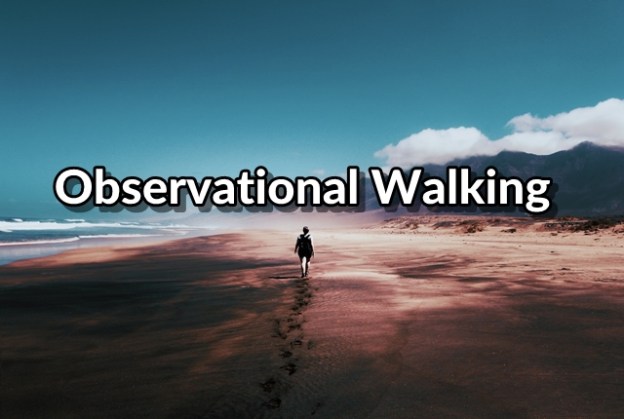
Observational walking is one of my favourite ways to de-stress and free my mind so I can focus in on my creative writing without distracting thoughts.

I also find it helps me if I am feeling a bit stuck, or just not sure how best to proceed with a story.

I am lucky that I live in the west of Ireland in the countryside and near the sea, so there are plenty of peaceful walks.

However, I have done this on city walks and in parks, so don’t let your surroundings stop you using this powerful tool.

Observational walking is a form of meditation and is not complicated.

You are simply walking at a pace where you can be aware of sounds and can carefully observe your surroundings.

A SLOWER PACE

old drawing of a sad man walking illustrating an article about observational walking.The pace might be considerably slower than your usual walking pace, so if you do a daily exercise walk you can do some observational walking as a warm up or slow down stage.

The key is being aware; listening and observing.

Listen for the sounds as you walk, whether that be birds singing, dogs barking, children playing, traffic, chatter.

It doesn’t matter, just listen and be aware without judging the sounds and without thinking about them.

THAT WANDERING MIND

If you find your mind begins to wonder about the source of the sounds, or other distracting thoughts then simply focus on your breath for a moment.

Each time you are distracted return to focusing on your own breath.

It doesn’t matter if you are distracted, or if your thoughts run away – you can return to focusing on observing your breath at any time.

This will provide the empty spaces in your thoughts and allow your inner creativity to emerge.

As you walk along let the sounds and sights you see come to you – rather than look around for them.

Again without judging or thinking – just quietly observing.

Observing your surroundings clears a space in your mind for creative writing ideas –  it also means you remember a great deal more.

The most trivial observation can grow into something much, much bigger.

This morning, for example, I noticed a woman stepping on a crack in the pavement. If I wanted to develop this further it might go as follows:

Mary walked quickly. She mustn’t have been superstitious, or else she didn’t notice a crack in the pavement. She didn’t slow down, and she didn’t step around it.

Jack noticed it.  Jack also noticed the small metal square embedded in the dirt. He snatched it up and dropped it into his briefcase before Mary had even walked the short distance to the edge of the footpath.

Okay so it’s not amazing but it is something. – a germ of an idea.

An idea that could be developed in a multitude of ways.

Creative writing activities such as observational walking clear the mind for ideas.

You can create anything. Even from a simple crack in the pavements like I did.

Or perhaps a strangely shaped cloud, or even a name carved in a tree or even oyster-beds in a bay.

In this newly created space in your mind ideas are allowed to form and emerge.

When you have a new idea always ask yourself what if? Here are some examples:

WHAT IF

One morning while I was out walking my dog paused to stare at a trampled trail leading to a hole in a field. I knew it was a fox hole having seen plenty of foxes in the area on previous occasions. But…what if it wasn’t a fox hole…

WHAT IF

The hole had been made by someone desperately trying to escape from something.

Or

If it was a portal to another realm.

Or

A shortcut to a children’s hiding place

Once you slow down and pay attention to your surroundings you will start to see a lot more than grass or footpaths.

There is a whole world out there ready to hand you ideas on a plate  all you need to do is stop for a moment and take a look.

‘Imagination is more important than knowledge. Knowledge is limited. Imagination encircles the world.’

Albert Einstein

Source: practicalcreativewriting.com

Visit us at First Edition Design Publishing

Author Up Close Series: Learning From Successful Authors

Though you may not know it by the prevalence of clickbait headlines sounding the death knell about author careers, successful authors are out there. Lots of them. And I’m not just talking about the ones who top the bestseller lists week after week. I’m talking about the authors whose names you may have never heard, who are quietly writing and earning income from their books.

And while there is no formula for becoming a successful author, or even a consensus about what defines “success,” there is much that can be learned from studying authors who are already where we hope to be one day. I’m fortunate to know several of these authors. I’ve had the benefit of their wisdom and expertise for years and wanted to share some of that wisdom with you. So this year, in my posts for Writer Unboxed, I’ll be sharing Q&A’s from authors I think we can all learn from.

My series, Author Up Close, will include Q&A’s with two of Writer Unboxed’s own: Anne O’ Brien Carelli, whose middle-grade novel was published by Little Bee in 2018; and Linda Seed, a contemporary romance author who had so much success self-publishing, she was able to leave her 9-5 to write full time. The series will also include interviews with Roger Johns, a traditionally published author who found himself in the enviable position of having to find an agent after being offered a publishing deal, and Vanessa Riley, a Ph.D. in mechanical engineering who writes multi-cultural Regency and historical romances in an industry that (falsely) believed there wouldn’t be a large enough audience for her work.

Author Up Close begins with a Q&A with Fiona Zedde. Fiona is the author of several novellas and novels including the Lambda Literary Award finalist Bliss. Her novel, Dangerous Pleasures, won the About.com Readers’ Choice Award for Best Lesbian Novel or Memoir of 2012. Fiona lives a location-independent lifestyle, traveling and sometimes living abroad for months at a time. As you’ll discover from our Q&A, her ability to adapt to changes in the industry has been key to her success as an author.

GW: You’re what the publishing industry considers a “hybrid author.” Was this an intentional strategy you adopted when you first launched your professional writing career or is this something that evolved?

FZ: This “fingers in different pies strategy” slowly took shape over the years. I started off working with a single New York publisher back in the mid-2000s and stayed that way for a good ten years while also working a corporate job. After a few changes and setbacks, which included leaving my 9–5 and being released by my NYC publisher, I realized I needed to do things a little differently if I wanted to continue writing and publishing.

Luckily, I soon received the opportunity to work with another NYC-based publisher (different genre and different name). I also eventually regained the rights to my backlist. At the suggestion of new author friends, I republished these novels myself. Once the backlist books became available again, readers began asking for sequels, and so I wrote and published a collection of short stories, some following the characters from the previously published books. That led to a full-length novel published last year.

These days, I work with a few different publishers as well as self-publish.

GW: In many respects, you’re living the dream as a writer who makes a living writing and who is location independent and travels the world. What are the key decisions/choices you’ve made in your career to make this lifestyle possible?

FZ: I think one thing I’ve done is remain open to different opportunities and open to change. The business of writing and publishing shifts quite a bit. Strategies that worked two years ago may be completely useless now, or vice versa. If I see that—despite marketing efforts and other factors—a writing name of mine is no longer doing well, I’m willing to scrap it and begin a new name, explore a new genre, and/or submit to different publishers. I also submit to short story anthologies every once in a while in hopes of finding a new audience or coaxing back readers who’ve lost touch with my work over the years.

GW: What are some of the challenges you’ve run across in within the publishing industry? 

FZ: One of the biggest challenges for me has been gaining readership outside of my black, female audience. Black readers dive into books of whatever genre they enjoy, despite the race of the author. Black writers aren’t afforded that same courtesy by a majority of non-black readers. At general, multi-author book signings, it’s interesting to see white readers move like water around a rock past the tables belonging to black writers, their gazes fixed on the next available white face.

My other challenge is marketing. I need to get so much better at that.

GW: Finally, what advice would you give a newbie writer who one day wants to be doing what you’re doing?

FZ: Network. Talk to the people already working the way you dream of working. Ask questions and listen carefully to the answers. At the beginning of this writing thing, I felt like I was doing everything on my own and didn’t think I had a community to turn to.  Now, I’m better at asking for help and advice as well as taking part in community, but it took me a while to get here.

You can learn more about Fiona and her writing, by visiting her at FionaZedde.com. Many thanks to Fiona for allowing me to interview her for this piece.

Over to you: what is some of the best advice you’ve received from your successful author friends? 

By

Source: writerunboxed.com

Visit us at First Edition Design Publishing

Sunday Writing Tip: Make Sure Your Scene Endings Hook Your Readers

Each week, I’ll offer a tip you can take and apply to your WIP to help improve it. They’ll be easy to do and shouldn’t take long, so they’ll be tips you can do without taking up your Sunday. Though I do reserve the right to offer a good tip now and then that will take longer—but only because it would apply to the entire manuscript.

This week, check how you end each scene and/or chapter and make sure you’re giving readers a reason to turn the page.

A scene break or chapter ending is a natural place for readers to put down a book, and sometimes we write it that way without considering the downsides. Characters go to sleep, they leave for a journey, they settle in to wait—they at in ways that say “pause the story here” in some way.

But when we end a scene with something that must be known—readers keep on reading. Readers who can’t put a book down even when the scene is over or the chapter has ended are ones who are going to rave about your book the next day (while yawning from lack of sleep).

Look at the ending of your scenes and chapters. Do they end with something to keep readers reading? Not just the last line, but the situation or need int he novel itself? Is there something going on readers want to see? Need to know? Must read the outcome for?

If not, tweak, trim, or shift so the break happens in a spot readers won’t be able to stop on.

By Janice Hardy, @Janice_Hardy

Source: blog.janicehardy.com

Visit us at First Edition Design Publishing

 

WITS Throwdown: Putting the “Social” in Social Media

The real title of this post is How To Put the Social in Social Media Without Losing Your Mind or All Your Free Time.

That’s a heavy promise, right? Social media does like to suck up valuable family time, writing time, down time. If you think about it as a big vaccuum that gives nothing back, you WILL be resistant to this whole “online social thing.”

This post is about how pick your online locations carefully and develop habits that help fit social media into the life you actually have. It’s about how to make connections during the time you choose to spend online. And of course, I share what I do to keep my love alive.

We’ve had two posts in this throwdown already. One from Fae, who pretty much detests it. One from Julie, who has found the one place in social media that doesn’t give her hives makes her happy.

Those two are introverts, whereas Laura and I are extroverts. All four of us have different stances on this topic. Even on the extrovert side, Laura is retired and I work more than full time.

Translation: I have two part-time day jobs that sometimes expand to three, plus writing, plus volunteering, plus an eight year-old. (Plus a very understanding husband.) Many things in life are more important than my writing and I’ve had to learn to be okay with that.

It was hard to let go of perfection and my yen to Fast Draft, but there are rewards from my overburdened schedule. A big one is my time-saving social media habits, which I will detail at the bottom of this post.

Important Note (like super-duper important): Taking the “social” out of social media defeats the entire purpose. You will resent all that wasted time. (At least I would.)

If you’ve hung out at WITS for a while, you’ve heard me wax rhapsodic about social media before. Below are several of my posts that will give you all the how-to and “what the heck is it” info you might want.

The above links are pretty big picture but there are also specifics to be had:

We’ve also had stellar tips for not getting overwhelmed on social media from veterans like Roni Loren who gave this sage advice: Only focus on the things that sizzle your bacon. Also, Colleen Story shared 7 Ways to Keep Social Media from Ruining your Mood.

And then there is little ol’ former technology-trainer me. I have a confession that won’t surprise you… I freaking love software and apps.

Love. Them.

I love the time-saving tools (although it’s super hard to beat my own kitchen timer for time management). I love the way technology connects people. I love the way Excel’s pivot tables summarize thousands of records into a table the size of your hand.

Technology is just cool.

However, time is in short supply and I’ve had to shoehorn social media into the schedule. Remember that promise from up top: How To Put the Social in Social Media Without Losing Your Mind or All Your Free Time ?

Here are my Top 5 “fit it in no matter what” social media tips:

1. The biggest trick I have is using the “in-between” time. In the long check-out line, or waiting in the doctor’s office. Waiting in the car line to pick up my kid. While I eat lunch. Just before I go to bed. While my kid reads to me (with my phone hidden from her view so she isn’t aware she only has half of my attention).

All those in-between moments add up. You’ll at least get 30 minutes a day. You can do a lot with 30 minutes! Plus, you’ve turned those boring “waiting” moments into something that is a reward (at least for me). Boorah.

2. Planning is everything. Some of your time will just be spent scrolling, liking, commenting. But a smart author plans out the week or the month, so the important updates get out now mantter how busy you are.

You can do a ton of graphics in less than an hour each week if you use Canva. Laura Drake explains how to own Canva.

3. Decide who your audience is and focus your time in their neck of the online world.

I love what this article at Contently has to say – it’s a few years old but it’s still pretty accurate.

Let’s talk strategy. You have limited time, maybe limited content, and there is a very specific audience you want to reach. Here’s a quick, non-scientific breakdown of who uses which network:

  • Teenagers gravitate towards Snapchat, YouTube, Tumblr, and Instagram.
  • Soon-to-be-wives and soon-to-be-moms are all about Pinterest.
  • Young parents and grandparents alike can be found on Facebook.
  • Business types and leaders rule LinkedIn.
  • Influencers and bloggers love Twitter, WordPress and Tumblr.

Here’s an infographic with my thoughts on the main social media apps out there. (Yes, I totally think Facebook is a huge time suck.)

Made in Canva…in about 8 minutes.

4. Set up Google alerts. You want the content you are passionate about to come to you so you don’t have to spend time chasing it down. No one has time for that. Google Alerts email the info right to you.

To set up one (or ten) of these handy alerts:

  • Go to google.com/alerts in your browser.
  • Enter a search term for the topic you want to track. As you enter your terms, view a preview of the results below.
  • Choose “Show Options” to narrow the alert to a specific source, language, and/or region. Specify how often, how many, and how to receive alerts.
  • Select “Create Alert.”

5. Don’t be afraid to schedule. Especially during busy weeks, when I don’t have time to both post AND monitor, scheduling tools let me “have it all.” I go back and forth over whether I like HootSuite or Buffer better, but here is an article that compares them both. I also used Social Oomph for a while.

Overall, I’m super happy with social media. I don’t use all the tools I’d like to use, and I always feel like I’m swimming up stream in terms of time, but notifications and alerts allow me to at least keep up with the people who are interacting directly with me. I count that as a win.

More than anything, your time online needs to be fun and productive. Find your tribe and enjoy them. If your time online is fun, you’re less likely to resent it or view it as wasted.

Now it’s your turn! Introvert or extrovert? Social media lover or hater? And what are the tricks that have allowed you to fit it into your busy schedule?


By Jenny Hansen

Visit us at First Edition Design Publishing

How Writing and Submitting Short Stories Improved My Novel

If you’re writing a novel and are nowhere near the end, why spend time on short stories? Doesn’t that distraction delay getting to the end of the current draft, a moment that always feels months away? I thought so once. One year, I wouldn’t let myself touch any other project until I’d worked on my novel every day. This lasted five months until I revisited “The End.” Again.

Why should a novel writer devote precious writing time to short stories? After five novel drafts, two years of submitting shorter fiction, and seven publications, here are my reasons.

Do Something With All Those Ideas

Not every idea deserves a novel. And there’s something cathartic about expressing an idea soon after inspiration strikes. I’m not holding my breath and suffocating the idea because I have to focus elsewhere. As powerful as some ideas feel in the moment, most are quite happy as short stories or flash fiction or poems, or being expressed at all. I now tend to start each idea in the shortest possible form. I only expand the word count if my gut and reader feedback suggest there’s more to say. In the meantime, I grow my list of stories and drafts, not only my list of ideas.

Understand the Impact of Every Edit

An effective edit rarely moves me in the same way as what inspired the story. Revising a longer work can be a dreary process because it’s difficult to grasp the impact of my efforts. This is not the case with flash fiction. Try changing a word in a 100-word story, swap sentences in 250 words, or drop a paragraph among only 1,000 words. You’ll notice an immediate impact on the entire piece. This inspires me toward better revisions by reminding me how powerful each change can be.

Feel A Sense of Completion More Often

Novel drafts take months or years to write. Short story drafts can take weeks. Flash fiction, anything under 1,000 words, can be even briefer. I’m not saying shorter work is easier to write, or requires any less thoughtful revision. But the satisfaction of reaching the end of a draft will happen sooner with shorter fiction. This can prevent listlessness after always having the same answer for “what are you working on?”

Practice Finding Comps

I read every market to which I submit. If I want a literary journal to publish my story, I not only follow their submission guidelines, but I prove I’ve engaged with what they’ve published. I do so by including the stories I read and liked in my cover letter to the editor. If they overlap with my subject matter or appeal to a similar audience, all the better.

In practice, this is akin to finding comparative titles, or comps, for a novel and citing them in your query letter. Prove that you’re thoughtful and have an understanding of the market.

Strengthen Your Query Letters

Every market where I’ve submitted short fiction requires a cover letter. Writing cover letters has taught me how to address editors, present myself, discuss my work, and highlight my accomplishments. This builds confidence in writing and revising query letters to literary agents. Growing my publication history also strengthens my credibility for the next stage of my writing journey.

Give More Than One Story A Chance

I no longer believe I have to withhold myself from other creative work to finish an ambitious project like a novel draft. Novels do take intense focus and persistence, but the reasons above led me to a new strategy.

I’m currently working on a novel during the weekdays and shorter projects on the weekend. This means that by default, the hardest thing gets the bulk of my time. Sometimes, my weekends are writing-free and the stories have to wait, but I’m always making progress.

Though my novel may take a while before it’s ready, all those shorter pieces are out there, being submitted, rejected, accepted, and in any case, read. Don’t withhold your words from the world because your magnum opus isn’t ready.

What’s been your experience juggling short and long projects?
Do you avoid multiple ongoing things at all cost?
How has one form of writing informed another?


Source: writerunboxed.com

Visit us at First Edition Design Publishing

4 Ways to Make Your Writing Easier


Why Do We Say that Writing is Hard?


I don’t think writing is hard – wooden tables are, gemstones are, and sometimes my head is, but writing? No.

It’s as simple and complex as having an idea, putting words together, adding the thoughts or feelings, linking to the research, and using keywords for SEO.


4 Ways to Make Your Writing Easier Two Drops of Ink Marilyn L. Davis


1. The Idea is the Starting Point


If you’re writing a blog about a particular subject, you’ve always got an idea. Can you present it from a different perspective? Are you an expert on the topic? Do you have credibility when it comes to that subject? If you’ve answered, “Yes”, then maybe you’re just bored with the idea.

That happens. How many times can I write, “Recovery works” to try and encourage someone struggling with their addictions? So far, I’ve filled a lot of pages on my other blog with exactly that same message.

In all fairness, not more than 5% of the posts literally include the words, “Recovery works”, but in each of these 185 posts, that’s the underlying message or idea.

Yet, each post is presented from a different viewpoint, or for some, it’s because I wrote from the perspective of depth rather than breadth.

Breadth and depth each had distinct advantages. With breadth, I can write an overview of the idea. With depth, I’ll isolate one key element after a general statement of intent and elaborate on that aspect.


2. What are the Thoughts and Feelings about the Idea?


Much of that writing entails describing thoughts and feelings; it’s personal to me, but judging from the comments, my experiences with the topic are commonplace.  So the idea of addiction and recovery have an already established audience. Now, it’s my job to take the idea and make it fresh and new.

One of the easiest ways to get readers interested is to ask questions. So far, I’ve asked four and will ask more before I’m finished. Why? Because I know that what I think, feel, or know is limited to my experiences and there are other people out there who can supply additional information that I might find useful.

So now that boring, “Been there, done that” idea is open to others, and sometimes the What’s In It For Me principle factors here – the readers get to let me know how much they know about the topic.  I don’t know how many other posts a reader’s comments have generated, but a fair number.

Beyond my interest and a reader’s interest, there’s always room for research.


3. What Are Valuable and  Interesting Research Links?


4 Ways to Make Your Writing Easier Two Drops of Ink Marilyn L. Davis

For some of us, the idea of research sounds like the library desk with musty, dusty tomes all opened to various pages, sticky notes protruding from them, and 3 x 5 cards littering the table.

Not today. Research is a key element in any post. Why? Because it validates your argument, presents reliable information by experts on the topic, references a quote that summarizes your topic, or lends credibility to your idea.

But too many people get careless in their links – the old Wikipedia will have something about it. Delve deeper than that. If you’re going to use Wikipedia, research the references and see where that leads. I’ve used the referenced sources before and been pleased with the linked information.

Links within also lend authority to any post.  They can be external or internal. If you write on a collaborative site, like Two Drops of Ink, then see what your co-writers have to say about the topic.  You’ve added a valuable link and given them some additional exposure for their writing.

I know that two of our monthly contributors, Noelle Sterne and Peter B. Giblett will always give links that let me know more about their chosen topics. I’ve yet to find a link in any of their posts that didn’t add value.

All of these links help with your SEO as well. And while we may not always understand the algorithms that Google uses, SEO is always a factor in getting your post noticed. Click To Tweet


4. Can You See Me Now?


4 Ways to Make Your Writing Easier Two Drops of Ink Marilyn L. Davis


How many of you have searched for yourself or your blog? Confession, I have. And if I’m simply looking at Marilyn L. Davis, boy do I rate. However, that’s not really how most people know me. It’s the same for your blog or business. You may find yourself, but is that how the average person is looking for your site or posts? Probably not.  Granted, some names are forever embedded in our brains. Think of all the major brands.

But since most of us aren’t a major brand, how do you get your name or blog to rank on the first page of Google? Eric Enge, general manager of Perficient Digital simplifies the problem.

“Google algorithm updates in 2018 revealed that Google is intensifying its focus on evaluating the content quality and at the depth and breadth of a website’s content, said Eric Enge, general manager of Perficient Digital.

“We tracked the SEO performance of a number of different sites,” Enge said. “The sites that provided exceptional depth in quality content coverage literally soared in rankings throughout the year. Sites that were weaker in their content depth suffered in comparison.”

It’s critical to understand your readers wants and needs, and to write posts that satisfy them. Jesse McDonald, SEO specialist and director of operations for Fully Integrated Enterprise SEO Agency – TopHatRank.com. states, “It will be more critical than ever for SEOs and content specialists to focus heavily on the user intent of the keywords they are targeting while creating content,” McDonald said.

But how do you attract new readers? By understanding how people use Google, Bing, Quora, or other search engines.

Expanding on the Keywords

A big trend now is the Keto diet. Google that and you get inundated with hits. So that’s a safe keyword. But a better site will include Keto:

  1. Recipes
  2. Hidden pitfalls (of Keto)
  3. Foods allowed  (on Keto)
  4. Foods to avoid (on Keto)
  5. The science (of the Keto diet)
  6. Lose weight (with Keto)
  7. … and more.

In the WordPress editor, you can add categories and tags. So for the above, I’d add all the other aspects and probably attract readers who wanted more in-depth information, not just Keto diet.

Yoast Plug-in is a Second Set of Eyes

Yoast is a plug-in for a WordPress site. It also has an editor that gives you insight or frequently used words in your post. This also helps you determine keywords and where to strategically place them:

  • In the title – near the beginning
  • Throughout the post
  • Only where relevant

Check all the features of Yoast before you publish. There’s a lot of tips, edits, and suggestions that help improve your writing, as well as giving you a list of internal links from your site that would add value to the post.

And it’s always nice to get the little green dots – means something is right.

Will They Understand This Post? 


4 Ways to Make Your Writing Easier Two Drops of Ink Marilyn L. Davis

Besides the SEO, Yoast will give you a readability score. This number is based on:

  1. Flesch Reading Ease
  2. Passive Voice
  3. Consecutive Sentences
  4. Subheading Distribution
  5. Paragraph Lengths
  6. Sentence Length

And don’t forget that images offer you one more place to add keywords in the ALT text. Since search engines can’t see an image, these words act as a point of references for the search engines.

For instance, all the images for this post include the name of the post, Two Drops of Ink, and my name.  As an aside, I remember looking for an addiction image on Google, and up popped one for From Addict 2 Advocate. That reinforced the message that images are advertising in the background. Use them.

With just these four tips, you can make your writing relevant to your readers, add additional perspectives, find valuable links, and get Google’s attention.

Simplify, share your perspectives, do your research, and give your readers value in your posts.

See, it’s not hard at all.


By Marilyn L. Davis
Source: twodropsofink.com

Visit us at First Edition Design Publishing