3 Artistic Truths Writers Can Find in a Miami Museum

Last week, I was able to escape the bomb cyclone and travel to Miami. Before you get too jealous, Florida was also experiencing an unusually cold week, and any time spent on the beach involved a sweatshirt and a blanket!

The Writer's Studio: 3 Artistic Truths Writers Can Find in a Miami Museum

Lucky for me, Miami has much more than its famously beautiful beaches. Its city energy is on par with New York and people travel from all over the world to eat authentic Latin food and experience the art scene. There were tons of museums and exhibitions I could visit (and take shelter from the cold!).

3 Artistic Truths Writers Can Find in The Everywhere Studio

One of the (free) exhibitions I visited in Miami was called “The Everywhere Studio,” which is on display at the brand new Institute of Contemporary Art. During my visit, I couldn’t help but be reminded of my own writer’s journey, The Write Practice, and all of you. Here’s why.

1. The Everywhere Studio recognized that art can be work

One of my favorite pieces of The Everywhere Studio was a video of a man bouncing in a corner like a bowling pin glued to the ground. It was redundant. It was banal. It was, according to its description, a “performance of endurance [that] invokes the idea of art as a form of labor, and not merely creative expression.”
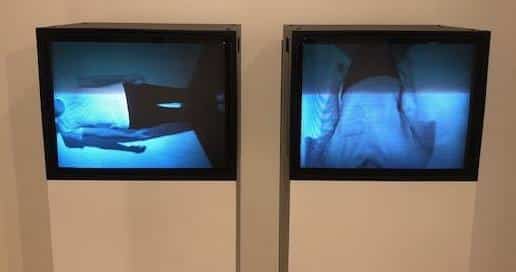
Photo of The Everywhere Studio at ICA Miami, courtesy of Monica Clark.

Many times writing is a blast, but other times, we’re literally just trying to meet a deadline or reach our daily word minimum and it’s just work. Or worse, it’s actively boring.

But at The Write Practice we embrace this part of writing as practice because it’s how beginners become good writers, and how good writers become great writers. We know that those moments are an inevitable stop on the road to greatness (or at least completion).

2. The Everywhere Studio had a wall of journal entries

I think most writers would have gravitated toward a grand display of one artist’s thoughts and ideas and doubts and mantras.

Is the journal not the quintessential writer’s studio?
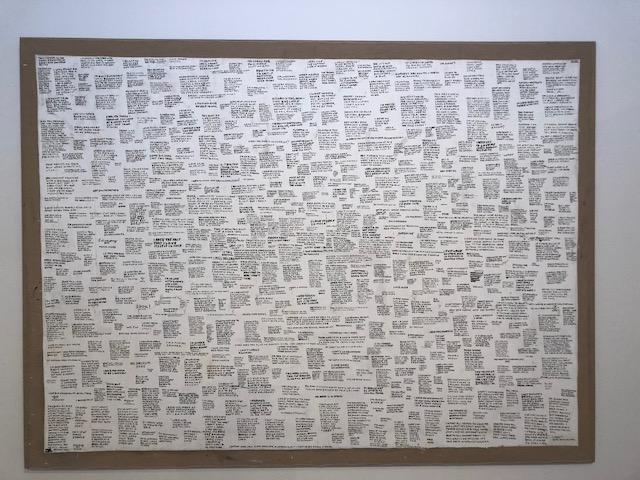
Photo of The Everywhere Studio at ICA Miami, courtesy of Monica Clark.

The intro to the The Everywhere Studio noted that the term “studio” has evolved such that many artists can’t point to a physical location where all the art happens. We’re increasingly mobile. And rent is expensive! To me, the journal is a great interpretation of the writer’s “studio.” It’s personal, it’s a mess, it’s incomplete.

Also, I think we all can relate to this gem (a close up of the above piece):
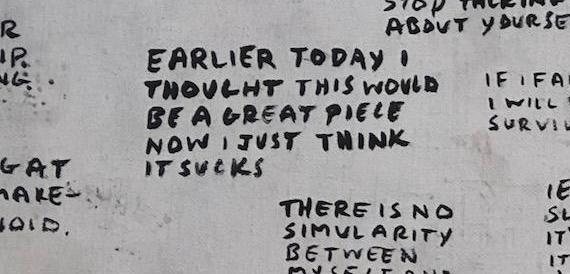
Photo of The Everywhere Studio at ICA Miami, courtesy of Monica Clark.

3. The Everywhere Studio created a sense of community

For many artists, especially writers, the process of creating can be a solitary one because often you’re literally alone.
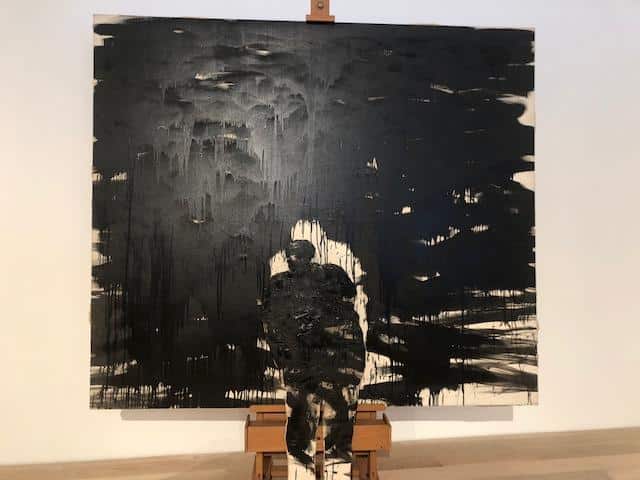
Photo of The Everywhere Studio at ICA Miami, courtesy of Monica Clark.

But there are actually a lot of people out there who can identify with the ups and downs of the creative process, which I remembered while visiting The Everywhere Studio. Strolling through the museum, I found myself able to relate to many of the artists’ studio interpretations, which was comforting.

Photo of The Everywhere Studio at ICA Miami, courtesy of Monica Clark.

Writers conferences and writing groups are great for finding this sense of community. So is The Write Practice. 🙂

The Art of Museums

Visiting The Everywhere Studio was a fun opportunity to look at my art and my writing in a different way. If you haven’t recently, I’d encourage you to visit a museum or exhibition near you. Don’t limit yourself to learning about just other writers: challenge yourself to find connections between writing and all the other kinds of art and creation you see.

Who knows what new inspiration you’ll discover?

Photos of The Everywhere Studio at ICA Miami are courtesy of Monica Clark.

What museums have inspired you? Or, what’s your writer’s studio? Let us know in the comments.

All the images are taken from https://thewritepractice.com/writers-studio/?hvid=1XdbkC

By Monica M. Clark
Source: thewritepractice.com

Visit us at First Edition Design Publishing


How to Revise Your Story Like a Pro

It’s suddenly 2018. Have you set an awesome writing goal for yourself this year?

I have, and I’m incredibly excited about it!

For some of us, that goal involves writing something brand new.

But for most of us, our 2018 writing goals probably involve rewriting a work in progress. It’s a draft, roughly complete or unfinished, that never seems to be “done,” no matter how much we tinker with it.

There’s a reason we get stuck in these perpetual works in progress. And if we don’t figure out how to overcome it, we might find ourselves in the same sticky mess 365 days from now.

The Myth of Revision

In secondary school, we are taught the writing process: Plan, Draft, Revise, Proofread, Publish.

As a secondary teacher, I face the most resistance from my students in that third step: Revision.

The first reason why is that we simply don’t want to do it. Revision isn’t nearly as enjoyable as creation, or as easy as correcting surface errors. Plus, it can be overwhelming, leaving us wondering if we even know how to revise a story.

But the second reason why we resist is the word itself, “Revision.” It’s a misleading term. It doesn’t really exist.

What we really have to do when we revise is rewrite.

And no one wants to rewrite, because rewriting is painful.

Demo Day

To properly revise, we have to identify that our existing creation is deeply flawed.

And while it may have been beautiful once before, it is negatively affecting the story around it.

Much like the Demo Day scenes in our favorite HGTV shows, we can’t simply work around the flaws. They’re affect everything else too directly, and have to be taken out with a sledgehammer.

Yet we don’t want to do it. We feel like we’re hurting the ones we love, or “our babies.”

Revision can literally feel like betrayal and death, because we have to accept that our creation, something that we have lovingly cultivated, must be destroyed.

Is it possible to keep parts of our old creation and rebuild around it?

Yes, but it’s surprising (and depressing) how seldom this works. Odds are, if a chapter, paragraph, or sentence isn’t working, it has to go.

Ouch.

Saving Our “Children”

Here’s the good news: Our creations don’t literally have to die.

Instead, they should get added to a “storage” document. When I was writing my novel, The Bean of Life, I was swinging my editorial sledgehammer like Chip and Joanna after drinking a case of Red Bull (my wife watches a lot of Fixer Upper).

Yet every one of my beautiful creations, my little narrative children, was carefully cut and pasted into my “TBoL Storage” document. For each stored bit, I labeled it with a bookmarked heading so I could easily find it if needed.

And you know what? I used it. There were many times I went back into that document and rescued a sentence or phrase that still had a role to play in the story.

But to be honest, I don’t remember 95% of those bits in that storage document (which is 50,000 words long). I’ve forgotten them, mostly because they were ultimately forgettable.

So here’s a tip for how to revise your story: do yourself the loving favor of protecting your creations. Never hit the “Delete” button (unless it’s just a typo). Always cut-and-paste your creations into storage, where they will be safe.

Enlightened Rewriting

To truly revise our work in progress and bring it to a state of “done,” we must rewrite it — often from a blank page one.

This doesn’t sound fun, and it will certainly be a lot of work.

But this new creation won’t feel anything like the first time. A first draft is like hacking our way through dense, dangerous jungle. This draft will be like climbing the stairs of an ancient temple where an enlightened monk awaits us at the top.

Here’s why you need to rewrite on a blank page: A crowded page is a prison; a blank page is freedom.

Trying to work within the confines of our old ideas and rigid prose does not provide the creation freedom that we need.

We need space. We need opportunity.

Maybe a blank page is something you find intimidating. No problem. Keep an important piece of description, or a line of dialogue, to spark your creativity. Give yourself a launch pad.

But remove the shackles of yesterday’s ideas.

It’s a new year, a time for new ideas. And it’s time for a major breakthrough on that perpetual work in progress.

Rewrite With Confidence!

Every old draft is a massive lesson that teaches us about our stories. The fact that we didn’t “get it right” doesn’t make us failures — it makes us artists. Art is failure of a very persistent nature. Some of the best pieces of art in the world were regarded as failures by their creators and contemporaries, and now are revered and copied.

So (re)write this year with confidence!

If your goal is to build the habits and mindset of a successful storyteller, this is a crucial step to take. We have to be able to put old ideas aside, learn from them, and take risky steps forward. Otherwise we will be stuck in a prison of the past, forever fearing the touch of the creative sledgehammer and its wonderful power.

What do you think? Can you revise, even on a crowded page, filled with old ideas that might not be working? Or do you prefer the freedom of an empty page of unlimited possibility?

What steps do you take to revise your stories? Let the community know in the comments!

By David Safford
Source: thewritepractice.com

Visit us at First Edition Design Publishing
Creative Writing Prompts for the Young at Heart

Today’s post includes a selection of prompts from my book 1200 Creative Writing Prompts. Enjoy!

Stories and poems for children are among the most magical and delightful written works in the literary canon.

Children’s literature has a universal appeal; the phenomenal international popularity of the Harry Potter books and movies is a testament to the power of children’s stories.

But there are plenty of other works that affirm the longevity of children’s literature: nursery rhymes, fairy tales, and classics such as Where the Wild Things Are, Goodnight Moon, and everything Dr. Seuss ever wrote.

Most of us writers first fell in love with the written word when we were children. Stories carried us on fantastical adventures. Words danced and soared through our imaginations. Many of us never grew out of the poems and stories we first cherished. We continue to enjoy them, and we pass them on to our children, grandchildren, nieces, and nephews.

Today’s writing prompts celebrate children’s literature and pay tribute to the young and the young at heart.

Writing Prompts

These writing prompts are filled with childlike wonder. Use them to write a poem, a story, or anything else that comes to mind.

  1. Children’s stories sometimes try to help kids solve difficult problems. Write a story about children overcoming nightmares, getting potty trained, wetting the bed, losing a pet or grandparent, or attending the first day of school.
  2. At the height of human technological development, a special child is born who can communicate telepathically with computers and other mechanical and electronic devices.
  3. Write a poem using the following image: a child sitting alone on a bench in a schoolyard.
  4. After learning his or her parents are struggling to make ends meet, a child prodigy decides to fix the family’s finances.
  5. Write a story about a child and his or her imaginary friend.
  6. A child living on a farm or ranch can hear the thoughts of animals—both the livestock and the local wildlife.
  7. Write a poem using the following image: a child giving another child a piggyback ride.
  8. While digging in the garden, a child finds a magic ring that makes any wish come true.
  9. It’s important for children to learn the alphabet. Write an ABC book. You can write a separate vignette for each letter, write a story linking them all together, or write a nonsense rhyme for each one.

Some Tips for Using These Writing Prompts:

  • Children’s writing uses simple language and made-up words.
  • Nothing speaks to children like bright, vivid images and lively characters.
  • Use rhyme and other musical devices and choose words that are fun to say.

Do you still read children’s poems and stories? Do you remember the ones you loved best as a child? Have you ever tried writing for kids? Do these creative writing prompts inspire you? Share your thoughts in the comments, and keep writing!

By Melissa Donovan
Source: writingforward.com

Visit us at First Edition Design Publishing

Critiques Make Your Writing Better, So Grin and Bear Them

Today I’d like to share an excerpt from my book 10 Core Practices for Better Writing.

This excerpt is from “Chapter Seven: Feedback,” which offers tips for giving and receiving critiques as well as coping with public criticism. The excerpt I’ve chosen to share today explains how to use critiques to make your writing better, and it also touches on dealing with difficult critiques.

“Criticism may not be agreeable, but it is necessary. It fulfills the same function as pain in the human body. It calls attention to an unhealthy state of things.” – Winston Churchill

There are two schools of thought about whether critiques of your work are beneficial.

One school of thought says that art is subjective; a critique is nothing more than someone’s opinion, and critiques might harm the artistic integrity of your work by interjecting someone else’s ideas and visions into it.

The other school of thought says that art may be subjective, but other people’s opinions matter and can actually be helpful. Writers may be too close to their own work to view it objectively, so a second opinion reveals strengths and weaknesses that the author simply can’t detect.

In my experience, when approached thoughtfully, critiques do far more good for your writing than harm. In fact, a critique can harm your work only if you let it, and let’s face it: ultimately, you’re the one who’s responsible for what you write.

It’s true that a critique is mostly someone else’s opinion about your work. But critiques also include ideas to improve your writing—ideas that may not have occurred to you. Additionally, a good critic will point out mechanical errors—grammar and spelling mistakes that slipped past you.

Critiques are designed to help writers, not to offend them or make them feel incapable. But the human ego is a fragile and funny thing. Some folks simply can’t handle the notion that despite all their hard work, the piece they’ve written is less than perfect.

As a writer, you have to decide whether you truly want to excel at your craft. If you do, then you need to put your ego aside and learn how to accept critiques graciously. If you can’t do that, there’s a good chance your writing will never improve and your work will always be mediocre.

Critiques are not tools of torture. They are meant to help you. If the critique is put together in a thoughtful and meaningful way, it should lift your spirits by pointing out strengths in the piece, but it should also raise some red flags by marking areas that need improvement.

Usually, critiques sting a little. That’s okay. Sometimes, you’ll get lucky and your suspicions about what is weak in your writing will only be confirmed. Other times, you’ll be surprised that the critic found weaknesses in parts of the work that you thought were the strongest.

Whether a critique will be beneficial or harmful depends entirely on you. Obviously, nobody can make you change what you’ve written; it’s up to you to pick and choose what you revise.

Tips for Accepting Writing Critiques and then Writing Better

With practice and by following the tips below, you’ll learn how to overcome your own ego; how to obtain a beneficial critique, evaluate it objectively, and apply it to your writing thoughtfully; and for all that, you’ll be a better writer.

  • Find someone who is well read, tactful, honest, and knowledgeable about writing. If you can find a critic who possesses all these traits, then you have overcome the first hurdle, because such persons are not easy to find.
  • Polish your work as much as you can before handing it over. Do not send a rough draft to someone who will be critiquing your work, otherwise much of the feedback you receive may address problems you could have found and dealt with yourself. The point of a critique is to step beyond your own perspective and abilities. Note: Some writers get developmental edits or use alpha readers who read the rough draft and then give general feedback on the story or idea. This is not a critique in the traditional sense. It’s more for bouncing ideas around.
  • Don’t harass the person who is critiquing your work by calling them every day, especially if they’re doing you a favor. If you are working under any kind of deadline, plan accordingly.
  • If possible, do not review the critique in the presence of the person who prepared it. The best way to first review a critique is to set aside some time alone. In some cases, you’ll do critiques in workshops or writing groups where you have to be prepared to hear live feedback. In these situations, there is usually an instructor guiding the critiques to make sure they are presented and accepted graciously.
  • You may have an emotional reaction. Some of the feedback may make you angry or despondent. Know that this is normal and it will pass.
  • After you review the critique, let it sit for a day or two. In time, your emotions will subside and your intellect will take over. The reasonable part of your brain will step in and you’ll be able to absorb the feedback objectively.
  • Revisit the critique with an open mind. Try to treat your own writing as if it were someone else’s. As you review it, ask yourself how the suggestions provided can be applied, and envision how they will make your work better.
  • Figure out what is objective and what is personal in the critique. Critics are human. Some of their findings may be technical—mistakes that you should definitely fix. Other findings will be highly subjective (this character is unlikable, this dialogue is unclear, etc.). You may have to make judgment calls to determine where the critic is inserting his or her personal tastes.
  • Decide what you’ll use and what you’ll discard. Remember, the critic is not in your head and may not see the big picture of your project.
  • Thank your critics. After all, they took the time to help you, and even if you didn’t like what they had to say or how they said it—even if the critique itself was weak—just be gracious, say thanks, and move on. Don’t argue about the feedback.
  • Now you can take the feedback you’ve received and apply it to your work. Edit and tweak the project based on the suggestions that you think will best benefit the piece.
  • You can apply the feedback to future projects too. Take what you learned from this critique and use it when you’re working on your next project. In this way, your writing (not just a single project) will consistently improve.

In some cases, you may not have control over who critiques your work. If it’s published, anyone can assess it, and they can assess it publicly. If you’re taking a class or workshop, peer-to-peer critiques may be required. In cases like these, it’s essential that you keep a cool head. Even if someone is unnecessarily harsh or rude in their (uninvited) delivery, respond tactfully and diplomatically.

If you can obtain useful critiques and apply the feedback to your work, your writing will improve dramatically. Critiques are one of the most effective and fastest ways of making your writing better.

Good luck with your critiques, and keep writing. Pick up a copy of 10 Core Practices for Better Writing for more tips and ideas to continuously improve your writing.

By Melissa Donovan
Source: writingforward.com

Visit us at First Edition Design Publishing
 

20 Creative Writing Careers

If creative writing is your passion, then you’d probably enjoy a career in which you could spend all day (or at least most of the day) pursuing that passion.

But creative writing is an artistic pursuit, and we all know that a career in the arts isn’t easy to come by.

It takes hard work, drive, dedication, a whole lot of spirit, and often, a willingness to take big financial risks — as in not having much money while you’re waiting for your big break.

When we think of people who make a living through writing, novelists and journalists come to mind immediately. But what other jobs are out there for folks who want to make creative writing the work that puts food on the table?

The Creative Writing Career List

Here’s a list of twenty creative writing careers that you can consider for your future. I’m not making any promises. You have to go out and find these jobs yourself, but they do exist. You just have to look for them and then land them.

  1. Greeting Card Author
  2. Comic Book Writer
  3. Novelist
  4. Creativity Coach
  5. Writing Coach
  6. Advertising (Creative)
  7. Screenwriter
  8. Songwriter (Lyricist)
  9. Freelance Short Fiction Writer
  10. Creative Writing Instructor
  11. Legacy Writer (write people’s bios and family histories)
  12. Ghostwriter
  13. Travel Writer (if you travel)
  14. Article Writer (write, submit, repeat)
  15. Columnist
  16. Video Game Writer (includes storytelling/fiction!)
  17. Personal Poet (write personalized poems for weddings, funerals, childbirths, etc.)
  18. Playwright
  19. Blogger (don’t tell me you don’t have a blog yet!)
  20. Creative Writing Consultant

I’m not saying you’re going to make a lot of money with some of these creative writing careers. You might have to earn your creating writing income part-time or on the side. But if you do what you love, the money (i.e. the success) just might follow. You’ll never know unless you try, right?

Do you have any creative writing careers to add to this list? Share your suggestions by leaving a comment.

By Melissa Donovan
Source: writingforward.com

Visit us at First Edition Design Publishing
 

Surviving the Newbie Blues

When I was a fledgling writer (and I do mean fledgling), I heard the adage that good writers read–a lot. And being a literary know-it-all with my six weeks of experience backing me up, I scoffed. “Read? Who has time to read? It’s all I can do to write a paragraph without being interrupted by three teenagers or dinner preparations or any one of many other distractions that each and every writer in the world faces.” Poor me. Little did I know back then that I’d condemned myself to Newbieland for as long as it took me to truly understand what writing is all about.

Writing is not romantic, easy, nor is it a profession for the faint-hearted. No one writes alone in a vine-covered garret or the tower of a crystal palace with servants to take care of the mundane things of life–like earning a living if your writing career doesn’t bring in several thousand dollars the first month or so. (That was sarcasm.) Instead, writers spend precious stolen moments honing their craft until life settles down. Maybe that’s when your spouse comes home to watch the kids, or the pizza delivery guy shows up and everyone’s too busy eating their deep-crust pepperoni with extra cheese pizza to pester you, or when the kids go to bed. Maybe it’s early morning or late evening, noon hours, coffee breaks, weekends, and may be, just maybe, it’s not until your retirement years.

My point is that just because I was trying my hand at writing didn’t mean the world would kindly step aside for me to work my genius and crank out bestseller after bestseller. That idea was quashed fairly quickly there in Newbieland where I resided until I’d learned a few hard lessons, including:

1.)  The writing field is jam-packed with talented, ambitious people who more often than not–no, make that always–knew a heck of a lot more than I did. Being a newbie was on one hand thrilling; on the other, terrifying, and I admit I often had the Newbie Blues.

2.)  Nobody has enough time to write. Nobody. Even the successful writers (and you know who you are, Successful Writers, although I imagine you’re not reading this) who consistently hit the bestseller lists probably have trouble with life getting in the way of their craft. Writing is no different than anything else we want to do in life. We need to make time and space for it.

3.)  It doesn’t come easy. Being a new writer means you know enough to know you don’t know enough about being a writer. (Please read that again until it makes sense.) A good share of the time I spent living in Newbieland was spent learning everything I could about writing, and yes, that included …

4.)  Reading! Yes, lots and lots of reading. In a moment I’ll list some of the books that have helped me tremendously, but first I want to tell you that reading anything helps to make you better at writing. It finally dawned on me that I wasn’t going to go anywhere with my raw talent. Just as if I had a great serve in tennis, I wasn’t going to hit Wimbledon right off the bat (or racket, as the case may be), I had to get rid of my bad habits and groom the good ones that others had learned before me. And to do that I had to read their advice in books on that topic or simply read the fiction books they’d written. Speaking for myself, I’ve learned more from reading the books of successful and great fiction writers than I could figured out for myself if I’d worked at it until the day I dropped dead. And by then it would be too late, and I wouldn’t give a rip, anyway. There’s just so much to know and to assimilate into your writing until it’s a habit, that not taking the advice of good authors is just plain silly.

Of course there are many other ways to learn. Critique partners, writing groups, conferences, and classes are just some of them. I concentrated on the reading aspect simply because it’s something you can do for little or no cost, and it’s a pleasant experience. No longer do I think it’s outrageous to think writers need to read everything they can get their hands on. I’ve moved out of Newbieland and I’m looking for a niche in Mightjustmakeitland. It’s still a long shot, but I’ll never get there if I don’t try. I hope I see you along the way.

Before I forget … trying reading Bird by Bird (Anne Lamott), Writing for the Soul (Jerry B. Jenkins), or On Writing (Stephen King). There are thousands of other books out there, most of which are no doubt very good, but I’ve read these three over and over. I also read the novels by Jerry and Stephen and Anne’s other non-fiction books. I learn something from each author and each of their books whether they’re trying to teach me or not. They’re that good.

Source: authorculture.blogspot.com

Visit us at First Edition Design Publishing

How to Achieve Goals: 5 Ways to Stay Motivated and Actually Accomplish Your Goals

The end of the year/beginning of the next one is always exciting. It’s a time to reflect on your accomplishments and prepare for the next ones. But often times, the newness and anticipation of New Year’s resolutions lasts for just a few months before fading away, checklists long forgotten in a dusty drawer. Here’s how to achieve goals and actually maintain your motivation throughout the new year.

acheive goal

5 Ways to Stay Motivated and Achieve Goals

If you want to stay strong throughout the entirety of 2018, here are five tips to help you achieve just that.

1. Set goals for the month rather than the year

That’s not to say year-long goals aren’t important, but “smaller” goals that are easily finished in a short amount of time will give you that rush of positive energy everyone needs in order to keep up the good work.

Think about your long-term hopes and dreams for yourself, such as writing a novel, and break them down into more manageable chunks that you can spread out over twelve months, like writing 10,000 words per month.

2. Write a checklist

Who doesn’t love checking off boxes when a task is completed? Make your list of goals something large, aesthetically pleasing, and visible.

It must be placed where you’ll see it often to remind yourself what still needs to be done and what you have already finished. And if you don’t enjoy looking at it, you won’t necessarily enjoy doing anything off the list, either. Keep it positive!

3. Create consequences

First decide if you are the kind of person who works better under the threat of punishment or the promise of reward. Maybe you work well with both, in which case, even better because you have plenty of flexibility with which to work.

If negative consequences are the way to go, give yourself deadlines for each of your goals. Writers have to work under deadlines all the time, which is a great way to boost productivity when you know someone is counting on you to pull through. But if you are your own boss, you have to come up with your own punishment, too. If you don’t reach the deadline, maybe consider pulling the plug on the television for a while.

If rewards cause you to race to the keyboard with glee, set concrete promises for yourself, such as, “If I finish editing this short story by the end of the month, I will treat myself to a nice dinner and a movie.” When you have a specific incentive in mind, you will be that much more determined to finish what you started.

4. Switch up your setting

If I ever start to feel bored with my usual routine, I pick up my laptop and move somewhere new. This can be as drastic as sitting yourself down at a coffee shop or library or as simple as moving to a new room in the house.

A different view and a different seating orientation can do wonders for your enthusiasm for your work.

5. Envision your future

What kind of writer do you want to be? When you picture yourself ten years in the future, what do you see for yourself?

Don’t be afraid to dream big. Imagining your future can be exciting and terrifying all at once, but it always helps when it comes to deciding what your next move should be.

But if you do, be ready to put in the work. The amount of effort you put into a task will match the outcome.

How to Achieve Goals and Make Changes in the New Year

Don’t sell yourself short. If you want to be somewhere else a year from now, figure out what you need to do to make the change and do it.

One more tip for how to achieve goals? Ask for help, if you need it. Having a community standing behind you in support is one of the best ways to drum up the courage to achieve your goals in any way possible.

You’ve got this.

What are your goals for the New Year? Do you have other tips for how to achieve goals? Let us know in the comments.

By The Magic Violinist
Source: thewritepractice.com

Visit us at First Edition Design Publishing

Writing Tips: Show, Don’t Tell

The first time I heard the advice “show, don’t tell,” I was young and it confused me.

Show what? Isn’t writing all about telling a story?

At the time, I shrugged it off as some kind of mysterious double-talk, but the phrase kept popping up: show, don’t tell.

It rolled off my teachers’ tongues. I spotted it in books and articles on the craft of writing. A couple of times, it appeared in red on my papers with an arrow pointing to a specific sentence or paragraph. Then I took a poetry class and had a big aha moment where show, don’t tell became abundantly clear.

In poetry studies, we talk a lot about imagery. This poem has vivid imagery. What a great image! The images in the first stanza don’t go with the images in the second stanza. This kind of talk didn’t make sense to me either. Images in poems? We’re supposed to be writing, not drawing!

The irony, of course, is that my writing was packed with imagery; I was more prone to showing than telling. Nevertheless, the phrasing of these writing tips perplexed me.

Since then, I’ve worked with plenty of young and new writers who have expressed embarrassment at having to admit they’re not sure what show, don’t tell means.

Show, Don’t Tell

Show, don’t tell is often doled out as writing advice, and it frequently appears on lists of writing tips. It even has its own Wikipedia page! Along with the advice write what you know and know your audience, it’s one of those writing-related adages that deserves some explanation because it seems counter-intuitive and raises a bunch of questions.

Yet it’s actually a simple concept. Ironically, the best way to explain it is to show, rather than tell someone what it means, and I don’t think anybody’s done that better than Anton Checkhov:

Don’t tell me the moon is shining; show me the glint of light on broken glass. – Anton Chekhov (source: Goodreads)

Oh, I Get It

I once heard a lecturer give a talk about love, and he made a good point: it’s not enough to tell someone you love them; you have to show people that you love them through your actions.

We can apply the same concept to writing.

You can tell your readers that two characters met and were instantly attracted to each other, or you could show the characters meeting, making eye contact, and checking each other out. He gulps, she bats her eyelashes, and readers get the picture.

When you show, you’re using words to create a scene that readers instantly visualize. Instead of intellectually registering what you’re telling them, they fully imagine what you’re showing them.

We can turn Checkhov’s explanation into a writing exercise in which we show, don’t tell readers our ideas:

Tell Show
Kate was tired. Kate rubbed her eyes and willed herself to keep them open.
It was early spring. New buds were pushing through the frost.
Charlie was blind. Charlie wore dark glasses and was accompanied by a seeing-eye dog.
Sheena is a punk rocker. Sheena has three piercings in her face and wears her hair in a purple mohawk.
James was the captain. “At ease,” James called out before relaxing into the Captain’s chair.

Now you try it. Think of some simple ideas that you could show readers instead of telling them. Feel free to share them in the comments.

Are there any writing tips that you hear frequently but don’t quite grasp? Share your thoughts and questions by leaving a comment, and make sure when you’re writing,
you show, don’t tell.

By Melissa Donovan
Source: writingforward.com

Visit us at First Edition Design Publishing
3 Steps to Complete Your Writing Goals in the New Year


For the last two weeks I have received emails from over eight different companies offering to teach me how to have a wonderful and amazing year next year. Their premise is that I will have a wonderful year if I complete a goal. Since I am a writer, perhaps I should complete some writing goals.

com

The companies offer to give me practical advice to assist me. Some of them even offered to give me a certificate of completion when I finished their course. The least expensive offer was close to five hundred dollars.

Today, I will give you my three steps to complete a goal and have a great New Year. And, I won’t charge you five hundred dollars.

3 Steps to Complete Your Writing Goals

I will give you a preview of the three steps. Beware, the next three lines contain spoilers:

Step One: Decide what you want to do

Step Two: Write down what you want to do

Step Three: Do what you wrote down.

1. Decide what you want to do.

Step one may seem simple. The most important word in step one is DECIDE. Yes, make up your mind.

You are creative, right? A writer. You have so many story ideas, which one should you do first?

Pick one. Just one. Work on this idea until it is finished. Focus. Finish.

But first you have to make up your mind. You can never finish something if you don’t start. So for now, make up your mind.

(If you are not sure what you should decide to do, consider these writing goals.)

People cannot hit what they do not aim for.

― Roy T. Bennett

2. Write down what you want to do.

Step two is essential. Well, all three steps are essential. Don’t skip a step.

You have to write down what you want to do.

Don’t rely on your memory. When you wake up the next day and your six cats are meowing to be fed, if you haven’t written down what you want to do, you might never remember. You have bills to pay and cats to feed. If it is not written down, you might not remember what you want to accomplish.

How many pages will you write today, this week? Decide, then write it down. Find a friend who would be willing to receive weekly updates from you. Send them at the end of the week how much you have written.

If you have a goal, write it down. If you do not write it down, you do not have a goal — you have a wish.

― Steve Maraboli

Dr. Gail Matthews, a psychology professor at the Dominican University of California, after studying two hundred and sixty seven people, discovered you are more likely to complete goals if you write them down or share them with a friend. Seventy percent of the participants who sent weekly updates to a friend achieved their goal or got more than halfway there. But of the people who didn’t tell a friend or write down their goal, only 35 percent made it that far.

3. Do what you wrote down.

Step three is an action step. You do what you wrote down.

You can control your future if you always obey what is written down. Before you go to bed tonight, write down what you want your future self to do. Such as, “Write three pages today.” When you wake up you will see the note you wrote the night before, and you will do what it says.

Last night I had my husband decide what time he was going to get out of bed this morning. First he wrote, “I want to get out of bed at seven.” I had him change it to “I will get out of bed at seven.” Then he signed the statement and I signed it as a witness to his promise. He made up his mind: step one. He wrote it down: step two.

This morning at seven, he hit the snooze button. Dr. Matthews’s suggestion to tell your goal to a friend helped my husband this morning. I opened the blinds, turned on the shower, and ripped off all the covers on the bed. Then he did step three and got out of bed.

The Gift of Writing Goals

In twelve more sleeps it will be the first day of a new year. A day of hope; a day where we can begin again. We can have that feeling every day, but the first day of a new year feels like a gift.

So, as you start your new year, think of the three steps. You don’t have to buy a fancy course. You can write. You can complete your goal of writing a first draft, editing the novel you wrote in November, or writing the story of why you flew to Asia in 1983 with a one-way ticket to Bangkok.

Decide what you want to do, write it down, and do it. I believe in you.

Tell your story.

Do you have trouble completing your writing goals? What do you do to help you complete them? Let us know in the comments.

by Pamela Hodges
Source: thewritepractice.com

Visit us at First Edition Design Publishing

Finding Meaning in Poetry

We humans are programmed to find meaning in everything. We find patterns where none exist. We look for hidden messages in works of art. We yearn for meaning, especially when something doesn’t immediately make sense.

Of course, art is open to interpretation, and some of the best works of art have produced a fountain of ideas about what they mean. From the nonsensical children’s story Alice in Wonderland to the complex historical fantasy series A Song of Ice and Fire, we wonder what a story means, what it’s really about, at its core.

Poetry is no exception. When we come across an abstract or vague poem, we look for meaning in it. We might even impose meaning on it.

Finding Meaning in Abstract Poetry

The literary canon is home to countless poems with abstract meaning. One of my favorites is “anyone lived in a pretty how town” by E.E. Cummings.

anyone lived in a pretty how town
(with up so floating many bells down)
spring summer autumn winter
he sang his didn’t he danced his did.

Whenever I read this poem, I see a lot of imagery: bells; the changing of the seasons; people; the sun, stars, and moon.  Phrases like “up so floating many bells down” are enigmatic. Cummings takes great liberty with grammar and punctuation, using all lowercase letters and eliminating spaces in some lines, which intensifies the poem’s ambiguity.

But what does it all mean? I can’t be sure. This uncertainty imbibes the poem with a sense of wonder. Each time I read it, the meaning changes ever so slightly. It’s almost an ethereal experience to revisit the poem every couple of years to see what it will be like this time.

Maybe Cummings had a particular idea in mind when he wrote this poem, or maybe he wasn’t sure what he was trying to say. Maybe the poem has no meaning and it’s just a nonsensical romp through language and imagery. I don’t think any of that matters. What matters is the act of Cummings writing the poem and the experience a reader gets from reading it. With a poem like this, each reader probably has a different experience. That’s quite a gift — one poem that can mean different things to different people.

Vague Meaning in Poetry

A poem’s meaning can be vague without being abstract or nonsensical. Consider “The Road Not Taken” by Robert Frost:

Two roads diverged in a wood, and I—
I took the one less traveled by,
And that has made all the difference.

It’s one of the most famous poems in world, and the lines above are often quoted and interpreted to promote individualism: think for yourself; be your own person; forge your own path. But an earlier stanza says that both roads are equally traveled:

Because it was grassy and wanted wear;
Though as for that the passing there
Had worn them really about the same…

Did the poet really take the road less traveled? Were both roads equally traveled and only in later tellings of his adventures did one become less traveled than the other? Did the poet believe the roads were equally traveled until the journey was completed? Is the narrator unreliable?

Although the poem is often interpreted to promote individualism, we never learn whether taking the road less traveled turned out to be a good or bad decision. What was the outcome? The reader is left to draw her own conclusions.

Meaning Can Be Clear or Nonexistent

Plenty of poems make their meaning clear. Emily Dickinson’s “Because I Could Not Stop for Death” comes to mind:

Because I could not stop for Death –
He kindly stopped for me –
The Carriage held but just Ourselves –
And Immortality.

The poet then takes a carriage ride with Death, ending their tour at a gravesite. The poem is clearly a statement on mortality and an examination of the big question: what happens after we die? There’s nothing ambiguous or cryptic about this poem. It might prompt you to contemplate the inevitable, but it’s not likely to confuse you or take on new meaning each time you read it.

Meaning in Poetry Writing

Meaning isn’t only found in the act of reading (and re-reading) poetry. Sometimes we start writing a poem with one idea in mind, but by the time we reach the end of the first draft, another idea or theme has emerged, maybe even something surprising or profound. Other times, we might write a poem and realize years later that there are layers of meaning in it; perhaps our subconscious produced something we weren’t aware of at the time the poem was composed.

The very act of writing poetry opens us to the meaning of our experiences and ideas, especially if we’re willing to give up control when we write and let ideas and words flow freely.

Freewriting is an ideal practice for generating enigmatic raw writing material. Sometimes a freewrite produces nothing but junk. Other times a freewrite contains a few captivating phrases, an interesting rhyme, or an unusual idea. Occasionally, if we’re lucky (and do a lot of freewrites), something almost magical emerges: a piece of writing — perhaps abstract, or maybe vague, possibly clear — worth polishing and sharing with others.

Analyzing poetry is always a good exercise for the mind, and searching for meaning is certainly an important part of poetry analysis. We cannot always know if we’ve inferred the correct meaning of a poem — or at least the meaning the author intended — but perhaps that doesn’t matter. If ten people come away from a poem with ten different interpretations, do we think a poem has failed to communicate clearly, or has it done something remarkable — provided ten different experiences from one source?

How often do you find yourself searching for deeper meaning in the poems you read? When you write poetry, how important is it that there’s a deeper meaning? Do you ever write a poem and later discover hidden meaning within it?

By Melissa Donovan
Source: writingforward.com

Visit us at First Edition Design Publishing