Monthly Archives: February 2018

7 Ways to Bring More Artistry to Your Writing

The killer and the poet — ideally both in balance.

That’s our theme for writers in 2018:

To sharpen up your “killer” side with strategic, analytic, and technical skills, without ignoring your “poetic” side that has the talent to create fascinating content.

Today’s post is about nurturing that inner poet — and adding more artistry to your posts, podcast scripts, and video content.

I use each of these every day, to shape each piece of writing with as much craft and care as I can.

The first is one of the great pleasures of being a writer …

#1: Read widely

A good writer should be a compulsive reader.

Cultivate the habit of reading anything and everything that interests you. If you only read other blogs about marketing writing, your voice is going to stiffen up.

Read fiction. Read nonfiction. Read biographies. Read poetry. Read anything that turns you on.

Reading about various topics gives you perspective. (Which has a funny way of sparking some of your best ideas in your main topic.) And reading various voices gives you words, phrases, and verbal music to inspire that inner poet.

From time to time, it’s a fabulous idea to listen to audiobooks as well. You’ll experience the language differently, and notice turns of phrase and writing rhythms that can start to spark new ideas for your own work.

#2: Speak it aloud

If you want your writing to have more music, you need to know what it sounds like. You need to read it aloud.

This is the fastest way to find missing words, typos, clichés, awkward phrases, and confusing passages. You’ll also often discover logical problems, or content that’s trying to address too many ideas at once.

I like to read an entire piece of content through at least once. I’ll also read a phrase or two out loud in a later editing pass, if I’m not sure it’s as clear as it should be.

For even more fun, read some of your favorite writers aloud sometimes, as well. You’ll notice all kinds of things about their writing that you’d missed before.

#3: Follow the Rule of 24

Larry Brooks wrote a post for us about this, and it’s a terrific rule of thumb.

Once you’ve finished your post — including what you think are all of your edits — let it rest for 24 hours before you publish it.

Then take a final look. You’ll find odd, embarrassing, or just bland words and phrases that you missed, no matter how careful your earlier edits.

Fresh eyes are perceptive eyes. Give yourself a good night’s sleep, then look at your work with those fresh eyes.

#4: Look for analogies

One of the best ways to add texture, voice, character, and persuasive power to your writing is to use more interesting analogies.

Keep your eyes open for these, and add them to your creative journal or content idea file whenever they occur to you.

While you’re at it, watch for compelling quotes, fascinating stories, and juicy data points that will add richness to your work.

Don’t have a journal or system yet to capture those? Start one.

#5: Select the thoughtful detail

Too much detail makes writing feel overstuffed and indigestible.

But a few details, carefully chosen, bring writing to life.

Details shine more brightly when they’re set, like perfect gemstones, all by themselves. Cram too many into one sentence and they start to look cluttered — and cheap.

Specific, sensory details add resonance to your writing and make it more memorable. Milton Erickson’s African violet story would be much less memorable if the woman had merely grown “flowers.”

Look for a color, a texture, a smell, or another sensory detail that can be added — sparingly.

By the way — if your topic doesn’t necessarily lend itself to sensory detail, your interesting analogy may uncover some opportunities.

#6: Exfoliate

When I edit content, whether or not I wrote it, the first thing I do is read through the piece and get rid of unnecessary words.

Here’s an example from one of my podcast scripts. There was a lot of verbal filler that could be trimmed without losing meaning.

I want to talk about something that seems to me to keep that keeps so many folks who could be doing great work from getting recognition.

Then, I usually do a second pass and look for even more unnecessary words. These critters are sneaky — they like to hide out in your writing, often camouflaging themselves as conversational style.

After that, I’ll do a third pass looking for phrases that are too long or just clunky, rewriting as I go. (The read-aloud nearly always finds a few of these.)

In a fourth pass, I look for overly “fancy” words that can be replaced with simpler or clearer ones. By this time, I’ll also have noticed any words that have been overused. For example, when writing this article, I used the word fantastic four times in the original draft.

Our Editor-in-Chief Stefanie Flaxman calls this process “writing exfoliation.” Every pass through the piece will reveal little rough spots that can be smoothed.

Once you have more experience, you’ll often catch multiple problems at once. A single pass might reveal a long sentence that can be cut into two, a pile of unnecessary words, some clunky phrasing, and a few Fancy Nancy words that can be simplified.

But no matter how experienced a writer or editor you are, the more passes you make, the smoother the writing will get. Four or five passes is typical for me, and I have no problem going to eight or nine (or more) if I feel a piece needs it.

By the way, it’s possible to exfoliate a sentence so much that it gets vague or confusing.

What blocks recognition?

That one went too far, if it’s intended to convey the idea from the original sentence above. Your read-aloud step will catch those and give you the chance to restore any lost clarity.

#7: Write every day

I’ve saved the most powerful for last.

If you want to be a much better writer, the wisest thing you can do is cultivate a habit of writing every day.

It doesn’t need to be thousands of words. It might be a paragraph or two, or even a thoughtful (and carefully edited) social media post.

Writing every day doesn’t mean publishing every day. Journal writing counts. So do drafts or sections of content you think you might publish later. Or rough sketches of ideas that you may or may not develop.

When you write every day, something funny happens in your brain. What Stephen King calls “the boys in the basement” start to get more active.

They start sending you more ideas, more turns of phrase, more metaphors, more stories, more fascinating details, more words. They notice more, and that means you start to become more creative — and more productive.

You don’t have to reach your mythical 10,000 hours to be a damned fine writer.

But the more often and consistently you practice, particularly if you spend plenty of time shaping and refining your work, the better you’re going to get.

How about you?

What are your favorite tips to hone your craft? Let us know in the comments!

Source: copyblogger.com

Visit us at First Edition Design Publishing
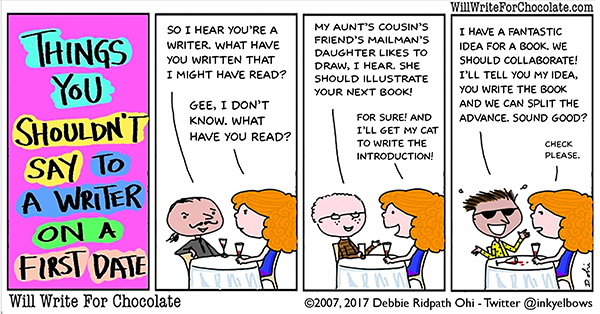
Things You Should Never Say To A Writer On A First Date

OHI0742-WWFC-ThingsYouShouldntSayToWriterOnFirstDate-v2flat-600

By Debbie Ridpath Ohi
Source: inkygirl.com

Visit us at First Edition Design Publishing
In the time you spend on social media each year, you could read 200 books

Somebody once asked Warren Buffett about his secret to success. Buffett pointed to a stack of books and said,

Read 500 pages like this every day. That’s how knowledge works. It builds up, like compound interest. All of you can do it, but I guarantee not many of you will…

When I first found this quote of Buffett’s two years ago, something was wrong.

It was Dec. 2014. I’d found my dream job. Some days, I would be there, sitting at my dream job, and I would think, “My god what if I’m still here in 40 years? I don’t want to die like this…”

Something wasn’t right. I’d followed the prescription. Good grades. Leadership. Recommendations. College. Dream Job. I was a winner. I’d finished the race. Here I was in the land of dreams. But something was terribly, terribly wrong.

Every day, from my dream job desk, I looked out into their eyes. Empty, empty eyes.

There were no answers.

In January of 2015, I found Buffett’s quote. I decided to read. I was going to read and read and read and never stop until I got some damn answers.

I didn’t quite make 500 pages a day, but, in these last two years, I’ve read over 400 books cover to cover. That decision to start reading was one of the most important decisions in my life.

Books gave me the courage to travel. Books gave me the conviction to quit my job. Books gave me role models and heroes and meaning in a world where I had none.

I want to say reading 200 books a year is an amazing thing. But the truth is, it’s not. Anybody can do it.

All it takes is some simple math and the right tools.

1. Do not quit before you start

When average Joe hears the advice “Read 500 pages like this every day,” his snap reaction is to say, “No way! That’s impossible!”

Joe will then go on to make up reasons to justify his belief without doing any deep thinking at all. These might include “I’m too busy,” “I’m not smart enough,” or “Books just aren’t for me.”

But what if we go a little deeper? For example, what does it actually take to read 200 books a year? Two years ago, I stopped to do the simple math. Here’s what I found: Reading 200 books a year isn’t hard at all.

It’s just like Buffett says. Anyone can do it, but most people won’t.

2. Do the simple math

How much time does it take to read 200 books a year?

First, let’s look at two quick statistics:

  • The average American reads 200–400 words per minute (Since you’re on Medium, I’m going to assume you read 400 wpm like me)
  • Typical non-fiction books have ~50,000 words

Now, all we need are some quick calculations…

  • 200 books * 50,000 words/book = 10 million words
  • 10 million words/400 wpm = 25,000 minutes
  • 25,000 minutes/60 = 417 hours

That’s all there is to it. To read 200 books, simply spend 417 hours a year reading.

I know, I know. If your brain is like mine, it probably saw “417 hours” and immediately tried to shut off. Most people only work 40 hours a week! How can we possibly read for 417 hours?

Don’t let your monkey brain turn you away yet. Let’s do a quick reframe for what 417 hours really means…

3. Find the time

Wowsers, 417 hours. That sure feels like a lot. But what does 417 hours really mean? Let’s try to get some more perspective.

Here’s how much time a single American spends on social media and TV in a year:

  • 608 hours on social media
  • 1642 hours on TV

Wow. That’s 2250 hours a year spent on TRASH. If those hours were spent reading instead, you could be reading over 1,000 books a year!

Here’s the simple truth behind reading a lot of books: It’s not that hard. We have all the time we need. The scary part—the part we all ignore—is that we are too addicted, too weak, and too distracted to do what we all know is important…

All it takes to start reading a lot more is to take “empty time” spent Twitter-stalking celebrities or watching Desperate Housewives and convert some of it to reading time.

The theory is simple. It’s the execution that’s hard.

4. Execute

We all know reading is important. We all know we should do more of it. But we don’t. The main reason this happens is a failure to execute.

I’m not so perfect at it yet, but here are some tactics that have helped me get results.

I. Use environmental design

If you were quitting cocaine, would you keep it lying around the house? Of course not. Media is designed to be addictive. Moving away from media addiction can be as difficult as quitting drugs.

The biggest bang-for-buck changes here are environmental.

If you want to read, make sure (1) you remove all distractions from your environment and (2) you make books as easy to access as possible.

As an example, here’s my immediate environment:

from original
(Charles Chu)

I travel a lot. That doesn’t stop me from reading. The picture on the left is of my “bookshelf” in Thailand. I try to keep books everywhere so I can just pick one up and start reading.

The picture on the right is my smartphone desktop. Notice there are only two apps. One of them—the Kindle app—is for reading. The other is for habits… Which brings me to my next point.

II. Upload habits

Willpower is not a good tool for lifestyle change. It always fails you when you need it most. Instead of relying on strength of mind, build a fortress of habits—these are what will keep you resilient in tough times.

If you’re not familiar with habit science, my favorite book on the subject is Tynan’s Superhuman by Habit. It’s infinitely practical, and practical is all I care about.

Getting good at habit formation took me years. Many of the mistakes I made were avoidable. If I could go back, I’d find a habit coach. Here’s how I see it. One game-changing idea from a good book is worth thousands of dollars. If a coach helps you read ONE more good book a year, you already get your money’s worth.

(A shout out to Cherry Jeffs and Nathan Sudds, two coaches who have helped me out a lot.)

III. Go multi-medium

When it comes to reading, be a jack of all trades, not a specialist.

If your goal is to read more, you can’t be picky about where you read or what mediums you use. I read paper books. I read on my phone. I listen to audiobooks. And I do these things everywhere—on park benches, in buses, in the toilet… Wherever I can.

Make your reading opportunistic. If you have a chance, take it. If you don’t have a chance, find one.

I read a book one day and my whole life was changed.

— Orhan Pamuk

If I hadn’t started reading, perhaps I’d still be at my dream job. Perhaps I’d still be at my desk, taking peeks at the clock and wondering if that was how I was going to die…

If you’re looking for answers, give reading a try. You may find much, much more than what you were looking for.

Source: qz.com

Visit us at First Edition Design Publishing

There are more than ten types of people who read books

People who read books have their own reading habits independent of the book format they like. Pages of paper books can be folded and highlighted, whereas notes can be jotted down on pages of an ebook (that don’t destroy the actual page) and highlighted as well. Someone may like to read in bath and another in bed. Riveted has identified ten types of book readers – but there are more.

Careful Page Turner. Books are so precious objects for this type of reader that even after reading a book, it looks like new.

Page folder. Books are full of memories and important things to note and remember. Every earmarked page has something to say to this reader.

Highlighter. Earmarking pages is not enough for this type of reader who wants to underline and highlight terms and lines.

Ebook user. Computers, tablets, ereaders and smartphones have users (unlike books that have readers), who read electronic books from the screen.

Paperback reader. In countries where ebooks have taken a large market share, sales of paperbacks has fallen, but there are still plenty paperback readers. Paperbacks are the classic choice of travelers, largely replaced today by ereader devices.

Hardcover lover. Book, music and movie industries have something in common: they can sell the same product many times to same customers, only in different package. Hardcover books have retained their market share despite ebooks (or paperbacks) that often are priced lower than hardcover products.

Library Hermit. With an endless supply of free books (and nowadays also the internet), it is easy to understand why some people like to spend hours in libraries.

Story Hoarder. A reader starts reading a story, but something makes him or her jump to the next book without finishing the first one. Some readers have he ability to jump from one story to the next without difficulties. I can do it with nonfiction books, but not with fiction.

Parallel computing. It is possible to read a book and listen to radio or (kind of) watch television at the same time, but playing a video game or cooking is difficult while reading a book. If you like to multitask, here is a tip for you: audiobooks. Another option is to download an app to your phone or tablet and let it read aloud an ebook for you.

Bedtime page turner. For some readers, it may be impossible to sleep before reading a little while, at least.

I can think of many additional types of readers, such as people who take a book along to a beach or park, and people who listen to audiobooks when they drive or commute. The emergence of ebooks has made books as a medium a flexible part of our lives, allowing us to enjoy them in many ways and in many places.

Source: klaava.com

Visit us at First Edition Design Publishing

Your Story Matters (Or… What a Reader Wants You to Know)

Hi, dear Villagers! *waves*

Let me take a brief moment to introduce myself. I’m Carrie, aka MeezCarrie, of ReadingIsMySuperPower. And I LOVE STORY!! I love short stories. I love epic stories. I love in between sized stories. I love contemporary stories. Historical stories. Mystery stories. Amish stories. Even some speculative and YA stories.

But most of all? I love THE Story. The one that starts with the ultimate ‘once upon a time’ – “In the beginning, God created the heavens and the earth” (Genesis 1:1) – and ends with the best ‘happily ever after’ ever (Revelation 21:4)

Because we are all part of that Story.

Yes, we all have a story in progress that is our own life. But everyone we meet does, too. And all those stories-in-progress are part of the Big Story that God is telling. Let me tell you – that is SO exciting to me!

I’m one of the new Seekerville bloggers, but I’m not seeking publication. I’m content to read other people’s stories and talk (incessantly) about them. But that up there? What I just said about being part of God’s Story?

That means I’m sorta like all the rest of y’all.

In a small way.

Ok.. not at all the same.

BUT… I am part of the greatest Story in the world. And so are you. That’s pretty stinkin’ incredible. The Author and Finisher of my Faith is telling a Story about me and about you. And He has promised to keep writing it until it’s completed – not when I die or when you die, but until the day Jesus returns. (Philippians 1:6)

Back in November, I had the pinch-me privilege of speaking with Cynthia Ruchti at the Art of Writing Conference just ahead of the 2017 Christy Awards gala. We talked about the darts of author discouragement and how to dodge them. After our session, a woman came up to me in tears. She whispered, “I didn’t know anybody else knew how I feel.” And then we both were in tears lol!

Author friends – can I encourage you a moment? You’re not alone. Writing may be a solitary career but the discouragements are consistent. Fear of rejection. The reality of rejection. Fear of the  possibility of a bad review. The depths of despair over an actual bad review. Your family doesn’t take you seriously. Your friends don’t take you seriously. It doesn’t pay the bills. It barely pays for coffee.

Oh… wait… I was supposed to be encouraging you. LOL.

I really was headed here, I promise.

You’re not alone. And you’re not left defenseless.

God has given you each other, and He has given you His Word. Community and grace wrapped up in a safe place like Seekerville.

You want to know another secret? YOUR STORY MATTERS.

Yep. I went there: all caps.

Because it’s so incredibly true and so incredibly important to understand.

The story you’re writing matters.

That story you’ve agonized over. The one that’s kept you up all hours of the night. The one that may or may not currently be taunting you with a blinking cursor of ‘I got nothing’. It matters. Even if no one else ever reads it. Even if no agent or publishing house wants it. Even if your beta readers and editors send it back with more tracked changes than you had words to start with.

Your story matters. Believe it. And believe in it.

But you know what? The story that God is writing in you and through you matters most of all. He is making you more like Jesus every day. He knew you before He formed you in your mother’s womb, and He had already had plans for your life. (Psalm 139, Jeremiah 1) He created you as a writer before you even had fully developed hands to hold a pen or tap away on a keyboard. Even better – He knew your role in His Story before you ever made your grand arrival on planet Earth. And that story matters on a scale we can’t even begin to imagine.

Maybe you’re like me and the only thing you write is a blog post… or a grocery list. Your story matters too. God placed you in His Story at just the right time and in just the right place so that you would come to know Him (Acts 17). He pursued you with an everlasting love and has engraved you on the palm of His hand. (Jeremiah 31, Isaiah 49). Think about that for a second – you matter so much to the God of the Universe that those nail-scarred Hands have your name on them.

Your story matters. Believe it. And believe in it.

I know good stories. I’m surrounded by them, à la the Dr. Seuss method of decorating. All the crannies, all the nooks, etc. This Big Story that God is telling is a good story. It’s the best story. It’s the standard by which all other stories are measured (whether they realize it or not). It’s also a true story. This fairy-tale to beat all fairy-tales – a prince on a white horse come to vanquish the enemy and rescue his bride – that’s OUR story (Revelation 19).

So when you’re tempted to throw in the towel and give up on your story – the one you’re writing or the one you’re living – remember this:

Your story matters. Believe it. And believe in it.

By Carrie Schmidt
Source: seekerville.blogspot.com

Visit us at First Edition Design Publishing

How to Spark Your Story With an Inciting Incident

If you are planning on writing a story, there is something you need to consider besides basic plot structure. You need to determine your Inciting Incident.

What incident will compel your protagonist to act?

What Is an Inciting Incident?

I am reading The Story Grid by Shawn Coyne and Story by Robert McGee to learn how to write a compelling story. Both Coyne and McGee emphasize the importance of writing a compelling inciting incident.

To incite means to stir, encourage, or urge on; to stimulate or prompt to action.

An inciting incident, then, is an event that forces your protagonist to act, compelling them to stop sitting around and do something.

Shawn Coyne has this to say about inciting incidents:

No matter the unit of story (beat, scene, sequence, act, or global Story) what the inciting incident must do is upset the life balance of your lead protagonist/s. It must make them uncomfortably out of sync . . . for good or for ill.

Robert McKee agrees:

If the protagonist’s toaster breaks it won’t compel her to get a job because she can afford to buy a new toaster.

However, if her bank manager steals all of the money from her account and flies to Brazil, she will be compelled to get a job. She is forced to act.

As Robert McKee says,

The protagonist must react to the Inciting Incident.

Why Do You Need an Inciting Incident?

If nothing happens to your protagonist you don’t have a story. Something has to happen.

Without an inciting incident nothing meaningful can happen. And when nothing meaningful happens, it’s not a story. —Shawn Coyne

If the story I am writing is about a toaster, but my toaster doesn’t do anything but sit on the counter, there is no story.

If the toaster catches on fire and burns down the house, then there is a story. Will the toaster get caught? Will the fire department blame the cat? Can the toaster be repaired?

How Does an Inciting Incident Happen?

An inciting incident can happen in one of two ways:

  1. By choice
  2. By accident

The protagonist might choose to adopt six cats, buy a one-way ticket to Japan, or decide to enter a hairy leg contest. All of these inciting incidents would compel the protagonist to take action.

Inciting incidents that are not by choice can happen as a coincidence, randomly, or as an accident. The protagonist meets a Naval Officer at a bar. A cat climbs into the protagonist’s lap and refuses to leave. You thought your flight left Bangkok at two in the afternoon, but it left at two in the morning, and there are no flights for another three days and you have spent all of your money.

No matter whether the inciting incident happens by choice or by accident, Robert McKee says it should occur “in the first 25 percent of the telling, no matter what the medium.”

If the writer, playwright, or screenwriter waits too long to incite the protagonist to action, the reader or audience might get bored and not continue with the story.

How Do You Resolve the Inciting Incident?

Shawn Coyne says the ending of a story must have two things:

  1. The ending must be reasonable and an inevitable result of the inciting incident.
  2. The ending must be surprising.

He gives examples of inciting incidents from different genres that have climaxes that are expected.

Murder mystery

  • Inciting incident = the discovery of a dead body
  • Climax = solving of the crime

Love story

  • Inciting incident = lovers meet
  • Climax = will the couple stay together?

Horror novel

  • Inciting incident = attack by the monster
  • Climax = confrontation between lead character victim and the monster from the inciting incident

An inciting incident creates chaos in the life of the protagonist. The story occurs when the protagonist tries to get their life back into balance. As Robert McKee says,

Characters are what they do. Story events impact the characters, and the characters impact events.

The climax or resolution of the story will put the protagonist’s life back together in some sort of new way, for better or worse. Hopefully, it will put their life back into balance.

What will your protagonist do? What is going to incite them to take action? Please let me know in the comments.

By Pamela Hodges
Source: thewritepractice.com

Visit us at First Edition Design Publishing

Don’t let your dream die with you

Arden Edwin Harper
May 17, 1926–January 8, 2018

The man pictured at top is my father, Arden Edwin Harper. He died this past Monday at the age of 91, and I miss him more than I can say. But I don’t want my loss (and that of my brother and sister) to override the value of the lesson he taught me. Of course there were many lessons, but the one I’m referring to is to not wait another minute to do (or at least put into action a plan to do) something you’ve always wanted to experience or accomplish.

While my father was a highly-educated man–he had a master’s degree and was a teacher, coach, principal, and superintendent of schools throughout his entire career in education (and beyond, since he taught mathematics at two different community colleges following his retirement from the public school system), he was also a gifted writer. Late in his life, around 80 or so, he began to take an interest in writing stories about his youth, his high school and college years, his experiences in the Army during World War II, and other topics. He had a phenomenal memory and could recall the names, dates, places, sisters, brothers, parents, etc., of everyone and every place that populated his stories. I have one book-length manuscript he wrote detailing his time in the Army during WWII, and many shorter essays/stories on other topics. I recall when I was younger hearing him say he’d like to write a book one day. I always assumed he would. After all, he was my dad; he could do anything.

When his interest in writing was re-kindled, he was into his ninth decade on this earth. Technology was a real challenge for him, although he was as sharp as he ever was right up until about a week before his death. Intelligence wasn’t the problem. It was not being able to keep up with the constant changes in technology and the publishing process that eroded his desire. Oh, he still enjoyed the act of writing and hearing my reactions to his pieces of work, but his interest in actually publishing anything at that late date was slowly being extinguished. It seemed insurmountable. Perhaps it was.

I mourned that loss, and tried many times to convince him that he still had so much to offer the world, that there weren’t many WWII veterans left who could so accurately tell their stories of that time in our history, that I would help all I could with any questions he had on computers, technology, or submitting his work. But I think he felt it was just too late. But I don’t think so. I think he could have done a fine job of writing that book (or books) even at his age. I think he thought he could always do it tomorrow, but tomorrow turned into next week and next month and next year, and eventually led to his last day.

I’m certainly not disappointed in the writing work he did accomplish. It is well-written, hilarious, inspirational, historically accurate, and done expertly. I will cherish it always. I’m disappointed, though, that he never had the chance to hold his published book in his hands and tell himself, “I did this.” Because he could have.

Now I know our desires and dreams change as we age. Other things were just as–or maybe more–important to him as time went on as writing ever was. He was happy, occupied, content. He read a lot, kept up on current events, was a master at crossword puzzles (I mean hard ones) and Sudoku. His mind was sharp, but his stamina waned, and so he eventually lost the will to do what he once thought he could do some time during his life.

Don’t let this happen to you. I’m primarily writing to you writers out there, but this could be applied to any dream or goal of anyone reading this. What’s the worst that could happen if you gave it (whatever “it” might be) your all? You might decide you don’t like it as much as you thought you would. You might fall flat on your face and tell yourself you’ll never do that again. So be it. That happens to me all the time. It happens to all of us all the time. But there’s something about that very special dream that makes us gun-shy. Hate it, fail it, but please, never, ever, ever sell yourself short by not trying it.

My dad didn’t completely give up on his dream, and I realize that the writing he did do was probably enough for him at that stage in his life. I’m happy for that; I really am. But I’m sad that the world didn’t know Arden Edwin Harper as the author of the fine work he produced.

Maybe I’m looking for something to hold on to now that he’s gone. Or wishing some accomplishment on him that he really never wanted that badly. Could my hearing him talk about writing a book have been a frivolous comment he made that I just took too seriously? Could his writing that book-length manuscript without having it actually published been enough for him? I won’t know this side of Heaven, and by that time it won’t matter.

My father was a fine man. The world will just have to take my word for it that he was also a fine author. Because he was.

Source: authorculture.blogspot.com

Visit us at First Edition Design Publishing

Reality Check for Authors … What Were You Thinking?

I’ve often said that authoring can be (and is at times) a lonely number. When you are hunkered down, the less “outside” noise, the better. When you are wondering,

What was I thinking when I thought (and told everyone) I could write a book?

… it can be a scary thought. When you are taking on the role of publisher, it could be your Holy Moly moment.

Those of us who are long-in-the-tooth in the publishing world get all those feelings, thoughts and experiences. And one thing we all know, is that YOU are not alone. Ever. There are gazillions of authors and authors-to-be who go through those same moments. What was I thinking …

I’m a HUGE supporter of creating an Author Inner Circle. An AIC that serves as a trusted advisory board … just to you. Your AIC knows you, what your book is about, helps shape your publishing plans, and acts as a reality check.

Throughout the publishing journey, authors need feedback, reality checks and plain old-fashion butt-kicking. And authors need a little kindness. Few think about putting together an “official” type of board to serve in the feedback/reality check/butt-kicking honors. An Author Inner Circle … a type of Advisory Board. Do you have one? Have you thought about creating one?

Who Belongs in Your Author Inner Circle?

It’s a new year. How about creating yours? Your Author Inner Circle … trusted colleagues, friends, and always individuals who have “been there, done that.” Most likely, Mom, Dad and your siblings are not included. The exception would be that they are experienced in publishing on their own—otherwise, you take a pass on them.

What you want are individuals who “get it” … they have an inkling of what is going on in the publishing business. They are also someones who:

  • have a kaleidoscope of business experience;
  • are connected with others;
  • have a sense of humor;
  • will say it as it is;
  • will call out the elephant in the room (which could be you);
  • love to brainstorming and bounce off-the-wall ideas around;
  • move you to action;
  • get what social media marketing is about;
  • will embrace your Vision for your book and where you want to go with it.

That’s a lot of someones … individuals who rarely will encompass all the ingredients as a single person.

Here are my nine someones that can make the difference between success and failure in your publishing endeavors:

  1. You want someone who has got an inkling of what is going on in the publishing business. We all know publishing is in a combo evolution and revolution. Who is out there in the midst of it?
  2. You want someone who gets your Vision for your book and where you want to go with it. She or he gets it; gets you; and becomes your cheerleader. The passion you have and amount of time, energy and money you invest in your commitment to your book project is understood and supported.
  3. You want someone who is connected with others and opens doors. Yes you do—someone with a phone call, text, or email request can get you to a source—someone who knows someone else that can smooth your way or offer assistance.
  4. You want someone who has a kaleidoscope of business experience. Absolutely—one of the key failure factors in the authoring/publishing business that most authors don’t recognize. This person gets a P & L, understands contracts and negotiating. If he or she knows publishing, it’s a bonus.
  5. You want someone who loves brainstorming and off-the-wall ideas. Eccentric, a tad wacky—you name it, this person walks to a different tune … most of them you don’t get, but once in a while, your unique and odd-ball someone hits it out of the park.
  6. You want some who gets social media marketing. But there’s a catch, this person has to be able to articulate knowledge/concept/game plan in your mother tongue what he or she is saying and you understand it. It doesn’t mean that you are going to be the full time implementer of what social media you are creating and using. For me, I write mine—but I don’t push it out. I have someone on my team that does that task daily.
  7. You want someone who has a sense of humor. Not only can authoring and publishing be lonely at times as you tunnel yourself into the completing of your book—there are booby traps along the way. Being goofy can be a good thing.
  1. You want someone who will say it as it is and not side-step any elephant in the room, including you. Let’s face it; we all get stubborn at times; quite myopic in the author paths we get into our head. You need a reality checker. Who is out there and has the guts to tell you that you are off your authoring/book rocker?
  2. You want a “Go-Go-Go” person who gets you into action. No butt-sitting allowed or procrastination allowed.

As you start to build this team of individuals, take little steps. You may instantly know who will fill several of the slots I suggest. You may have other categories based on your genre that need to be added. Some, you will interact with one-on-one via phone, in person, or an online platform. Some, you might gather over Zoom, Go-to- Meeting, Skype or other online video mediums. And some may be let’s get together for breakfast or lunch.

This is a time I will say to you, just do it … it’s a new year for you and your publishing.

By Judith Briles
Source: thebookdesigner.com

Visit us at First Edition Design Publishing
Google to Sell Audiobooks, Teases 50% Off Your First Purchase in Leaked Banner

Back in November I brought you the news that Google was looking at selling audiobooks in Google Play, and now it appears the launch is imminent.

9to5Google reports that a last night a banner for the new audiobook section of Google Play went live in the Play Store. The banner linked to the audiobook section of the store. That section isn’t live yet as I right this on Saturday, but clearly that is going to change fairly soon.

Google to Sell Audiobooks, Teases 50% Off Your First Purchase in Leaked Banner Audiobook Google Books Google Play

The Play Store does have a few audiobooks in its Music section, but 9to5Google says the implementation has always felt a little sloppy. And in any case, those audiobooks aren’t listed in their own category. That makes them so hard to find that they might as well not exist.

Google Play via 9to5Google

Source: the-digital-reader.com

Visit us at First Edition Design Publishing

Kill Perfectionism With This One Practice

It can feel impossible to know where to start writing.

We can become paralyzed by fear, worrying our words will offend or bore readers, or worse, that we’ll never have any readers at all.

If we jump in, we might quickly find ourselves nose-deep in all the complications of story writing, tangled in plot, character development, and dialogue tags. Or a Google search might drown us in writing advice, suddenly flinging us into an identity crisis — who are we, why do we write? Are we plotters or pantsers? How can we even know the difference? *hides under desk*

This isn’t just a problem for newbies, either.

The Story of a Perfectionist Writer

Despite having been a published nonfiction writer for over a decade, when I wanted to branch into fiction writing, I had no idea where or how to start.

As a planner, it made sense to me to begin with an outline. I started there, but pretty soon I became bogged down in perfectionism, trying to think the whole story out before beginning to write it. The story screeched to a halt.

I’d heard many stories are character led, whatever that meant, so I created a character; a gruff, bristly cowboy, leaning up against a barn, with a cigarette smouldering between his thick fingers. Unfortunately for him, that was all the depth I could give him without the context of a story. Years later, when I’d think of him, he’d still be standing there, smoking that same cigarette, isolated and alone without a plot to live in. Poor guy.

My solitary efforts yielded nothing, so I read. And researched. And listened to podcasts and watched videos. (A perfectionist’s fancy way of procrastinating.) In the swirl of information, the identity crisis hit. Who was I? Why did I want to write fiction? Was the ability inborn, or could I learn it?

Pretty soon I was convinced fiction writing was too complicated for me.

The Advice That Transformed My Writing

Finally I invited my friend for coffee and to beg for advice. She’s an avid fiction author who pumps out at least one book a year and has thirty titles to her credit, so I knew she’d have some excellent insight.

“How on earth am I supposed to do this??” I asked her. “How does one create a story?” I leaned in, eager for the key to my fiction-writing success.

She shrugged. “You just write it.” She said it matter-of-factly, like it was as obvious. To me, it was obviously wrong. That’s what I’d been trying to do, and it wasn’t working.

“Just write it? I can’t do that. I need a plan.”

“No you don’t. I start most stories without a plan. As I write, the story comes.”

“What?! That’s insane!”

She shrugged again. “You might end up writing a whole lot of crap, but if you keep going, you find the good stuff.”

I didn’t buy it, but let the advice percolate. Writing was too difficult a task to risk “writing crap.” I couldn’t bring myself to do it.

Then, in the book Outlining Your Novel, K.M. Weiland proposed two words that changed my life: “What if?” I realized finding the answer would necessitate a lot of dead-end scenarios. I would have to jot down a lot of crummy ideas and terrible plots before I came up with the best one. I would have to allow those incomplete, embryonic, never-to-see-the-light-of-day ideas out onto paper.

That’s when I realized my friend’s advice was true. I would have to “just write it.”

That morning, I sat to write a fiction piece. Anything. It didn’t matter. I was just going to make it up on the spot. Even if it was crap, I decided, it would at least blunt the perfectionism that had held me back.

Inspired by a painting, I wrote one line. Then another. I kept adding one after the other without knowing anything about who was in the story or why. It was a freeing exercise to “just write.” What resulted was a mediocre story that had a reasonable plot and semi-inspiring conclusion.

3 Lessons About Perfectionism From a Writer Who “Just Wrote”

The experience taught me three things:

1. Giving yourself permission to write total crap quiets perfectionism

Perfectionism isn’t necessarily bad. In its healthy state, it can drive us to achieve goals and feel a deep sense of satisfaction as a result. In its unhealthy state, though, it can freeze us with fear or cripple us with self-criticism. That’s the version we need to break free from.

It starts with giving ourselves permission to not be perfect — to write crap.

With that permission firmly in place, it becomes this decision to conduct an experiment, the results of which do not define us or our abilities.

This one, highly effective, low-risk decision can make an effective path through perfectionism. It sure did for me.

2. Permission to write crap unlocks creativity

Creativity is a cautious, tender creature. It hides from anything that might kill it — like the pressure we put on it to be something it isn’t.
However, with the decision to cast aside high-achievement and simply run an experiment, suddenly the pressure to write the next Harry Potter dissipates, and we’re free to let whatever we think of flow onto that blank page.

Permission to write crap unlocks creativity.

“It’s about getting that critic out of the way and immersing yourself in a flow of pure creativity. Do that, and you’re doing well.” Sean Platt, Write, Publish, Repeat

3. To grow in the craft of writing, one must write

Research, reading, thinking, or “letting it percolate” do not a book write. They’re necessary to the process of writing, but they are not the only elements.

Knowing and doing are two different things — it’s the difference between knowledge and experience. One can become knowledgeable about driving by reading books, interviewing the best drivers and car manufacturers, and studying related stats.

When they get in the car, though, the realities of the experience come to life. Hundreds of traffic signs, lights, pedestrians, and flashing ads all pull attention from what seemed like a simple task. Understanding is born.

Sometimes, perfectionism is just a cover for procrastination.

The Secret to Writing Success

Here it is: At some point, every single writer must finally follow these three steps: 1) Place butt on chair. 2) Place fingers on writing apparatus. 3) Write words.

Give yourself permission to do just that, and who knows what stories you’ll create?

What strategies do you use to overcome perfectionism in writing? Let us know in the comments.

Source: thewritepractice.com

Visit us at First Edition Design Publishing