Tag Archives: tips

Why The More Successful Writers Fail The Most

Successful Writers

Sometimes, we meet/discover a writer who is super successful.  We think they must have been super lucky, too. Right place, right time and all that. If only we were so lucky!

But what if I told you they’re super successful BECAUSE they failed … A LOT. Seems like an oxymoron, right? Except it isn’t. Many amazing writers are ‘successful failures’.

The above quote is from J K Rowling’s Harvard Commencement Speech, The Fringe Benefits of Failure and the Importance of Imagination. Being as successful as she is, it’s hard to think of her as a writer who failed. But she did and so have countless other success stories.


Failure Is Not Fatal

Maya Angelou is another amazing writer. She came up against huge obstacles in her life, yet she saw the value of failure. Every time life smacked her down, this courageous woman got right back up. Does failing the most equate with learning the most? Maybe.

I think the key to getting past failure is this … None of us know how long the thorny path is. It could take two years, five years or ten years to become successful. Even then, the thorns are still there … Except now they’re entwined with ‘success flowers’ and the path is a nicer walk!


The Value Of Mentors, Allies & Moral Support

You don’t HAVE to have a mentor, but there’s a reason they play such a big part in The Hero’s Journey. Mentors can be helpers and facilitators in writers’ journeys. Speaking from experience, I can say it definitely helps when dealing with the thorny path. A mentor can guide you and reassure you as you go through your journey:

Creative: The path of thorns leads up a mountain. The prickles are bad enough. I don’t want to fall and hurt myself.

Mentor: You’re not going to see the beautiful view from the ground.

Creative: Okay, I’ll climb a little way … A stone hit me on the head!

Mentor: It’s just a stone.

Creative: Okay, I’ll climb a little more. Hey, a flower! Pretty. I’ll climb some more … ten stones hit me on the head! That’s it! I’m done. Everyone else is lucky. Look how far they’ve climbed. They’re not getting pelted with stones.

Mentor: You can’t see their injuries from down here. I guarantee most of the people up there have not only had stones hit them on the head but have also been smacked in the face with rocks, boulders have almost flattened them, while a flock of angry seagulls pecked at their faces! You have to take what’s thrown at you, all of it, in order to walk the path of success.

So much of the creative life is about being brave and confident. The value of mentors is they can  help you achieve this and facilitate your career. They can also console you when you have failed. Most importantly, they can remnind you to get back off your arse and try again!

But you don’t have a mentor? That’s okay. Surround yourself with allies … Writer friends who really ‘get it’. Moral support is so important. Why not join the B2W Facebook group today!


So … how do we succeed?

Yep! By failing. This means you must not fear failure. Embrace it. Small fails. Big fails. Fail at as much as you can because each opportunity needs to be taken. If you don’t take it, there is neither failure or success.

So, keep failing Bang2writers. Before long, like a caterpillar turns into a butterfly. Failure has no choice but to become success. Here’s some more links on what it takes:

33 Industry Insiders on Success, Dreams & Failure

Failure Is not Fatal. How To Succeed, No Matter What

The Truth About Success: 30 Creatives Who Broke In Late

24 Experts On The Foundation Of Success

6 Ways YOU’RE Stopping Your Own Writing Success

Good Luck!


Source: bang2write.com

Visit us at First Edition Design Publishing

All About Productivity

Productivity is a key concern of Bang2writers. It’s not difficult to see why: procrastination is a huge problem for writers. It’s easy to get stuck in a non-productive rut. We are daydreamers after all!

So, if you’re a hobby writer wanting to turn pro, or a pro wanting to get more done, you need to learn how to boost your productivity. Luckily, we at B2W Headquarters have put together this handy round-up to help you make the most of your writing time.

1) 11 Habits That Can Transform Your Productivity

Create good habits. Sounds easy, doesn’t it?? Yet it’s something many creatives struggle with. Working for yourself, sometimes with little to zero pay, can damage productivity and good habits. HERE are some tips to help stay on track.

2) The Weird and Wonderful Habits of 20 Famous Writers

Want to know which famous writer you are most like when it comes to crazy writing habits? Maybe you want to adopt the habits of a writer you admire to help increase productivity? CLICK HERE.

3) 6 Tips for Boosting Writing Productivity

HERE are some more ideas for improving productivity. The key? Work smarter not harder!

4) 1 Simple Tip to Help You Get More Writing Done

What is ‘dead time’? How can you use it to get more writing done? Don’t let time control you, control time. You might not have a Tardis or a Time-Turner but you do have control over a lot more of your time than you think. Find out HERE.

5) 5 Steps to Beat Procrastination and Stay Focused

Here are some great procrastination busters. No one EVER said ‘I wish I had procrastinated more’! HERE are the steps you need to make sure you won’t regret *not* making the time to create that wonderful work bubbling inside you.

6) How to Get Writing Done, According To 20 Famous Authors

The best way to get stuff done? Learn from the masters – and mistresses! – in the know. Check out these tips, HERE.

7) How to Stop Wasting Writing Time Procrastinating Online

 Did you watch last night’s episode? Yeah, there was a huge argument in an online writing group about that show, did you see it? Blah, blah, CONCENTRATE! To learn how to avoid getting distracted during times allocated for writing, CLICK HERE.

8) How to Improve Your Focus as A Writer

With so many distractions it can be difficult to focus. HERE are some great tips for keeping your eyes on the prize.

9) 12 Unusual and Achievable Productivity Hacks for Writers

Turn an old tennis ball into a car key holder, use your cat as a winter hat. We all love a fun life hack. HERE are some cool productivity hacks to try out today.

10) How To Set Meaningful Goals And Stick To Them

Productivity isn’t about just throwing spaghetti at the wall. Creating meaningful goals means you’re much more likely to stick to them! Find out why, HERE.

Last Words

I hope you enjoyed this round-up on productivity. No more excuses. Get that wonderful work finished and out in the world for others to enjoy. Laser focus!

By Lucy V Hay
Source: bang2write.com

Visit us at First Edition Design Publishing

What it Feels Like When Your Writing is Rejected – and How to Bounce Back

One reader asked me: “I’d like to know what it’s like to get rejected by a publisher or several (if that’s ever happened to you) and how you bounce back from it.”

It has indeed happened to me – as you can see from the photo above! Those are all the rejection letters I received in 2007 – 2008, for a fantasy novel that I was shipping around to agents/publishers, and for short stories that I was sending to magazines. I’ve had plenty of rejections since then, too: competition entries that didn’t even get placed, guest posts pitches that were turned down, reviews of my novels that were less than stellar.

Rejection is simply part of the business of writing. Of course, it would be great if everything you wrote was loved and snapped up by the first editor who saw it. But agents and editors are inundated with new material on a daily basis – perhaps receiving hundreds of manuscripts every week, when they might only take on one or two new authors every year.

Here’s what you need to know about rejection:

#1: Being Rejected Doesn’t Mean Your Writing is Bad

Looking back at those stories I wrote in 2007 – 2008, they were far from brilliant. But they weren’t awful, either. During the same time period, well as collecting a stash of rejection letters, I had two small competition prizes and two short-listings for my short stories. I also started freelancing for several blogs.

When you receive a rejection letter, don’t take it as a sign that your writing sucks. There are all sorts of reasons why a manuscript might be selected – perhaps the magazine had just taken an article on a very similar theme, or published a short story with the same premise. Maybe the agent you’ve written to just doesn’t click with your writing style.

All writers get rejected. Every best-selling writer you know – including J.K. Rowling and Stephen King – has received rejection letters.

#2: Getting a Piece Accepted is a Numbers Game

One of the reasons that I had so many rejection letters in 2007-08 was because that I’d decided to enter as many short story competitions in Writing Magazine and Writers’ News as I could. I wrote around 15 – 20 short stories that year, and while most of them didn’t place in the competitions, four did. I sent out the others to magazines, and managed to get one accepted.

Over the past month or so (as I write this in 2018), I’ve been sending out freelancing proposals to potential/former clients for the first time in quite a long while … my youngest has started nursery school, so I’ve suddenly got some extra working hours. Some of those pitches have been rejected; others met with no response. But some were enthusiastically accepted!

The more stories or article pitches or book proposals you write, the more chances you have of success. Create a spreadsheet so you can keep track of which stories you’ve sent where, and every time a story comes back, send it out to a new publication.

#3: Facing Rejection Gets Easier

The first few times I got rejection letters, it hurt. I’d written the best novel I could at the time, and I’d spent ages researching agents, composing cover letters, printing the manuscript in the right format, and so on. I thought that if only I could get my novel accepted, I could quit my day job (I have a slightly more realistic idea about advances now…).

But after a few rejections, I stopped minding so much. I started sending out short stories as well as the novel. I began to understand that rejections are simply part of the writing life, and that – while they might be a little disappointing – they’re just one person’s opinion.

Your first rejection will probably hurt. Your tenth rejection might sting. But every time you recover from a rejection and send something out again, you’ll find that those rejections have a little less power over you.

Moving On From Rejection

You might have noticed above that my rejection letters are from 2007 – 2008. I first wrote this post in 2012, and I updated it in 2018 … so what’s happened since?

At the end of July 2008, I left my day job. In September 2008, I started an MA in Creative Writing, and began to work on a new novel (instead of short stories).

My freelancing work – mostly for websites – wasn’t just a great way to make steady money as a writer, it was also a great way to build my confidence. Getting paid on a regular basis felt like a pretty strong validation of my writing!

My novel, Lycopolis, took three years to finish. I did approach one agent and one editor at a conference, but neither wanted to take the novel on. As the months went by, though, I saw more and more authors – new and established – bring their novels out themselves, as ebooks and print-on-demand works. I decided to bypass the rejection game and take the self-publishing route with Lycopolis (2011) and the next two novels in the trilogy: Oblivion (2015) and Dominion (2016). You can find out about all three on my author website.

(If you’re wondering about the big gap between novels, that’s because my daughter and son were born in early 2013 and late 2014 respectively!)

I also started blogging here on Aliventures back in 2009. With my blog and the weekly newsletter, there’s no one to reject my writing – and I usually get lovely comments that help me know I’m on the right track.

Today, writers have a wealth of different options. You aren’t reliant on agents and publishers to get your stories, articles, or poetry out there.

Yes, having an agent or publisher still has many benefits. When I first wrote this post, back in 2012, I’d just finished a book in Wiley’s Dummies series, Publishing E-Books For Dummies, and I certainly appreciated the advance! 😉 (As well as the attention to detail from my editors, and the opportunity to be associated with a major book brand.)

But … you don’t have to be entirely at the mercies of the publishing industry. If you wanted, you could do any of these pretty much immediately:

I’m definitely not suggesting that you should stop (or avoid) submitting your work to agents and publishers. Collect up those rejection slips and be proud: you’ve survived them! The more rejections you get, the closer you are to an acceptance.

At the same time, find a way to bypass the agents and publishers, so you can get at least some of your writing out there to the world. Having an audience – even if that’s just a handful of friends and family – is hugely rewarding, and can help to take away any lingering pain of rejection.

Whatever stage you’re at with your writing, good luck. If you’ve had any personal experience of rejection – or acceptance! – that you’d like to share, feel free to leave a comment below.

Source: aliventures.com

Visit us at First Edition Design Publishing

Good People Making Bad Choices: Could this be your character?

Good people making bad choices is something that many of us struggle to fathom. I mean, surely if they were ‘good’ then they would ultimately go with their better judgement. Good people uphold values such as human dignity, even when it’s tough. World War II was when this phenomenon really came into the public eye, as the world struggled to accept that all Germans were not monsters. In fact, the trial of Adolf Eichmann, the person directly responsible for Hitler’s ‘Final Solution’, found that many of the war criminals standing before them were mild-mannered, courteous people.

And the moment any psychological phenomenon becomes interesting, writers tend to perk up and listen. Does this relate to my character? Maybe this is why he did what he did? Or if you’re anything like me, how could I tie this into a ‘what if’ question for a future concept? Could it be the something that my readers will mull over long after they’ve finished?

Well, let me tell you a story. Those of you that have heard of Milgram’s experiments on obedience will recognise the scenario I’m about to dramatize (I’ve taken the Milgram’s procedure and brought it to life with the help of some fictional characters), for others, you’re about to discover what the average person is capable of.

When Ben saw the ad for a learner experiment, he read it twice.

“Surely it can’t be that simple,’ he thought, ‘you’re basically getting paid to turn up!”

But that’s exactly what the typed page on the university noticeboard said. Thinking of Emily and their upcoming anniversary, the prospect of some easy cash was enticing.

When Ben turned up, he was introduced to Geoff. Geoff was middle-aged, and kind of mild-mannered looking with his glasses and round belly. The experimenter, this guy tall and serious looking with his white lab coat and clipboard, held out the tip of two straws. It seemed the person that drew the short-straw would be the learner, and the other, the teacher. Ben had never done any teaching, but he wasn’t keen on drawing the short-straw just because…well, it’s the short-straw.

His relief when his red straw drew out and was twice the length of Geoff’s had his tension easing. He gave Geoff an apologetic smile, to which Geoff responded with an affable one of his own. The experimenter, Ben couldn’t remember whether he introduced himself, took Geoff to a chair. Geoff had a few minutes to read a piece of paper before the experimenter strapped him into it.

Geoff looked down at the metal straps holding his arms down, and Ben watched as the experimenter smeared electrode paste before attaching electrodes. “The paste is to prevent burning and blistering.”

Geoff smiled in gratitude. “I have a heart condition, I thought I’d let you know.”

The experimenter continued with the paste and the electrodes. “Although the shocks may be painful, they won’t cause any permanent tissue damage.”

Ben’s shoulders felt a little tense. This was a little more…well…medical that he’d imagined. But the experimenter was calm and collected as he came took Ben to an adjacent room. Ben was confident he knew what he was doing.

Ben took a seat and the experimenter pointed to a dial and some buttons before him. “You’re going to ask Geoff some questions. We want to test his memory.”

Ben nodded. Seemed straightforward enough.

“If Geoff makes a mistake, I want you to administer progressively larger shocks to Geoff each time.”

Ben frowned at the dials. Their descriptors had words like Slight, Moderate, Strong, Intense, Extreme Intensity and Danger: Severe Shock. “Okay.”

The experimenter held an electrode to Ben’s arm. “This is 45 volts.”

The tingling buzz was a shock, but not painful. Ben mentally shook himself, he was being silly. The experimenter knew what he was doing, and this was probably important.

Geoff got the first few questions correct. But then he started making some errors. Very soon, Ben was dialling up to 75 volts and Geoff was grunting in pain. He looked at the experimenter, discomfort making him shift in his seat.

The experimenter made some notes in his clipboard. “Please continue.”

Ben pulled in a steadying breath and asked the next question. At 120 volts, Geoff shouted that the shocks were becoming painful. Uneasiness was making Ben’s hand tremble. He turned to the experimenter. “I think…I think we shouldn’t go any higher.”

“The experiment requires you to continue.”

Ben turned back to the dial. Maybe Geoff wouldn’t get too many more wrong. At 150 volts Geoff demanded to be released from the experiment. At 180 volts he cried out that he couldn’t stand it any longer. Ben was now sweating, each show of pain from Geoff had his teeth gritting and his chest constricting. “We need to stop.

The experimenter shook his head. “It is absolutely essential that you continue.”

Ben looked at Geoff, who was now panting. He looked down at his hand wrapped around the dial. It is absolutely essential that you continue.

Geoff continued to cry out at each shock. By the time the dial was at 250 volts, he was crying out in agony. At 300 volts Geoff stopped responding to the cue words. The experimenter told Ben to treat these as a wrong answer.

Ben shot up from his chair. “This is wrong,” he shouted. “We’re hurting him!”

The experimenter’s gaze was steely. “You have no other choice but continue.”

Ben hovered; half standing, wanting to run; half sitting, and hating himself for it. This was wrong. He wasn’t someone that does this to people. What would Emily think of this all?

But he had no choice. The authority figure standing beside him, unyielding and demanding, had said so.

Disgust and dread stung the back of Ben’s throat as he notched the dial up to Extreme Intensity. He pretended he didn’t hear Geoff’s scream as he pressed the button…

Now, I wonder if you’re empathising with Ben’s discomfort, but secure in the knowledge that you would be different?

What Ben didn’t know is that Geoff was a confederate, an actor and accomplice, to one of the most famous experiments into obedience to authority. There was no shock, no pain, no deadly electrical current. The experimenter knew this, as did Geoff.

Ben, on the other hand, had just shown us what the average-Joe was capable of.

When they first devised this experiment, Milgram and his researchers predicted that no more than 20% of normal, psychologically balanced human beings would comply with the direction to continue shocking the learner past 135 volts. They predicted no one would continue past 255 volts.

What they found was that 65% of participants continued to the highest level of 450 volts, and all the participants continued to at least 300 volts. Milgram’s experiment has been replicated in multiple countries, with males and females, and across different settings. Milgram felt safe to conclude that the average person could be directed to commit horrific acts if obeying an accepted authority figure.

Once you’ve processed what this means for ourselves and humanity, you’ll start considering what this could mean for a character and a story world. Did we just witness the birth of a villain? What if Ben was an apprentice, and this was his master? What if his master progressively increased the violence that Ben believed he had no choice but inflict? Ultimately, who would Ben become as he aged, and eventually became a master himself?

Or is Ben going to live with his choices for the remainder of your narrative? What if this was a single event, and Ben went home to Emily and their anniversary? If Ben internalises the decision he made to hurt another, he may not acknowledge (or know) the influence that authority has over us. That would be a tough cross to bear (and yep, a wound was just born!).

If you like the post don’t forget to share it!

By Tamar
Source: psychwriter.com.au

Visit us at First Edition Design Publishing


Poetry Prompts for the End of the Year

The end of another year is just around the corner. It’s a busy season packed with holiday shopping, gatherings with friends and family, and preparations for the new year ahead.

Maybe you don’t have time to sit and write the way you usually do. Maybe your head is spinning with all the things you have to get done. That’s fine. Just set a few minutes aside and let these poetry prompts walk you through a brief writing session.

We’ll even keep the focus on things that are going on right now–things like food, holidays, gifts, goals, and the new year.

Poetry Prompts

To use these poetry prompts, simply pick one of the lists below and write a quick poem using all of the words from the list. The lists are categorized to make choosing a little easier. Select the one that speaks to you, and then get busy writing.

If you’re not as busy as everyone else and are feeling up for a bigger challenge, try making one poem with all the words from all the lists. Up the ante by using the list titles as well. If you’re feeling lazy or have an itch to break the rules, go ahead and mix up the lists and pick whatever words you want.

Just remember to have fun.

Holiday Food Gifts End of the Year New Year
red suit
festival of lights
gift
winter solstice
merry
baking cookies
gravy
morsels
forks and napkins
platter
shopping mobs
bows and baubles
wrapping paper
gracious
big sale
the past
looking ahead
future
calendar
celebrate
beginning
champagne
tomorrow’s plans
hangover
day off

More Tips for Using Poetry Prompts

As you work through these poetry prompts, keep the following tips in mind:

  • Try to write about something unexpected. If you choose the “Holiday” list, then make your poem about anything BUT the holidays.
  • Mix two or three lists of poetry prompts together and take out some words or add in a few of your own. Then write your poem.
  • Use the five list titles rather than the words in the lists.

As always, enjoy your poetry session, and keep writing!


By Melissa Donovan
Source: writingforward.com

Visit us at First Edition Design Publishing

Writing Deadlines: The Unlikely Secret to Creative Freedom

Do you know how to set your own writing deadlines to accomplish your dreams? Ruthanne wrote here about how a move helped her discover the power of deadlines. Joe heartily endorses setting your own deadlines with consequences as accountability (that’s how he wrote his most recent book).

Learning to set and meet your own writing deadlines not only helps you get your work done, it provides creative and productive freedom.

I’m a firm believer in deadlines.

Some will argue that creativity has no end point and that they can’t be inspired if there’s a timeline. If that mindset results in powerful writing and stories that resonate with readers as regularly as you’d like, then go forth and continue with the process that is working for you!

If, however, you can’t seem to finish in the time and manner you desire, a little deadline practice might be just the thing you need to propel your writing forward.

Why you need a writing deadline

I’m a teacher. My students regularly develop ideas, draft, revise, and submit their writing.

When I don’t set a deadline for assignments, guess how many students voluntarily turn in their work in a timely manner? Very few.

This probably sounds familiar if you’ve had a traditional school experience (adult working environments often work this way too!).

We tend to think we’ll have more time to do it later, or that we just need a little more research, experience, or coffee. (You probably do need more coffee.) Others believe they do their best work at the last minute, but sometimes that is because it’s the only time they write.

A deadline cuts down all those reasons and forces us to get to work.

Planning for a writing deadline

As I plan for student deadlines, I always make room for thinking and idea development. We draft. Then we take several passes at the writing to revise.

I realized early in my teaching career that most students were going to spend about the same amount of time on a first draft whether they wrote it in one speed session the night before it was due or spaced it out over several days. Most students didn’t take the time to revise, because they didn’t know how or there wasn’t time after an all-nighter.

As a result, I began in-class writing sprints, telling students the first draft was due at the end of the period. Whining inevitably ensued, but guess how many students had a draft at the end of the period? All of them. Funny how a ticking clock activated the words.

If you are planning your own deadline, look at when you want the final draft done and then back plan, giving yourself time to revise, write, and develop the idea. (Pro tip: leave yourself a little more time for revision than you think you’ll need if this is your first time revising.)

When you blow a deadline

You might be thinking, “I’ve tried that before and I blew it. Deadlines don’t work for me.” Just because you miss a deadline doesn’t mean they don’t work. It means you have an opportunity to grow.

I recently missed a deadline here at The Write Practice. I felt terrible, but I didn’t wallow in it. I apologized and did some self-evaluation. Why did I miss it? What could I do to avoid letting it happen again?

Consider that sometimes your writing deadlines are unrealistic. Manage those expectations more effectively and set a new, better deadline. Sometimes you are in a difficult writing or life season. Be honest about that and forgive yourself, knowing the situation will change.

The more you practice setting and meeting writing deadlines, the better you will get at estimating time and the amount of work needed.

The secret freedom of setting your own deadlines

My high school students claim to want independence, but they are just like me. I want the fun parts of independence without the responsibility. At the beginning of the year, I am the one who provides deadlines and due dates, but I slowly begin to turn that responsibility over to students as the year progresses. Why?

When they require someone else to set their deadlines, they aren’t really in control of their life and process. I’m the same way. If I know an article is going to take me an hour to write and another hour or two to edit, I can wait until the night before it’s due and stay up late to finish, or I can do it when it makes the most sense in my schedule.

Why wait for someone else to tell me when it is due? I take control of my creative process by setting my own writing deadlines.

When you ignore your own deadlines

For a long time, I set goals or deadlines for myself, and then I wouldn’t follow through. I thought maybe it was just me. I realized though that no one had ever taught me to push through the process.

I believe it was Tim Grahl who once talked about how he would push through procrastination and tell himself, “You need to do this now, because Friday-you isn’t going to have the time or energy.”

That resonated with me. I have since used it with students to help them think through to the end.

I also realized I couldn’t continue to ignore my own writing deadlines after completing a 60,000 word draft during NaNoWriMo a few years ago. I still needed about 20K to finish the story.

No one had a deadline on that book but me. If I hadn’t set my own deadline, the book wouldn’t be in revision right now. It would still be sitting on my hard drive — not even collecting dust like a respectable unfinished manuscript of old.

If you are still in the I-should-write-a-book stage, no one is going to give you a deadline. You have to do it for yourself. Accept that truth and find freedom in knowing you are in control of this part of the process.

Deadlines have a best friend: accountability

When you combine a deadline with another writer or group to hold you accountable, you will find yourself meeting writing deadlines left and right. When I first joined Becoming Writer, our forum here at The Write Practice, I knew I needed to post something each Friday. Suddenly, I had a deadline and a group of people who checked on me.

If you are struggling to set and meet your own deadlines, find a partner or group to help hold you accountable.

I still work under deadlines that others set for me, but I have found that more often than not, I can challenge myself to beat those deadlines by making my own.

What has been your experience with deadlines? Have you found them to be freeing or constricting? Share in the comments.

By Sue Weems
Source: thewritepractice.com

Visit us at First Edition Design Publishing

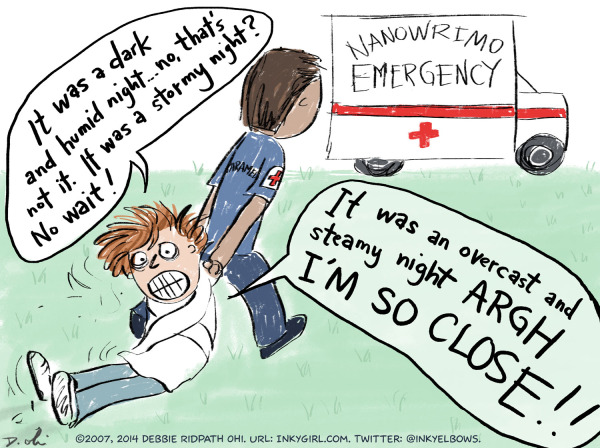
Comic: NaNoWriMo Emergency


Source: inkygirl.com

Visit us at First Edition Design Publishing

How do you describe a place? 6 setting tips

The setting of your story is key to readers being able to imagine ‘being there’. How do you describe a place so it is characterful and contributes effectively to your story? Try these 6 tips:

1. Describe place through characters’ senses

We feel connected to place in a story when we see it through characters’ senses. Bring senses such as sight, hearing, touch, smell and even taste (there’s edible wallpaper in Charlie and the Chocolate Factory) into your setting. Using every sense might not make sense for your book, yet it’s possible. In Roald Dahl’s children’s classic, set in a sweet factory full of wonder, it somehow makes sense even the wallpaper is delicious.

When describing places in your story, think about tone and mood. Should this setting be intimidating or welcoming? Ancient, dusty and arcane or ultra-modern and spotless? What does an ancient, dusty mood smell like (old books? Damp carpets?).

Use the ‘Core Setting’ section of your story dashboard on Now Novel to brainstorm descriptive elements and create more detailed settings.

Example of effective sensory place description

In Margaret Atwood’s novel Cat’s Eye (1989), the protagonist Cordelia recalls her childhood in flashbacks. Here, Cordelia describes her childhood home, when her parents would throw bridge (the card game) parties:

Then the doorbell begins to ring and the people come in. The house fills with the alien scent of cigarettes, which will still be there in the morning along with a few uneaten candies and salted nuts, and with bursts of laughter that get louder as time passes. I lie in my bed listening to the bursts of laughter. I feel isolated, left out. Also I don’t understand why this activity, these noises and smells, is called “bridge.” It is not like a bridge. (pp. 168-169)

Atwood uses sound and smell to paint an idea of the strangeness of being a child in an adult’s world. She uses the young Cordelia’s senses to create place and this puts us in the scene, as we experience young Cordelia’s surrounds through her perspective.

2. Include time period in description

‘Time’ is an important aspect of setting. This is particularly so in historical fiction. Details from the types of buildings and shops that line the main road of a city to individual details of people’s clothing and speech contribute to a sense of when the story happens. A story set in 1950s Chicago will naturally have very different buildings, cars, and people, than one set in the late 2000s.

How do you describe a place so the reader can sense the time period?

  • Show technology: What are the ordinary tools people have at their disposal? See, for example, the period-specific radio in the image below
  • Show culture: How do people live? Are there rigid gender roles between the sexes? What do the majority believe? Convey these social patterns and habits in the way people speak and things they say
  • Include current interests, challenges or obstacles: In the time period of your story, what are the hot topics of the day? Are people worried about a war, a new law, a change in government?

Period setting - 1950s Chicago scene with old radio | Now Novel

Example of time period in setting description

In Alice Munro’s semi-autobiographical collection of stories, The View from Castle Rock (2006), the Canadian author traces the history of her Scottish ancestors. Here, she recalls the simple ways of village life in the 1700s, describing the life of her ancestor William Laidlaw:

The first story told of Will is about his prowess as a runner. His earliest job in the Ettrick Valley was as a shepherd to a Mr. Anderson, and this Mr. Anderson had noted how Will ran straight down on a sheep and not roundabout when he wanted to catch it. So he knew that Will was a fast runner, and when a champion English runner came into the valley Mr. Anderson wagered Will against him for a large sum of money. (p. 9)

The details here convey a sense of rural life in 18th Century Scotland. Descriptions of herding sheep and rival runners create a sense of an agrarian, outdoor way of life conjuring earlier, less modern times.

Munro goes further creating period in her setting by describing the clothing Will receives in reward for winning the race against the English runner:

Mr. Anderson collected a fine heap of coins and Will for his part got a gray cloth coat and a pair of hose.

The reference to hose, which men don’t typically wear in modern times, further places the story in earlier times.

3. Include small-scale changes in time

In addition to creating the broader sense of time or period, you can use small-scale time (such as time of day or the way place changes week to week or month to month).

Think of how time of day and physical changes to a place in time can both contribute tone and mood.

For example, if a city is bombed over a week’s period in a story, what does it look like at the start versus at the end? As an exercise, describe a sleek, modern city in a few sentences. Then describe the same elements of the city after a week of civil warfare. What has changed and what mood do these changes create?

Including time of day can create moods such as:

  • Fear: Nighttime may bring vulnerabilities such as reduced visibility and general fear
  • Langour and laziness: The golden light of a late afternoon outdoor social gathering, for example</li.
  • Excitement: For example, the breaking light of an important and exciting day such as a wedding or holiday

Weaving in details of time of day as well as the way places change over a day, week, month or year will create a sense of your setting being a dynamic, active and real place.

Example of effective use of small-scale time in writing setting

In his historical novel Oscar and Lucinda (1988), the Australian author Peter Carey describes a stormy nighttime scene where the lights in Oscar’s family’s home go out:

There was no torch available for my father because I had dropped it down the dunny [toilet] the night before. I had seen it sink, its beam still shining through the murky fascinating sea of urine and faeces… So when the lights went off in the storm the following night, he had no torch to examine the fuse-box. (p. 3)

Carey weaves a succession of nightly events together to show the frustrations of Oscar’s father. This use of time, coupled with the stormy setting, creates tension. When the father asks Oscar’s mother where the fuse-wire is, she says ‘I used it…to make the Advent wreath’ [for the church].

Oscar’s father’s response is to blaspheme. The mother, being devout, makes them all kneel to ask God’s forgiveness.

Carey ends the scene showing a change in the setting and how the mother interprets it:

We stayed there kneeling on the hard lino floor. My brother was crying softly.
Then the lights came on.
I looked up and saw the hard bright triumph in my mother’s eyes. She would die believing God had fixed the fuse. (p. 5)

Carey masterfully uses a tense nighttime setting and situation (lights going out in a storm) to show different family members’ personalities. The mother’s response is to turn to her faith, the father’s to think of practical matters like finding fuse-wires to fix the lights.

The stormy nighttime setting provides a dramatic backdrop to the action, giving both the cause for the situation and the mood of the scene.

How do you describe place? Infographic | Now Novel

4. Show how characters feel about your setting

Story settings affect and alter characters’ moods and states of mind, just as places affect our own. Learning how to describe a place thus means, in part, learning how to describe places so that they reveal characters’ desires, interests, fears and more.

Bring your character’s personalities, passions and histories to bear on the setting details they notice and describe.

We often return to this example because it’s an effective description of setting and the feelings it evokes:

124 was spiteful. Full of a baby’s venom. The women in the house knew it and so did the children. For years each put up with the spite in his own way, but by 1873 Sethe and her daughter Denver were its only victims. (p. 3)

This is the opening to Toni Morrison’s Beloved (1987), describing the haunted quality of her protagonist Sethe’s family home. Morrison immediately creates a sense of feeling in her setting description. Describing her characters as ‘victims’ of the house makes it clear it is a place of trauma and suffering.

Morrison continues to convey the character of place brilliantly:

The grandmother, Baby Suggs, was dead, and the sons, Howard and Buglar, had run away by the time they were thirteen years old – as soon as merely looking in a mirror shattered it (that was the signal for Buglar); as soon as two tiny hand prints appeared in the cake (that was it for Howard). (p. 3)

Morrison lists interesting, mysterious details about the haunted air of 124, and the different details of place that are the final straws for individual members of Sethe’s family.

Overall, the effect of her place description is to create a sense of hostility and ‘unhomeliness’. We have a clear sense of the emotions place produces or reawakens.

5. Keep setting description relevant to the story

Often writers starting out try to describe every little detail in painstaking detail. Others describe everything in broad generalizations. Each have pros and drawbacks. The advantages of detailed place description are:

  • Vivid visuals: We see more of the setting in our mind’s eye
  • Authenticity: Details often create a sense of reality. For example, if the rooms of a house have different light, objects, curiosities

The cons of detailed description are that it can slow narrative pace and clutter your prose.

Being too broad and abstract has its own cons, however. If you describe a high street, for example, and say ‘The shops all have lavish window displays’, we don’t see any difference between them.

It’s often best to balance a little relevant detail here and there with broad description elsewhere to give both the specific qualities and the general feeling of a place.

What is relevant setting description?

It’s description that is:

  • Relevant to impending events: E.g. Including an object that will be used in a scene, such as a murder weapon
  • Revealing about place or character: For example, if a character’s bedroom is messy it tells us something about their personality (that they’re lazy, perhaps, or merely busy or chaotic)
  • Worth mentioning: Beginning writers often include unnecessary descriptions such as ‘she walked across the lounge and headed to her bedroom’. It’s more concise to simply say, ‘She went to her bedroom’

Example of relevant setting description

In his novel Love in the Time of Cholera (1985), Gabriel Garcia Marquez describes Dr. Juvenal Urbino as one of the most respected men in the Carribean town where the story takes place.

Here is description of the doctor’s arrival at a party in the middle of a storm:

In the chaos of the storm Dr. Juvenal Urbino, along with the other late guests whom he had met on the road, had great difficulty reaching the house, and like them he wanted to move from the carriage to the house by jumping from stone to stone across the muddy patio, but at last he had to accept the humiliation of being carried by Don Sancho’s men under a yellow canvas canopy. (p. 34)

This is a simple, effective example of relevant setting description because:

  • Marquez uses how a character interacts with his challenge-ridden setting (the mud and the wet) to reveal character. Because the doctor is so respected he is carried, but he is also ‘humiliated’ by this, showing his proud nature
  • The setting description focuses on the key transition that sets up the next scenes – people’s arrival for a luncheon to commemorate the silver anniversary of Urbino’s colleague’s graduation

6. Make a list of adjectives to describe your story locations

Learning how to describe a place means also broadening your vocabulary with words that capture setting. There are so many adjectives to describe an ‘old’ building, for example. Each of the following terms describe age, yet with different shades of meaning:

  • Ancient: Belonging to the very distant past (OED)
  • Anachronistic: Belonging or appropriate to an earlier period, especially so as to seem conspicuously old-fashioned (OED)
  • Prehistoric: (Informal) Very old or out of date (OED)
  • Archaic: Very old or old-fashioned (OED)
  • Venerable: Accorded a great deal of respect, especially because of age, wisdom, or character (OED)

Even if you don’t use every word you find, this exercise will help you pinpoint the mood of a place. Think about elements such as a place’s:

  • Age
  • Mood
  • Atmosphere
  • Size
  • Appeal

Find adjectives that convey these qualities in a way that make place more specific. ‘Venerable’, for example, suggests respect that comes with age as described above. ‘Decrepit’, by contrast, suggests falling apart and ugly with age.

Source: nownovel.com

Visit us at First Edition Design Publishing

My Map to Immersion

I’ve always loved maps. My earliest memories of map-reading are from family car-trips. My dad would reach into the (gigantic!) glove compartment of our ’68 Chevy Bel Air, and hand back the newest neatly folded roadmap of Michigan from his (gigantic!) pile of maps to my sister and me (hey, anything that quiets backseat rowdiness). He religiously picked up the AAA’s latest version from his insurance agent, whose office was a stone’s throw from his barbershop. (In his defense, those were days of growth for American infrastructure.)

My sister and I would pore over the map, pointing out the odd town names of the Mighty Mitten, and giggling over the absurd trips one could make between them: from Bellevue to Belleville (in our Bel Air!); Pontiac to Cadillac; Bad Axe to Hell; Podunk to Jugville; and even Colon to Climax (a very pleasant 30 minute ride, I swear).

Beyond the giggles, I found it all enthralling. I mean, let’s face it, Michigan has an alluring shape. Not to mention her 3,288 miles of shoreline (second only to Alaska). I remember studying the coasts, the islands, and the towns at the extreme tips of peninsulas—places like Northport, Mackinac, Copper Harbor, and Whitefish Point, and wondering how it would feel there—to be surrounded by nothing but water and forest. I’ve since been to most of the places I wondered about. And though a rare few failed to live up to the expectations of youth, most have exceeded them, and several have become favorite getaways.

My love of maps has undoubtedly contributed to my enduring love of my home state. But I can see that my love of maps also provided a natural lead-in to my love of reading.

And I’ve also become convinced that a line can be drawn from my love of maps to my current life as a writer. Allow me to diagram my case.

A Tolkien of My Affection

As some of you may know, I write epic fantasy, and cite Tolkien as a guiding star among the constellation of my inspirations. Before reading Tolkien, I’d been captivated by a middle-grade book by Dirk Gringhuis called The Young Voyageur. My parents bought it for me in the gift shop of the restored Fort Mackinac, on Mackinac Island (one of those intriguing map dots I mention above). The entire inside cover of the book is a map of the Great Lakes, marked with all of the French and British forts along the shores, and charting the protagonist Danny’s travels, covering hundreds of miles of shoreline and rivers… in a canoe!

Many of the places Danny found himself were places I had visited (thank you, history-buff parents). As I read I found myself referring to the map often. I also remember going to our family encyclopedias to look up French Voyageurs (thank you, “go-look-it-up-yourself, kid” parents). And I clearly recall finding an image of an early French map of the Great Lakes much like the one at the top of this post. I was predictably fascinated, trying to reconcile rivers and landmarks, marveling over how it might have been drawn at the time that it was. All of which put me right into Danny’s shoes.

I’m not sure how long it was after reading The Young Voyageur that I discovered Tolkien (thanks, Mr. Raymond!), but not more than a couple of years. I remember stumbling upon the map at the front of The Hobbit before I started it, and loving the tiny trees of Mirkwood and the drawings of the Misty Mountains. Closer study revealed the tiny dragon drawn above the Lonely Mountain and the spiders embedded in the forest. Then there was that heavy line from top to bottom demarking, “The Edge of the Wild.” Whoa.

There was so much to be gleaned. Which only served to fuel my fervor for the story.

The whole process started over again with The Lord of the Rings boxed set, except this time I didn’t need to stumble upon the map. I immediately sought it out, and was delighted to find the map expanded to reveal Middle Earth in its glorious entirety. It was an enticing indication of how far the story would expand, and I endlessly dissected it, referring to it almost comically often as I read.

Undeniably Tolkien’s maps played a role in pointing me down the storytelling path.

Connecting the Dots

Though I’ve always loved them, lately maps have been even more on my mind than usual. It started with WU’s own Tom Bentley, who’d come across an excellent essay on books with maps by Sarah Laskow. Tom rightly surmised that I’d be of the map-geek persuasion, and kindly passed it along. A few days later a dear friend reached out to me with a question about my latest manuscript, which she is kindly beta-reading. The question was about the locations of two port cities. Her confusion was understandable, but it made me realize that a glance at a map would’ve easily answered it. But I hadn’t provided one.

Over a decade ago I read a piece by fantasist Joe Abercrombie about why he hadn’t included a map for his debut, in which he says, “I want a reader to be nailed to the text… not constantly flipping back to the fly-leaf to check just how far Carleon is from Uffrith, or whatever. The characters often don’t know what’s going on. If they don’t have a conveniently accurate map to hand, why should the reader?”

Abercrombie’s piece contends that our stories should be compelling and self-explanatory without visual aids. Plus, not being trained cartographers (Joe and I and most other writers), our efforts can potentially open us to a level of scrutiny that’s often irrelevant to the story. At the time of reading it, I’d already tried my hand at mapmaking. Extensively. And in my less than stellar results I immediately saw his point. Besides, agents and editors to whom we submit will consider no such supplement.

I determined then that, in spite of my love of maps, the story would have to stand on its own. And I simply stopped drawing them.

Finding the Way Back to Maps 

“One of life’s great treats, for a lover of books (especially fantasy books), is to open a cover to find a map secreted inside and filled with the details of a land about to be discovered. A writer’s map hints at a fully imagined world, and at the beginning of a book, it’s a promise. In the middle of a book, it’s a touchstone and a guide. And at the end, it’s a reminder of all the places the story has taken you.”—Sarah Laskow, from her essay, How Writers Map Their Imaginary Worlds

In the interest of full disclosure, there have been occasions when a reader has requested one, and I’ve sent along my old original map (redrawn by my talented brother-in-law from one of my crappy attempts). Also, full disclosure: Abercrombie’s recent books have maps, though I’m not sure if he changed his mind or was pressed to it by his readers or his publisher.

But generally speaking, I’ve chugged along through six manuscripts without the inclusion of maps. The world of my story has since expanded well beyond my old maps’ borders. Though my story-world is roughly based on the Black Sea and Aegean regions and the Danube River Valley, a real map would never suffice as a stand-in.

My story-world is fairly vast, with a wide variety of topography. There are smoky villages and teeming cities; rocky peaks and round, green mountains; thundering seas and calm blue lakes; vibrant young pine forests and aging oak woods. And yet most every square mile of this fictional realm has remained crystal clear to me. I often struggle to recall the names of minor characters and other details, but I have almost perfect recall of the place names, along with a mental image of each.

It was Laskow’s quote above that spurred me. I finally attempted a map of the entire area of my current story-world. The endeavor has awoken something deep and old inside of me. Something enduring. I am relearning something about myself. True, as a storyteller, maps can show you how to put things in context. They can help you keep your storyline straight and true, even if they’re never meant to be shown to readers.

But more than any of that, maps are an invitation to wonder, and an incitement to imagine.

[As an aside: these days, with so many tools available online, there’s no excuse to avoid making maps, if only for your own use. I used a fantasy mapmaking website called Inkarnate. My attempt is far from complete, and the scale still feels off (reminding me of Abercrombie’s warning). But making it was easy and fun. I’ve put it on my website, if you’re curious.]

Whether you’re a map lover like me, or are just looking to be reawakened to wonder, I encourage you to give story mapmaking a try.

Charting a Course to Fiction

I’m certain that my work will have to continue to stand on its own without any visual aids. But I’m glad I found my way back to my love of maps.

I can more clearly see the path that brought me here. It was about more than a boy learning to read a map. It was about finding where I was and imagining where else I could go. Which is only a short trip to wondering what it might be like there. Then just a step to imagining what might happen next.

Isn’t that what fiction is—mentally conceptualizing the world through an invented scale, then conveying that concept via the written word? Placing yourself on the page, then visualizing the ability to move within it, and then finding your way to a new and unknown experience?

It certainly has been for me. I believe that my love of maps provided a model for what followed in the pages of my story beyond. And in the pages I continue to produce. Maps have provided the very genesis of my ability to immerse myself in story. I consider it a wonderful gift.

Which direction do you fall when it comes to book maps? Do you love maps? If so, can you draw a connection from that to your love of fiction?

Wishing a happy Thanksgiving to the Americans among you. I hope everyone safely finds their way to a blessed holiday among family and friends.

By Vaughn Roycroft
Source: writerunboxed.com

Visit us at First Edition Design Publishing

Writing for Audiobook

Do you love audio books?  Maybe you like to devour the latest epic fantasy novel while you’re on an equally epic road trip, or let a new thriller by your favourite writer entertain you during a boring but necessary house clean. Maybe you have a child who adores the Harry Potter books but is not quite up to reading the last two on his or her own – how excellent to have Stephen Fry do that job instead. I’m of a generation that used to enjoy radio serials – in New Zealand we had one called Portia Faces Life (Portia was a lawyer whose personal and professional lives were both complex.) Another was Doctor Paul: A Story of Adult Love, which I suspect couldn’t have been so very adult, or my parents would not have allowed me to listen to it on days when I was home from school sick.  I also remember the evening book readings on radio, in particular Arthur Conan Doyle’s Sherlock Holmes stories, and a night plagued by fearful dreams after listening to The Speckled Band.

Fast forward to the present day. Technological advances have transformed our world, both for good and bad. The publishing business is no exception. I’ve been a published writer for twenty years, and I’ve been fortunate enough to see almost all my novels published not only in print and ebook formats, but also as audio books. Up until this year, the books have come out first in print and ebook, and have later been produced as audio books, often with a different publisher. The audio books have proved popular with readers, sometimes outliving the print editions. Maybe that shouldn’t surprise me in this time-poor society! Audio books allow multi-tasking in a way print books and ebooks don’t. This year I’ve been writing a novel specifically intended for audio book production. This was something new for me, and I’ve learned a few things along the way.

As a reader, I value the effective and original use of voice – my favourite writers of fiction all use voice cleverly to help convey the mood and meaning of their story, to give it a unique shape and character. I try to do the same in my own writing, and increasingly I develop structures around voice. This particular story is an expansion of a novella already written and published. The story, Beautiful, is based on the fairy tale East of the Sun and West of the Moon, and my version is written in first person from a single point of view. My narrator is not the heroic young woman who is the protagonist of the original tale. My character is not human. The story I created for her has its roots in the fairy tale, but moves far beyond it. Because I had worked hard to develop this character’s striking and unusual voice, I believed the story was particularly suited to audio book production. Here are some things I’ve learned along the way.

I generally read my work aloud to check that rhythm and flow are OK, and I knew that would be especially important this time around. Reading aloud helps you to hear what is clunky, what is repetitive, what is long-winded, and also what soars, what soothes, what makes a strong and powerful statement. It highlights bad pacing and stylistic errors such as oft-repeated words, sequential sentences with the same structure, lack of variety in sentence length and so on. I was happy with my manuscript as submitted, but as I hadn’t done a straight-to-audio book project before, I wasn’t sure what to expect. The editorial notes I got back were overall positive, but it was clear I still had a few things to learn about writing for audio book.

I had not considered how my word count would equate to the time taken to narrate. My editor pointed out that a certain section of the book, in which not much action occurred, added around 7,000 words, and that this would take 45 minutes of audio. I was shocked! His request that I tighten up that part of the story seemed entirely reasonable, and I did so. In retrospect, I think I was lucky that they accepted a ms that was (drops voice to a whisper) nearly 20,000 words longer than the contracted word count.

Some things simply don’t work in an audio book. My character can read and write, but in a very limited way. At one point in the book she’s writing place names on a map, in company with another character who can draw but not write. In the text, the place names are spelled correctly when our narrator is saying them aloud: Queen’s Castle, Troll Cliffs, and so on. But as she writes them on the map she spells them as a small child might do: Kweens Kasl, for instance. In an audio book the misspellings would sound exactly the same as the correct names, and would therefore be nothing but a stumbling block for the person narrating, and meaningless to the listener. I changed them back on request.

I’ve realised while working on this project how much I care about the way my stories sound, whether read aloud, or as imagined in the mind of the reader. I’m sure that comes first from my lifelong love of traditional storytelling which has a rhythm and flow all its own. And it comes also from being a musician since I was very young – if you love music as well as writing, the patterns of the first make their way into the second. Now I’m waiting with eager anticipation to find out who is chosen to narrate my book.

Some of you may have narrated your own audio books. Some of you may have published your own. I’d love to hear your experiences with audio book writing and publication.  Please share your successes and challenges in the comments section. Or tell us about your favourite audio books and why you love them!

By Juliet Marillier
Source: writerunboxed.com

Visit us at First Edition Design Publishing