Tag Archives: novel

How Novelists Can Say More with Less

Less is more. More impacting. More riveting. More intriguing. Throughout history, marriages have failed and wars have been won or lost over a mere word or two. Jesus said, “Let your yes mean yes and your no mean no.” Simply stated, as was his style.

I often share with my clients something my eleventh-grade English teacher used to spout frequently: “Say what you mean. Don’t say what you don’t mean.”

The best way to say what you mean is to use only the words you need—the most appropriate words for your context—and discard the rest. Think of the pages of your novel as expensive real estate. Writers who want to write well should aim to be as picky about the words they string together as the foods they eat or the clothes they wear. Pickier.

Bogging Down Your Writing Is a Bad Thing

Your novel’s pacing will be greatly affected by word choice. If you bog down your sentences with unnecessary words, your scenes will drag. In addition, using boring, flat, or weak verbs and adjectives will make the reading dull, no matter how exciting your plot might be.

Take a look at this Before passage and see if you can spot some of the problems. Then read my revision and compare.

 Before:

Suddenly, lightning struck!!! It was so loud and noisy, Debby screamed and lost hand control of her drinking glass, spilling it and shattering it on the Italian stone coffee table. Somehow, the power was gone, a blackout took place, and Debby trembled as she fearfully listened to the thunder rolling in louder in waves than usual. She felt it was so loud, the house began to shake. As if being in the middle of an earthquake. She began to cry and instantly the danger passed and everything was calm.

Debby was still frozen, too afraid to move much. She slowly turned her head to the left and then to the right as she focused her attention on what was going on through the front room window. She heard the sound of a loud vehicle idling outside of her home and that sound grew louder. Approaching the window with caution, she slowly pulled the left curtain open. Her eyes widened as she saw an old run-down rusty car parked out in front of her house. It showed no headlights . . . just sitting and idling with an ominous sound coming from its tailpipe.

A cold draft suddenly made Debby tremble greatly as she began to see what was starting to materialize. Two red beams of light, very small, like tiny eyes, began to glow from within the car where the driver was sitting on the front seat. The glow grew brighter and then she realized suddenly that they were indeed eyes and they were gazing right at her!!! Debby started to gasp for breath and she felt her heart was suddenly stricken with intense pain as if there was a tight grip of a fist around it . . . tightening. As her pain grew, her body began to crouch forward, nearly ripping the curtain off its rod.

Was that exhausting to read? Try this.

 After:

Without warning, lightning struck. Debby screamed and dropped her glass, which shattered on the Italian stone coffee table. The lights flickered out, and she trembled as thunder shook the house as if an earthquake rolled under it. Then, the night quieted, except for the patter of heavy rain and the murmur of distant thunder.

Debby froze, trembling. She turned and peered through the front room window. A motor idled on the street. With barely a touch, she pulled the curtain aside. A badly damaged black-and-white patrol car sat parked in front of her house, headlights off, no red-and-blue flashing lights. An ominous sound came from its tailpipe.

A cold draft tickled Debby’s neck as she watched two red beams of light, like eyes, glow inside the dark car where a driver sat. The glow grew brighter and Debby gasped. They were eyes—and they were gazing right at her.

A stab of pain made Debby clutch her chest. With a cry, she buckled with her fist entangled in the curtain and fell to the floor, the fluttering cloth covering her face like a shroud of death.

The first thing you probably noticed is the word count dropped by about a third. Think about ditching adverbs and replacing weak verbs with stronger ones. Avoid excessive punctuation, such as multiple exclamation marks.

A great way to seek and destroy extraneous words and passages is to use Word’s Find and Replace. Search for it was, there were, ing, and ly. Often a word ending in ing will reveal a wordy phrase, and ly will catch adverbs (we’ll cover pesky adverbs in a later chapter).

Overall, take the time to consider each word you use and see if you can’t come up with a better word, maybe one more colorful or descriptive. A phrase like “It was interesting and I liked it” is not interesting, and readers won’t like it. Write in your unique style and genre, but do it well.

Think of rewriting as creating a reduction sauce. The more you can eliminate those words and phrases that are not rich in flavor, the less you will have in the end. Which is more. And more, in most cases, is better.

What words or phrases do you often use that are superfluous?

Source: livewritethrive.com

Visit us at First Edition Design Publishing

Genre in Writing

This post from December 2016, has been re-edited and re-published in April, 2019.

Broad and Narrow Genres

Since the proliferation of Creative Writing courses in universities in the Anglo world, much has been written and said about “genre” in writing.

Creative Writing contrasts with Nonfiction Writing in the broader sense. The former is the sort of writing that novelists, short story writers and poets employ. Nonfiction includes traditional biographical works, academic texts, journalism, and books on a diverse range of subjects, such as food (recipes), self-help and memoir.

Within fiction, there is a breakdown into specific genres: science fiction, romance, historical fiction, mystery, horror, detective stories, action, fantasy and adventure.

Literary Fiction and Commercial Fiction

Literary fiction can be distinguished from commercial fiction, the latter referring to popular “genre” writing that publishers hope to sell to a wide readership. Literary fiction is best defined by contrast with commercial fiction. In the book trade, it is seen as having greater literary merit, focusing on depth of character and a concern with style.

Many writers today are writing for commercial reasons, to be published or self-published in books, eBooks, or online, as quickly as possible. Literary fiction attracts writers who are experimenting with form and interested in lyrical expression and often dark and emotive themes.

The term “creative writing” is more appropriate as an umbrella term for writing that employs fictional devices. This distinguishes it from academic writing, which endeavours to present factual or argumentative texts in an objective framework.  Journalistic writing, too, is based on the principal goal of providing factual information to the public, although there will be some overlap with fiction in its use of devices, such as dialogue and narration.

Creative Nonfiction

Non-Fiction includes traditional biographical works, academic texts, journalism, and books on a diverse range of subjects, such as food (recipes), self help and memoir.

Truman Capote’s nonfiction work In Cold Blood (1966 ) is looked on as the forerunner of this genre in modern times. It is also the ultimate true crime novel. Based on painstaking research and interviews, Capote used the story of the cold-blooded killing of a family in rural Kansas, and his investigation of the crime, as the plot for his novel. It is written brilliantly, employing all the techniques of the best fictional writing: strong characterisation, realistic sounding dialogue, vivid imagery, and narrative suspense, without wavering from the facts. Apart, perhaps from the ending, where he improvises a little; endings are often difficult for this type of factually based writing.

One of the first attempts at a creative nonfiction novel in Australia was Poppy by Drusilla Modjeska (Penguin 1990), in which the author recounts her mother’s life. It is well told but lacks the dramatic, page-turning aspect of plot-driven fiction. A past master at this subjective type of writing is Helen Garner, whose The First Stone is now a classic, as well as a cause of ongoing controversy for student discussion in Creative Writing Courses in Australian universities.

Memoir

Modern Memoir has taken on a slightly different aspect within this recent context. It refers to first person narration that focuses on a particular aspect or period of a person’s life.  Memoir “sticks to the facts” but employs creative devices, such as narrative drive, strong characterisation, vivid dialogue, and dramatised events.

The best memoirs focus on a universal issue or concern that the author illustrates via personal experience.

It differs from fiction, wherein connections are concealed behind invented characters, settings and names. Many writers are wary of “treading on the toes” of living relatives and friends when they recount true events. It is easier and less constricting to create, rather than to recount the facts.

Lee Gutkind, an American author, is looked on as the Godfather of Creative Nonfiction today. He is the editor of a Creative Non-fiction journal and the author of Keep It Real: Everything You Need to Know About Researching and Writing Creative Nonfiction.

Specific Genres

Of course, with fiction, there is a breakdown of genres within the broad genre: science fiction, romance, historical fiction, mystery, horror, detective stories, action, fantasy and adventure.

Here is a more exhaustive list of possible genres from Cathy Yardley’s blog: Rock Your Writing.

Action/Adventure — stories including epic journeys, lots of conflict, high stakes, some violence.
Erotica — stories of sexual exploration.
Fantasy — stories usually involving magic, other worlds, mythological/mystical figures.
Horror — stories that invoke fear.
Literary Fiction — stories with a focus on the quality of the prose over the narrative arc.
Mystery — stories that involve solving a crime, usually a murder.
Thriller/Suspense — stories of high tension that can involve either action or mystery.
Romance — stories about love/intimacy.
Sci-fi — stories usually involving technology, aliens, science-related alternative worlds.
Westerns — stories taking place in America’s “Old West,” often with focus on justice.
Women’s fiction — stories about women experiencing emotional growth.  Primary emotion:  hope.

By Anne Skyvington

Source: anneskyvington.com.au

Visit us at First Edition Design Publishing
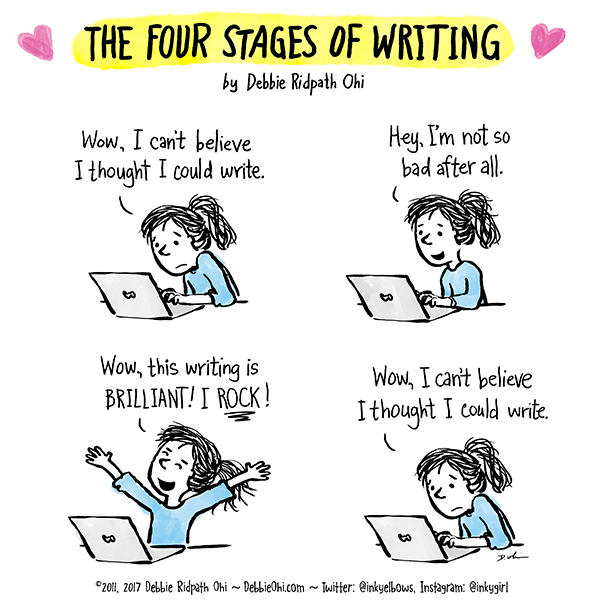
ME, as I work on my middle grade novel.

OHI0017-WRI-4StagesWriting-v7-Handwritten-flat-600

No guarantee that my middle grade novel will ever be published; that’s out of my control.

I’m trying to focus on what I can control:

(1) Writing the best book I possibly can, and

(2) FINISHING the book.

Source: inkygirl.com

Visit us at First Edition Design Publishing
 

How Writing and Submitting Short Stories Improved My Novel

If you’re writing a novel and are nowhere near the end, why spend time on short stories? Doesn’t that distraction delay getting to the end of the current draft, a moment that always feels months away? I thought so once. One year, I wouldn’t let myself touch any other project until I’d worked on my novel every day. This lasted five months until I revisited “The End.” Again.

Why should a novel writer devote precious writing time to short stories? After five novel drafts, two years of submitting shorter fiction, and seven publications, here are my reasons.

Do Something With All Those Ideas

Not every idea deserves a novel. And there’s something cathartic about expressing an idea soon after inspiration strikes. I’m not holding my breath and suffocating the idea because I have to focus elsewhere. As powerful as some ideas feel in the moment, most are quite happy as short stories or flash fiction or poems, or being expressed at all. I now tend to start each idea in the shortest possible form. I only expand the word count if my gut and reader feedback suggest there’s more to say. In the meantime, I grow my list of stories and drafts, not only my list of ideas.

Understand the Impact of Every Edit

An effective edit rarely moves me in the same way as what inspired the story. Revising a longer work can be a dreary process because it’s difficult to grasp the impact of my efforts. This is not the case with flash fiction. Try changing a word in a 100-word story, swap sentences in 250 words, or drop a paragraph among only 1,000 words. You’ll notice an immediate impact on the entire piece. This inspires me toward better revisions by reminding me how powerful each change can be.

Feel A Sense of Completion More Often

Novel drafts take months or years to write. Short story drafts can take weeks. Flash fiction, anything under 1,000 words, can be even briefer. I’m not saying shorter work is easier to write, or requires any less thoughtful revision. But the satisfaction of reaching the end of a draft will happen sooner with shorter fiction. This can prevent listlessness after always having the same answer for “what are you working on?”

Practice Finding Comps

I read every market to which I submit. If I want a literary journal to publish my story, I not only follow their submission guidelines, but I prove I’ve engaged with what they’ve published. I do so by including the stories I read and liked in my cover letter to the editor. If they overlap with my subject matter or appeal to a similar audience, all the better.

In practice, this is akin to finding comparative titles, or comps, for a novel and citing them in your query letter. Prove that you’re thoughtful and have an understanding of the market.

Strengthen Your Query Letters

Every market where I’ve submitted short fiction requires a cover letter. Writing cover letters has taught me how to address editors, present myself, discuss my work, and highlight my accomplishments. This builds confidence in writing and revising query letters to literary agents. Growing my publication history also strengthens my credibility for the next stage of my writing journey.

Give More Than One Story A Chance

I no longer believe I have to withhold myself from other creative work to finish an ambitious project like a novel draft. Novels do take intense focus and persistence, but the reasons above led me to a new strategy.

I’m currently working on a novel during the weekdays and shorter projects on the weekend. This means that by default, the hardest thing gets the bulk of my time. Sometimes, my weekends are writing-free and the stories have to wait, but I’m always making progress.

Though my novel may take a while before it’s ready, all those shorter pieces are out there, being submitted, rejected, accepted, and in any case, read. Don’t withhold your words from the world because your magnum opus isn’t ready.

What’s been your experience juggling short and long projects?
Do you avoid multiple ongoing things at all cost?
How has one form of writing informed another?


Source: writerunboxed.com

Visit us at First Edition Design Publishing
What Can Flash Fiction Do For Novel Writers?

Are you familiar with flash fiction? Have you dismissed it because you write novels or screenplays or something significantly longer? Well, don’t give up on it just yet. Writing and publishing flash fiction can help in ways you probably weren’t aware, as Gila Green is here to explain.

Book publishing is a tough, competitive business. Still, there’s no reason to make the road harder to travel. Enter flash fiction—an excellent way to break into both fiction and nonfiction book publishing.

Flash fiction pieces are very short stories that still include their own character development and plot. Other names for flash fiction include nano fiction, micro fiction, postcard fiction, and sudden fiction. Usually anything under 1,000 words is considered flash, but it can be as brief as fifty.

If your goal is to publish long, you may be thinking that writing short is a waste of time. I’d like to share five ways writing and submitting flash fiction can shorten the road to novel publication.

Practice Working with Editors

In publishing you absolutely cannot have enough contacts. When you publish flash fiction you will be dealing with an editor—at least one, and sometimes two. Occasionally, you’ll correspond with an acquisition editor who accepts your work and directs you to the editor of that specific genre, or that specific issue. No matter how short your pieces are, that experience working with editors is valuable. You will be that much more polished when communicating with a potential novel editor one day.

Contacts, Contacts, Contacts

If you get particularly lucky, there will be a well-established guest editor for that issue, and you’ll have that editor’s direct contact e-mail and a reason to communicate. This happened to me recently. Imagine my delight when my piece was accepted and I received a personal email from Alicia Elliott with her comments on my work.

You might ask yourself how connecting with editors on very short pieces can really make a difference to you. First, remember that most editors of literary magazines and anthologies are published writers. When your book is under consideration and you receive that all-too common email asking about your marketing plans, you can include that editor’s name as a potential contact.

Second, if you send that editor a polite and personal email, he or she might in future consider giving you a blurb for your novel or a recommendation for a writer’s retreat, advice, or news about industry events.

Examples of a light, personal touches you might include in such a message:

  • “It was a pleasure working with you and I hope we have a chance to work together again soon in future.”
  • “Please add me to your mailing list for future issues and events.”
  • You might also join the publication’s social media and interact in a positive way. I have continued to ‘like’ magazines that have published my work and to communicate with editors on LinkedIn, briefly sharing news. You can also expand your writer’s community this way, far beyond the editor who accepted your piece.

Another point to consider is that flash doesn’t stop at magazines; there are also flash anthologies. Some of those magazines and anthologies are linked to small presses like Akashic Books—a publisher who asks for themed flash fiction and then puts out themed story collections.

This means one short piece could land you as an author in an anthology from a respected press. Not only will that be on your bio, but all of the writers published with you will be pushing that anthology. That’s a lot more marketing partners than you’d have on your own, and it is great exposure for a future novel.

Versatility

Contrary to popular belief, flash isn’t always associated with fiction. Writing a memoir? There’s a micro-memoir online magazine waiting for your submission. There’s nonfiction flash essay and flash event writing, too. Erika Dreifus has put together a fantastic list here. The wonderful versatility of flash applies to genre as well, including crime flash, romance, horror, and most other categories.

Practical Experience

Finally, flash fiction is an excellent way to develop your skills as a writer. You have to make the reader fall in love with your story very quickly, and that takes ability and talent. It’s worth practicing and will improve your novel writing, making it that much more publishable.

Flash Writing as a Dress Rehearsal

I’ve met more than one novelist who told me her novel started with an admired flash piece that she decided to expand. Don’t be surprised if you end up ditching the novel you’re struggling with and stretching out your flash piece to full-manuscript size once you see the micro version of it up on a popular site. There’s nothing like applause to stir up some imagination and motivate you to write more.

In conclusion, no matter what novel genre you’re writing, flash fiction can help you break into publishing your longer works. The most prestigious magazines, including The New Yorker, are big flash fans. If the biggest names in literature are excited about it and publishing it, it’s worth a second look.

By BECCA PUGLISI
Source: writershelpingwriters.net

Visit us at First Edition Design Publishing
How to end a novel: Writing strong story endings

Knowing how to end a novel is an essential skill for fiction writers. Story endings often stay with us as readers – especially when they’re satisfying, haunting, clever or profound. Here are 7 ways to end a novel. May they inspire you to find the best closing for your story:

1. Leave readers guessing: The open-ended story

2. Bring readers full circle: Ending where you began

3. Pull the rug from beneath their feet: Shocking twist endings

4. Create feel-good lingering: ‘Happily ever after’ endings

5. Build in ‘what next?’ – Cliffhanger endings

6. Create complex resolutions: Combining ending types

7. Avoid cliched and unsatisfying story endings: Ending ‘don’ts’

Let’s explore each of these story ending types in greater detail:

1. Leave readers guessing: The open-ended story

Leaving your story open-ended is an interesting but risky approach. Open-ended closing chapters may work in a literary novel. Yet in a genre romance novel, readers typically expect that lovers will be united.

What makes an open-ended story satisfying? It allows the reader to imagine, to fill in the blanks. Without a guide for how we should interpret the final scenes, we’re free to decide for ourselves what they mean.

An example of an open ending: An anti-hero killer ends up relocating and going incognito. This ending was used by the writer’s of the Showtime TV adaptation of Jeff Lindsay’s Dexter series. Not giving a final conflict or confrontation leaves room for future installments.

J.K. Rowling took a similar approach in the final book of her Harry Potter series. (Rowling however also advanced the timeline several years, with her characters shown as grown adults in her epilogue. This was interpreted as a way for the author to convince her devoted readers there would be no more stories involving her characters’ teenage years.)

Even though this type of story ending leaves some room for imagination and interpretation, make sure that you:

  1. Resolve secondary conflicts and arcs so that there is at least some sense of resolution. For example, even if a primary villain lives to fight another day, perhaps their henchmen get their just desserts.
  2. Don’t mistake an open ending for letting the story peter out – even if there is no decisive conclusion, maintain tension to the end.
  3. Know your reason for leaving your story open-ended. Perhaps you want to convey a specific message (in the case of the example above, it could be that sometimes ‘bad’ people get away with bad deeds).

Another type of story ending is the ‘full circle’ closing. Here, everything returns to how it all began:

2. Bring readers full circle: Ending where you began

If you prefer a stronger sense of an ending, the ‘full circle’ story ending can be highly satisfying. This is a particularly effective way to end a book if your story began with a mysterious, unresolved situation. [Brainstorm the starting and ending scenarios for your story using Now Novel’s step-by-step process.]

Example of a ‘full circle’ story ending

David Mitchell’s novel Cloud Atlas is an excellent example of this type of novel ending.

In his sci-fi adventure novel, Mitchell hops between eras and locations from section to section. Each section ends on a cliffhanger or with an unknown unexplained. The author resolves each story arc in reverse order from the middle. This creates a sort of mirror structure around the central post-apocalyptic section.

Cloud Atlas ends with the resolution of the first interrupted story arc. We learn the fate of a character taken ill aboard a ship, and a shocking twist about a primary relationship for the character. Mitchell thus returns us to the first set of characters, and the novel’s first time setting and style (the first and last sections are written as journal entries at sea). This mirror or cyclical structure gives Mitchell’s novel a particularly satisfying sense of completion.

Shocking story endings that surprise us with a major twist are also effective:

3. Pull the rug from beneath their feet: Shocking twist endings

The plot twist is a typical ending for the short story. Famous short fiction authors such as O. Henry and Edgar Allan Poe mastered the ‘twist in the tale’ ending. Yet this can also be a satisfying ending to a longer work of fiction. Masters of the surprise ending include the authors Kazuo Ishiguro and Ian McEwan.

Alec Worley, in his post ‘The 5 types of twist ending’, lists the following types of story twists:

How to end a novel with a reversal: the 5 types

  1. Identity reversal: In which ‘someone turns out to be someone else’. A character is not who we (or other characters) thought they were. This is a common ending type when there is an unreliable narrator.
  2. Motive reversal: In which the reader assumes a character is acting out of the desire for x when what they really want turns out to be y. For example, we think a character seeks a lover because they’re romantic, but they turn out to be controlling and power-seeking.
  3. Perception reversal: In this type of story ending, the protagonist realizes their world or their understanding of it is out of step with reality. This is a common ending type in Poe’s dark, Gothic stories.
  4. Fortune reversal: Here a character is brought low or elevated to new highs by a stroke of luck or unforeseen circumstances. Dickens’ Great Expectations is an example. The character Pip inherits a fortune from a mystery benefactor, who turns out not to be the person he thought.
  5. Fulfillment reversal: A character reaches the goal of their primary motivation. But another character’s actions undo their hard work.

An ending doesn’t have to be shocking or surprising. Yet surprising reversal endings give readers the uncanny feeling of having been duped. This sense of surprise can make your climax more dynamic and exciting.

Story endings - quote by Stephen King | Now Novel

4. Create feel-good lingering: ‘Happily ever after’ endings

A twist ending, especially a shocking, discomforting one, carries the risk of angering readers who were looking forward to an expected resolution. Sometimes you’ll simply want to give readers what they expect and desire of a novel in your genre.

A tidy wrap-up can be comforting and reassuring – it’s why most childhood tales end with ‘happily ever after’ (or simply the reassuring finality of ‘the end’).

Even if a tidy ending feels a little too predictable, there are ways to make the wrap-up more interesting:

5. Build in ‘What if?’ – Cliffhanger endings

If you want to explore your fictional world further over a series of books, cliffhangers are effective story endings.

Think of how screenwriters handle plot arcs in thriller TV series. While each major plot arc of each season is mostly resolved, there is something left over that leaves viewers hankering for the next season to start. The bodyguard’s ward may be killed and they fail in their main task, but they (and us) still need further answers. Who was the culprit? What was their motivation?

Think of each book in your series as a season. Building the ‘what next?’ into your closing chapter will keep readers on the lookout for your next installment. It also helps to stop your resolution from feeling too tidy and convenient.

6. Create complex resolutions: Combining ending types

There’s no reason why you should have to stick to just one of the story ending types listed above.

There’s no single correct answer for how to end a novel. A simple return to the beginning can be effective, but the way David Mitchell returns to the beginning in Cloud Atlas with new information is both complex and satisfying. It’s a combination of a ‘full circle’ ending and a final twist.

Explore ways you can combine different types of ending to provide some surprise and some satisfaction.

Writing story endings - John Irving quote | Now Novel

7. Avoid cliched and unsatisfying story endings: Ending ‘don’ts’

Some story endings feel hollow and unsatisfying. Here are novel endings to avoid in your writing:

  1. The deus ex machina

    A deus ex machina describes when an unlikely story event provides a quick, all-too-convenient resolution. It usually feels contrived. The term is derived from the ancient Greek for ‘God from the machine’. In the Greek theatre, actors playing Gods would be lowered onto the stage on a rope via a crane-like contraption, usually to resolve primary conflicts. Try to avoid lowering in convenient Gods near the end of your story on obvious rope.

  2. The abrupt ending

    The end of a novel serves multiple important functions: It resolves major questions raised by preceding plot events (or purposefully leaves some unanswered). It clarifies and rounds off important ideas or themes (reinforces the ‘point’ of the novel). It also shapes the lingering impression readers will have of your story as a whole.

    Avoid moving your story to an end without sufficient build-up and release. The best story endings weave together all the different threads that have been laid out before the reader. It’s often subtler to do this over several ending scenes or chapters. This is often smoother than hurriedly tying all your characters’ arcs up in a clumsy knot. This being said, there are no ‘rules’. Bret Easton Ellis ends The Rules of Attraction mid-sentence. However you choose to end your story, know your reasons.

Source: nownovel.com

Visit us at First Edition Design Publishing
Learn How to Write and Finish a Novel

According to Kurt Vonnegut, “The primary benefit of practicing any art, whether well or badly, is that it enables one’s soul to grow.” If this is true, then nothing makes for more mature souls than writing a novel, a form that particularly requires perseverance and patience. Though there are no hard and fast rules for how to get from the first draft to bookstore shelf, these guideposts on how to write a novel will help you find your way.


01. Give Some Thought to Plot.


Writing a novel can be a messy undertaking. The editing process will go easier if you devote time to plot in the beginning. For some writers, this means an outline; others work with index cards, putting a different scene on each one. Still, others only have a conflict and a general idea of where they plan to end up before diving in. If you’ve been writing for a while, you already know how your brain works and what kind of structure it needs to complete big projects. If you’re just starting out, then this may be something you’ll learn about your writing process as you revise your first novel.


02. Get a First Draft Down.

Though it is a good idea to test your idea out on other writers, resist getting feedback on the writing itself at this stage. Focus on getting the complete story down on paper instead. If you have trouble with writer’s block or tend to let, projects stall, NaNoWriMo might be helpful. Other writers maintain a regular schedule and spread the writing out over a longer period of time. Still, others enroll in novel classes, which provide weekly deadlines and community.


03. Be Prepared to Revise.


At a reading for his first book a few years ago, novelist Dominic Smith commented that the one thing he wasn’t prepared for in writing a novel was the amount of work between first draft and published book. In one way, this is heartening. However inspired you might feel while writing it, the first draft will probably be bad. It will be clunky, disorganized, and confusing. Entire chapters will drag. The dialogue will be unconvincing and wooden. Rest assured that it’s this way for everyone. And like writers everywhere, you just have to roll up your sleeves and get to work rewriting it.


04. Solicit Feedback.

When you think it’s time to start contacting agents, get feedback from writers you trust. Don’t be surprised if they send you back to your desk for another draft. Address any large structural problems first, and then go through the book scene by scene. Anytime you have a question about whether something is working, stop and see what you could do to make it better. Don’t just hope the reader won’t notice. If you want your book to be good, revise with your most intelligent, most thoughtful reader in mind.


05. Put It Aside.

If you find yourself banging up against the same problems with every draft, it may be time to work on something else for awhile. Sixteen years elapsed between the first draft of Jane Austen’s Pride and Prejudice and the published version, for instance. Katherine Anne Porter likewise took years on some of her most famous stories. If you find yourself losing your way, go back to the fun parts of writing. Create something new; read for fun. With each new project you take on and each book you read, you’ll learn new lessons. When you come back to the novel — and you will come back — you’ll see it with more experienced eyes.

By
Source: thebalancecareers.com

Visit us at First Edition Design Publishing
 

The 3 Secrets to Addictive Fiction

In today’s unbelievably competitive industry, how can you make your fiction the best?

Addict your reader.

Make reading your stories and novels an addictive experience. The reader who is addicted to your writing will plunge into your fiction and then fight to stay there forever.

But how can you addict your reader to your stories?

Use the secrets that all great authors have used throughout the ages to give the reader exactly what they want. There are literally thousands of these secrets, but in my work as an independent editor I have prioritized them and categorized them into the simplest possible arrangement—three basic categories.

I teach fiction through its three aspects:

1. character
2. plot
3. prose

However, beyond than that, I teach the secrets to making these three aspects addictive:

1. unforgettable character
2. inescapable plot
3. mesmerizing prose


Secret #1 Unforgettable Character

The most fundamental truism of fiction is that all great plot grows out of character.

You can design any type of plot you like. However, if it’s not grounded in the character of your protagonist, it will be nothing but a mish-mash of events from which the reader can disengage at any time and walk away.

On the other hand, you can design almost no plot at all, and if it’s grown entirely from the character of your protagonist, the reader will not only be addicted to your work, they’ll convince all their friends and relatives to become addicted as well.

Ask yourself:

How did James Bond become a cultural icon, although his plots are repetitive and he must frequently be rescued by a young woman he’s just met? What made Agatha Christie a phenomenon of her genre, although her mysteries so often hinge on her villains’ implausible acting skills and even authorial cheating? Why do we still love Cathy and Heathcliff, although Wuthering Heights is so bizarrely organized and consists almost entirely of a laundry list of inhuman behavior?

Because Bond, Miss Marple, Hercule Poirot, Cathy and Heathcliff are the unforgettable characters from which their plots grow.

This means that character is where we always start.

So how do we make this character unforgettable? That work is based upon the character’s conflicting internal needs. These needs must be internal or they won’t be powerful enough to fuel an entire novel. They must conflict, or there won’t be any climax to this story. And they can be explored most effectively through the three basic human needs: love, survival and justice.

There’s a lot to discuss about a protagonist’s conflicting internal needs. And I’ll teach you all about them in my 2nd guest post for Write to Done: The 2 Steps to Creating Unforgettable Character.

Secret #2 Inescapable Plot

Now what is this unforgettable character going to do?

A story—short fiction or novel—is, at its most fundamental, simply an opportunity for the reader to spend time with your unforgettable character. To make friends with them. To bond. To allow this character to become a part of their life.

This means you must design a plot that gives the freest possible reins to the protagonist’s character—exploring it, exposing it, delving into it to reveal its most intriguing and hidden facets.

The paperback genre industry of the early 20th century can teach us everything we need to know about how to design plot. Those authors cranked out their genre novels regularly and reliably, treating fiction as a day job to which they showed up and worked five days a week, 45-50 weeks of the year.

What do readers get out of genre fiction?

A plot that hooks them quickly, takes them for a thrilling whirl, then throws them off a cliff.

This is rooted in our human addiction to things that come in threes: the simplest construct that exists that also retains a crucial layer of complexity.

And this is why I teach three-act structure: Hook, Development, Climax.

Within these three acts, we can refine our design based upon the importance of climax. Each act has a unique purpose, to which we can devote a full half of that act. And each act also needs a climax, to which we can devote the other full half of that act. That’s how important climax is.

Once we have these six structural pieces, we can refine our design even further by breaking each piece into six more pieces. In this way, we can quickly and easily design a plot of 36 pieces along a specific pattern.

I call this holographic design.

The reader has already unconsciously adopted this pattern through the reading of their first great story. It’s what they expect. Because it’s great storytelling. And, through proper design, it’s what we can regularly, reliably give them.

But how do we turn this simple design into a rollercoaster ride, one that will keep the reader addicted on every single page? There’s a counter-intuitive trick to this that gives your plot the essential contrast that throws your entire design into three-dimensional relief, gripping your reader, meeting their unconscious expectations, and making your plot inescapable.

I’ll teach you all about this in detail in my 3rd guest post for Write to Done: The 4 Steps to Designing Inescapable Plot.

Secret #3 Mesmerizing Prose

Finally there is the writing of this character-grown plot.

How do you turn a brilliant, well-developed idea into a novel of some 70,000-100,000 words—a novel that the reader can’t forget, can’t escape, can hardly put down even for a minute? Because 70,000-100,000 are a whole lot of words. And the reader has a life to live.

How do you write a novel that’s mesmerizing? One to which the reader is addicted?

You’ll hear a lot in the writing community these days about how to make time to write, how to write faster and more efficiently, how to get your manuscript finished. This advice is mostly about time management, on the assumption that your life is not set up for endless hours in front of the keyboard. However, focusing upon time management misses a crucial element of writing: you write because you love to.

Truly, if writing is not the one thing you love to do above all else, then go find out what is and do that. Life is too short for wasting on doing things you don’t love.

And if writing is the one thing you love to do above all else, then you don’t need time management. You need stamina. You need to stay in touch with your passion. You need, especially, to know what you’re doing.

Only through a combination of your passion and an understanding of your work can you make your time at the keyboard as productive as humanly possible. Only in this way can you produce manuscripts full of life, while also devoting yourself to the life that is your own.

Your first goal, of course, is to get a draft written. But there are tricks to the efficient writing of a first draft. And there are certainly techniques to editing that draft into polished prose.

I’ve developed a set of guidelines that I use for writing quick first drafts and then turning my clients’ drafts into powerful professional prose. And I often teach my clients these guidelines. Of course, I never teach them all—those are my trade secrets. But I learned them all from the published works of great authors. And you can too.

All you have to do is study in-depth hundreds novels line-by-line and practice for thousands of hours in order to discover what makes writing clear, strong, and vivid. Mesmerizing.

To which authors and stories are you addicted? Why?

By Victoria Mixon
Source: writetodone.com

Visit us at First Edition Design Publishing

The Two Scenes in Your Novel That Will Need the Most Rewriting

Novels are tricky. There’s so much to juggle that no-one gets it quite right the first time round … and most authors end up doing wholesale rewrites, rather than just making a few editorial tweaks.

I’ve come to accept that rewriting is just part of the process of creating a novel. Each time I start work on a new book, I want to be a more efficient writer – and while I have found some things easier, I still end up doing a lot of rewriting and reworking.

Maybe it’s the same way for you.

Whether you’re working on your first draft of your first novel, or you’ve completed a bunch of novels already, there are two scenes that you’re likely to spend a lot of time rewriting:

  • The opening of your novel
  • The climax of your novel

However hard you worked in the first draft, and however much you planned, these are just really difficult scenes to pull off well.

But the good news is – even if your first draft doesn’t quite hang together in these key areas, rewrites can fix anything!

Why Your Opening Scene (Probably) Needs Rewriting

The first scene of your novel needs to do a lot of heavy lifting. It has to get the story going – no mean feat! – and it has to establish your main character(s). At the same time, it needs to set the tone for what’s to come and it has to “hook” your reader.

Plus, unless you draft your book patchwork-quilt style, working on scenes here and there and stitching them all together at the end, the opening scene is probably the very first thing you wrote when you began your first draft. Chances are, your ideas have shifted a bit (or a lot!) since then.

The first scene of my novel Lycopolis went through about a dozen rewrites. I had several completely different versions of that scene – in the very first draft, for instance, I went with an omniscient perspective dipping in and out of all my different characters’ viewpoints. It soon became clear that this wasn’t going to mesh well with the limited close third-person perspective I ended up using for the rest of the novel!

If the current draft of your opening scene isn’t quite working, you might want to ask yourself:

  • Have I started this novel at the right moment? Would it be better to skip the preamble and jump straight into the action? (Or, conversely, do you need to backtrack and start a little earlier?)
  • Does this scene introduce my main character(s)? If not, is there a good reason – or would it be better to start with them?
  • Is there a “hook” in this scene … something that would capture readers’ interest and keep them turning the pages? (It doesn’t need to be something huge and dramatic, unless your genre requires that!)
  • Does this scene fit well with the rest of my novel? You could write a brilliant first three pages for a competition or an agent … but if they seem to belong to a different book altogether, they’re not going to get you far!

Why the Climax of Your Novel (Probably) Needs Rewriting

The climax of the novel is the high point of tension/action where everything comes together. Your protagonist, after the greatest trial yet, finally wins what they were after all along. (Or, in a less happier novel, your protagonist finally fails irrevocably.)

The climax, like the opening, needs to do a huge amount of work. It has to pull together lots of different threads from your novel, and potentially quite a few different characters. In many novels, your hero has to face what seem like insurmountable odds … and s/he needs to triumph regardless. But that triumph must be earned, and convincing.

Invariably, I find that the first time I draft this scene in my novels, it falls a little flat. The action isn’t dramatic enough. The very real possibility of danger isn’t potent enough. The characters don’t struggle enough. With each rewrite, the climax involves more tension, danger and drama.

Occasionally, after the first draft, I find I’ve changed my mind about how it should all end. This happened with my second novel, Oblivion, which took a long time (my kids were both born along the way!) and where I realised that I wanted the novel to end quite differently from how I’d originally planned.

If the climax of your novel isn’t quite coming together, you might want to ask yourself:

  • Is my protagonist struggling (and even suffering) as much as they should here? How could I make this harder for them?
  • What price does my protagonist pay for success? If they haven’t already sacrificed something to get to this point, maybe that should happen during the climax.
  • Have I tied up various loose ends from the novel? (It might well be fine to address some of these after the climax, in the final pages of the novel – but be careful it doesn’t end up dragging on too long.)
  • Does the victory come because of the protagonist’s actions? Be careful if not: if someone else steps in to save the day, or if the protagonist wins through a stroke of luck or an act of God, the climax might feel unsatisfying to you readers.

If you find yourself rewriting your opening scene and the climax of your novel multiple times, don’t be surprised or dismayed – it’s perfectly normal to end up reworking these a lot. Other scenes in your novel might need much less attention, because they’re neither so complex nor so crucial.

With my own novels, I’ve definitely had times when I felt like I would never get these scenes finished to my satisfaction. Eventually I did! If you’re at that stage right now, hang on in there – take a break or get someone else’s input if you can, and then get back to the rewrites. Good luck!

By Ali
Source: aliventures.com

Visit us at First Edition Design Publishing
15 Ways to Make Your Characters Suffer (for the Good of Your Novel)

Note: This post was originally published in 2016, and was updated in June 2018.

Do your characters suffer enough?

Even if you’re writing a light and fluffy romance, at some point, someone in your novel is going to need to get hurt.

I’m not suggesting all-out graphic torture here, obviously – unless that suits your genre. Suffering comes in a lot of different forms – and I’m going to go through a bunch of those in a moment.

In general, making characters suffer should do at least one, ideally both, of these:

  • Advance your plot: bad stuff may well need to happen in order for your heroes to get to (and earn) their happy ending. Often, some degree of suffering is what drives the plot: the protagonist is unhappy with their life as-is and wants to change things.
  • Deepen or reveal character: either we see who someone really is when they’re hurt (someone who seemed a bit of a wimp turns out to have hidden strength; someone who was nice on the surface reveals a vindictive side) … or it’s part of their character arc.

Any and all of your characters can get to suffer: heroes, villains, and those with walk-on parts. The main difference is in how the reader will respond.

Our natural reaction to seeing someone hurt or in pain is to feel sympathy towards them. If they’re a particularly nasty character, though, we might well feel they’re getting their just deserts. The more awful they are, the less likely we are to feel sorry for them – even if their suffering is pretty extreme (think Ramsay in Game of Thrones, for instance).

If a minor character suffers, the importance of this may well be how the hero (or villain) responds: do they help? Are they distressed? Amused? Indifferent? Introducing someone who’s in some kind of pain can also be a good way to instantly get the reader’s sympathy.

15 Ways to Make Characters Suffer

There are some fairly obvious ways to hurt your characters: physical violence being pretty high on the list. However, that won’t always suit your novelistic purposes (sure, you could break your protagonist’s legs, but that may make the rest of your story fall apart) – and it’s not appropriate for every genre.

Keep in mind, too, that suffering and misery alone aren’t going to make for a very interesting story: what’s important is how these alter the characters and the plot (generally, if something’s impacting one of those, it’ll impact the other).

If you’re a bit stuck for ideas, though, or you feel like your characters should go through a bit more misery but whacking them around in a fight isn’t going to quite cut it … here are different ways to make your fictional people suffer.

This is not, I suspect, an exhaustive list – please do add your ideas in the comments! I’ve split these into “physical” and “non-physical” (though obviously there’s an overlap in many cases); other than that, they’re not in any specific order.

Physical Suffering

#1: Sleep Deprivation

As any parent of small children can tell you, this can be pretty horrific! 😉 It brings together physical exhaustion and emotional/mental difficulties too, so it could be a handy one to go for if you’re avoiding outright violence, or if you want something more emotionally draining than purely physical pain.

The cause of the sleep deprivation is (or should be!) significant; if nothing else, these will impact on how the character feels about it (and how easily they can solve it). A young baby? A snoring partner? Insomnia? Deliberate torture?

Handy for: plot complications (character may be unsafe to drive, operate machinery, etc); seeing who a character is / how they respond under pressure.

Example: Season 4 of Dexter begins with Dexter and his wife Rita pretty sleep deprived due to baby Harrison crying at night – this kicks off the plot as Dexter accidentally brings the wrong file to court, resulting in a violent killer going free.

#2: Hunger

A character who’s hungry has a very basic, pressing need to fulfil. This might be a temporary situation (they’re stranded somewhere with no food and possibly no water) or a more ongoing form of suffering that drives the whole plot.

Handy for: pushing characters into making tough decisions (anything from “steal to feed a child” to “resort to cannibalism”).

Example: In The Hunger Games, by Suzanne Collins (as you might guess from the title) hunger drives the plot. Teenagers compete in annual “hunger games” to win food for their communities.

#3: Health Condition

Any long-term physical health condition could impact on (quite possibly drive) the plot. It doesn’t necessarily have to have a constant presence: for instance, if a character occasionally suffers strokes or migranes, that could be a source of stress and conflict but not something that limits them at every moment. It could be anything from minor to debilitating.

Handy for: (if the condition exists from page one) limiting a protagonist who might otherwise be too powerful or succeed too easily; (if the condition arises during the novel) forcing a protagonist to come to terms with the loss of their hopes or dreams – or even to face their own mortality.

Example: One of the main characters in Linda Green’s And Then It Happened ends up in a coma, due to a head injury, part way through.

#4: Pregnancy

While it felt awkward to count this as “suffering”, pregnancy will at least limit a character – morning sickness and exhaustion in the first trimester; increasing size and tiredness in the third. There’s also the possibility of an unwanted pregnancy, and how your character reacts – which quickly shades into more mental types of suffering. In some romance novels, pregnancy (particularly accidental pregnancy) can be a source of conflict and story tension.

Handy for: other characters’ responses (e.g. concern for pregnant character and unborn child); racking up the tension for the reader if the pregnant character ends up in a dangerous situation; possible drama surrounding any complications, or simply the labour and birth.

Example: Intelligence operative Angela Burr in The Night Manager is pregnant with her first child – this doesn’t have any particular dramatic impact on the plot, but does make her more potentially vulnerable, particularly as she gets more involved in the action towards the end of the series.

#5: Long-Term Injury

A broken leg or arm, or a serious wound, can limit a character’s actions for a fair amount of time. These aren’t necessarily going to cause continuous pain (a broken limb will be very painful in the immediate aftermath, but assuming it’s treated and the character has painkillers, it’s going to be more like an inconvenience than a source of agony).

Handy for: keeping a character on the sidelines during a particular part of your plot; other characters’ reactions to the injured one; how the character reacts to having to rest and recover; initial drama and conflict as the injury gets seen to.

Example: In The Accident Season, a YA novel by Moira Fowley-Doyle, various characters suffer injuries – when the story opens, Cara (the narrator) has sprained her wrist, and her older sister Alice has fallen down the stairs.

#6: Short-Term Injury

This doesn’t have to be minor (it might well be life-threatening), but it should be resolved fairly quickly with minimal lasting effects. E.g. if someone has lost a lot of blood, they could be bandaged up (and possibly treated in surgery) but back on their feet after a couple of days.

Other short-term injuries might be painful (bruising, burns) but not incapacitating.

Handy for: immediate pain and trauma; getting a character back into the plot quickly; potentially changing the relationship between the injured character and character(s) who help; works well in light/comic novels too.

Example: In Off to be the Wizard, a comic speculative fiction novel by Scott Meyer, the protagonist Martin suffers a number of fairly amusing minor injuries, particularly in the early chapters.

#7: Incarceration

A character is – rightly or wrongly – imprisoned. The suffering here could simply be the loss of their freedom, or that could be compounded by other types of suffering (separation from their loved ones, being ill-treated or tortured, hunger…) If the incarcerated character is a more minor one, then the protagonist might be pushed to rescue them, particularly if they’re in danger or being used as leverage.

Handy for: getting them out of the way; giving them time to reflect on how they’ve screwed up; furthering the plot (e.g. through their escape attempt); could easily be part of their character arc.

Example: Tony Stark in Iron Man is captured by terrorists early on during the narrative: this is a hugely important moment in both his character arc and the plot of the whole Iron Man series: he invents the Iron Man suit in order to escape.

#8: Torture

The character is deliberately and repeatedly hurt (physically, but you can bring in psychological angles too) by another character. This is – at least ostensibly – usually for information but it could be a form of punishment … or, if your antagonist is particularly heinous, just for “fun”. It can potentially have a medical component: the torturer isn’t causing them pain for pain’s sake, but because they’re testing the character in some way.

Handy for: making your villain pretty darn unredeemable; pushing good characters to their limits; blurring the moral lines (under what circumstances would the mostly-good guys torture someone?); causing your protagonist a great deal of anguish if someone else is being tortured in order to break them.

Example: Firefly’s Mal (Captain Reynolds) and Wash, in “War Stories” are tortured by bad guy Niska; significant primarily for the character development / interaction between them (and to some extent for other characters too, particularly the relationship between Wash and his wife Zoe).

Non-Physical Suffering

You can put characters through hell without a single cut or bruise. Here are a few ideas:

#9: Financial Problems

Money (as most writers notice at some point!) can be a massive source of stress. This can work for almost any character, however well-off – e.g. they lose all their money, or they go through an acrimonious divorce, or money is a serious source of relationship stress.

Handy for: putting pressure on a relationship; forcing difficult decisions (especially if physical suffering – e.g. hunger – is on the horizon); conflict between characters.

Example: The gulf between rich men and their (usually female) assistants, who are paying off student loan debt, kicks off drives the plot in The Assistants by Camille Perri.

#10: Losing a Job

On its own, this isn’t necessarily a form of suffering – but assuming the character wanted or needed the job, then it’s likely to lead to financial or social difficulties. They may face a crisis of self-identity.

If losing a job is a bit drastic, an explicit or implied threat to a character’s job can be a milder way of achieving some of the same effects. In children’s or YA fiction, expulsion from school, or the threat of it, can work in a similar way to an adult losing a job.

Handy for: relationship problems (with spouse, former co-workers, etc); character blaming themselves; freeing up a character to have more time for interesting things than going to work every day!

Example: A fairly large source of tension in Season One of Marvel’s Agent Carter is the gulf between Peggy Carter’s work in law enforcement and the highly illegal activities she’s undertaking on the side in order to protect Howard Stark (who she believes – rightly – is not guilty of the crimes he’s been accused of).

#11: Social Problems

Perhaps your character is rejected by their community, or is misunderstood or vilified. They might be at fault or they might be blameless – or perhaps something in between. The pain this causes could range from feeling a bit lonely to being devastated; if you’re writing something fairly dark, it could well lead to the character being hunted down and physically attacked.

Handy for: questioning identity, potentially striking out in a new direction, feeling like they have nothing else to lose, potentially making some bad choices

Example: In K.M. Weiland’s Storming, Hitch, the protagonist, returns to a close-knit community that he left years before – and there’s a lot of animosity towards him (particularly from his sister-in-law).

#12: Bereavement

One particularly effective, if horrible, way to make your character suffer is to kill someone they love. This might be part of the plot (the antagonist murders their best friend) or it might be part of the back story (their spouse is dying or has died before the story begins).

Handy for: deep distress and despair; questioning of their purpose; potentially strengthening their resolve to succeed in reaching their goal.

Example: Detective Jamie Brooke in Joanna Penn’s Desecration has a terminally ill 14-year-old daughter who passes away part-way into the novel: a huge source of grief for Jamie, but also a critical part of the plot, as the body is stolen.

#13: Mental Illness

There’s a whole range of potential suffering under the broad umbrella of “mental illness” – depression, anxiety, eating disorders, drug addiction, PTSD, etc. You might have a protagonist with a backstory of mental illness – or your protagonist might have a friend or relative suffering with a particular mental health difficulty. I’m sure it goes without saying, but do approach these with a bit of caution and sensitivity.

Handy for: starting off the novel with a character already facing a difficult struggle; introducing mental health problems part way as a result of traumatic plot events.

Example: Jessica Jones, in Marvel’s Jessica Jones, is suffering from a form of PTSD (plus, if not outright alcoholism, at least alcohol abuse) from the first episode.

#14: Esoteric Suffering

I’m using this as a catch-all for types of suffering that might crop up in speculative fiction, horror, and some thrillers. Think psychic powers or super-powers: pain or suffering caused by something at least somewhat supernatural, which could be anything from some kind of advanced technology to magic-wielding humans to an evil demon.

Handy for: something painful (quite possibly cripplingly so) that doesn’t have lasting effects; showcasing antagonist’s power even at a distance; creepy or unsettling effects; causing or interacting with other types of suffering.

Example: The Hunter in Ceila Friedman’s Coldfire trilogy can inflict this sort of pain, particularly in the form of nightmares.

#15: Fear

One fairly simple (but often potent) form of suffering is to have a character who’s afraid. This doesn’t necessarily have to result in any eventual injury or harm: simply having them really scared can ramp up the tension, and can potentially push them into difficult or bad decisions.

Handy for: increasing tension without increasing the body count; keeping scary things just slightly off the page (often scarier!); pushing characters into a corner; making them make a brave decision (or live with the fact they didn’t).

Example: Five-year-old Jack in Emma Donoghue’s Room goes along with his mother’s plan to free them (which involves rolling him up in a rug and pretending he’s dead) despite being understandably scared.


And in case that list isn’t quite enough for you, here are some bonus ways to pile on the suffering:

  1. Your character’s own stupid decisions caused the Bad Thing to happen to them.
  2. Your character’s brave, heroic act caused the Bad Thing: they stood up for justice, and it go them shot / arrested / etc.
  3. Your character isn’t the one suffering (or not the only one) – someone they love is in pain.
  4. It looked like something was finally going to go right for your character … but then it all came crashing down.

If, like me, you’re sometimes a bit of a wimp when it comes to letting your characters suffer … write the first draft as lightly and fluffily as you want, then pile on the suffering in subsequent rewrites. It’ll make for a stronger, more compelling novel.

By Ali
Source: aliventures.com

Visit us at First Edition Design Publishing