Category Archives: ebook

Fascinating Words for Colors (and the Battle of Magenta)

Imagine not having a word for “yellow” or “beige” or “orange.” For many years, English got by with a lot fewer words for color than we have today.

By

Mignon Fogarty,

Grammar Girl


This a Stitcher Premium exclusive Grammar Girl podcast episode. Want to hear it? Head to stitcherpremium.com/grammar and use code GRAMMAR to sign up for your free trial and get access to all archived ad-free episodes, bonus episodes, and more.

Colors are such fundamental, tangible things that it’s hard to imagine not having names for them, but the number of words for colors varies widely by language and for many, many years, English got by without a lot of the color names we take for granted today.

In nearly all languages, the first colors to get names are black and white.

Black

“Black” comes from very old words that meant “to burn” or “burned.” But the same old words also gave us “blake,” which is a now obscure word that meant pale, pallid, and ashen. In fact, the Oxford English Dictionary says that it is often difficult to tell which of these two colors is meant in Old English texts when the context doesn’t make it clear. And to make it even more complicated, at some point, “black” could also be used to describe something bright, shining, or glittering, perhaps related to the idea that something that is burning is all those things. So it took “black” a while to be limited to what we think of as black today.

White

“White” is a little more straightforward. In Old English, it meant “bright and radiant, or clear and fair.” It could be describing something we think of as white such as snow, milk, or an old person’s hair, but it could also describe something transparent, or something light yellow, pale gray, or silver. Online Etymology Dictionary says “White” is also one of the oldest surnames in English, originally referring to people with fair hair or a fair complexion.

There are still languages today that have just two words for colors that are essentially white for all light or warm colors and black for all dark or cool colors.

Red

That surprised me, but one thing that surprised me most was that the next color almost all languages name is red—one theory is that it’s because it is the color of blood.

Although black, white, and red all likely go back to the prehistoric language Proto-Indo-European (PIE), Online Etymology Dictionary states that red is “the only color for which a definite common PIE root word has been found.

Red shows up in a lot of place names where it referred to the color of natural elements such as rocks and soil. For example, the Oxford English Dictionary lists Radcliffe, Radclive, Redmile, Redford, and Rattery, all from 1086, and slightly later Radly and Redhill. The same root for “red” also likely gave us the word for the color “rust.”

In those early days though, “red” was probably the name for the color rust, as well as purple, pink, and orange.

In fact, we call people redheads instead of orangeheads because at the time we started calling them anything, the word “orange” hadn’t entered the language as a color word, and the word “red” included the orangey color of red hair.

Interestingly, the Irish writer Stan Carey told me that the Irish word for red hair is different from the general Irish word for red.

Grue

After red, most languages add a word for either yellow or a spectrum that includes both green and blue that language experts sometimes call “grue.” Since blue and green are so prevalent in nature, I would have expected one of them to be the third word more languages would add, but I was wrong!

You can think of these as the five base colors that most languages have: black, white, red, yellow, and green/blue. And English today is described as having 11 main color words: those five base colors (black, white, red, yellow, and green/blue) plus brown, orange, pink, purple and gray, but some languages have more or different words. For example, Russian, Greek, and Turkish have separate words for light blue and dark blue.

Gray, Brown, and Orange

Gray and brown are both very old words that go back to Old English, and orange came from the color of the fruit after oranges were introduced to Europe, around the mid-1500s.

Purple

Purple was originally a shade of crimson “obtained from mollusc dye” and associated with people of importance such as emperors, kings, cardinals, and so on. It came to describe many colors in the spectrum between red and violet. The color we think of as purple today was first called purple in the 1400s.

Pink

Pink is especially interesting. According to the OED, “pink” originally referred to “a greenish-yellow lake pigment made by combining a vegetable coloring matter with a white base such as a metallic oxide.” It seems like that first “pink” was more of a description of the process than the color, since the OED notes there were colors such as green pink, brown pink, rose pink, and pink yellow. The origin of the word is unknown, but in the 1600s, the word “pink” also started being used to mean the light red color we think of today. The origin of the greenish-yellow pink and the light red pink are both listed as unknown, and it’s unclear to me whether etymologists think they are related, but I think not.

This second pink—the one we think of today—probably comes from the color of the flower Dianthus, but the flower probably got its name from the spiky, scalloped shape of its petals because if you’ve ever used pinking shears, you know that “pink” has another meaning: to cut a scalloped or zigzag edge on fabric. Earlier, it also meant to punch holes or slits into fabric. So the “cut fabric” meaning of pink came first, the flower Dianthus was called a pink because of the shape of its petals, and then we got the color pink from the color of the Dianthus flowers.

But English also had a different word to describe the color pink before we started using “pink.” In the 1500s and into following centuries you could use the word “incarnate,” which comes from the Latin word for “flesh.” It doesn’t look like it was used alone the way we use colors alone today, as in “That flower is pink.” Still, you could describe something as “an incarnate color,” meaning a pink or fleshy color, or say you picked “incarnate clovers,” meaning pink clovers.

Colors from Nature

Colors continued to come from nature through the 1700s. For example, ultramarine, a blue color, comes from Latin that means “beyond the sea,” probably because the color originally came from a blue pigment from the mineral lapis lazuli which came from Asia.

The late 1700s gave us “maroon,” from the French word for the color of a chestnut, and “puce,” from the French word for flea or the color of a flea (yes, the insect).

Colors After Chemical Dyes

Advances in chemistry in the mid-1800s that allowed manufacturers to make synthetic dyes led to an explosion of new colors, and the fashion industry in particular embraced the ability to add novelty to its products and drove the adoption of many new color words. According to a book called “Bright Modernity: Color, Commerce, and Consumer Culture”:

“Women’s magazines disseminated the names of new colors and sometimes their origins. Acquiring this knowledge was part of keeping up with fashion for the  middle-class female consumer.”

Many of these new color words came from French. Some of the colors this new era gave us include the following:

  • Mauve: The French word for the color of the mallow plant’s flower
  • Ecru: From the French word for “raw or unbleached” because it is the color of unbleached linen
  • Beige: From the French word to describe the color of undyed, unbleached wool
  • Burgundy: Referring to the color of wine through the Burgundy region in France
  • Turquoise: From the Old French word for “Turkish” because the turquoise-colored stone was originally imported from the Turkish region

The mid-1800s also gave us “aquamarine,” which comes from Latin and means “sea-water,” and “khaki,” which comes from the Urdu word for “dusty.”

Tangerine, the fruit, got its name in the mid-1800s because that particular type of orange was imported from Tangier, and it started being used as a color word in 1899.

There are so many more interesting color words, and I just learned that Kory Stamper from Merriam-Webster is writing an entire book about color words, but I’ll end with the two words that got me started on this grand expedition into color words in the first place: magenta and solferino.

Magenta was originally patented in 1859 by a French chemist and called “fuchsine,” after the fuchsia flower, but soon thereafter was changed to honor a French military victory over the Austrians near the northern Italian town of Magenta. And solferino is a bright crimson purplish red or purplish pink (sources disagree) named around the same time as magenta after a village in northern Italy, again because of a battle that took place in the region.

Solferino also appears to be a coloring that can be added to liquor, at least it was in 1866 when it was used as a tincture that was mentioned alongside caramel and turmeric in the book The Independent Liquorist. The author described solferino as “The handsomest, as well as the most powerful color known to the trade.”

Source: quickanddirtytips.com

Visit us at First Edition Design Publishing
 

Magic Without Rules

Your Hosts: Brandon, Mary Robinette, Margaret, and Howard

When we say “without rules” we’re talking about stories whose magic is not held under logical scrutiny for the reader. There are lots of reasons why you might do this, and in this episode we’ll talk about not just about the why, but also the how.

Credits: This episode was recorded by Dan Thompson and mastered by Alex Jackson

Play

Take a story with rule-based magic. Now have the rules all go wrong, the characters realize they don’t really understand the rules at all.

Source: writingexcuses.com

Visit us at First Edition Design Publishing

When Fiction Doesn’t Work—What Can Be Learned?

By Bonnie Randall 

Part of the How They Do It Series 

JH: You can learn just as much from a bad book as a good book.

Stephen King said “Unless you read, you do not have the tools to write.”

Books that whisk us deeply into a story, have characters who become dear friends, or use language in such a way that leaves us breathless, are powerful tools for writers, because those elements are replicable and take our fiction to higher, deeper, and more meaningful levels.

What, though, about fiction that doesn’t move you in any sort of positive way? Can writing lessons be gleaned from these pieces also? 

I am currently reading a novel that has me turning pages—but not in a good way. I am so frustrated from waiting for the reveal of the ‘Big Bad Secret’ the heroine is withholding that I am thumbing through and skimming just to get to the place where she coughs it up. The suspense is not working for me at all, and partly it’s because of the ambiguity surrounding whatever this secret is; there are no clear clues or indicators, and what is presented is vague.
Also, there has yet to be a clear reason why the character is being cagey about her secret in the first place. Additionally, while the character herself is being indirect, the plot keeps getting >thisclose< to revealing The Big Bad…and then being thwarted by convenient twists.
To add to the frustration, there are also interludes which come in the form of handwritten letters from one character to another—and said letters are heavily implied to be written by the heroine with the secret, and yet (I cheated) actually end up being written by the hero when all is said and done.

(Here’s more on What is “Bad Writing?” (And How Can We Avoid It?))

This does not feel like author cleverness to me, but instead like author trickery; it is one thing to not trust an unreliable character, but quite another to not be able to trust an unreliable author.

The take-aways from this reading experience for me are:

1. When employing the device of the ‘Big, Bad Secret’, strike a good balance that leaves your pacing on the side of suspense rather than frustration—and always have a good reason why your character is keeping their secret under wraps in the first place.

2. If you are going to use an ambiguous POV, make sure you do not leave your reader feeling tricked. There needs to be at least one Easter Egg in each ambiguous passage that raises doubt—and maybe even makes it fun—for the reader to wonder “Is this really Character X? Or could this be Character Y who is thinking / doing / saying these things?”

Now: How about you? Have you read a book that was a real miss for you, yet was still able to impart some good learning?

Please share whatever that book taught you to do (or not do), but do not reveal the title. (Because jeez…what if it’s one of my books?!) Seriously, we don’t want to book-bash, and besides: one reader’s trash is another reader’s treasure; the book I am referring to here, for example, has far more positive reviews than negative, and is selling rather hotly too (which begs the question—what the heck do I know, anyway?!)

Okay, folks. Your turn. And….GO!

Bonnie

Source: blog.janicehardy.com

Visit us at First Edition Design Publishing
The Secret to Writing the Killer Plot Twist

A woman in Poughkeepsie plucks your debut novel off the shelf. Okay, fine. It doesn’t have to be Poughkeepsie. It can be anywhere—Marietta, Springfield, Sedona—wherever. The town doesn’t matter because your debut novel flew off the shelves in every big and small town across America. Mostly because of one big thing. You pulled off the killer plot twist.

Now everyone who reads your book thinks they’re your biggest fan. That lady in Poughkeepsie? You’re about to become her favorite author. And she’s going to hand your book to her best friend and tell her in an urgent and serious whisper, “You have to read this. I still can’t believe the ending.”

Sound too good to be true? It’s not. Because the secret to pulling off the most memorable plot twist since Psycho isn’t a magic spell. It’s the unreliable narrator.

What is An Unreliable Narrator?

Put simply, an unreliable narrator is a character who lies. Sure, sometimes he lies because he has something to hide. But the lie isn’t always deliberate. Sometimes he just doesn’t know the whole story. So how can he explain it right? Sometimes he’s too crazy (American Psycho) or too tired (Fight Club) or too drugged (Fear and Loathing in Las Vegas) to see the full story as it unfolds. But one thing is for sure. Regardless of the reason for his failure, the unreliable narrator’s story is not what it appears to be. And here’s the secret: it’s the gaps in his tale that leave space for the twist.

How Unreliable Narrators Set You Up for a Plot Twist

In life, we brush shoulders with killers and liars, psychos and saints. We don’t always know a killer or liar when we meet one. Maybe he’s just limping Linus from 2A who hides an unlikely amount of antifreeze under his kitchen sink. Or maybe it’s that mom who rolls her kids to the park in the double stroller. What is she really drinking from that flower printed water bottle?

Life creates a multitude of untrustworthy characters who blend with the crowd. The best fiction does too.

You’ve guessed it. Unreliable narrators feature in so many twisted plots precisely because of what they hide. It’s those missing pieces, the parts of the story they hold back, that feature in the big reveal at the end. And that big reveal? The one where we learned what really happened? It changes how we understand the whole story, doesn’t it? Hence the perfect plot twist.

Ready to see them in action?

How to Instigate Your Own Plot Twist (Two Iconic Examples)

Pi from Life of Pi is a character who keeps you guessing. His story of ship wreck and survival at sea isn’t the first of his fantastical tales. But even though his stories are tough to believe, you find that you want to. Since you don’t want to believe what you already know, you become a willing participant in the deception. So the twist surprises you all the same.

Pi is an example of The Embellisher, an unreliable narrator who tells tall tales for fun. But The Embellisher isn’t the only type of unreliable narrator. Verbal Kint from The Usual Suspects uses deliberate deception to trick you in one of the most memorable plot twists in modern storytelling.

Verbal is a Self-Preservationist, an unreliable narrator who lies to save himself. He’s the only survivor of a boat explosion. How he came to be on that boat is a mystery that investigators are determined to extract from him. Verbal’s tale twists many times before the final reveal. Surprise, in this case, is built on deception.

These are just two examples of unreliable narrators. But in 7 Unreliable Narrators to Twist Your Plot I reveal the techniques behind the Self-Preservationist and more. In this article, you’ll get seven character types to wow your biggest fans.

And that lady in Poughkeepsie? She doesn’t need to know you learned it here.

Source: mandywallace.com

Visit us at First Edition Design Publishing
The 7 best cookbooks for beginners, according to an insider

Need to find the best cookbooks for beginners? A cookbook publishing insider shares the 7 best cookbooks for beginners, no matter what kind of beginner you are!


There’s almost nothing more exciting than new beginnings, and to me, there’s definitely nothing more exciting the start of a new cookbook collection.

Anytime a graduation, wedding, baby shower or any other gifting occasion comes up, I have to physically restrain myself from buying 5 new cookbooks for that friend entering a new stage of life. And I mean it–someone (ahem, Jarrett) has gotta hold me back.

Because, you see, I think that finding your way in the kitchen is one of the great pleasures of life. And that’s not even mentioning the practical incentives. Like that whole thing about how cooking at home is the #1 best thing you can do to save money, save your health, and save your relationships.

It’s true: cooking is magic for every corner of our lives, which is why it can be so rewarding to give yourself or someone you love the gift of a few cookbooks. But which are the best cookbooks for beginners? Can there even be one set of best cookbooks for beginners?

The 7 best cookbooks for beginners: why this list is different

In researching for this article, I found that many of the other online lists of the best cookbooks for beginners weren’t really for beginners. They shared books that were either too comprehensive (read: intimidating) for beginners or too high-brow (read: doubly intimidating) for beginners. And many didn’t acknowledge that there are many different kinds of beginners, and that therefore, the best cookbook for one type of beginner just wouldn’t do for another.

So instead, I decided to research and prepare my own master list of the best cookbooks for beginners. It’s organized by the type of beginner you might encounter, as well as by what that beginner might actually be interested in learning.

This list is sourced both from my 10+ years of editing and working on cookbooks, as well as my own life as a home cook and a bordering-on-obnoxious gifter of cookbooks. (And no, I haven’t personally worked on any of these–these truly are just my favorites to gift!)

I hope you find this list helpful for spotting that one best cookbook that will work for your beginner, so you can set them (or yourself) on the path of good cooking and good living.

The 7 best cookbooks for beginners

The best cookbooks for beginners who: want to master the basics

best cookbooks for beginners

How To Cook Everything: The Basics

Mark Bittman

There are many cookbooks for beginners who want to master the basics, but this is the best one for one reason: step-by-step photos. Beginners often feel a surge of confidence if they can see exactly how each step is done and how the food should look. So the 1,000 photos in this thorough starter will go far to relieve their newbie anxiety.

I especially love the beginning sections that explain—with more photos!—the different ways to cook, from sautéing to braising to pan-frying. (You won’t believe how often I hear beginners express nervousness because they don’t know what “sauté” means!)

This book is the next best thing to treating your beginner to a one-on-one cooking class. And it’s easily one of the best cookbooks for beginners (and pros!) who want to master the basics.

The best cookbooks for beginners who: love to go out to eat

best cookbooks for beginners

Comfort Food Makeovers: All Your Favorites Made Lighter

America’s Test Kitchen

Here’s a secret: the best way to get a beginner in the kitchen is to convince them they can eat better at home than at their favorite restaurant. And what are the two things that keep us from going out to eat every single night? Cost and health.

Comfort Food Makeovers is the perfect solution for this, as it shows beginners how they can make many restaurant favorites at home for about half the cost and half the calories. Think Olive Garden’s Fettucine Alfredo, Red Lobster’s Cheesy Biscuits, Chili’s Nachos, and much more.

The best part? The crew at America’s Test Kitchen explains exactly what changes they made to lighten up each recipe. So with each recipe, your beginner will be learning how they can modify and substitute their way to healthier food on their own.

The best cookbooks for beginners who: love to watch recipe videos

best cookbooks for beginners

Tasty Ultimate: How to Cook Basically Anything

Tasty

Have a beginner in your life who loves to watch those 30-second recipe videos online but hasn’t spent much time in the kitchen? Tasty Ultimate is from the minds behind many of the internet’s most popular over-the-top recipe videos. You know, the ones with the mouthwatering cheese-pulls and ooey gooey frosting drizzles. And here it delivers more of the same in book form.

This book is perfect for the beginner who gets excited about outrageous mash-up foods—things like Mozzarella Stick Onion Rings and Fried Egg Pizza—but isn’t into the old school bouef bourguignons of other beginner cookbooks.

The best cookbooks for beginners who: are foodies but can’t cook

best cookbooks for beginners

Food52 Genius Recipes: 100 Recipes That Will Change the Way You Cook

Kristen Miglore

I love gifting this cookbook as a wedding gift and graduation gift, because it really is chockful of the best-of-the-best recipes. You’ll find simple staples like deviled eggs, no-knead bread, and fried chicken, as well as one of my favorite recipes of all time: Marcella Hazan’s Tomato Sauce with Onion and Butter.

The recipes are contributed by a star-studded line-up, full of names the foodie in your life will recognize, like April Bloomfield and Nigel Slater. The recipes aren’t fussy, but they are all elevated in some way. Some in exquisitely simple ways (like the onion and butter added to Hazan’s tomato sauce) and others with twists that could be used again and again (like the Salt-Crusted Potatoes that get a Cilantro Mojo dipping sauce).

This cookbook is perfect for beginners who don’t shy away from sophisticated, chef-y food when they go out to eat, but who want to start with the simplest, best versions at home.

The best cookbooks for beginners who: are newlyweds

best cookbooks for beginners

Date Night In: More than 120 Recipes to Nourish Your Relationship

Ashley Rodriguez

This is such a sweet cookbook for beginners because it’s infused with the warmth that comes from cooking and eating as a couple. It’s the perfect wedding gift because it promises the newlyweds a lifetime of hours at the table together, sharing about their days and feeling close again, even as the distractions of kids, work, and to-dos ebb and flow throughout life.

The recipes are special enough that you’ll feel like you’re treating your spouse to something out-of-the-ordinary. Yet the ingredient lists are short enough for weeknight date-night food, not once-a-year Valentine’s Day food.

This is the best cookbook for beginners who are beginning their lives together in the kitchen. Hopefully, it will show them just how important dinnertime can be for staying anchored to each other.

The best cookbooks for beginners who: are college bound

best cookbooks for beginners

The 5 Ingredient College Cookbook: Easy, Healthy Recipes for the Next Four Years & Beyond

Pamela Ellgen

Here’s the truth: your college-bound beginner probably won’t do much cooking. But here’s another truth: this might be the first time your beginner is choosing all of her own meals. And over the next four years, she’s going to start getting kitchen-curious. What better way to speed up that introduction to the kitchen than to make her first cooking experiences incredibly simple and soothing?

That’s why I love this book—it’s not about flashy cooking or learning knife skills or using new ingredients. It’s 5 ingredient cooking for the student who has never once made French toast or macaroni and cheese but is finally ready to try. It’s also great for the beginner who’s on a student budget. It’ll help them swap a few fast food meals for meals eaten at the dorm without settling for styrofoam-y noodles.

Remember: beginners have to begin somewhere. And college really is the best time to take that first baby step into the kitchen.

The best cookbooks for beginners who: are budget-minded

best cookbooks for beginners

Good and Cheap: Eat Well on $4/Day

Leanne Brown

It’s no secret: cooking at home is the #1 best way to save money (not to mention improve your health)! Yet eating at home can feel expensive and time consuming if you’re surrounded by the wrong recipes. You know, those recipes that make you buy ingredients you’ll only use once, or that call for pricey proteins like shrimp or steak.

Instead, help any budget-minded beginner arm herself with the simplest, most delicious, and affordable recipes she can get her hands on. This IACP award-winning cookbook has been a sensation because it proves that you can eat well on just $4 a day (the U.S. food stamp allotment) without resorting to processed, packaged, nutrition-devoid food.

There’s almost no cookbook collection that wouldn’t benefit from this practical and clever cookbook. But it’s especially one of the best cookbooks for beginners who want to crush their savings goals.

Source: cooksplusbooks.com

Visit us at First Edition Design Publishing
10 Reasons Why You Should be Proud to be a Writer

Sometimes I compare my job as a writer to his and I wonder if I’m bringing enough value to the world and helping enough people.

Genevieve Parker-Hill

The above quote comes from a wonderful post called Write the Book, Save the World.

In the post Genevieve wonders why she should be proud to be a writer when her husband who works with a large nonprofit organization seems to be bringing so much more value to the world?

Here at WritetoDone we believe every single writer matters. As Genevieve says:

what if your work helped just one person? What if your work connected with one person and colored their life with joy for one moment? What if it gave just one person a powerful connective experience, a sense that they aren’t alone?

Below are 10 reasons why you should be proud to be a writer in the real world, because in the real world, writing, and writers, really matter.

proud-to-be-a-writer

Let me know in the comments below why YOU are proud to be a writer.

Source: writetodone.com

Visit us at First Edition Design Publishing

25 Ideas for Your Author Blog

By Bryn Donovan

Part of The Writer’s Life Series

JH: Writers hear it all the time—“Oh, you should start a blog.” Not a bad idea, but the hard part is knowing what to blog about. Bryn Donovan visits the lecture hall today to share some ideas on just what to do with our authors’ blog.

Bryn Donovan earned her MFA in creative writing from the University of Arizona, and in her day job, she’s the acquiring editor for Hallmark Publishing. She’s published novels both as Bryn Donovan and as Stacey Donovan, and she’s also the author of 5,000 Writing Prompts and Master Lists for Writers. She blogs about writing and positivity at bryndonovan.com.

Take it away Bryn…

When I first began my blog a few years ago, two friends of mine, my husband, and my sister-in-law were my only readers. Writing posts would sometimes feel pointless, but I told myself Well, you’ve got to start somewhere.

Now I have over 3,000 subscribers, and I get 4,000 to 5,000 people a day reading my posts because they found them in an online search or on Pinterest. It’s the main way people find out about me and my writing.

One thing that keeps some people from blogging is that they’re not sure they’ll be able to think of enough things to write about. In my book 5,000 Writing Prompts, I included 500 ideas for blog posts. Here are twenty-five ideas, most of which aren’t in the book, geared specifically for author blogs. I hope you like them!

25 Ideas for Blog Posts

1. Share ten weird facts about yourself. This is a classic for a reason. It’s a great first post…and it’s fun to do after people think they’ve gotten to know you, too.

2. If you’re trying to decide between a few different photos for the official author photo on your blog, ask people to weigh in. This is a great first or second post for a blog that gets people engaged and connected with you.

3. Can’t decide what story to write next? Share the ideas you’re considering and ask people to vote.

4. If you’re writing a horror story, write about haunted places or scary incidents. If you’re writing a mystery, write about a real-life unsolved mystery. If you’re writing a romance, share your favorite romantic scenes in movies.

5. Write about ten of your favorite books of all time.

6. Near the end of December, write about the best books you read in the past year.

7. Share your “dream casting” for your work in progress: choose an actor for each character in the story.

8. Share photos of your writing assistants—that is, your pets—and ask others to do the same. People love showing you pictures of their cats and dogs!

9. Post a roundup of your favorite public domain quotes about reading and writing.

10. Share your writing research! If you’re setting a novel in Chicago, post a list of movies set in Chicago. If you’ve learned something interesting about medieval weaponry or scientific breakthroughs, tell everyone about it.

11. Post a list of all the weird things you’ve Googled as a writer. It’s funny, and it may make people curious about what you’re up to.

12. Share a mood board of your work in progress: put together a grid of nine images that express the feeling of the story.

13. Invent and share a recipe for something easy, like a sandwich or a cocktail, inspired by your work in progress. Maybe you could create a few for various characters!

14. You can also create recipes, cocktails, or “mocktails” based on fictional characters you love from a TV show, book series, or movie…especially if you’re writing something in a similar vein.

15. Write about tropes or plot lines you love as a reader or a viewer. (For instance, I personally love any story that features strong bonds between brothers …and I love amnesia stories. We all have our favorites!)

16. If you’re a struggling writer, share your best dirt-cheap recipe or your best tips for being frugal.

17. Share the results of a personality test you took, and ask people what their type is!

18. Or share the zodiac signs, Myers-Briggs types, or enneagram types of the characters in your work in progress.

19. Write about a trip you’re planning or a goal you’re pursuing, and ask for advice.

20. Share your favorite writing tools: the best pens, journals, software, books about writing, and websites (like this one!)

21. Ask people what their three proudest accomplishments are…and share yours, too.

22. Post pictures of book covers you love.

23. If you ever happen to be in the very fortunate position of having two different choices for the cover of your next book, and you love both of them…ask people to vote. They’ll love it.

24. Share photos of the place where you do most of your writing. Maybe add photos of other writer’s spaces and studios. Ask their permission first, but if you’re linking to their blogs, they’ll probably love it.

25. Write about the top ten authors you admire in your genre. You don’t have to ask to link to their blogs or websites. They will definitely love it.

Whether you’ve just been thinking about starting a blog, or if you already have one, I hope you found something here to inspire you. If you’re a blogger, please share your advice for others in the comments—I’d like to learn from you, too! Thanks for reading, and happy writing!

Never have writer’s block again.

Source: janicehardy.com

Visit us at First Edition Design Publishing


How to Find Inspiration—Fiction Therapy

Whether you’re wondering what happens next in your story, want to write your first novel, or are about to start on the next instalment of your long-running series, there are always times when you’ll need inspiration. And it is often surprisingly close by.

‘Be observant,’ said the dramatist, Lajos Egri, ‘and you will be forced to admit that the world is an inexhaustible pastry shop and you are permitted to choose from the delicacies the tastiest bits for yourself.’

It’s that easy.

Except it’s not.

It’s difficult to suddenly ‘be observant.’ You don’t have time to sit around looking at things. You have to pick up the kids, get to the supermarket, make dinner, finish off that last game of solitaire. And you have to write!

Hemingway noted that it was difficult to be observant, but he also recognized its importance for writers. Being observant, he said in his 1935 Esquire article, Monologue to the Maestro, takes practice. ‘You should be able to go into a room and when you come out know everything that you saw there and not only that. If that room gave you any feeling you should know exactly what it was that gave you that feeling. Try that for practice.’

You don’t have to memorize every object in a room. There are simpler ways to get inspiration for your writing from observing the world around you. It can start with your morning shower.

Try to use all five senses next time you take a shower. Notice how the water falls, how it splashes and goes off at different angles. How would you describe the soap smell? Does the warm water taste different from a cold glassful? Does the water feel warmer on your face than on your back or legs? And listen to the sound of the spray and how being in the shower can distort other sounds?

As your characters go about their everyday routines, try to pick similar moments in your day to gather details you can use in your writing.

Eating is another good opportunity to practice these kinds of observational skills. How do you hold your cutlery? How do you cut the food? Do you pile it all on the back of the fork or scoop it up? Stop just before you take a bite. Look closely at the texture, the shape and colors. Notice any aromas. Then, when you put that morsel in your mouth, take a moment to taste it before you bite. When you do bite, does it make a noise? Does it crunch? Do your teeth clack together? Does the food taste different when you start to chew? What kind of flavors are released?

After a while, you can start to make notes of your observations. Wherever you are, somewhere new or somewhere familiar, take time to look around and enjoy what author David Mitchell called ‘free gifts’ in a recent interview with the LA Times.

‘When I go to a place I get a number of free gifts … I’ll get five decent sentences … about the place; they’re textual photographs. If you get these free gifts, use them in the text, use them in the prose, use them in descriptions. Put them in and they’re lovely little things to find on the forest footpath of the story, of the book.’

If you do that, you too could become wonderfully eloquent when giving a simple piece of advice.

You don’t even have to go somewhere new to get your five sentences. Try to write a few lines about the room you’re in right now. Look around, in all the corners, under the furniture, to see if you can find something you’ve never noticed before. Or find new ways to describe how the seat feels under you.

Internal inspiration

It’s not only the external world that can provide inspiration. There is often a whole conversation going in inside your mind. It can be worth taking a moment to stop and listen in.

This is especially useful if you’re writing from a first person point of view.

Try to observe how thoughts arise in your mind. What are your thoughts like? Do you think in words? Do they come in complete sentences? Maybe you think in images. How could you translate them to the page?

Don’t try to change your thoughts. Your thoughts are not good or bad, they’re just thoughts. Sit there and listen. That too takes practice.

Look for moments of conflict in your own thoughts too. When you consider having another coffee, for example. Or should you write one more page first? Try to listen to that to and fro as your mind tries to rationalize the best choice:

‘I’ll get a coffee first, that’ll give me the boost I need to write this next page.’

‘Yeah, but if I write the page first, the coffee could be a nice reward.’

Try to observe this whole thought process and see if you can introduce that into your writing to make your characters’ internal conversation and inner struggles seem more realistic.

Sometimes, when you’re lacking inspiration, it only takes a sentence or two to give you that spark, to set you off again. And those couple of sentences can be right in front of you now. Just take a look.

Where do you look for to get inspiration on those difficult days? Do you have sources of inspiration that never fail? What other tips do you have to fill those blank pages?

Every month, I look at the many different aspects of fiction—character development, plot, story structure, etc.—and offer advice and tips to help you work through the problems in your novel.

I have adapted many of the concepts you’ll see here from proven techniques used in modern psychotherapy. Hence: Fiction Therapy.

By
Source: writerunboxed.com

Visit us at First Edition Design Publishing

Creating Believable Villains

What are the trademarks of a villain?

Do they have dark, piercing eyes, a snarly grin, crooked-yellowed teeth, knobby fingers, an evil laugh? Or is there more to it than that? The antagonist can be the hardest character to write but also the most fun. How can we be successful at it? Here are some tips I’ve learned along the way.

Make them appear human – nobody likes a pure evil villain. They need to be likable or they fall flat. Give them a redeeming quality. Maybe we even want to cheer for them. Think Hannibal Lector or the Blacklist’s Raymond Reddington. Yes, they are evil but still have amiable qualities. We find ourselves applauding them.

Give them a clear motivation for their actions – we need to know why they’re doing their evil deeds. Their motives need to feel fair and just in their minds. Start with the basic reasons for their crime. Passion, greed, jealousy, but give it an added kick. Let’s place ourselves in their shoes. What makes them tick? Why do they think the way the do? In one of my stories the antagonist has a daughter who needs constant medical care for her deadly condition, so he justifies his actions to get the money to provide her with the necessary attention. This gives the reader empathy for the antagonist.

Give them flaws – we can’t make the villain’s life too easy. They need to work hard at being bad. Keep them in constant conflict, making things more difficult for them as the plot unfolds. Maybe they’re OCD and that keeps them from getting their hands dirty at a crime scene. Perhaps they’re disabled and struggle with getting around. Whatever the flaw, make it realistic.

Hide them in plain sight – don’t make the villain a klutzy moron. That robs the reader and makes them angry. We want to keep them guessing and surprised at the end of the story. Also, we can’t make the antagonist a minor character. This is cheating and doesn’t satisfy the plot. Give subtle clues as to who the criminal is, but make them the boy next door or the female everyone likes. This will give our stories plausibility.

Give your villain backstory – I like to do a full character sketch on the antagonist just like I do for my protagonist. Don’t cheat them in the development stage of your story. Get to know them. Sit down with them for coffee and ask some poignant questions. What are their dislikes? Loves? What is their deepest fear? What were they doing at the age of fifteen? We need to know them inside and out in order to make them come alive.

Fit their behavior appropriately – plant seeds along the way so when they commit a crime it doesn’t come out in left field. For example, if your villain is about to strangle someone give him big hands. Perhaps he works out to pump up his muscles. Or if he’s building a bomb, give him a military background or one in science. Remember, it needs to be realistic.

Creating villains can be fun. Study your favorite and then design yours to be believable and one that will keep your reader turning the pages!

By Darlene L. Turner

Source: almostanauthor.com

Visit us at First Edition Design Publishing

Sinking Into The Bog

In my last post (“Inspired to Emulation—or Preparing to Jump“), I talked about The Rule of No Rules, and how reading other writers you admire will provide the best writing advice you will ever receive.

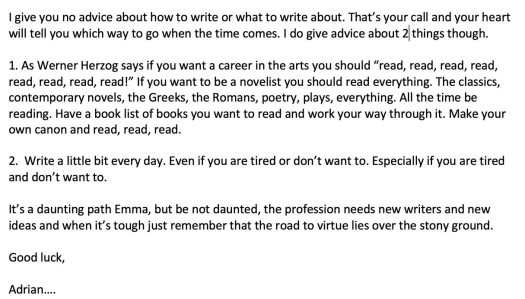
Not long after the post went up, one of my favorite novelists, Adrian McKinty—who writes brilliantly about Northern Ireland during the Troubles from the perspective of a Catholic detective serving in the overwhelmingly Protestant Royal Ulster Constabulary—posted the following letter on Twitter. He composed it to an aspiring author who had asked his advice on this whole writing business. This is what Adrian wrote in response (the recipient’s name has been removed for the sake of privacy ):


I’m tempted to end this blog post here, because I couldn’t possibly say anything as perfect, but that would be cheating, or lazy, or both. So instead, I’m going to talk a little about my writing process, and in so doing I ironically intend to prove that Adrian is absolutely right—there are no rules. (Incidentally — for more on Adrian and his truly wonderful books, visit his blog The Psychopathology of Everyday Life.)

I’m currently writing a new novel, and for the sake of this post have been taking note of my revision process, which otherwise would go largely unanalyzed. I make no assertions that my way is the right way—in fact, I would like to begin with a contrarian point, that my way actually is slow, laborious, and not suitable for “mainstream” writers obliged to crank out one or more books a year. I will leave guidance on that front to those entitled to provide it. My way is simply my way, and I hope by discussing it I might help you shed light on your own, for better and/or worse.

Searching for a phrase that might describe my way of revising, I first came up with “descending into the text,” but that seemed so utterly hokey, so sniffily pompous, I discarded it immediately.

Instead, deferring to my recent research on all-things-Ireland, and hoping for a bit of ironic wit to cut through the humbug, I settled on the title above. It’s suggestive of a process of discovering something already there on the page, buried beneath some obscuring element, waiting to be unearthed. Although that does indeed resonate with some of what I mean here, something very different is at play as well. Creation, not just discovery, figures in.

What I discover as I’m writing a given scene or chapter is that the first couple of drafts only descend so far into the emotional, dramatic, and experiential truth of the situation. I sometimes describe the precess as working out a preliminary sketch then gradually, slowly, layering on the color.

Or think of it this way: I get the furniture arranged, I invite everyone in, and listen to the first things that pop into their minds (and out of their mouths) given my initial sense of where things need to go.

This will usually occupy me for a day or two. Often I will tinker with this or that, tightening the prose, trimming away the excess, eliminating repetition, correcting mistakes. Fiddling. Mucking about. Getting acquainted with the material.

Then I descend a little further. I often need time off—overnight will do, usually—to let my unconscious prowl around the situation I’ve invented, to notice what my conscious writer self has overlooked due to being preoccupied with word choice, sentence structure, punctuation, and so on. (William James was referring to this back and forth between conscious and unconscious effort with his bon mot: “We learn to ski in the summer, and learn to swim in the winter.”)

I notice that my characters are, as yet, largely functional—they’re playing their roles, not acting like real people in the situation with quirks, tics, contradictions, dual agendas, bad habits, emotional blind spots, and so on. I need to liberate them from what I want them to do and simply let them behave.

Step one, I imagine their appearance and physical nature more specifically, and look for what I missed so far—the torn pocket on a shirt, mustard stain on a tie, worn heels on the shoes, hair dye, a hand tremor, cologne or perfume. This almost always brings me closer to the character’s emotional and psychological specficity as well.

Step Two, I remind myself of each character’s Objective, Obstacle, and Action: what she wants in the scene, what stands in her way, what she does to overcome the obstacle to achieve her goal. I clarify and intensify the tension, and make sure I’m revealing through conflict, not straight narration.

Due to Donald “Master Don” Maass’s expert advice, I now also ask myself how each character hopes to feel by the end of the scene, and what happens to that hope, that feeling, given what happens. This helps me not only understand each character better, but to distinguish among them—for example, if I have friends or siblings or co-workers in the scene, this is usually where I begin to separate them more clearly in my mind.

Once I have that in hand, if the scene still feels unfinished, I take each character’s perspective and run through the scene from their point of view, then do so with each of the other characters. I listen for what each character would really say given what just happened. each character’s distinct rhythms, their idiosyncratic word choice (more on that below)—most importantly, I imagine more deeply what they would feel and what they would do, letting the dialogue, if any, arise from that.

On the issue of word choice specific to each character: One of the greatest techniques I ever learned in this regard I gernered from Joshua Mohr, another wonderful writer. He suggested setting up a dialogue grid, with each character’s specific or idiosyncratic verbal expressions, from certain words they “hit” particular hard or often, to regional dialect, to favorite curse words, to syntactical peculiarities—e.g., the subjectless sentence (“Going to the dance tongiht?”), the serial interrogatory (“Mrs. Hornby? You know the report you wanted me to write? About Chaucer?”)

If I’m still feeling like I’m not quite there, I remind myself how this scene fits into each character’s general Yearning—their dream of life: the kind of person they want to be, the way of life they hope to live. This scene is a moment in that pursuit—where does that moment fit in the general outline provided by the story, and the story within their lives. If I’ve associated the Yearning with an image, a symbol, or a piece of music, how does that get reflected here?

Similarly, what is holding them back from fulfilling their Yearning—what wounds, weaknesses, limitations, moral flaws are undermining their pursuit of their dream of life. How is all that reflected here?

Sometimes this takes deliberate effort, other times it’s an intuitive plunge into the scene. It may take one day, it may take three—but if I’m not getting it right by then, it’s time to move on.

As I continue into the story, my unconscious will continue providing me little insights—a change in an action, a line of dialogue, a description—and I’ll jot them down and slip them in where they fit, or make notes to myself to return to the scene and write the change in.

This sort of revising-as-I-go is contrary to the advice of many writers, who save this sort of revision for a second pass after they “have the story down.” But I don’t feel I’ve truly got the story down until I do this sort of sinking into each scene. Until then I’m just skimming the surface of events—and is that really the story?

This deeper exploration of each scene often feels like discovery, as though I’m finding what was already there but wasn’t yet aware of. And yet it is also creation, obviously, because I am inventng new details, adding touches I come up with on the fly. The test of truth to any created bit, however, is if it serves the story, rather than feeling jammed in or slapped on for effect. So in truth it is more of a back and forth between creation and discovery, and the bog I’m sinking into is my imagination.

Regardless, this effort typically also prompts me to go to my outline and make changes in the overall story—usually to upcoming scenes, but on occasion for already written scenes as well.

I know this all sounds laborious, and as already noted, it’s time-consuming. I can’t say I recommend it, and I envy those who can work well more rapidly. I’ve tried just plowing ahead, however, hoping to get a “lousy first draft.” Sooner or later it just feels wrong, like I’ve taken a wrong step, or have sold short the real possibilities in the story. I’ve ultimately had to accept that this is simply my process, and as I often tell my students, one of the most important things you will learn as a writer is how you work and coming to trust that.

Now, of course, we all develop bad habits, and shouldn’t allow them to undermine our work in the name of “owning our process.” But in the inevitable calculation of what is the best use of your time, you need to gauge for yourself whether that time is better spent moving ahead with your current way of doing things or better spent breaking down those bad habits, learning new ones, and suffering the inevitable struggles any such change in methods will entail. (Those who have taken the plunge into Scrivener have no doubt insights to share on this trade-off.)

Regardless, we once again return to The Rule of No Rules. You have to find your own way into and out of the bog, as both Adrian and I have advised. Sadly, there are no guarantees—or, as Adrian advised his fledling writer, “It’s just the nature of the beast.” There are simply the stories only you can tell, and that will have to suffice, as it always has.

What parts of your writing process would you change if you knew how, or could risk the readjustment time required? What do you think of Adrian’s advice to his fledgling writer—do you agree? Disagree? Something in between?

By
Source: writerunboxed.com

Visit us at First Edition Design Publishing