Tag Archives: Write Practice

Is It Okay To End A Sentence With A Preposition?

Occasionally, we grammar enthusiasts need to take a step back and lighten up a little bit. While there are some grammar rules that are hard and fast (I’m looking at you, comma splice), sometimes there is wiggle room (like the controversial claim that you can split infinitives). Today, we’re tackling another wiggly rule: is ending a sentence with a preposition okay?

Well, guess what? I’m here to liberate your pens and tell you that it’s okay for your protagonist to ask her cheating boyfriend who he was just with.

What Is a Preposition?

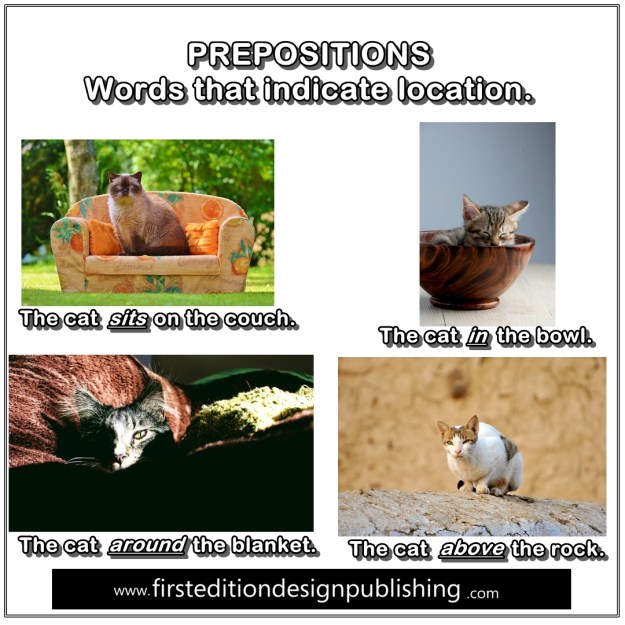
First, a quick review: what is a preposition? These cats explain it pretty well.
cats

To sum up:

The prepositions above show the cats’ locations in space. Let’s add to the fun with these prepositions that show location in time:

I fed the cats at seven this morning.

Pamela will clean the seven litter boxes in the evening.

After you pet the cats, wash your hands before you eat, please.

Is Ending a Sentence With a Preposition Bad?

Recently, we talked about the “rule” that you shouldn’t split infinitives and why it’s really okay.

The bottom line: a few centuries ago, when our grammar was a murky mess, some outspoken grammarians decided to apply Latin rules to English, regardless of whether that was a sensible choice.

In this case, dramatist John Dryden was the first to take up the pen against ending sentences with prepositions, way back in 1672. He claimed that since you can’t end a sentence with a preposition in Latin, you shouldn’t do it in English, either.

The Problem With Following the Rule

English isn’t Latin, though, and we structure our sentences very differently. It’s easy to construct perfectly logical and grammatically sound sentences whose only “fault” is that they end with prepositions.

Plus, when you try to “fix” these sentences, you can end up with some pretty crazy twists, like this quote often misattributed to Winston Churchill:

“This is the sort of nonsense up with which I will not put!”

And as we recognize how arbitrary and baseless this rule was to begin with, we’ve moved away from strictly adhering to it. So if you’ve ever written yourself into a corner fretting over the preposition rule, breathe deep.

It’s okay to end a sentence with a preposition.

That being said, there are a few caveats.

When It’s NOT Okay to End a Sentence With a Preposition

If the meaning of the sentence is still clear without the ending preposition, then remove it.

In my hometown in the hills of western PA, it’s not uncommon to overhear someone on the phone asking, “Hey, where are you at?” “Where are you” doesn’t need any clarification, so cut that “at.”

Then again, it’s also not uncommon to overhear someone refer to a group of people as “yinz guys,” so I’d hardly claim my hometown as a beacon of good grammar and usage.

However, if the preposition is key to the sentence’s meaning, and moving it would cause unnecessary written acrobatics, it’s fine to end your sentence with the preposition. For example:

Carla wanted to run, but her feet refused. What was she waiting for?

Rewriting that last phrase would completely convolute the prose. No one asks, “For what was she waiting?” Come on now.

Ditch Dryden (Or Don’t)

Is it okay to end a sentence with a preposition? Yep.

Is this claim controversial? You bet.

Still . . . maybe it’s time to rethink how much we pay attention to those Latin-obsessed 17th century introverts.

Have you heard the “rule” (*cough* myth) that ending a sentence with a preposition is a grievous error? Do you ever end sentences with prepositions? Let us know in the comments section.

By Alice Sudlow and Liz Bureman
Source: thewritepractice.com

Visit us at First Edition Design Publishing
How to Publish a Short Story: Write Your First and Second Drafts

Two weeks ago, I urged you to come on a publication journey with me, one where I walk you through the process of planning, writing, and submitting a short story. This is the second post in the four-part series on how to publish a short story. By the end, you’ll have a story ready to send out to publications!

If you’re a little late to the party, never fear! You can still participate. Look back at the first two steps and then join me back here.

This week, we’re going to concentrate on writing and the first edit.

NOTE: Throughout this series, DO NOT post your work in the comments. I’m going to ask you to submit to a publisher at the end of this series, and posting it here would be considered publishing it. Our Becoming Writer community is a great place to workshop your story before you submit it.

Writing Your Story

By now, you should have a publication in mind and have the answers to a couple basic questions. Maybe you brainstormed or did a full outline. Bonus points if you’ve got a draft! (But don’t worry if you don’t.)

Now pick up the pen and write the thing!

This series is focused on how to submit stories and isn’t meant to be a masterclass in short story writing, but I’ve tried to include as many basics as I can. For further information on writing shorts, check this out.

If you’ve got a draft already, this post will still be useful to you, so don’t skip reading it!

3. First Draft: Write in One Sitting

Smile. This is the fun part.

Short stories are meant to be consumed in a single sitting, so it makes sense to write them in one. This isn’t as daunting as it seems. You’ll find your enthusiasm will drive you to the end and the story will flow much better.

Sit down and write. Write quickly. Write badly. Just write.

This is not the time to worry about your word count. Wait, what? I know. I told you to pick out a publication and they’ve given you a word count to stick to. Ignore that for the moment.

Right now, your job is to tell your story. The story will let you know when it’s finished. Overwriting is fine, and actually encouraged, at this stage. On the opposite end, if you’re lacking in words, that’s okay, too. You can always fill in more description later.

For now, just let it flow.

But do remember the four questions I gave you the last time and keep them in mind as a roadmap for going forward. Don’t worry if you get a little lost or off-track. Sometimes stories insist on a life of their own. Don’t panic. That’s normal.

4. Break Time

When you’ve written the last word and are riding that rush of excitement, I need you to do something vitally important: TAKE A BREAK! This is so important, I’ve included it as one of the steps instead of simply mentioning it in passing.

Put the story away and out of your mind. I recommend a three-day hiatus at this stage. That’s just enough for you to forget what you wrote and why you wrote it that way, but not enough time to lose interest in the story.

Don’t look at it. Don’t edit it. Don’t even think about it.

Read a book, get some sleep, or work on another story. Fight the urge to edit right away!

5. Second Draft: Get Critical

This is the less fun but crucial part. Your first draft is not perfect.

Say it with me now: MY FIRST DRAFT IS NOT PERFECT!

You’ve had a break and hopefully you’ve forgotten why you loved this specific turn of phrase or that overlong description. Now you’re going to get brutal. You’re going to cut, add, and rearrange with all the mercy of a general on a battlefield.

First things first: Make sure your story is a story! This might sound obvious, but sometimes it’s not.

When I first started writing shorts, it was all nonsense. Halfway decent prose, but utter nonsense. There was no point. There was no character development. There was no climax. It took a long time for me to realize I was getting rejected because I hadn’t written a story.

A short is different from a novel. You don’t have time to ramble. But a short story is still a story and needs to read like one. It must contain all the elements I mentioned mine lacked. And it must have a beginning, middle, and end.

Here are a few short story fundamentals to achieve that goal:

Elements of a Short Story: What Should Be

  1. Start with action: No overly complicated scene setting or a ton of character inner musings needed. Get the story moving.
  2. Show, don’t tell: Telling seems like a good way to get to the point, right? Nope. A short story is still a story, not a sequence of events spat out in synopsis form by a robot. This happens, then this happens, and finally this happens, is an outline, not a narrative.
  3. Good pacing: Good shorts don’t spend too much time on description and rush through the action. They flow well from one scene to the next and none of those scenes are unnecessary.
  4. Climax and efficient build up to it: Every single word in a short story needs to drive the reader to the climax. Move toward that climax efficiently. If there’s something that doesn’t serve this purpose, chop it. And make sure your climax is in there!
  5. Satisfying resolution: Your ending must wrap up your story. It needs to be clear, there can be a twist or surprise (but make sure that surprise isn’t coming out of nowhere), and there needs to be a change from the way things were in the beginning.

Common Short Story Mistakes: What Shouldn’t Be

  1. Overcomplicated plot: Again, keep it simple. Shorts revolve around one central theme, action, upheaval, or event. If you’ve got a bunch of B plots, your story probably isn’t suited for the structure of a short.
  2. Too much backstory and world-building: Only tell us what we need to know, when we need to know it. You can know every little detail about your character’s third-grade experience or the ecosystem of your fictional planet, but is it necessary for your reader to know? This is a general rule when writing, but especially so for shorts. You don’t have the space to tell us everything. Stick to the point.
  3. Bad dialogue: This is one of the things I see the most with short stories. One way to fix this is to read your dialogue aloud, preferably with a partner. If it sounds funny coming out of your mouth, it’s not right. Remember, people rarely use another person’s name when talking to them and contractions are your friend.
  4. Head hopping: Stay in one point of view. There’s not enough time or space in a short to skip around.
  5. Abrupt ending: Make sure you haven’t just cut off your story to stay in the word count. (The climax is not the ending!) Take us all the way through.

Write, Write, Write!

For the next two weeks, concentrate on getting through the first and second drafts using the tips above. This might get frustrating at points. You may want to give up. Don’t. You’ll get through it.

And most importantly: Your writing DOES NOT suck! (We all need that little reminder now and then.)

Still wondering how to publish a short story? Don’t worry. In the next post, I’ll go over getting feedback and the nitpicky edits of the third draft. Soon, your story will be publication ready!

Which short story elements do you think you do the best? Which do you think you need to work on? Let me know in the comments.

By Sarah Gribble
Source: thewritepractice.com

Visit us at First Edition Design Publishing
Style Guides: Essential Writing Resources for Professionals

When we’re writing, we run into a lot of technical issues. Where do the quotation marks go? When is it correct to use a comma? How should titles be formatted?

Some of these questions are answered by the rules of grammar, spelling, and punctuation. But other questions are not addressed by grammar: there’s no official rule for how to format a title.

We writers need trusted resources that we can use to resolve all these issues, especially if we want to produce work that is both grammatically correct and stylistically consistent.

That’s what style guides are for. Style guides answer grammatical questions and provide guidelines for consistency.

What is a Style Guide and Should I Use One?

A style guide is a manual that establishes rules for language (including grammar and punctuation) and formatting. Within academia, these guides also provide standards for citations, references, and bibliographies. Many disciplines have their very own style guides, such as the Publication Manual of the American Psychological Association.

These manuals promote proper grammar and ensure consistency in areas where grammar is unclear. Style guides answer all those burly writing questions that are absent from the rules of grammar: Did you use a serial comma in the first paragraph, but leave it out in the third? Have you used italics in one post to refer to a book title, but in another post used quotation marks?

Basically, a style guide is an all-purpose writing resource.

If you’re serious about writing, then you should definitely use a style guide. Since a style guide’s primary function is to render a work consistent and mechanically sound, every project will benefit from its application. That includes creative writing, freelance writing, and blogging!

In many cases, a style guide is not only appropriate, it’s mandatory. If you’re writing for submission, it’s a good idea to check a publication’s submission guidelines to see if they require writers to use particular style guide.

By establishing standards, a style guide will help you streamline your work. Once you are accustomed to using a particular set of guidelines, the writing process will flow more smoothly, because you won’t have to stop and deliberate on grammar and style. Your readers will be pleased too, since inconsistency causes confusion.

Which Style Guide Should I Use?

There are lots of different style guides, from the The AP Stylebook to the The Chicago Manual of Style. Which one should you use?

In many cases, the matter of which style guide to use is not up to the writer. As mentioned, publishers will provide guidelines explaining which style guide is required.

Most newspapers adhere to The Associated Press Stylebook on Briefing on Media Law (often called The AP Stylebook), whereas a small press publisher might ask you to use The Elements of Style (often referred to as Strunk and White). Professors and teachers generally require students to use the MLA Handbook for Writers of Research Papers, Sixth Edition.

What about freelance writers, bloggers, fiction writers, and everyone else?

writing resourcesThe most popular style guide for general use is The Chicago Manual of Style, and this is also the style guide commonly used for manuscripts (i.e. novels and anthologies). Many other writing guides are based on Chicago or will defer to it for any areas of style that they do not specifically address. It covers formatting, includes rules for good grammar usage, and provides a roadmap that ensures your work is mechanically consistent.

For general use, Chicago is by far one of the best writing resources on the market, and for me, it’s been one of the best investments I’ve made for my own writing career.

Do you use a style guide, and if so, which one? Are there other writing resources that you can’t live without? Share your favorites in the comments.

By Melissa Donovan
Source: writingforward.com

Visit us at First Edition Design Publishing

12 Nature-Inspired Creative Writing Prompts

Today’s post includes a selection of prompts from my book, 1200 Creative Writing Prompts. Enjoy!

Creative writing prompts are excellent tools for writers who are feeling uninspired or who simply want to tackle a new writing challenge. Today’s creative writing prompts focus on nature.

For centuries, writers have been composing poems that celebrate nature, stories that explore it, and essays that analyze it.

Nature is a huge source of inspiration for all creative people. You can find it heavily featured in film, television, art, and music.

Creative Writing Prompts

You can use these creative writing prompts in any way you choose. Sketch a scene, write a poem, draft a story, or compose an essay. The purpose of these prompts is to inspire you, so take the images they bring to your mind and run with them. And have fun!

  1. A young girl and her mother walk to the edge of a field, kneel down in the grass, and plant a tree.
  2. The protagonist wakes up in a seemingly endless field of wildflowers in full bloom with no idea how he or she got there.
  3. Write a piece using the following image: a smashed flower on the sidewalk.
  4. A family of five from a large, urban city decides to spend their one-week vacation camping.
  5. An elderly couple traveling through the desert spend an evening stargazing and sharing memories of their lives.
  6. A woman is working in her garden when she discovers an unusual egg.
  7. Write a piece using the following image: a clearing deep in the woods where sunlight filters through the overhead lattice of tree leaves.
  8. Some people are hiking in the woods when they are suddenly surrounded by hundreds of butterflies.
  9. A person who lives in a metropolitan apartment connects with nature through the birds that come to the window.
  10. Write a piece using the following image: an owl soaring through the night sky.
  11. A well-to-do family from the city that has lost all their wealth except an old, run-down farmhouse in the country. They are forced to move into it and learn to live humbly.
  12. Two adolescents, a sister and brother, are visiting their relatives’ farm and witness a sow giving birth.

Again, you can use these creative writing prompts to write anything at — poems, stories, songs, essays, blog posts, or just sit down and start freewriting.

By Melissa Donovan
Source: writingforward.com

Visit us at First Edition Design Publishing


Poetry: Making Music with Words

Most writers are primarily concerned with the meaning of the words they choose. Is the language precise and accurate? Do the words provide the best connotation for what the writer is trying to communicate? Does the language show, rather than tell?

But poets take language a step further and push it into the realm of music. Poets care about meaning, precision, and accuracy as well as connotation and imagery. But they also care about how words sound, because musicality is a fundamental feature of poetry.

Poets use various elements of music to compose a poem. But because the written word is read and not heard, some elements of music aren’t available, like pitch and timbre.

Spoken word and performance (or slam) poetry are exceptions, because these works are designed to be heard and can incorporate musical elements that aren’t available to authors who write to be read. But most poets rely on a variety of literary devices and techniques to bring music to their work. Foremost among these are meter, sound, rhyme, repetition, and structure.

Meter (Rhythm)

In poetry, meter is a syllabic pattern, which is determined by stressed and unstressed syllables. We’ll use bold to denote stressed syllables in the first line of “What Kind of Times Are These” by Adrienne Rich:

There’s a place between two stands of trees where the grass grows uphill

Let’s see what happens when we strip away the language, so we can see the raw meter of the line:

da-da-DUM da-DUM da-DUM da-DUM da-da DUM DUM da-DUM

As you can see, the meter gives the poem rhythm, an underlying drumbeat. This demonstration shows why it’s important to review the syllables in the lines of your poetry to check the meter.

Sound (Melody)

A song’s melody is determined by the sequence and length of notes played or sung by musicians. In poetry, melody is driven by the vowel and consonant sounds within the words of the poem. Consider this simple tune: la de-da, la de-da, la-la-la. 

Now compare it to this: doo-da, doo-da, doo-de-da.

We don’t know the exact notes or melody just from reading these sounds, but there is an implied tune when we read them aloud. We can bring a little rhythm to the sounds as well by placing stress on select syllables:

LA de-da, LA de-da, LA-LA-LA. 

DOO-da, DOO-da, DOO-de-DA.

So how do we put it all together? By choosing words that match the melody and meter that we’re aiming for:

LA de-da, LA de-da, LA-LA-LA. 
On the dock, six o’clock, stomp on rock

DOO-da, DOO-da, DOO-de-DA.
Stooping, drooping, boorish king

You’ll notice that in addition to rhythm and meter, we introduced some rhymes.

Rhyme

The most common rhymes are perfect end rhymes–words that appear at the end of lines in poetry and that rhyme perfectly. Here’s an example from Dr. Seuss’s The Lorax:

Unless someone like you cares a whole awful lot
Nothing is going to get better, it’s not.

The words lot and not rhyme perfectly and are placed at the end of the first two lines, respectively. The placement of rhyme in a poem, coupled with its meter, can give the lines a sing-song quality. We can use different meters, sounds, and rhyme placements to pull different musical qualities into our poetry. Here’s an excerpt from “Spelling” by Margaret Atwood, which shows internal rhymes:

At the point where language falls away
from the hot bones, at the point
where the rock breaks open and darkness
flows out of it like blood, at
the melting point of granite

Try reading these lines aloud to hear the inherent music contained within. Notice that the lines do not use a metrical pattern, but the layered internal rhymes give it rhythm:

  • away and breaks
  • hot and rock
  • bones, open, and flows
  • The word point appears three times in these five lines, but the repetition of this word is barely noticeable.

It’s worth noting that some poems don’t rhyme at all. Rhyme is important in poetry, but it’s actually a subset of a broader and even more important poetic device that is essential in both poetry and music: repetition. After all, rhyme is just repetition of sounds.

Repetition

Repetition is the technique that really sums up how we make music out of words in poetry. All of the techniques mentioned above ultimately use repetition:

  • We create a pattern of stressed and unstressed syllables — and a pattern is really just repetition.
  • We choose words and arrange them in such a way that they create a pseudo melody, which is achieved primarily by patterning (or repeating) certain sounds.
  • And we use rhyme — maybe end rhymes that ring like cymbals or internal rhymes that jingle like a tambourine. Rhymes are, by nature, repetition.

Layering the repetitions of these elements creates greater musical dynamics in a poem.

As you can see, a poem’s musicality really comes from the repetition of various elements within the lines and stanzas. And there are more elements that we can repeat. Alliteration is the repetition of consonant sounds in close proximity: prickly pears. Assonance is the repetition of vowel sounds in close proximity: hat rack.

Some poems even use repetition in their very structure.

Structure

A poem’s music also comes from its structure — the length of lines and stanzas, placement of line and stanza breaks, punctuation, and spacing. All of these elements contribute to the poem’s structural sounds and therefore contribute to its musicality.

In music, a rest is an interval of silence. In poetry, these intervals are indicated by line breaks, stanza breaks, punctuation, and spacing. Rests are similar to the concept of white space in art.

For example, punctuation provides indicators for pausing (or resting) with commas and periods or inflections for questions and exclamations.

Do You Make Music with Poetry?

Plenty of excellent works of poetry aren’t especially musical. But musicality is an important aspect of poetry.

How do you infuse your poetry with music?

By Melissa Donovan
Source: writingforward.com

Visit us at First Edition Design Publishing

Keep Writing!

When life gets hectic, it’s impossible to get your creative writing done. Inspiration might be knocking, but the house is so full, you’re not sure you can open the door and let it in. How can you keep writing?

What if all you need is sixty seconds?

We all have responsibilities to fulfill and obligations to meet. We’ve got bills to pay, jobs to do, children to care for, and pets to play with. The lawn has to be mowed, garbage taken out, laundry done, dishes cleaned; the list goes on and on and on.

How Do We Find Time for Creative Writing?

Our writing happens when the muse is happily seducing our imaginations — when new worlds magically appear on the page and when fictional characters seem more real than some of the people we know in our day-to-day lives.

Creative writing is one of those pursuits that, for many people, is a dream. Like music, dance, acting, and art, it seems unattainable. Like athletics, entrepreneurship, and leadership, it seems meant only for the chosen few. Every day a writer is born. And every day, a writer gives up, overwhelmed by all the things in life that require time, energy, and attention.

Every day, another blog is abandoned, another novel shelved, another poem left unfinished. “I just don’t have time anymore,” a writer says, then deletes a file that was going to be the next great American novel, or crumples up a poem that would have inspired the next great world leader and throws it in the trash.

Don’t Give Up

What if J.K. Rowling had given up on her fantastical story? What if George Lucas had given up on his groundbreaking film? What if the Beatles hadn’t taken a chance on that new sound everyone was calling rock and roll? What kind of world would we be living in?

I almost gave up on my creative writing. For several years, I rarely wrote, other than the writing I had to do for work, which was technical or business writing. It was only by sheer luck that the company I worked for closed, forcing me to find some other path, and only by an odd combination of chance, drive, and a willingness to take risks did I return to my writing so that I could sit here years later amazed that now I make (part of) my living doing it.

And I’m willing to take the dream a little further, do a little more. Whether it’s this year, next year, or in five years, the dream is mine, and I’m not giving up on it.

Neither should you.

Keep Writing!

If you don’t have time to write, then make time.

You don’t have to sit down and write ten pages a day. In five minutes, you can jot down a few paragraphs. In fifteen, you can run off a page. Some days, you’ll get lucky and be able to steal an hour or two. Other days, you’ll have to crunch just to get a couple of minutes.

All that matters is that you keep writing, no matter what.

A Little Tiny Writing Exercise

A few years ago, I came across this website called One Word. It’s one of those sites you save and then forget about but rediscover every few months when you’re cleaning out your bookmarks. Every time I visit, I use it (because it’s interactive), and by the time I leave, which is maybe a minute and a half later, I feel strangely refreshed and revitalized.

One Word gives you just that — one word. Then it gives you something else. It gives you time. You get sixty seconds to write whatever you want, inspired by that single word, that gift.

It doesn’t sound like much, but every time I’ve visited that site and cranked out a minute’s worth of words, I’ve always felt good when I finished, like my right brain just got a little massage and the rest of my body is thanking me for it. And whether it’s been hours or days since I last took time to work on my own creative writing, One Word always reminds me that my passions need to have a priority in my life.

It’s a lot like the way I feel when I hear an inspiring, uplifting speech that motivates and moves me, except at this site, the words aren’t someone else’s; they’re mine. Well, except for that one.

Feed Your Soul

Here’s the thing about creativity: it is food for the soul. It’s the one thing that has a guaranteed return on investment. The more creativity you spend, the better you feel, the more creative you become, and more nourished is your spirit.

People like us need to feed the fire to keep the passion burning. Giving up on your creative writing isn’t an option because if we give up, we dry up. When you feed your right brain, your whole body benefits, and when you feed the fire that is your passion, your whole life and everyone in it reaps the rewards.

So make some time, take some time, to write. Go to OneWord.com and write for just a minute (surely you can spare sixty seconds — how about right now?) or close all those windows and open up your word processing software or turn off the computer and pick up your journal and just write.

And then keep writing.

By Melissa Donovan
Source: writingforward.com

Visit us at First Edition Design Publishing

Your Story Matters (Or… What a Reader Wants You to Know)

Hi, dear Villagers! *waves*

Let me take a brief moment to introduce myself. I’m Carrie, aka MeezCarrie, of ReadingIsMySuperPower. And I LOVE STORY!! I love short stories. I love epic stories. I love in between sized stories. I love contemporary stories. Historical stories. Mystery stories. Amish stories. Even some speculative and YA stories.

But most of all? I love THE Story. The one that starts with the ultimate ‘once upon a time’ – “In the beginning, God created the heavens and the earth” (Genesis 1:1) – and ends with the best ‘happily ever after’ ever (Revelation 21:4)

Because we are all part of that Story.

Yes, we all have a story in progress that is our own life. But everyone we meet does, too. And all those stories-in-progress are part of the Big Story that God is telling. Let me tell you – that is SO exciting to me!

I’m one of the new Seekerville bloggers, but I’m not seeking publication. I’m content to read other people’s stories and talk (incessantly) about them. But that up there? What I just said about being part of God’s Story?

That means I’m sorta like all the rest of y’all.

In a small way.

Ok.. not at all the same.

BUT… I am part of the greatest Story in the world. And so are you. That’s pretty stinkin’ incredible. The Author and Finisher of my Faith is telling a Story about me and about you. And He has promised to keep writing it until it’s completed – not when I die or when you die, but until the day Jesus returns. (Philippians 1:6)

Back in November, I had the pinch-me privilege of speaking with Cynthia Ruchti at the Art of Writing Conference just ahead of the 2017 Christy Awards gala. We talked about the darts of author discouragement and how to dodge them. After our session, a woman came up to me in tears. She whispered, “I didn’t know anybody else knew how I feel.” And then we both were in tears lol!

Author friends – can I encourage you a moment? You’re not alone. Writing may be a solitary career but the discouragements are consistent. Fear of rejection. The reality of rejection. Fear of the  possibility of a bad review. The depths of despair over an actual bad review. Your family doesn’t take you seriously. Your friends don’t take you seriously. It doesn’t pay the bills. It barely pays for coffee.

Oh… wait… I was supposed to be encouraging you. LOL.

I really was headed here, I promise.

You’re not alone. And you’re not left defenseless.

God has given you each other, and He has given you His Word. Community and grace wrapped up in a safe place like Seekerville.

You want to know another secret? YOUR STORY MATTERS.

Yep. I went there: all caps.

Because it’s so incredibly true and so incredibly important to understand.

The story you’re writing matters.

That story you’ve agonized over. The one that’s kept you up all hours of the night. The one that may or may not currently be taunting you with a blinking cursor of ‘I got nothing’. It matters. Even if no one else ever reads it. Even if no agent or publishing house wants it. Even if your beta readers and editors send it back with more tracked changes than you had words to start with.

Your story matters. Believe it. And believe in it.

But you know what? The story that God is writing in you and through you matters most of all. He is making you more like Jesus every day. He knew you before He formed you in your mother’s womb, and He had already had plans for your life. (Psalm 139, Jeremiah 1) He created you as a writer before you even had fully developed hands to hold a pen or tap away on a keyboard. Even better – He knew your role in His Story before you ever made your grand arrival on planet Earth. And that story matters on a scale we can’t even begin to imagine.

Maybe you’re like me and the only thing you write is a blog post… or a grocery list. Your story matters too. God placed you in His Story at just the right time and in just the right place so that you would come to know Him (Acts 17). He pursued you with an everlasting love and has engraved you on the palm of His hand. (Jeremiah 31, Isaiah 49). Think about that for a second – you matter so much to the God of the Universe that those nail-scarred Hands have your name on them.

Your story matters. Believe it. And believe in it.

I know good stories. I’m surrounded by them, à la the Dr. Seuss method of decorating. All the crannies, all the nooks, etc. This Big Story that God is telling is a good story. It’s the best story. It’s the standard by which all other stories are measured (whether they realize it or not). It’s also a true story. This fairy-tale to beat all fairy-tales – a prince on a white horse come to vanquish the enemy and rescue his bride – that’s OUR story (Revelation 19).

So when you’re tempted to throw in the towel and give up on your story – the one you’re writing or the one you’re living – remember this:

Your story matters. Believe it. And believe in it.

By Carrie Schmidt
Source: seekerville.blogspot.com

Visit us at First Edition Design Publishing

How to Spark Your Story With an Inciting Incident

If you are planning on writing a story, there is something you need to consider besides basic plot structure. You need to determine your Inciting Incident.

What incident will compel your protagonist to act?

What Is an Inciting Incident?

I am reading The Story Grid by Shawn Coyne and Story by Robert McGee to learn how to write a compelling story. Both Coyne and McGee emphasize the importance of writing a compelling inciting incident.

To incite means to stir, encourage, or urge on; to stimulate or prompt to action.

An inciting incident, then, is an event that forces your protagonist to act, compelling them to stop sitting around and do something.

Shawn Coyne has this to say about inciting incidents:

No matter the unit of story (beat, scene, sequence, act, or global Story) what the inciting incident must do is upset the life balance of your lead protagonist/s. It must make them uncomfortably out of sync . . . for good or for ill.

Robert McKee agrees:

If the protagonist’s toaster breaks it won’t compel her to get a job because she can afford to buy a new toaster.

However, if her bank manager steals all of the money from her account and flies to Brazil, she will be compelled to get a job. She is forced to act.

As Robert McKee says,

The protagonist must react to the Inciting Incident.

Why Do You Need an Inciting Incident?

If nothing happens to your protagonist you don’t have a story. Something has to happen.

Without an inciting incident nothing meaningful can happen. And when nothing meaningful happens, it’s not a story. —Shawn Coyne

If the story I am writing is about a toaster, but my toaster doesn’t do anything but sit on the counter, there is no story.

If the toaster catches on fire and burns down the house, then there is a story. Will the toaster get caught? Will the fire department blame the cat? Can the toaster be repaired?

How Does an Inciting Incident Happen?

An inciting incident can happen in one of two ways:

  1. By choice
  2. By accident

The protagonist might choose to adopt six cats, buy a one-way ticket to Japan, or decide to enter a hairy leg contest. All of these inciting incidents would compel the protagonist to take action.

Inciting incidents that are not by choice can happen as a coincidence, randomly, or as an accident. The protagonist meets a Naval Officer at a bar. A cat climbs into the protagonist’s lap and refuses to leave. You thought your flight left Bangkok at two in the afternoon, but it left at two in the morning, and there are no flights for another three days and you have spent all of your money.

No matter whether the inciting incident happens by choice or by accident, Robert McKee says it should occur “in the first 25 percent of the telling, no matter what the medium.”

If the writer, playwright, or screenwriter waits too long to incite the protagonist to action, the reader or audience might get bored and not continue with the story.

How Do You Resolve the Inciting Incident?

Shawn Coyne says the ending of a story must have two things:

  1. The ending must be reasonable and an inevitable result of the inciting incident.
  2. The ending must be surprising.

He gives examples of inciting incidents from different genres that have climaxes that are expected.

Murder mystery

  • Inciting incident = the discovery of a dead body
  • Climax = solving of the crime

Love story

  • Inciting incident = lovers meet
  • Climax = will the couple stay together?

Horror novel

  • Inciting incident = attack by the monster
  • Climax = confrontation between lead character victim and the monster from the inciting incident

An inciting incident creates chaos in the life of the protagonist. The story occurs when the protagonist tries to get their life back into balance. As Robert McKee says,

Characters are what they do. Story events impact the characters, and the characters impact events.

The climax or resolution of the story will put the protagonist’s life back together in some sort of new way, for better or worse. Hopefully, it will put their life back into balance.

What will your protagonist do? What is going to incite them to take action? Please let me know in the comments.

By Pamela Hodges
Source: thewritepractice.com

Visit us at First Edition Design Publishing

Kill Perfectionism With This One Practice

It can feel impossible to know where to start writing.

We can become paralyzed by fear, worrying our words will offend or bore readers, or worse, that we’ll never have any readers at all.

If we jump in, we might quickly find ourselves nose-deep in all the complications of story writing, tangled in plot, character development, and dialogue tags. Or a Google search might drown us in writing advice, suddenly flinging us into an identity crisis — who are we, why do we write? Are we plotters or pantsers? How can we even know the difference? *hides under desk*

This isn’t just a problem for newbies, either.

The Story of a Perfectionist Writer

Despite having been a published nonfiction writer for over a decade, when I wanted to branch into fiction writing, I had no idea where or how to start.

As a planner, it made sense to me to begin with an outline. I started there, but pretty soon I became bogged down in perfectionism, trying to think the whole story out before beginning to write it. The story screeched to a halt.

I’d heard many stories are character led, whatever that meant, so I created a character; a gruff, bristly cowboy, leaning up against a barn, with a cigarette smouldering between his thick fingers. Unfortunately for him, that was all the depth I could give him without the context of a story. Years later, when I’d think of him, he’d still be standing there, smoking that same cigarette, isolated and alone without a plot to live in. Poor guy.

My solitary efforts yielded nothing, so I read. And researched. And listened to podcasts and watched videos. (A perfectionist’s fancy way of procrastinating.) In the swirl of information, the identity crisis hit. Who was I? Why did I want to write fiction? Was the ability inborn, or could I learn it?

Pretty soon I was convinced fiction writing was too complicated for me.

The Advice That Transformed My Writing

Finally I invited my friend for coffee and to beg for advice. She’s an avid fiction author who pumps out at least one book a year and has thirty titles to her credit, so I knew she’d have some excellent insight.

“How on earth am I supposed to do this??” I asked her. “How does one create a story?” I leaned in, eager for the key to my fiction-writing success.

She shrugged. “You just write it.” She said it matter-of-factly, like it was as obvious. To me, it was obviously wrong. That’s what I’d been trying to do, and it wasn’t working.

“Just write it? I can’t do that. I need a plan.”

“No you don’t. I start most stories without a plan. As I write, the story comes.”

“What?! That’s insane!”

She shrugged again. “You might end up writing a whole lot of crap, but if you keep going, you find the good stuff.”

I didn’t buy it, but let the advice percolate. Writing was too difficult a task to risk “writing crap.” I couldn’t bring myself to do it.

Then, in the book Outlining Your Novel, K.M. Weiland proposed two words that changed my life: “What if?” I realized finding the answer would necessitate a lot of dead-end scenarios. I would have to jot down a lot of crummy ideas and terrible plots before I came up with the best one. I would have to allow those incomplete, embryonic, never-to-see-the-light-of-day ideas out onto paper.

That’s when I realized my friend’s advice was true. I would have to “just write it.”

That morning, I sat to write a fiction piece. Anything. It didn’t matter. I was just going to make it up on the spot. Even if it was crap, I decided, it would at least blunt the perfectionism that had held me back.

Inspired by a painting, I wrote one line. Then another. I kept adding one after the other without knowing anything about who was in the story or why. It was a freeing exercise to “just write.” What resulted was a mediocre story that had a reasonable plot and semi-inspiring conclusion.

3 Lessons About Perfectionism From a Writer Who “Just Wrote”

The experience taught me three things:

1. Giving yourself permission to write total crap quiets perfectionism

Perfectionism isn’t necessarily bad. In its healthy state, it can drive us to achieve goals and feel a deep sense of satisfaction as a result. In its unhealthy state, though, it can freeze us with fear or cripple us with self-criticism. That’s the version we need to break free from.

It starts with giving ourselves permission to not be perfect — to write crap.

With that permission firmly in place, it becomes this decision to conduct an experiment, the results of which do not define us or our abilities.

This one, highly effective, low-risk decision can make an effective path through perfectionism. It sure did for me.

2. Permission to write crap unlocks creativity

Creativity is a cautious, tender creature. It hides from anything that might kill it — like the pressure we put on it to be something it isn’t.
However, with the decision to cast aside high-achievement and simply run an experiment, suddenly the pressure to write the next Harry Potter dissipates, and we’re free to let whatever we think of flow onto that blank page.

Permission to write crap unlocks creativity.

“It’s about getting that critic out of the way and immersing yourself in a flow of pure creativity. Do that, and you’re doing well.” Sean Platt, Write, Publish, Repeat

3. To grow in the craft of writing, one must write

Research, reading, thinking, or “letting it percolate” do not a book write. They’re necessary to the process of writing, but they are not the only elements.

Knowing and doing are two different things — it’s the difference between knowledge and experience. One can become knowledgeable about driving by reading books, interviewing the best drivers and car manufacturers, and studying related stats.

When they get in the car, though, the realities of the experience come to life. Hundreds of traffic signs, lights, pedestrians, and flashing ads all pull attention from what seemed like a simple task. Understanding is born.

Sometimes, perfectionism is just a cover for procrastination.

The Secret to Writing Success

Here it is: At some point, every single writer must finally follow these three steps: 1) Place butt on chair. 2) Place fingers on writing apparatus. 3) Write words.

Give yourself permission to do just that, and who knows what stories you’ll create?

What strategies do you use to overcome perfectionism in writing? Let us know in the comments.

Source: thewritepractice.com

Visit us at First Edition Design Publishing

7 Lies Writers Believe (and the Truths You Need to Know Instead)

First Edition Design eBook Publishing

The writing world is filled with land mines—lies that, when you step on them, blow you right off your creative feet.

I’ve stepped on all of these in my writing career, and every author-friend I know has set them off, too. That tells me they’re pretty common.

Lies Writers Struggle With

I want to help arm you against these painful, dangerous explosions, so I present to you seven lies that writers believe—and the truths that can help you get back on your feet.

Fair warning: this will be a very quote-heavy article. Why? Because I don’t want you to just take my word for it. I want you to see that all creative minds have to navigate these mines—including the best authors in the world.

Lie #1: If you haven’t made it/gotten an agent/become famous by now, you never will.

This is a rough one. When we finally get the courage to start writing (and *gasp* tell people that we are), a funny thing happens: for some reason, others forget everything they know about how skill training works, and they insist we should have “arrived” already.

Baloney. Does anything work that way? Even people with genius taste buds need to learn how to cook. Being “discovered overnight” is an enchanting fantasy, but it’s a dangerous myth.

Here’s the truth: just like getting in shape, climbing a mountain, or memorizing a symphony, writing takes time to master. 

Sam Sykes said once that no matter who you are as an author, you pay your dues at one end or another. To put it another way: it takes many years to be an overnight success. Maybe you haven’t “made it” yet. That doesn’t mean you never will.

“An overnight success is ten years in the making.”
― Tom Clancy, Dead or Alive

“Timing, perseverance, and ten years of trying will eventually make you look like an overnight success.”
― Biz Stone

“It takes 20 years to make an overnight success.”
—Eddie Cantor

“Actually, I’m an overnight success, but it took twenty years.”
—Monty Hall

If you haven’t made it/gotten an agent/become famous by now, you aren’t out of time yet. Keep writing. Keep reading. Don’t quit.

Read the rest of the truth at The Write Practice

First Edition Design eBook and POD Publishing

 Visit us at First Edition Design Publishing