Tag Archives: writing career

Why Humans Love Story

So, following on from last week, in our 4 post series which will be part of Harness Your Reader’s Psychology, we’re delving deeper into why readers read. This week, we’re exploring exactly why we are so drawn to narrative…and it may not be the reason you think!

If you were to ask a fellow Homo Sapien why they read, they’ll give you a variety of answers. In fact, I polled my readers, asking them this very same question, and here are some of the answers I received:

‘If I’m having a bad day or I’m stressed, I block everything out and pick up a book. I feel much better after I’ve spent a few hours reading.’

‘I read because I love stories! As a mom of five kids it is a stress reliever to be able to pick up a book and let my imagination take over for an hour or so. ‘

What’s not to love about a good book!! They offer adventure, romance, thrills, chills, and mystery!! A book offers escape from our daily grind!! You can escape between the pages for awhile!! Travel to new cities, foreign lands or briefly experience life in the past. There is no limit to what you can see or experience through the pages of a book!! I love to read!! There is nothing that can compare to a well written book!!

‘As an escape. Life isn’t easy and escaping into someone else’s “life” gives me a break from my own.’

Psychologists like to look for themes, overarching principles, so that they can understand general trends in human thoughts or behaviours. Looking at the responses above, some say it explicitly, others allude to it, but they all say ‘escapism’ in one form or the other, and they all point to reading feeling good. If you asked me that question a few years ago, I would have said the same thing. Losing yourself in a world not my own is exactly why I read. It feels good to disappear into those imaginary places.

But if you think about it, reading for escapism is actually counterintuitive.

To start with, when we dive into a story, we’re usually diving into situations that are more stressful, angst-filled, and emotional than the ones we experience in real life. Books walk us through journeys defined by heart-ache, loss, zombies, and pain. Why we don’t like to lose ourselves in stories of happy families and the mundane is something we’ll cover later. For now, appreciating that the good stories which draw us in and don’t let go are founded on struggle and stress raises a valid point.

How can that be escapism?

Secondly, losing yourself to the point where reality dissolves into the peripheral (how many of us have had toast or pasta burn because we got lost in a book?), isn’t smart. Evolutionary speaking, it’s deadly. That’s when predators pounce, thief’s see a window of opportunity, or rivals drag your partner into the night.

Evolution but doesn’t have the time or the energy to carry useless, frivolous, potentially dangerous traits through the generations. And if you think about it, getting lost in a story isn’t obviously useful: from centuries ago, when keeping an eye out for sabre tooth tigers was pretty essential for survival, through to modern times, where keeping down a job means food in your fridge.

And yet story has been so pervasive and universal that it’s survived the ruthless mill of evolution, that unrelenting process that screens out anything that doesn’t ensure our species will be here to produce future generations. If it’s not securing our survival, then its cut. Gone.

Extinct.

Why then? Why is story still around? Why is it woven so tightly into the layers of our life?

Is it possible, that story actually serves a function in human survival?

Essentially, story was, and continues to be, our first virtual reality. Just like it’s much safer for pilots to learn to fly in simulators, we get to learn the complicated lessons of life through the experience of others. In the same way pilots prefer to make their mistakes much closer to the ground, we get to see what could happen if our baby sitter didn’t turn out to be who we thought they were, how to take down a zombie, what a serial killer is capable of, or how to navigate a dystopian world, what the ripple effect of having an affair with your neighbour is. In real life, mistakes can be devastating for pilots and us alike. With story, we get to do all of this and more, all without the deadly crash landing.

In fact, readers in my poll captured it beautifully:

‘To travel, fly, love, cry and live without moving from my seat. Books are my precious friends.’

‘To live multiple lives in multiple different shoes.’

‘Reading takes me to places I haven’t been, both real and imaginary. I experience emotions that I may not have had or can empathise with. I can remember the intensity of falling in love, giving birth, loving children, the excitement of seeing wondrous places, and experience the fear and dread of experiences I hope I shall never have.’

It’s the last words that really capture that reading is about far more than escapism: ‘experience the fear and dread of experiences I hope I shall never have.’ And yet, she chooses to immerse herself in it.

When I learnt all this, as a reader I felt validated. I finally figured out why I turn up to work gritty eyed and wishing I drank coffee because ‘just one more chapter’ turned into ‘there’s only a hundred pages to go’ (and obviously, there’s no point in stopping). It’s not about poor self-control, an addictive personality or a belief I can function on three hours sleep. My brain is wired to want this! (Okay, fine…maybe self-control got skipped in my DNA…)

But as a writer I was fascinated.

Readers are unconsciously drawn to our words for more than just escapism. There are certain elements their subconscious brain is looking for, and once we know what that is…

We can give it to them.

As for what that is? That will be next week’s post 🙂

By Tamar Sloan

Source: psychwriter.com.au

Visit us at First Edition Design Publishing

9 of the BEST Quotes on Writing Ever!

Today’s post is a fun post, a collection of quotes on writing I have been sharing on the Positive Writer Facebook Page over the last few weeks and I thought you’d enjoy them as well! These are 9 of my favorites.


Start writing, no matter what. The water does not flow until the water is turned on. ―Louis L’Amour


If I waited for perfection, I would never write a word. ―Margaret Atwood


Your intuition knows what to write, so get out of the way. ―Ray Bradbury


I believe myself that a good writer doesn’t really need to be told anything except to keep at it. ―Chinua Achebe


A professional writer is an amateur who didn’t quit. ―Richard Bach


I write entirely to find out what I am thinking, what I am looking at, what I see and what it means. What I want and what I fear. ―Joan Didion


You fail only if you stop writing. ―Ray Bradbury


Writing is its own reward. ―Henry Miller


There is no greater agony than bearing an untold story inside of you. ―Maya Angelou

I hope you enjoyed these!

What’s your favorite quote about writing? Share it in the comments.

Source: positivewriter.com

Visit us at First Edition Design Publishing

4 Signs You’re Sabotaging Your Writing (And What to Do About It!)

Oh, the lovely struggles of a writer’s life — bloodthirsty deadlines, toxic clients, lack of inspiration… These things come with the package, whether you like it or not. But did you know that you are the greatest enemy of your own work?

Out of hundreds of excuses — bad days, the dreaded writer’s block or simple laziness — you, as a writer, bear the sole responsibility for whether words appear on the page or not. It took me a while to acknowledge this and improve (a bit). Now I want to make it easier for you.

Take a look at these four signs and see whether you’re making the same mistakes!

1. You Don’t Prepare an Outline

As much as I like to get “adventurous” with my writing once in a while, my disorganized soul always craves for a grain of order and structure. It’s surprising how even a simple plan can help with all kinds of writer’s ailments.

I’ve battle-tested working without and with an outline, and the writing has always been smoother and more pleasurable for the latter. Even the roughest of rough outlines will give you a solid direction and keep your thoughts from going astray. It will also prevent you from constantly adding and changing things!

Don’t get me wrong. You probably won’t need a master plan for a simple Tweet. But as your projects get more complex and wordy, an outline will be the only thing standing between you and a rambling disaster. You don’t have to go to extremes and follow your plan to the letter; an outline is meant to give you a heading, that’s all.

2. You’re Getting Your Deadlines All Wrong

A reasonable deadline will help you to stay on track with your writing, be it your next big novel or that blog post you should deliver in two days. An unreasonable deadline will give you a headache at best.

Now, I get it. It’s difficult to set sensible timelines for your work when you’re just starting your writing career. It takes time and many finished projects before you can estimate the time needed to wrap an assignment. But are you honest with yourself when you’re setting those deadlines?

I sometimes try to fool myself that a certain project is going to take longer or shorter than it really should. I realized that I do this get more downtime between assignments or simply postpone the work as much as I can.

What to do instead?

  • If you struggle with setting attainable deadlines, review your past projects for estimates.
  • If you’re just starting delivering projects, make sure to track your project time for future reference.
  • Give yourself a small time margin for unforeseen hiccups (10-20% of the total project time).

3. You Try to Do Everything at Once on the First Draft

Do you sometimes stop writing your first draft only to improve a sentence or use a better word? If so, then you’re sabotaging your writing big time.

Silencing your internal editor may be difficult, especially if you’re a perfectionist and want to write a masterpiece on the first try. That’s what would happen to me when I was just starting writing longer pieces and delivering client work. I’d constantly halt and ruminate on a phrase or a sentence that just didn’t seem like a good fit.

If you’re like me, then the spellchecker probably drives you crazy with all those red marks popping up all over the page (Ok, if your page is covered in “blood” from header to footer then you can probably slow down, just a bit!). But the truth is, everybody gets spelling wrong on the first run, and for some, this remains true all the way till the final draft.

It’s even more tempting to combine writing your first drafts with research. Some people prefer to look things up as they go instead of digging into a topic in advance. This approach is even more destructive and totally breaks the creative flow.

If you’re still troubled by your spelling mistakes, you’ll find many interesting insights in this post.

What to do instead?

  • DO NOT attempt to fix all the flaws of your fledgling text on the first draft; your first draft should be free from criticism, both internal and external.
  • Do your research first, and don’t you dare google things up as you write!
  • Unleash your internal critic on the 2nd, 3rd and all the consecutive drafts, but not before that.
  • If the spellchecker distracts you, turn it off.

4. You Celebrate Way Too Early

There are those moments when I finish a paragraph or a substantial part of a project and think: “I’ve done a solid piece of work here…It’s time to rest now!” And so I rest…

I grab a sandwich, take a walk, read a book or even go for a bike ride. The possibilities here are limitless, and since my brain has just done the heavy lifting, it deserves some downtime, right?

While taking occasional breaks from writing is absolutely necessary to keep your mental nuts and bolts in place, I learned the hard way that short breaks tend to beef up in duration if you let them. It’s tempting to notoriously stretch break time and justify it with a flabby “I’ve accomplished something and deserve this!”

I’m not saying that you shouldn’t reward yourself for little successes and reserve some time for small celebrations. By all means, please do (a stroll in a park makes for a great brain-reset). But sometimes it’s better to be a bit tougher on yourself than to despair over a deadline that has just flashed by because you got lost in a book, again.

Does any of these signs sound familiar? Are you guilty of committing similar crimes against your writing? Let me know!

Source: littlezotz.com

Visit us at First Edition Design Publishing
When Fiction Doesn’t Work—What Can Be Learned?

By Bonnie Randall 

Part of the How They Do It Series 

JH: You can learn just as much from a bad book as a good book.

Stephen King said “Unless you read, you do not have the tools to write.”

Books that whisk us deeply into a story, have characters who become dear friends, or use language in such a way that leaves us breathless, are powerful tools for writers, because those elements are replicable and take our fiction to higher, deeper, and more meaningful levels.

What, though, about fiction that doesn’t move you in any sort of positive way? Can writing lessons be gleaned from these pieces also? 

I am currently reading a novel that has me turning pages—but not in a good way. I am so frustrated from waiting for the reveal of the ‘Big Bad Secret’ the heroine is withholding that I am thumbing through and skimming just to get to the place where she coughs it up. The suspense is not working for me at all, and partly it’s because of the ambiguity surrounding whatever this secret is; there are no clear clues or indicators, and what is presented is vague.
Also, there has yet to be a clear reason why the character is being cagey about her secret in the first place. Additionally, while the character herself is being indirect, the plot keeps getting >thisclose< to revealing The Big Bad…and then being thwarted by convenient twists.
To add to the frustration, there are also interludes which come in the form of handwritten letters from one character to another—and said letters are heavily implied to be written by the heroine with the secret, and yet (I cheated) actually end up being written by the hero when all is said and done.

(Here’s more on What is “Bad Writing?” (And How Can We Avoid It?))

This does not feel like author cleverness to me, but instead like author trickery; it is one thing to not trust an unreliable character, but quite another to not be able to trust an unreliable author.

The take-aways from this reading experience for me are:

1. When employing the device of the ‘Big, Bad Secret’, strike a good balance that leaves your pacing on the side of suspense rather than frustration—and always have a good reason why your character is keeping their secret under wraps in the first place.

2. If you are going to use an ambiguous POV, make sure you do not leave your reader feeling tricked. There needs to be at least one Easter Egg in each ambiguous passage that raises doubt—and maybe even makes it fun—for the reader to wonder “Is this really Character X? Or could this be Character Y who is thinking / doing / saying these things?”

Now: How about you? Have you read a book that was a real miss for you, yet was still able to impart some good learning?

Please share whatever that book taught you to do (or not do), but do not reveal the title. (Because jeez…what if it’s one of my books?!) Seriously, we don’t want to book-bash, and besides: one reader’s trash is another reader’s treasure; the book I am referring to here, for example, has far more positive reviews than negative, and is selling rather hotly too (which begs the question—what the heck do I know, anyway?!)

Okay, folks. Your turn. And….GO!

Bonnie

Source: blog.janicehardy.com

Visit us at First Edition Design Publishing
The Secret to Writing the Killer Plot Twist

A woman in Poughkeepsie plucks your debut novel off the shelf. Okay, fine. It doesn’t have to be Poughkeepsie. It can be anywhere—Marietta, Springfield, Sedona—wherever. The town doesn’t matter because your debut novel flew off the shelves in every big and small town across America. Mostly because of one big thing. You pulled off the killer plot twist.

Now everyone who reads your book thinks they’re your biggest fan. That lady in Poughkeepsie? You’re about to become her favorite author. And she’s going to hand your book to her best friend and tell her in an urgent and serious whisper, “You have to read this. I still can’t believe the ending.”

Sound too good to be true? It’s not. Because the secret to pulling off the most memorable plot twist since Psycho isn’t a magic spell. It’s the unreliable narrator.

What is An Unreliable Narrator?

Put simply, an unreliable narrator is a character who lies. Sure, sometimes he lies because he has something to hide. But the lie isn’t always deliberate. Sometimes he just doesn’t know the whole story. So how can he explain it right? Sometimes he’s too crazy (American Psycho) or too tired (Fight Club) or too drugged (Fear and Loathing in Las Vegas) to see the full story as it unfolds. But one thing is for sure. Regardless of the reason for his failure, the unreliable narrator’s story is not what it appears to be. And here’s the secret: it’s the gaps in his tale that leave space for the twist.

How Unreliable Narrators Set You Up for a Plot Twist

In life, we brush shoulders with killers and liars, psychos and saints. We don’t always know a killer or liar when we meet one. Maybe he’s just limping Linus from 2A who hides an unlikely amount of antifreeze under his kitchen sink. Or maybe it’s that mom who rolls her kids to the park in the double stroller. What is she really drinking from that flower printed water bottle?

Life creates a multitude of untrustworthy characters who blend with the crowd. The best fiction does too.

You’ve guessed it. Unreliable narrators feature in so many twisted plots precisely because of what they hide. It’s those missing pieces, the parts of the story they hold back, that feature in the big reveal at the end. And that big reveal? The one where we learned what really happened? It changes how we understand the whole story, doesn’t it? Hence the perfect plot twist.

Ready to see them in action?

How to Instigate Your Own Plot Twist (Two Iconic Examples)

Pi from Life of Pi is a character who keeps you guessing. His story of ship wreck and survival at sea isn’t the first of his fantastical tales. But even though his stories are tough to believe, you find that you want to. Since you don’t want to believe what you already know, you become a willing participant in the deception. So the twist surprises you all the same.

Pi is an example of The Embellisher, an unreliable narrator who tells tall tales for fun. But The Embellisher isn’t the only type of unreliable narrator. Verbal Kint from The Usual Suspects uses deliberate deception to trick you in one of the most memorable plot twists in modern storytelling.

Verbal is a Self-Preservationist, an unreliable narrator who lies to save himself. He’s the only survivor of a boat explosion. How he came to be on that boat is a mystery that investigators are determined to extract from him. Verbal’s tale twists many times before the final reveal. Surprise, in this case, is built on deception.

These are just two examples of unreliable narrators. But in 7 Unreliable Narrators to Twist Your Plot I reveal the techniques behind the Self-Preservationist and more. In this article, you’ll get seven character types to wow your biggest fans.

And that lady in Poughkeepsie? She doesn’t need to know you learned it here.

Source: mandywallace.com

Visit us at First Edition Design Publishing
10 Reasons Why You Should be Proud to be a Writer

Sometimes I compare my job as a writer to his and I wonder if I’m bringing enough value to the world and helping enough people.

Genevieve Parker-Hill

The above quote comes from a wonderful post called Write the Book, Save the World.

In the post Genevieve wonders why she should be proud to be a writer when her husband who works with a large nonprofit organization seems to be bringing so much more value to the world?

Here at WritetoDone we believe every single writer matters. As Genevieve says:

what if your work helped just one person? What if your work connected with one person and colored their life with joy for one moment? What if it gave just one person a powerful connective experience, a sense that they aren’t alone?

Below are 10 reasons why you should be proud to be a writer in the real world, because in the real world, writing, and writers, really matter.

proud-to-be-a-writer

Let me know in the comments below why YOU are proud to be a writer.

Source: writetodone.com

Visit us at First Edition Design Publishing

25 Ideas for Your Author Blog

By Bryn Donovan

Part of The Writer’s Life Series

JH: Writers hear it all the time—“Oh, you should start a blog.” Not a bad idea, but the hard part is knowing what to blog about. Bryn Donovan visits the lecture hall today to share some ideas on just what to do with our authors’ blog.

Bryn Donovan earned her MFA in creative writing from the University of Arizona, and in her day job, she’s the acquiring editor for Hallmark Publishing. She’s published novels both as Bryn Donovan and as Stacey Donovan, and she’s also the author of 5,000 Writing Prompts and Master Lists for Writers. She blogs about writing and positivity at bryndonovan.com.

Take it away Bryn…

When I first began my blog a few years ago, two friends of mine, my husband, and my sister-in-law were my only readers. Writing posts would sometimes feel pointless, but I told myself Well, you’ve got to start somewhere.

Now I have over 3,000 subscribers, and I get 4,000 to 5,000 people a day reading my posts because they found them in an online search or on Pinterest. It’s the main way people find out about me and my writing.

One thing that keeps some people from blogging is that they’re not sure they’ll be able to think of enough things to write about. In my book 5,000 Writing Prompts, I included 500 ideas for blog posts. Here are twenty-five ideas, most of which aren’t in the book, geared specifically for author blogs. I hope you like them!

25 Ideas for Blog Posts

1. Share ten weird facts about yourself. This is a classic for a reason. It’s a great first post…and it’s fun to do after people think they’ve gotten to know you, too.

2. If you’re trying to decide between a few different photos for the official author photo on your blog, ask people to weigh in. This is a great first or second post for a blog that gets people engaged and connected with you.

3. Can’t decide what story to write next? Share the ideas you’re considering and ask people to vote.

4. If you’re writing a horror story, write about haunted places or scary incidents. If you’re writing a mystery, write about a real-life unsolved mystery. If you’re writing a romance, share your favorite romantic scenes in movies.

5. Write about ten of your favorite books of all time.

6. Near the end of December, write about the best books you read in the past year.

7. Share your “dream casting” for your work in progress: choose an actor for each character in the story.

8. Share photos of your writing assistants—that is, your pets—and ask others to do the same. People love showing you pictures of their cats and dogs!

9. Post a roundup of your favorite public domain quotes about reading and writing.

10. Share your writing research! If you’re setting a novel in Chicago, post a list of movies set in Chicago. If you’ve learned something interesting about medieval weaponry or scientific breakthroughs, tell everyone about it.

11. Post a list of all the weird things you’ve Googled as a writer. It’s funny, and it may make people curious about what you’re up to.

12. Share a mood board of your work in progress: put together a grid of nine images that express the feeling of the story.

13. Invent and share a recipe for something easy, like a sandwich or a cocktail, inspired by your work in progress. Maybe you could create a few for various characters!

14. You can also create recipes, cocktails, or “mocktails” based on fictional characters you love from a TV show, book series, or movie…especially if you’re writing something in a similar vein.

15. Write about tropes or plot lines you love as a reader or a viewer. (For instance, I personally love any story that features strong bonds between brothers …and I love amnesia stories. We all have our favorites!)

16. If you’re a struggling writer, share your best dirt-cheap recipe or your best tips for being frugal.

17. Share the results of a personality test you took, and ask people what their type is!

18. Or share the zodiac signs, Myers-Briggs types, or enneagram types of the characters in your work in progress.

19. Write about a trip you’re planning or a goal you’re pursuing, and ask for advice.

20. Share your favorite writing tools: the best pens, journals, software, books about writing, and websites (like this one!)

21. Ask people what their three proudest accomplishments are…and share yours, too.

22. Post pictures of book covers you love.

23. If you ever happen to be in the very fortunate position of having two different choices for the cover of your next book, and you love both of them…ask people to vote. They’ll love it.

24. Share photos of the place where you do most of your writing. Maybe add photos of other writer’s spaces and studios. Ask their permission first, but if you’re linking to their blogs, they’ll probably love it.

25. Write about the top ten authors you admire in your genre. You don’t have to ask to link to their blogs or websites. They will definitely love it.

Whether you’ve just been thinking about starting a blog, or if you already have one, I hope you found something here to inspire you. If you’re a blogger, please share your advice for others in the comments—I’d like to learn from you, too! Thanks for reading, and happy writing!

Never have writer’s block again.

Source: janicehardy.com

Visit us at First Edition Design Publishing
 

How to Find Inspiration—Fiction Therapy

Whether you’re wondering what happens next in your story, want to write your first novel, or are about to start on the next instalment of your long-running series, there are always times when you’ll need inspiration. And it is often surprisingly close by.

‘Be observant,’ said the dramatist, Lajos Egri, ‘and you will be forced to admit that the world is an inexhaustible pastry shop and you are permitted to choose from the delicacies the tastiest bits for yourself.’

It’s that easy.

Except it’s not.

It’s difficult to suddenly ‘be observant.’ You don’t have time to sit around looking at things. You have to pick up the kids, get to the supermarket, make dinner, finish off that last game of solitaire. And you have to write!

Hemingway noted that it was difficult to be observant, but he also recognized its importance for writers. Being observant, he said in his 1935 Esquire article, Monologue to the Maestro, takes practice. ‘You should be able to go into a room and when you come out know everything that you saw there and not only that. If that room gave you any feeling you should know exactly what it was that gave you that feeling. Try that for practice.’

You don’t have to memorize every object in a room. There are simpler ways to get inspiration for your writing from observing the world around you. It can start with your morning shower.

Try to use all five senses next time you take a shower. Notice how the water falls, how it splashes and goes off at different angles. How would you describe the soap smell? Does the warm water taste different from a cold glassful? Does the water feel warmer on your face than on your back or legs? And listen to the sound of the spray and how being in the shower can distort other sounds?

As your characters go about their everyday routines, try to pick similar moments in your day to gather details you can use in your writing.

Eating is another good opportunity to practice these kinds of observational skills. How do you hold your cutlery? How do you cut the food? Do you pile it all on the back of the fork or scoop it up? Stop just before you take a bite. Look closely at the texture, the shape and colors. Notice any aromas. Then, when you put that morsel in your mouth, take a moment to taste it before you bite. When you do bite, does it make a noise? Does it crunch? Do your teeth clack together? Does the food taste different when you start to chew? What kind of flavors are released?

After a while, you can start to make notes of your observations. Wherever you are, somewhere new or somewhere familiar, take time to look around and enjoy what author David Mitchell called ‘free gifts’ in a recent interview with the LA Times.

‘When I go to a place I get a number of free gifts … I’ll get five decent sentences … about the place; they’re textual photographs. If you get these free gifts, use them in the text, use them in the prose, use them in descriptions. Put them in and they’re lovely little things to find on the forest footpath of the story, of the book.’

If you do that, you too could become wonderfully eloquent when giving a simple piece of advice.

You don’t even have to go somewhere new to get your five sentences. Try to write a few lines about the room you’re in right now. Look around, in all the corners, under the furniture, to see if you can find something you’ve never noticed before. Or find new ways to describe how the seat feels under you.

Internal inspiration

It’s not only the external world that can provide inspiration. There is often a whole conversation going in inside your mind. It can be worth taking a moment to stop and listen in.

This is especially useful if you’re writing from a first person point of view.

Try to observe how thoughts arise in your mind. What are your thoughts like? Do you think in words? Do they come in complete sentences? Maybe you think in images. How could you translate them to the page?

Don’t try to change your thoughts. Your thoughts are not good or bad, they’re just thoughts. Sit there and listen. That too takes practice.

Look for moments of conflict in your own thoughts too. When you consider having another coffee, for example. Or should you write one more page first? Try to listen to that to and fro as your mind tries to rationalize the best choice:

‘I’ll get a coffee first, that’ll give me the boost I need to write this next page.’

‘Yeah, but if I write the page first, the coffee could be a nice reward.’

Try to observe this whole thought process and see if you can introduce that into your writing to make your characters’ internal conversation and inner struggles seem more realistic.

Sometimes, when you’re lacking inspiration, it only takes a sentence or two to give you that spark, to set you off again. And those couple of sentences can be right in front of you now. Just take a look.

Where do you look for to get inspiration on those difficult days? Do you have sources of inspiration that never fail? What other tips do you have to fill those blank pages?

Every month, I look at the many different aspects of fiction—character development, plot, story structure, etc.—and offer advice and tips to help you work through the problems in your novel.

I have adapted many of the concepts you’ll see here from proven techniques used in modern psychotherapy. Hence: Fiction Therapy.

By
Source: writerunboxed.com

Visit us at First Edition Design Publishing

Sinking Into The Bog

In my last post (“Inspired to Emulation—or Preparing to Jump“), I talked about The Rule of No Rules, and how reading other writers you admire will provide the best writing advice you will ever receive.

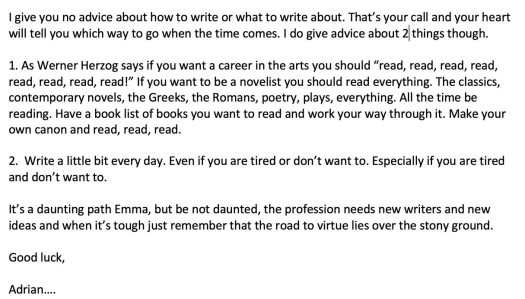
Not long after the post went up, one of my favorite novelists, Adrian McKinty—who writes brilliantly about Northern Ireland during the Troubles from the perspective of a Catholic detective serving in the overwhelmingly Protestant Royal Ulster Constabulary—posted the following letter on Twitter. He composed it to an aspiring author who had asked his advice on this whole writing business. This is what Adrian wrote in response (the recipient’s name has been removed for the sake of privacy ):


I’m tempted to end this blog post here, because I couldn’t possibly say anything as perfect, but that would be cheating, or lazy, or both. So instead, I’m going to talk a little about my writing process, and in so doing I ironically intend to prove that Adrian is absolutely right—there are no rules. (Incidentally — for more on Adrian and his truly wonderful books, visit his blog The Psychopathology of Everyday Life.)

I’m currently writing a new novel, and for the sake of this post have been taking note of my revision process, which otherwise would go largely unanalyzed. I make no assertions that my way is the right way—in fact, I would like to begin with a contrarian point, that my way actually is slow, laborious, and not suitable for “mainstream” writers obliged to crank out one or more books a year. I will leave guidance on that front to those entitled to provide it. My way is simply my way, and I hope by discussing it I might help you shed light on your own, for better and/or worse.

Searching for a phrase that might describe my way of revising, I first came up with “descending into the text,” but that seemed so utterly hokey, so sniffily pompous, I discarded it immediately.

Instead, deferring to my recent research on all-things-Ireland, and hoping for a bit of ironic wit to cut through the humbug, I settled on the title above. It’s suggestive of a process of discovering something already there on the page, buried beneath some obscuring element, waiting to be unearthed. Although that does indeed resonate with some of what I mean here, something very different is at play as well. Creation, not just discovery, figures in.

What I discover as I’m writing a given scene or chapter is that the first couple of drafts only descend so far into the emotional, dramatic, and experiential truth of the situation. I sometimes describe the precess as working out a preliminary sketch then gradually, slowly, layering on the color.

Or think of it this way: I get the furniture arranged, I invite everyone in, and listen to the first things that pop into their minds (and out of their mouths) given my initial sense of where things need to go.

This will usually occupy me for a day or two. Often I will tinker with this or that, tightening the prose, trimming away the excess, eliminating repetition, correcting mistakes. Fiddling. Mucking about. Getting acquainted with the material.

Then I descend a little further. I often need time off—overnight will do, usually—to let my unconscious prowl around the situation I’ve invented, to notice what my conscious writer self has overlooked due to being preoccupied with word choice, sentence structure, punctuation, and so on. (William James was referring to this back and forth between conscious and unconscious effort with his bon mot: “We learn to ski in the summer, and learn to swim in the winter.”)

I notice that my characters are, as yet, largely functional—they’re playing their roles, not acting like real people in the situation with quirks, tics, contradictions, dual agendas, bad habits, emotional blind spots, and so on. I need to liberate them from what I want them to do and simply let them behave.

Step one, I imagine their appearance and physical nature more specifically, and look for what I missed so far—the torn pocket on a shirt, mustard stain on a tie, worn heels on the shoes, hair dye, a hand tremor, cologne or perfume. This almost always brings me closer to the character’s emotional and psychological specficity as well.

Step Two, I remind myself of each character’s Objective, Obstacle, and Action: what she wants in the scene, what stands in her way, what she does to overcome the obstacle to achieve her goal. I clarify and intensify the tension, and make sure I’m revealing through conflict, not straight narration.

Due to Donald “Master Don” Maass’s expert advice, I now also ask myself how each character hopes to feel by the end of the scene, and what happens to that hope, that feeling, given what happens. This helps me not only understand each character better, but to distinguish among them—for example, if I have friends or siblings or co-workers in the scene, this is usually where I begin to separate them more clearly in my mind.

Once I have that in hand, if the scene still feels unfinished, I take each character’s perspective and run through the scene from their point of view, then do so with each of the other characters. I listen for what each character would really say given what just happened. each character’s distinct rhythms, their idiosyncratic word choice (more on that below)—most importantly, I imagine more deeply what they would feel and what they would do, letting the dialogue, if any, arise from that.

On the issue of word choice specific to each character: One of the greatest techniques I ever learned in this regard I gernered from Joshua Mohr, another wonderful writer. He suggested setting up a dialogue grid, with each character’s specific or idiosyncratic verbal expressions, from certain words they “hit” particular hard or often, to regional dialect, to favorite curse words, to syntactical peculiarities—e.g., the subjectless sentence (“Going to the dance tongiht?”), the serial interrogatory (“Mrs. Hornby? You know the report you wanted me to write? About Chaucer?”)

If I’m still feeling like I’m not quite there, I remind myself how this scene fits into each character’s general Yearning—their dream of life: the kind of person they want to be, the way of life they hope to live. This scene is a moment in that pursuit—where does that moment fit in the general outline provided by the story, and the story within their lives. If I’ve associated the Yearning with an image, a symbol, or a piece of music, how does that get reflected here?

Similarly, what is holding them back from fulfilling their Yearning—what wounds, weaknesses, limitations, moral flaws are undermining their pursuit of their dream of life. How is all that reflected here?

Sometimes this takes deliberate effort, other times it’s an intuitive plunge into the scene. It may take one day, it may take three—but if I’m not getting it right by then, it’s time to move on.

As I continue into the story, my unconscious will continue providing me little insights—a change in an action, a line of dialogue, a description—and I’ll jot them down and slip them in where they fit, or make notes to myself to return to the scene and write the change in.

This sort of revising-as-I-go is contrary to the advice of many writers, who save this sort of revision for a second pass after they “have the story down.” But I don’t feel I’ve truly got the story down until I do this sort of sinking into each scene. Until then I’m just skimming the surface of events—and is that really the story?

This deeper exploration of each scene often feels like discovery, as though I’m finding what was already there but wasn’t yet aware of. And yet it is also creation, obviously, because I am inventng new details, adding touches I come up with on the fly. The test of truth to any created bit, however, is if it serves the story, rather than feeling jammed in or slapped on for effect. So in truth it is more of a back and forth between creation and discovery, and the bog I’m sinking into is my imagination.

Regardless, this effort typically also prompts me to go to my outline and make changes in the overall story—usually to upcoming scenes, but on occasion for already written scenes as well.

I know this all sounds laborious, and as already noted, it’s time-consuming. I can’t say I recommend it, and I envy those who can work well more rapidly. I’ve tried just plowing ahead, however, hoping to get a “lousy first draft.” Sooner or later it just feels wrong, like I’ve taken a wrong step, or have sold short the real possibilities in the story. I’ve ultimately had to accept that this is simply my process, and as I often tell my students, one of the most important things you will learn as a writer is how you work and coming to trust that.

Now, of course, we all develop bad habits, and shouldn’t allow them to undermine our work in the name of “owning our process.” But in the inevitable calculation of what is the best use of your time, you need to gauge for yourself whether that time is better spent moving ahead with your current way of doing things or better spent breaking down those bad habits, learning new ones, and suffering the inevitable struggles any such change in methods will entail. (Those who have taken the plunge into Scrivener have no doubt insights to share on this trade-off.)

Regardless, we once again return to The Rule of No Rules. You have to find your own way into and out of the bog, as both Adrian and I have advised. Sadly, there are no guarantees—or, as Adrian advised his fledling writer, “It’s just the nature of the beast.” There are simply the stories only you can tell, and that will have to suffice, as it always has.

What parts of your writing process would you change if you knew how, or could risk the readjustment time required? What do you think of Adrian’s advice to his fledgling writer—do you agree? Disagree? Something in between?

By
Source: writerunboxed.com

Visit us at First Edition Design Publishing

Does Every Lead Character Need An Arc?

At a Bouchercon some years ago, Lee Child was part of a panel on characters in thrillers. An audience member asked him a question about character change. “Every character has to have an arc, right?”

“Why?” Child said. “There doesn’t have to be character change. We don’t need no stinkin’ arcs.”

Everybody in the room cracked up. Child went on to explain that he loves Dom Perignon champagne, and he wants it to taste the same each time. And so, too, he wants his Jack Reacher books to offer the same pleasurable experience every time out. Reacher doesn’t change. Reacher does his thing. It’s how he does it that provides the pleasure.

Later on, Michael Connelly was interviewed in a packed room. He talked about his decision at the beginning of the series to have Harry Bosch age chronologically. In each book Bosch is about a year older. And he has varying degrees of inner development. Talk about your arcs! The series is still going strong and it’s a wonder to behold.

So there you have it, a tale of two writers and two approaches, both of which work. They provide different experiences and readers can choose which they like best—or go with both, for variety.

When I teach about character work, I do say that a lead character does not have to change in a fundamental way.  For example, in the film The Fugitive, Dr. Richard Kimble does not become a new man. He does not have to discover his “true self.” What he has to do is grow stronger as he meets extraordinary challenges.

Similarly, Marge Gunderson in Fargo does not change, but shows her inner strength by solving a horrific crime, far beyond what she’s had to deal with before.

So in this kind of thriller, the character is already who he or she needs to be, but gets tested and finds new strength to endure.

A nice wrinkle to this type of story is when the Lead’s strength inspires another character to change. That’s what happens in The Fugitive. Kimble’s relentless search for the killer of his wife turns Sam Gerard from a lawman who “doesn’t care” about the facts of a case, to caring very much indeed.

In Casablanca, you have both kinds of change. Not only does Rick Blaine change radically, from a man who wants to be left alone to one who joins the war effort, but so does the little French captain, Louis.  Rick’s act of self sacrifice at the end inspires Louis to leave Casablanca with Rick, and also fight the Nazis. It is, of course, the beginning of a beautiful friendship.

One of the most important questions you can ask at the beginning of your novel is whether the main character will undergo fundamental change or not. If not, then the story is about the character growing stronger.

Source: writershelpingwriters.net

Visit us at First Edition Design Publishing