Tag Archives: writing tips

From 101 Creative Writing Exercises: Haiku

Today’s writing exercise comes from my book, 101 Creative Writing Exercises, which takes writers on an exciting journey through different forms and genres while providing writing techniques, practical experience, and inspiration.

Each chapter focuses on a different form or writing concept: freewriting, journaling, memoirs, fiction, storytelling, form poetry, free verse, characters, dialogue, creativity, and article and blog writing are all covered.

Today, we’ll take a peek at “Chapter 7: Form Poetry” with a poetry exercise simply called “Haiku.” Enjoy! 

Haiku

Although haiku appears to be one of the simplest poetry forms, it’s actually quite complex. To truly understand haiku, you need to know a little bit about the Japanese language, or more specifically, some key differences between Japanese and English. Also, traditional haiku adhere to a few pretty strict rules regarding form and content.

A haiku consists of seventeen moras or phonetic units. The word mora can loosely be translated as syllable.

A haiku is a seventeen-syllable verse. Traditionally, haiku were written on a single line, but modern haiku occupy three lines of 5-7-5 syllables.

Haiku also use a device called kireji (cutting word). This word breaks the haiku into two parts, which are distinctly different but inherently connected. The kireji is not a concept used in English, so poets writing haiku in English often use punctuation marks instead of kireji, usually a hyphen or ellipses.

The kireji provides structure to the verse and emphasizes imagery used on either side. It may not always be easy to identify the kireji in a haiku, but if you look for a word or punctuation mark that abruptly breaks the train of thought and severs the haiku into two parts, you’ve probably found it.

Another basic element of haiku is the kigo (season word). A true haiku is set in a particular season and is fundamentally concerned with nature. The kigo might be an obvious word like snow (indicating winter) or it could be vague as with a word like leaves (which can be present in any season).

Contemporary Haiku

There is much debate (and some controversy) over what technically qualifies as a haiku. Some poets merely adhere to the 5-7-5 syllabic and line structure and disregard the kireji and kigo elements. Purists insist that a poem is not haiku if it does not meet all of the traditional requirements.

Additionally, many modern poets do not write haiku that exclusively focus on nature. Contemporary haiku explore just about any subject imaginable.

The Exercise

Try your hand at writing a few haiku. For this exercise, focus on writing a poem that is seventeen syllables on three lines with the following meter: 5-7-5.

Tips: The most captivating haiku are quite lovely and use imagery that is almost tangible. Many haiku have an element of surprise or use turns of phrase that are clever, reminiscent of puns.

Variations: Write a few haiku that follow stricter, more traditional rules. These haiku are concerned with nature and include the kireji (cutting word) and kigo (season word).

Applications: Haiku remain popular and can be found in literary and poetry journals. They are also ideal for social media (especially Twitter) and are fun and quick to write. They promote clear, concise writing and can help you cultivate the art of using vivid imagery.

Give it a Try

Feel free to write a haiku and share it in the comments. Don’t forget to pick up a copy of 101 Creative Writing Exercises, available in paperback and ebook.

By Melissa Donovan
Source: writingforward.com

Visit us at First Edition Design Publishing


How to Write a Book in 100 Days

Let’s start with the obvious: You don’t know how to write a book. I’ve written seven books, and I don’t really know how to write a book either. I have a process that works, sure, but with writing, as with many things in life, it’s always when you think you know what you’re doing that you get into trouble.

So let’s just admit right now, you don’t know how to write a book, and definitely not in 100 days, and that’s okay. There, don’t you feel better?

How to Write a Book in 100 Days 2

There’s this one moment I think about all the time. I had just finished work—I had this horrible desk job at the time—and as I was getting ready to go home, I felt this urge come over me to become a writer. I had felt like I wanted to become a writer before, for years actually, but in that moment, it was all-consuming. Have you ever felt like that before?

And so, instead of going home, I got out a blank piece of paper, and I stared at it. I stared at that blank piece of paper for a really long time. Because I was looking for a book. If only I could come up with the perfect idea, if only I could write a book, then I’d finally feel like a writer.

But I couldn’t think of anything, or at least nothing worthy, and after staring at that blank piece of paper for an hour with nothing, I gave up. In that moment, I felt like I was further from my goal to become a writer than I ever had be. I was so discouraged.

I was discouraged because I didn’t know how to write a book.

Honestly, I might still be there today if I hadn’t had a few lucky breaks and several mentors to teach me the process of how to write a book.

13 Writers Who Finished Their Books in 100 Days

You might say you’re not able write a book in 100 days. You might worry that you’re not able to write a book at all. But I don’t believe that. I honestly believe that everyone can write a book, and I’m not just saying that. I believe it because I’ve done it.

In fact I wrote my first book in fewer than 100 days. I wrote my latest book in just sixty-three days.

I’m not alone, either. I’ve worked with hundreds of other writers to write their books, too. Here are just a few:

Fall 2017 Cohort

These writers are just a few who finished their books in our Fall semester of the 100 Day Book program.

Stella Moreux had been “marinating” on an idea for her “southern fried” fantasy novel for more than three years, but it wasn’t until she signed up for the 100 Day Book program that she seriously started writing it. “I won’t mince words when I say this was hard,” Stella says in her post about the writing process. “However, I would not trade this experience for anything. I survived and finished! The 100 Day Book Program is a challenge but worth it!”

Jodi Elderton had written short stories, but never a novel, and with almost two jobs and young kids, she worried she never would. But she says, “This program made it doable, if you stick with it.” By the end, she finished her novel and said to her writing community, “We made it!” Read Jodi’s full story here.

Rita Harris had an incredibly hard year. After committing to writing her novel, she says she had a marriage breakdown, sold her house and moved, and then had a health scare. Any one of those things could have derailed her writing process, but she kept going, motivated by the writing team she had surrounded herself with and the accountability she agreed to. Despite everything, she finished her book, “something which I doubt I would have had even without the life challenges I faced during the course of my writing if I had not enrolled in the program.” Read her story of determination here.

Karin Weiss‘s novel, A Roaring Deep Within, had been languishing half-finished for years. When she began the process, she thought it would be easy, mostly rewriting, but the process proved much more difficult than expected. What saved her was the writing community in the 100 Day Book program. “I found there a ‘writer’s community,’” she says, “that was available night and day that gave me support and motivation to keep going when my energy dragged, or when I felt discouraged at a tough point in my writing.” Read more about how Karin finally finished her novel-in-progress here.

Spring 2017 Cohort

These writers are just a few who finished their books in our Spring semester of the 100 Day Book program.

Sef Churchill decided to write her book in 100 days “on an impulse one Thursday night.” She followed our process, and by Sunday had committed to an idea. How did it go? “Now I have a book,” she says, “a book which before that first Sunday, I had not even dreamed of.” Check out the 10 lessons she learned about the book writing process.

Ella J. Smyth wrote two of her Romance novels (two novels!) in a little over a 100 days. She talks about her experience, and the power of accountability, here.

Nathan Salley set aside one day a week to write his book, and in that restricted amount of time he was able to finish his book in less than 100 days. You can read about Nathan’s experience (and his next steps into publishing) here.

When Margherita Crystal Lotus told me her sci-fi/fantasy mashup novel was going to be over 100,000 words, and that she was going to do it in 100 days, I had a few doubts she would be able to finish it in time. But she did finish in time, a few days early in fact. And now she’s about to publish the finished book. You can read more about her novel The Color Game here.

Kira Swanson rewrote her novel, which she finished in NaNoWriMo, expanding it from a 70,000-word first draft into a 100,000-word second draft. She recently pitched it to agents and had five of them ask to see the finished manuscript. You can read more about her novel revision experience here.

100 Day Book Challenge Performance

Sandra Whitten was feeling lost and unprepared in the midst of her first book. But after she signed up for our course, she began writing every day for the first time and finally finished her book. You can read more about Sandra’s experience here.

Fran Benfield said that before she signed up for our program, she was “drowning in a sea of words” (I can relate to that feeling!). But she did finish, and found her voice through the process. You can read about how she wrote her memoir here.

Uma Eachempati had been wanting to write about her father’s experience as a prisoner of war during World War II for years. She finally finished it in August, writing it in less than 100 days!

Doug Smith told me he had been thinking about his idea for a novel, Phoenix Searching, “for more years than I care to admit to.” By following our process, he finally finished his novel in May! “What I thought was a long shot,” he says, “turned out to be totally doable.”

These writers have finished their books in less than 100 days, and the reality is you can too. You just need to have the right process.

How to Write a Book in 100 Days: 5 Steps

What did these writers do differently? How do you actually write a book in 100 days? There are five steps:

1. Commit to an idea.

Having an idea is easy. Committing to an idea isn’t, especially if you’re like most writers I know and have dozens of them!

The first step to writing a book is to commit to executing—no matter how you feel about your writing during the process, no matter how many new ideas you come up with in the meantime, no matter what other important things come up. You have to commit to finishing no matter what.

2.  Create a plan.

I’ve found that the people who have planned are much more likely to finish their books. A plan doesn’t have to look like a detailed outline, though, so if you’re not into plotting, that’s okay.

Here are a few things your plan should include:

  • Word count. How long will your book be? (Here’s a word count cheat sheet.) Divide that by how many days you have to write: e.g. there are about 71 weekdays in 100 days.
  • Intention. Where will you write each day? How long will you write each day? Visualize yourself writing there for that long.
  • Publishing and Marketing process. Not because you need to know that now, but because by thinking about it and visualizing it, you improve your chances of actually getting there.

If you think through each step of your book, from your initial idea through the writing process to the publication and marketing of your book, you’ll be much more prepared when the writing goes wrong (because it will).

3. Get a team.

Most people think they can write a book on their own. Most people think they don’t need support or encouragement or accountability to write a book. And that’s why most people fail to finish their books.

That was me. I used to think that I could do it own my own. Honestly, I thought I had no choice but to do it on my own. And I failed again and again and again.

Don’t be most people. The great writers throughout history wrote in the midst of a community of other writers. You need a community, too.

A team might look like:

  • A writer’s group
  • A writing course or class
  • An editor or mentor

When you get stuck, as you inevitably will, it’s your team who will help you get unstuck. Don’t start writing your book without one.

4. Write badly every day.

Your first draft will not be perfect. Far from it. You may not be able to stand how bad your writing is. Your sentences might come out as deformed monsters. Your story or logic might go off on strange tangents. You may feel like everything you write is stupid, shallow, and boring.

Write anyway.

It always starts out like this. Writing is iterative. Your second draft will be better than your first. And your fifth draft will be better than your second.

Write badly all the way to the end. You can fix it later.

5. Get accountability.

I had been writing my latest book for two years, two unproductive years of feeling bad about myself all the time for not writing. This was my seventh book. I should have known how to write a book by now. I didn’t.

It took two writing friends calling me out (see step 3) for me to finally realize I needed to take drastic measures.

And so I wrote a check for $1,000 to the presidential candidate I disliked the most (this was during the 2016 election), and gave it to a friend with orders to send the check if I missed my deadline. I’ve never been more focused in my life, and I finished my book in sixty-three days.

Pretty good accountability, right? Most writers need deadlines and accountability to stay focused and do the hard work of writing.

You Can Try to Do This on Your Own, But You Probably Won’t

Have you ever tried to write a book and failed? I have. Many many times over. My biggest mistake was trying to do it alone.

Honestly, it wasn’t until I hired a coach and found a writing mentor that I finally finished my first book.

If you want to write a book, I would love to help you. Right now, for a limited time, you can join the 100 Day Book program. Over the course of 100 days, I’ll guide you through the writing process, and by the end of the 100 days, you’ll have a finished book.

So many writers have finished their books in this program (including the writers above), and so can you. If you want to join the program and finish your book in 100 days like the writers above, you can sign up here.

Have you finished writing a book? What was the most important thing that enabled you to finish? Let us know in the comments!

By Joe Bunting
Source: thewritepractice.com

Visit us at First Edition Design Publishing
How to Use Foreshadowing Like a Master Storyteller

Foreshadowing is a task writers have to approach with the same careful precision they use when threading a needle. It’s not always easy, but when done right, you’re in business. Hinting at a future revelation is necessary for authors of mystery novels, for example, but it’s useful for all writers looking to include a killer twist—no pun intended. Not sure how to use foreshadowing? Not to worry — today we’re covering techniques you can use to thread that needle.

2 Ways to Use Foreshadowing Like a Master

Foreshadowing is a delicate balancing act. You have to toe the line between throwing a random plot twist into your story and making the surprise too predictable for the reader. The trick is to leave a trail of bread crumbs. Here are two techniques you can try for how to use foreshadowing:

1. Drop hints

At first glance, it may seem like a near-impossible task to communicate to your reader that whatever you’re mentioning is going to be important later. How will they know what to look for? After all, there are so many elements to a story, some of which won’t matter at all for your twists.

Is there something significant about that green dress the heroine wears in chapter four? Does it matter that the neighbor walks his dog at three o’clock every day? Luckily, there are a couple of useful ways to clue your reader into the fact that something is important.

This is one of those ways.

See what I did there? By setting that sentence apart from the rest of these paragraphs, I made you pay attention. Now, all of a sudden, you had to insert a pause before and after those few words.

If something critical happens in your story that is going to come up again later, make sure it stands out in the crowd. Start a new paragraph, insert a break in your chapter, whatever you have to do.

A simple formatting technique can make things a little too easy, though. If your hints are hammered into the reader’s head instead of being gently dropped, the magic and mystery vanishes. Decide if there is a better way to get your point across.

2. Repetition is key

Repetition is another trick you can use to send your reader the mental message that they should be paying attention. Think of this as the technique teachers use in their classes. Though some might say, “Write this down; it’s important,” all most teachers have to do is repeat a certain point in various ways throughout the class and their students will make sure that information is in their notes.

Don’t tell your reader to “write this down,” but do rephrase and repeat the key points of your plot.

For example, in one of my sci-fi stories, two of my characters have different habits when it comes to how they put their coats away when they get home: Astrid always tosses her coat across the back of the couch and Dawn always hangs hers up. Every time Dawn and Astrid return to their apartment, I make sure to point out in some way that Dawn’s coat ends up on her hook and Astrid’s is tossed aside.

Later on in the story, Dawn is kidnapped and replaced by a doppelgänger. Though I don’t come right out and say it, it’s obvious that Astrid becomes suspicious of “Dawn.” Why? She doesn’t hang up her coat. It ends up thrown onto the couch along with Astrid’s.

This clue is essential to figuring out that “Dawn” is not who she claims to be, and if the reader is as perceptive as Astrid is, they’ll pick up on that.

Walking the Tightrope

Like with every aspect of writing, foreshadowing gets easier with a little bit (or, I should say, a lot) of practice.

Write with the mindset of a reader. Try to think how you would react to your own story. Is it too easy to figure out? Too out of the blue?

You’ll know what feels right in the end.

Do you have more suggestions for how to use foreshadowing? How do you approach your plot twists? Let us know in the comments!

By The Magic Violinist
Source: thewritepractice.com

Visit us at First Edition Design Publishing
How to End a Story With a Brilliant Twist

Don’t you love a great twist ending?

Often appearing in the middle or at the end of a story, a twist can completely transform the reading experience into a wild ride where anything can happen.

But executing a twist isn’t easy, and if done improperly, can leave your reader feeling deeply disappointed.

And that’s just what many writers unsuspectingly do.

The Wrong Kind of Twist

A “twist” is the revelation of crucial information that radically changes the reader’s understanding of the story. And to work properly, the twist must be related to a major choice made by the protagonist.

Many writers fail to make this connection. Rather, they think that a twist ending simply needs to withhold any important background information until the end of the story. And then, upon revealing it, they will somehow have reached a surprising and satisfying ending.

But this isn’t the case.

I found this to be true as a judge of the 2017 Fall Writing Contest, hosted by The Write Practice. The theme, “Let’s Fall in Love,” yielded many stories where characters simply “remembered” things that happened long ago. Perhaps they were visiting a cemetery where a loved one was buried, or a residence from childhood. The memories came back, and bits of information were revealed throughout the 1,500 word allotment. Then the story was over.

Nothing happened. Little changed.

Sure, surprising information appeared here and there, but it didn’t arrive in the context of choice. 

The revelation of surprising information is not climactic action. Information doesn’t do anything; it just explains.

Yet when that information accompanies a surprising, climactic choice, it enhances the complexity of the choice.

A bad twist is information posing as a choice. But a great twist reveals a choice that the reader usually can’t see coming, and why it is so impactful.

That’s the kind of twist you want.

The Right Kind of Twist

The best twists focus on Choice, and reveal one or two things:

  1. A contradictory motivation behind a major choice
  2. A hidden, contradictory major choice

Take Toy Story 2. 

The heart-wrenching song “When Somebody Loved Me” is a slow, painful twist that reveals the seemingly contradictory choice that Jessie the Cowgirl is making: to go to a museum, rather than entrust herself to another owner. Why? Because despite the nature of a toy (to be loved by a child), Jessie has been deeply wounded by her previous owner, and is too scared to make herself vulnerable again.

Tell me that scene didn’t rip your heart out! 

Or think of The Shawshank Redemption. The protagonist, Andy, has been making a very important (and methodical) choice during his 19 years in prison. The twist reveals it, completely changing the characters’ (and the viewer’s) understanding of Andy’s choices throughout the whole story. His secret choice has been contradicting his visible choices the whole time.

Tell me that moment didn’t change your life!

Both of these twists accompany and complicate a major choice made by a character. They also reveal something contradictory about the character’s nature.

That’s the stuff of a powerful twist!

How to Write a Great Twist

Executing a powerful twist ending isn’t easy. It takes lots of planning, drafting, and revising. And it won’t always work the way you expect. Here’s how to do it:

1. Plan Choices

When you outline and draft, focus on the big, high-risk choices your characters can make. Experiment with a variety of choices, some that are outside your plan or even your comfort zone.

And as your characters solidify in the world of your story, focus on one to two choices that will truly surprise your reader. Hone in on choices that seem to contradict outward appearances or add deeply empathetic context to their difficult choices.

2. Don’t Keep “Secrets”

Unless you’re in the Mystery genre, try not to keep secrets. Sure, be intentional and sparse with your exposition, but don’t buy into the lie that secret background information qualifies as a satisfying twist.

In fact, you should write versions of scenes where you intentionally reveal crucial information (those would-be secrets)! You may find that the scene works better with the truth on the table. It will certainly force you to focus more on character choice, rather than character backstory!

And even in the Mystery/Thriller genres, the best secrets are tied to choices as well. Usually these big secrets are wrapped up in lies, which qualify as character choices — especially when you show them in action.

Keep the focus on choice, and you’ll find yourself in a great position to start executing a twist.

3. Wait Until the Perfect Moment

The best way to identify the perfect moment is to answer this question: “When are the stakes the highest?”

It’s at that moment that you should unleash your twist, as it complicates the high-risk choices made by your character.

I relished the opportunity to do this when I wrote a murder-mystery play. After the “false” ending, just when the characters and audience believe that the evil has passed, the killer reveals his true nature in a deeply personal and shocking way, murdering someone very close to him. It altered every choice the audience had seen him make for nearly two hours, and was even a complicated choice in and of itself, motivated by anger and a thirst for revenge.

But it took a ton of planning, drafting, and revising to finally get right!

Do the Twist

A great twist ending is worth the effort. It sits atop the storyteller’s Mt. Olympus, right alongside eliciting a full-bellied laugh from your reader, or a puffy-cheeked cry.

Few stories are able to deliver it in a deeply satisfying way. Will yours?

Remember: These take lots of practice. You’ll hardly ever get a perfect twist right on the first or second, or even third, try.

But it’s totally worth it. For many of us, great storytelling twists motivate us to tell our own stories. We long to recreate the catharsis of an unpredictable twist.

So do it right. Focus on choices, and the seemingly contradictory reasons why characters make them. Don’t simply hide backstory, but use it to complicate the difficult decisions every character has to make.

So write on, fearless storyteller! And have fun planning and writing great twists that will thrill your readers every time!

What are your favorite twist endings? How do you surprise your readers with a brilliant twist? Let us know in the comments.

By David Safford
Source: thewritepractice.com

Visit us at First Edition Design Publishing
Whose Writing Advice Should You Follow?

Some writing experts say, “Write what you know.” Others say, “Make it up as you go.” Some say, “Write by the seat of your pants.” Other say, “No! Start with an outline.”

With so much contradictory writing advice floating around out there, what’s a writer to do? 

Know Your Goals

First and foremost, the writing advice you embrace should align with your goals as a writer. Think about what you’re trying to achieve, and take your priorities into consideration as you weed through all the advice you encounter. For example, if you want to publish a book a year, you might consider advice from writers who advocate outlining, since it increases production speed from concept to publication. You’ll find some writing advice moves you closer to your goals while other advice interferes with your objectives; choose the advice you heed accordingly.

Everybody’s Different

What works for another writer might not work for you. Most authors today write on their computers (some even write on their tablets or smart phones), but there are also authors who use pen and paper, and that’s what works for them. Don’t assume that other writers are doing it wrong, but don’t assume you’re doing it right, either. And be wary of advisors who insist on specific methods, practices, and processes for all writers.

Don’t Be Stubborn

It’s unfortunate when a writer dismisses good advice out of sheer stubbornness or arrogance. If your process or practices aren’t working for you, you might need to let them go instead of stubbornly clinging to them. Similarly, don’t assume that you know better than people who have been working at the craft for years or decades. If you refuse to heed — or even consider — the advice of experienced professionals, don’t expect your writing to improve. And don’t enter the craft thinking you know better than people who have studied and practiced writing their entire lives.

Be Willing to Try New Things

I believe the real secret to selecting the best writing advice is to try new things. This is especially important when dealing with contradictory advice. Some writers work better under a deadline; others need an open-ended work schedule. But if you’ve never tried working under a deadline, you can’t know if it would improve your productivity or the quality of your work. Try new things, and you’ll eventually find your own optimum working style.

Check Your Ego

Like so many other types of artists, writers can be sensitive and egotistical. It hurts when we come across advice that makes us feel like we’ve been doing it wrong. Some people don’t like to be reminded that they — and their writing — are not perfect. Accept your flaws and imperfections. Embrace the fact that there will always be more to learn and room for improvement. Be open to writing advice; it’s not there to make you feel inadequate or inferior; it’s there to help you become the best writer you can be.

There’s a Time and Place for Everything

A common piece of writing advice is “show, don’t tell.” But there are times when it doesn’t make sense to show the reader certain events. You might heed different bits of writing advice at different times and for different projects. Perhaps you outline your novels but you write short stories by the seat of your pants. Maybe you “write what you know” when you’re working on nonfiction projects, but you like to delve into make believe when writing fiction. Use the writing advice that you need when you need it.

Check the Source

If you’re uncertain about a piece of advice, look further into the source. Are you getting advice from someone who’s new to the craft? Is this source even a writer? The world is full of people who think they’re experts on everything under the sun; make sure you can distinguish an uninformed opinion from qualified writing advice.

Take It All with a Grain of Salt

Finally, take it all with a grain of salt. If you’re getting your work done and improving your writing skills with each project, you’re probably already on the right path. As you pick up new bits of writing advice, experiment with them and see if they have a positive impact on your work. Remember, writing advice exists to help all of us become better writers. Know your goals. Take the writing advice you need, when you need it. Be willing to experiment. But most importantly, keep writing.

By Melissa Donovan
Source: writingforward.com

Visit us at First Edition Design Publishing


Writing Tips: Write What You Know

A common piece of writing advice is write what you know.

When I first heard this advice, I thought it was odd. I don’t remember where I first heard it, but I remember thinking that as far as writing tips went, it was absurd.

What about writing from your imagination or your feelings? How do genres like science fiction and fantasy fit into the idea that you should only write what you know?

It all seemed rather limiting. Was I supposed to write about American suburbia? That’s what I knew, and it was the last thing I wanted to write about.

One of the reasons memoir doesn’t appeal to me as a writer is because I don’t want to write what I know. I don’t want to relive my life. I want to use writing to live outside of my life, to explore what I don’t know.

I decided to disregard the advice and write whatever I wanted.

What Does It Mean to Write What You Know?

Over the years, I began to understand that write what you know isn’t one of those writing tips that is meant to be taken literally. It’s not an instruction; it’s a guideline.

J.K. Rowling invented a world of magic, a world that many of us might dream about but none could know in the literal sense. Yet she based that world on our world and on the many fantastical, fictional worlds that already exist in literature. Even if we’re not consciously aware of it, we are constantly influenced by what we’ve read, seen, and experienced. My guess is that in one way or another, the seeds of Harry Potter’s world came from Middle Earth, Narnia, and a galaxy far, far away.

The most fantastical worlds in storytelling are beloved because they are full of truths. They tell us who we are as individuals and as a society. I would guess that Ms. Rowling knows a thing or two about friendship and loyalty because there is truth in the relationships that exist between Harry and his closest friends, Ron and Hermione. These relationships have ups and downs but are constant.

While flipping back and forth between two channels late at night, Suzanne Collins saw kids competing on reality TV and footage of the war in Iraq. The images blurred in her tired mind, and the Hunger Games were born. She didn’t know a world where children were thrust into an arena to fight to the death. But she could take what she knew (or could learn), add a heap of her own imagination, and render a believable story world.

To write what you know does not mean you only write about experiences you’ve had, people you’ve met, or places you’ve been. It means you use what you know about life, nature, and humanity as the foundation for your stories.

Write What You Want

I believe the best writing is a balanced mixture of what the writer knows and what the writer seeks. Maybe the setting is the writer’s home town and the characters are based on her friends and family, but the plot is completely outside her realm of experience. Maybe the plot is taken from history, which the writer has researched (and therefore knows), but the world in which it is set is drawn from her imagination. Creativity and art are all about combining existing elements in innovative ways.

It is true: you should write what you know, but you should also leave room in writing for the unknown, room to explore and discover new truths, ideas, and possibilities:

  • Write what you feel. Use your personal, emotional experiences and share them with the reader through characters you’ve invented. Emotional truths make a piece of fiction honest and compelling.
  • Write what you imagine. Let yourself explore a world of possibilities: fantastical beasts, mythical creatures, aliens, and strange, magical worlds.
  • Write what you experience. Every experience you’ve had can be translated to fiction. Remember your first day of school? Tweak that experience and give it to one of your characters, even if the character is an elf or an alien.
  • Write what interests you. You can write what you know after you’ve learned it. Conduct research about things that interest you and then use those things in your stories. Pull facts and ideas from history, current events, and textbooks.
  • Write what matters to you. It goes without saying that your work must matter to you. Write about what moves you, stirs your passion, fills you with joy or rage. If you’re invested in your project, it will come through in your writing and it will speak to higher truths.

What do you write?

How do you feel about writing tips like write what you know? Do you try to write what you know? How far outside of what you know do you take your writing? Share your thoughts by leaving a comment, and keep writing.

By Melissa Donovan
Source: writingforward.com

Visit us at First Edition Design Publishing

4 Lies That Are Keeping You From Writing a Book

There is a book inside you.

There has to be. Why else are you reading a post about writing a book?

lies 2

Getting that book out, of course, is the extremely difficult part. The words don’t come out as we imagine. The time to write shrinks as life gets busier.

And so many questions vex us — so many lies that we tell ourselves to avoid the challenge ahead.

But you have to write your book. It’s one of the greatest driving forces in your life.

4 Lies That Stop You From Writing Your Book

Before you can get started, you have to confront and reject the four lies that have probably been keeping you from writing the book of your dreams. Tackle these lies head-on, and replace them with the truth:

1. It has to be long

How long should a novel be? Is there an exact number of words or pages for it to be a success?

This question can certainly stop us in our tracks. The idea of writing a novel always seems enormous, like climbing the world’s tallest mountain.

Yet there is no rule about how long the book has to be. That’s up to you.

Sure, there are genre-specific suggestions about word counts. The good news is that most of them are lower than you might think! Especially if you are a new author, agents and editors want to see how much story you can tell with fewer words, saving on publishing costs.

There is no absolute book length that works. Of Mice and Men is 30,000 words long, while A Game of Thrones is 300,000.

It’s up to you and your creative process, so don’t let false expectations and fear tell you that your book won’t be long enough to count.

2. I have to have the story figured out

This lie is a crippling one. It demands perfection even before we’ve started.

Yet it is impossible to know exactly how our stories are going to go before we’ve written them. Every attempt at a story runs into surprises and roadblocks. Our plans, no matter how exhaustive, always fail to materialize just how we thought they would.

This is completely natural — and it’s really, really good!

Yet our inner perfectionist makes impossible demands. It suggests that deviating from your plan is somehow failure.

But this is a lie! Creativity is deviation from the plan! It is finding solutions when logic and order don’t work!

So while it is extremely wise to have a plan, and know where your story is generally going, don’t give up on your book dream just because you haven’t created it yet!

3. I’ll start but I won’t finish

My favorite Shakespeare play is Macbeth, which features one of my favorite storytelling devices: the self-fulfilling prophecy. By resisting the witches, Macbeth brings about his own tragic doom.

Unfortunately, this trope extends into real life, especially with artists like us. We long to create, but fear that we lack the discipline or talent to finish something good.

So we give up before even starting. Hence, the self-fulfilling prophecy.

Don’t let this lie seduce you. It  is especially seductive because it delivers a sense of false control: “If I don’t start, then I won’t fail,” the thinking goes.

To fulfill your dream of writing a book, you have to commit to finishing, no matter what. Even if you fall off the wagon for a season, you can still get back in the writing groove.

But you have to get started first.

4. No one’s going to read it

This is similar to the previous lie because it speaks a prophecy that we fulfill on our own. “No one’s going to read it, so I just won’t write it,” we think to ourselves.

What a tragic lie! Our struggling self-confidence produces tangible failure, all by doing nothing!

We can’t know who’s going to read or buy our book yet. We just can’t. By the time we’ve finished writing it, our life situation will have changed because time rolls on.

I will say this, though: Very few people actually fulfill the commitment to write a book.

Most hem and haw, mumbling about “wishing” and “someday.” Very few actually do it.

By writing a book, you will attract readers to yourself, especially if you serve those readers along the way.

One popular way of writing a book is to blog it, as Andy Weir did with The Martian. One chapter at a time, he posted to his website and slowly gathered a following. While he is certainly a rare and privileged case, it shows how giving and serving with our writing can solve our readership problem.

Commit to Your Book

There’s a book inside of you. That’s why you’re on this website, looking for help with your writing.

So commit.

Whether it’s 100 words a day, 500, or 1000, commit to working on your book every day.

Join a community, like a local writer’s group, Becoming Writer, or the 100 Day Book Program. Hold yourself accountable by joining other writers with a similar dream as yours.

But whatever you do, own the reality that you are a writer with a dream. There is a book inside of you that is longing to be written. It won’t be easy. It never is.

But it is beautiful and totally worth it.

So commit to your book today, and begin the journey that will change your life forever!

Have you committed to writing your book? Share how you’re keeping up with your commitment in the comments below!

By David Safford
Source: thewritepractice.com

Visit us at First Edition Design Publishing
 

Is It Okay To End A Sentence With A Preposition?

Occasionally, we grammar enthusiasts need to take a step back and lighten up a little bit. While there are some grammar rules that are hard and fast (I’m looking at you, comma splice), sometimes there is wiggle room (like the controversial claim that you can split infinitives). Today, we’re tackling another wiggly rule: is ending a sentence with a preposition okay?

Well, guess what? I’m here to liberate your pens and tell you that it’s okay for your protagonist to ask her cheating boyfriend who he was just with.

What Is a Preposition?

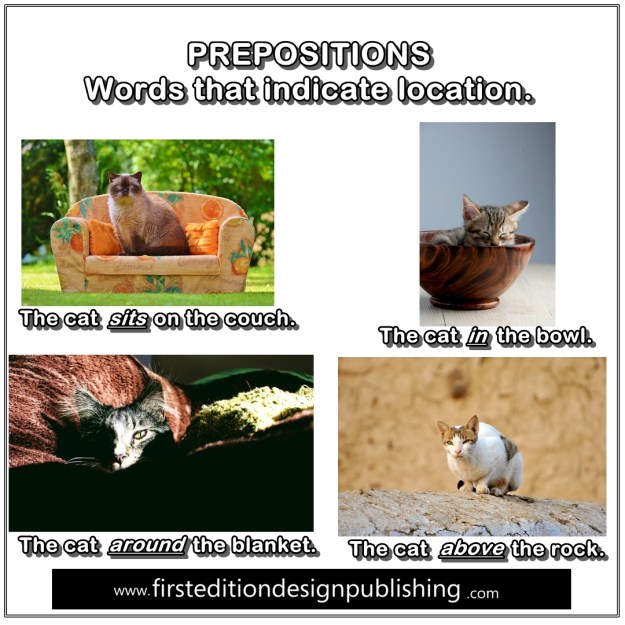
First, a quick review: what is a preposition? These cats explain it pretty well.

cats

To sum up:

The prepositions above show the cats’ locations in space. Let’s add to the fun with these prepositions that show location in time:

I fed the cats at seven this morning.

Pamela will clean the seven litter boxes in the evening.

After you pet the cats, wash your hands before you eat, please.

Is Ending a Sentence With a Preposition Bad?

Recently, we talked about the “rule” that you shouldn’t split infinitives and why it’s really okay.

The bottom line: a few centuries ago, when our grammar was a murky mess, some outspoken grammarians decided to apply Latin rules to English, regardless of whether that was a sensible choice.

In this case, dramatist John Dryden was the first to take up the pen against ending sentences with prepositions, way back in 1672. He claimed that since you can’t end a sentence with a preposition in Latin, you shouldn’t do it in English, either.

The Problem With Following the Rule

English isn’t Latin, though, and we structure our sentences very differently. It’s easy to construct perfectly logical and grammatically sound sentences whose only “fault” is that they end with prepositions.

Plus, when you try to “fix” these sentences, you can end up with some pretty crazy twists, like this quote often misattributed to Winston Churchill:

“This is the sort of nonsense up with which I will not put!”

And as we recognize how arbitrary and baseless this rule was to begin with, we’ve moved away from strictly adhering to it. So if you’ve ever written yourself into a corner fretting over the preposition rule, breathe deep.

It’s okay to end a sentence with a preposition.

That being said, there are a few caveats.

When It’s NOT Okay to End a Sentence With a Preposition

If the meaning of the sentence is still clear without the ending preposition, then remove it.

In my hometown in the hills of western PA, it’s not uncommon to overhear someone on the phone asking, “Hey, where are you at?” “Where are you” doesn’t need any clarification, so cut that “at.”

Then again, it’s also not uncommon to overhear someone refer to a group of people as “yinz guys,” so I’d hardly claim my hometown as a beacon of good grammar and usage.

However, if the preposition is key to the sentence’s meaning, and moving it would cause unnecessary written acrobatics, it’s fine to end your sentence with the preposition. For example:

Carla wanted to run, but her feet refused. What was she waiting for?

Rewriting that last phrase would completely convolute the prose. No one asks, “For what was she waiting?” Come on now.

Ditch Dryden (Or Don’t)

Is it okay to end a sentence with a preposition? Yep.

Is this claim controversial? You bet.

Still . . . maybe it’s time to rethink how much we pay attention to those Latin-obsessed 17th century introverts.

Have you heard the “rule” (*cough* myth) that ending a sentence with a preposition is a grievous error? Do you ever end sentences with prepositions? Let us know in the comments section.

By Alice Sudlow and Liz Bureman
Source: thewritepractice.com

Visit us at First Edition Design Publishing
How to Publish a Short Story: Write Your First and Second Drafts

Two weeks ago, I urged you to come on a publication journey with me, one where I walk you through the process of planning, writing, and submitting a short story. This is the second post in the four-part series on how to publish a short story. By the end, you’ll have a story ready to send out to publications!

If you’re a little late to the party, never fear! You can still participate. Look back at the first two steps and then join me back here.

This week, we’re going to concentrate on writing and the first edit.

NOTE: Throughout this series, DO NOT post your work in the comments. I’m going to ask you to submit to a publisher at the end of this series, and posting it here would be considered publishing it. Our Becoming Writer community is a great place to workshop your story before you submit it.

Writing Your Story

By now, you should have a publication in mind and have the answers to a couple basic questions. Maybe you brainstormed or did a full outline. Bonus points if you’ve got a draft! (But don’t worry if you don’t.)

Now pick up the pen and write the thing!

This series is focused on how to submit stories and isn’t meant to be a masterclass in short story writing, but I’ve tried to include as many basics as I can. For further information on writing shorts, check this out.

If you’ve got a draft already, this post will still be useful to you, so don’t skip reading it!

3. First Draft: Write in One Sitting

Smile. This is the fun part.

Short stories are meant to be consumed in a single sitting, so it makes sense to write them in one. This isn’t as daunting as it seems. You’ll find your enthusiasm will drive you to the end and the story will flow much better.

Sit down and write. Write quickly. Write badly. Just write.

This is not the time to worry about your word count. Wait, what? I know. I told you to pick out a publication and they’ve given you a word count to stick to. Ignore that for the moment.

Right now, your job is to tell your story. The story will let you know when it’s finished. Overwriting is fine, and actually encouraged, at this stage. On the opposite end, if you’re lacking in words, that’s okay, too. You can always fill in more description later.

For now, just let it flow.

But do remember the four questions I gave you the last time and keep them in mind as a roadmap for going forward. Don’t worry if you get a little lost or off-track. Sometimes stories insist on a life of their own. Don’t panic. That’s normal.

4. Break Time

When you’ve written the last word and are riding that rush of excitement, I need you to do something vitally important: TAKE A BREAK! This is so important, I’ve included it as one of the steps instead of simply mentioning it in passing.

Put the story away and out of your mind. I recommend a three-day hiatus at this stage. That’s just enough for you to forget what you wrote and why you wrote it that way, but not enough time to lose interest in the story.

Don’t look at it. Don’t edit it. Don’t even think about it.

Read a book, get some sleep, or work on another story. Fight the urge to edit right away!

5. Second Draft: Get Critical

This is the less fun but crucial part. Your first draft is not perfect.

Say it with me now: MY FIRST DRAFT IS NOT PERFECT!

You’ve had a break and hopefully you’ve forgotten why you loved this specific turn of phrase or that overlong description. Now you’re going to get brutal. You’re going to cut, add, and rearrange with all the mercy of a general on a battlefield.

First things first: Make sure your story is a story! This might sound obvious, but sometimes it’s not.

When I first started writing shorts, it was all nonsense. Halfway decent prose, but utter nonsense. There was no point. There was no character development. There was no climax. It took a long time for me to realize I was getting rejected because I hadn’t written a story.

A short is different from a novel. You don’t have time to ramble. But a short story is still a story and needs to read like one. It must contain all the elements I mentioned mine lacked. And it must have a beginning, middle, and end.

Here are a few short story fundamentals to achieve that goal:

Elements of a Short Story: What Should Be

  1. Start with action: No overly complicated scene setting or a ton of character inner musings needed. Get the story moving.
  2. Show, don’t tell: Telling seems like a good way to get to the point, right? Nope. A short story is still a story, not a sequence of events spat out in synopsis form by a robot. This happens, then this happens, and finally this happens, is an outline, not a narrative.
  3. Good pacing: Good shorts don’t spend too much time on description and rush through the action. They flow well from one scene to the next and none of those scenes are unnecessary.
  4. Climax and efficient build up to it: Every single word in a short story needs to drive the reader to the climax. Move toward that climax efficiently. If there’s something that doesn’t serve this purpose, chop it. And make sure your climax is in there!
  5. Satisfying resolution: Your ending must wrap up your story. It needs to be clear, there can be a twist or surprise (but make sure that surprise isn’t coming out of nowhere), and there needs to be a change from the way things were in the beginning.

Common Short Story Mistakes: What Shouldn’t Be

  1. Overcomplicated plot: Again, keep it simple. Shorts revolve around one central theme, action, upheaval, or event. If you’ve got a bunch of B plots, your story probably isn’t suited for the structure of a short.
  2. Too much backstory and world-building: Only tell us what we need to know, when we need to know it. You can know every little detail about your character’s third-grade experience or the ecosystem of your fictional planet, but is it necessary for your reader to know? This is a general rule when writing, but especially so for shorts. You don’t have the space to tell us everything. Stick to the point.
  3. Bad dialogue: This is one of the things I see the most with short stories. One way to fix this is to read your dialogue aloud, preferably with a partner. If it sounds funny coming out of your mouth, it’s not right. Remember, people rarely use another person’s name when talking to them and contractions are your friend.
  4. Head hopping: Stay in one point of view. There’s not enough time or space in a short to skip around.
  5. Abrupt ending: Make sure you haven’t just cut off your story to stay in the word count. (The climax is not the ending!) Take us all the way through.

Write, Write, Write!

For the next two weeks, concentrate on getting through the first and second drafts using the tips above. This might get frustrating at points. You may want to give up. Don’t. You’ll get through it.

And most importantly: Your writing DOES NOT suck! (We all need that little reminder now and then.)

Still wondering how to publish a short story? Don’t worry. In the next post, I’ll go over getting feedback and the nitpicky edits of the third draft. Soon, your story will be publication ready!

Which short story elements do you think you do the best? Which do you think you need to work on? Let me know in the comments.

By Sarah Gribble
Source: thewritepractice.com

Visit us at First Edition Design Publishing
Why Multitasking is Killing Your Writing

Many writers I know are overwhelmed and struggle to focus on writing anything. Do I research? Get a draft down? Should I be blogging? Do I need to get a business license? What about social media? What’s for dinner? (Sorry, my kids added that one).

multi 2

A few years ago, I learned a technique that helped me get a handle on my to do list, and freed me to prioritize my writing. Along with sneaking time to write, learning to write in batches has changed the way I work.

Batching is a technique I first began to use in my day job to make sure I don’t get stuck in the lesson-planning-rabbit-hole-of-ideas. I could plan lessons all day long, but my students need me to teach and grade, my colleagues need me to answer emails or attend meetings, and occasionally I need to use the restroom or eat lunch.

I began batching several years ago, identifying the most critical tasks and then setting aside specific time for each.

If the idea of planning gives you hives, don’t worry! We’ll start small and then you can scale, building focus on writing as you go.

Know your what and why

As a writer, know what you want most. If you are working on your first book, the most important thing you can do is finish a first draft. If you are building a blogging tribe, your priority needs to be words on the page (and blog) on a regular schedule.

You have to know what you want most because everything will feel like it needs attention right now. It doesn’t.

Choose the top one or two things you want from your writing time this month and take a few minutes to understand why this is the priority. Don’t skip this step, because it will be the motivation you need to tell the multitasking elves in your brain to pipe down while you work.

Make it actionable

Make sure your priority task is something that is actionable and in your control. Here’s an example of the difference: instead of “get an agent,” your task might be “query five agents this week.” I can’t forcibly “get an agent” without being arrested, but I can research and query five agents who would be a great fit for me and my book.

If you are finishing a book, set a word count goal. Building a blog? Set a number of posts per week or month goal. If you are working on marketing, set the goal of creating an email sequence to reach your email list.

Maybe you’re thinking: But I need to do all those things! Everything I read tells me to blog and market and email and write and daydream and get an agent.

Please hear me say this in my most compassionate, firm teacher voice: No. You don’t have to do all those things today.

In fact, trying to do them all at once is killing your writing and motivation. Over time you may complete each of those tasks, but unless you are a full-time writer with an assistant, it isn’t all getting done this week.

Release yourself from unrealistic expectations and choose the top two or three priorities.

The magic of batching

I often watch students as they write, and sometimes they write a sentence, check Twitter, open their Biology homework, and then go back to their essay or story. Then they wonder why they can’t get any momentum. Adults do the same thing.

I read about batching several years ago, and the simplicity of it appealed to me. When you batch, you work at one type of task for a set amount of time, take a break, and then either continue the same task or switch to a new one for a set amount of time.

For example: Let’s say I’m writing blog posts and sorting/answering emails. I set a timer for twenty minutes and only work on writing a blog post. If I finish the first one and the timer hasn’t gone off, I start a new blog post, and continue working until the timer rings. Then I take a three to five minute break. I reset the timer for twenty minutes and start working through emails.

For twenty minutes, I say no to the call of social media, the research reference I need to look up for that blog post, and anything else that threatens to distract me. I just focus on writing.

Steve Jobs, in reflecting on innovation, once said, “People think focus means saying yes to the thing you’ve got to focus on. But that’s not what it means at all. It means saying no to the hundred other good ideas that there are.”

His words apply to anything we want to accomplish. Focus is saying “no” to a thousand things crying for our attention. Batching helps you prioritize and focus, knowing that the other things on your list will have a turn in time. Your writing life is worth valuing by giving it the most precious resource you have: time.

Get simple

Stop overthinking and making tasks more difficult than they have to be (I’m speaking sternly to myself here).

Make your list of two or three high priority tasks. Begin with the one you identified that was most important. Set the timer. Don’t let yourself wallow or writhe, just work on it for twenty minutes. Take a quick break and do it again.

Over time, I hope you’ll find that it frees your mind to go all in on the task at hand and focus on writing instead of wandering from tab to tab in your browser, letting multitasking steal your time.

Have you tried working in batches? What do you do to prioritize your writing time and focus on writing? Let us know in the comments.

By Sue Weems
Source: thewritepractice.com

Visit us at First Edition Design Publishing