Tag Archives: on writing

How to Become a Writer: Where to Start

If you want to become a writer but feel uncertain how to begin, you are not alone.

Writing, and especially fiction writing, can seem like a mysterious art, even to those who practice it. So if you’re starting from nowhere, it may take some work to convince yourself you can do it. Yet, in all honesty, becoming a writer is not a difficult matter. To become a best-selling novelist or win the Booker Prize may be difficult. But to become a writer or even a published writer is relatively easy.

Recently, I received three emails from people, each of whom want to become a writer. They all expressed very typical concerns. Below is what they said and how I would answer them.

Incidentally, I don’t pretend my advice on this subject is brilliant or original. There are no magic answers to these questions, only the same simple answers that have worked for most beginning writers.

The Student Writer

Here’s what the first person wrote in an email:

I found the articles on this site educative and inspiring. I am hoping to be a writer too but am still in school. please advice me on what to do.

I’m not sure whether this person is in high school or university. But it doesn’t matter. Here’s what to do if you are in a similar situation. Simply put, the best thing to do if you want to become a writer, regardless of your age, is to write regularly. Even if you write for just 10 minutes a day or one day a week. Even if you have to get up an hour before everyone else to get some quiet time.

The hard thing in the beginning is to make yourself devote time to writing. Yet writing is something you can only learn by doing – just like riding a bicycle or skiing. Some people have theorized that it takes 10,000 hours to master any skill. Writing is like that. And the more you write, the better you get at it—the greater your sense of how words should flow as they express thoughts, observations, and feelings. There are no shortcuts here. You just have to keep doing it until it becomes as natural as walking.

Remember too that a writer is simply someone who writes. If you are writing, you have already become a writer. The readership comes later.

The second thing that will help you become a writer is to read a lot. To some extent, it doesn’t matter what you read – anything from comic books to popular magazines is more grist for the mill. However, it cannot hurt to delve into the classics. There is a reason the great poets and authors are revered. The more of their language you can get into your head, the better.

When you feel ready and have a small body of work you feel good about, seek out other writers who can help you. Share your work and get their comments. If all they do is criticize and tear your work to shreds, don’t give up. Take their advice to heart and try to do better. Eventually you will get more compliments than criticism.

Once you reach the stage where you are getting positive feedback, look for places where you can publish. Maybe you start with a blog or a student newspaper. Today there are many more places online than ever before where you can publish your words. Eventually, you may find people who will pay you.

Bonus Video from ClueTV: Neil Gaiman

Stuck at the Idea Stage

This person is in the grip of an idea, but not sure what to do with it:

i want to write a book and i have a title but don’t have any clue at all about how to get started. i need some advice badly.

The person didn’t say if they want to become a writer of fiction or nonfiction. A title isn’t much to go on either, but if it’s an idea that won’t let go, it is a good starting point.

If you’re at this stage, I suggest you try to flesh out that idea. Play the part of an objective observer and start asking yourself questions about the title. Any questions will do. Invent answers that feel right.

After doing this for a while, you should have a better idea what this book will be about. At that point, I recommend you make some kind of an outline. If this will be fiction, perhaps start with the 8 Elements of Plot. If the book is to be nonfiction, try to come up with a one paragraph summary of your topic and the core message of the book. Decide who will be your audience. You want to tell them something they will be glad to know. Then decide on the arguments, evidence, ideas, information, etc. you need to prove your thesis. Those may become chapters. Doing some research on your topic will give you more ideas.

Once you have an outline you are happy with, you just have to start writing. Maybe the first draft won’t be any good. That’s all right. Just keep writing until you have a complete draft. Then go back and revise, rewrite, add new chapters, cut ones that don’t work, etc. Share your words and ideas with other people and get their feedback. Maybe it will take you ten drafts to get it right. That’s okay. It’s a learning process.

When you work on your second book, you will have an easier time because you already know what has to be done and that you can do it.

Bonus Video:
Important Advice from Ira Glass On How to Become a Writer

Child Writers

The third email came from a professed child:

hiya, I’m 11 yrs old and I really want to write a novel, even if I do get it finished, do you think that the publisher will except me as I don’t want to do self publishing.

Sometimes our most profound dreams and ambitions come to us at 11 years of age, before adolescence overshadows them. I myself first wanted to become a writer when I was 11. I taught myself to type on my father’s old manual typewriter and spent many evenings churning out science fiction short stories. It was a much more rewarding activity than many others I could have pursued at that time.

My advice to anyone this young who wants to become a writer is that, if possible, you should follow that dream. You’ll be very glad you did. Even if you never become a professional writer, you will become a better writer. And writing is a skill that is more valuable than most people realize, no matter what your profession.

It’s also important to remember that getting published isn’t everything and that writing a novel can be a fun activity even if it never gets published. Artists often make hundreds of drawings and paintings before they sell one. Great actors often start in amateur theatre. Similarly, writers often have to write several “practice novels” or short stories in order to develop their skills.

Besides, some people have published books at a young age, so who can say what will happen? Whether a book gets published depends on many factors, including the quality of the writing, the subject matter, the publisher’s preferences, what’s popular at the time, etc. Luck plays a big role too.

So if your dream is to become a writer, start by writing for your own enjoyment. Later on, you can look for a readership.

Also, you and your parents should check out the Young Writers Program at NaNoWriMo. It’s an annual fun challenge in which you try to write a novel in 30 days. You decide what length of novel to go for. They have a great workbook full of helpful advice on planning. You can challenge your friends to see who can write the most words before the contest is over.

You don’t have to show anyone what you’ve written unless you want to, so no one will criticize your novel. It’s all about quantity, not quality, and having fun.

And the best part is that you will become a writer over the course of the month.

So grab the pen. The empty page is waiting. You have nothing to lose, and much to gain…

By By Glen C. Strathy
Source: how-to-write-a-book-now.com

Visit us at First Edition Design Publishing
 

Poetry Prompts for Paying Tribute

Writers have been expressing their feelings through poetry for centuries. Rant poems release anger, melancholy poems reveal sorrow, and love poems declare affection. Some poems are meant to make readers laugh. Other poems make people think.

Tribute poems (or odes) express praise for the poem’s subject. Odes can be written to honor people, animals, objects, and abstract concepts. You can just as easily write an ode to your grandmother as you could write an ode to your imagination.

Today’s poetry prompts ask you to identify something or someone worth celebrating and then write a tributary poem honoring the subject you’ve chosen.

Poetry Prompts

Each of the poetry prompts below asks you to choose a different kind of subject. The prompts are designed to get you thinking about what matters to you and why and then inspire you to express your feelings through poetry.

  1. Someone you love: The most traditional odes are written to extol the virtues of a loved one. Whom do you love? Tell them why with a poem.
  2. Someone you admire: You don’t have to know or love someone to pay tribute to them. Write a poem honoring one of your heroes, someone who has, from a distance, made a difference in your life.
  3. An inanimate object: You can write a silly poem about how much you admire your toaster, or you can write a serious piece declaring the magnificence of an inanimate object with more meaning (something like a book, perhaps?).
  4. An abstract concept: Can you pay tribute to love itself? Write a poem honoring something that can’t be seen or touched: honor, passion, curiosity, or loyalty. Or music.
  5. Someone you despise or view as a villain: What happens when you look at your enemy and search for their merits? Can you see the good in someone you see as bad?
  6. A total stranger: Has a total stranger ever helped you? Have you ever thought about all the people in this world you’ve never met but who affect your life?
  7. A place: The beach, the mountains, the vast sea, and deep space are all great places for tributary poems. Write about the city you love, the town you call home, or your favorite vacation destination.
  8. Fandom: Write a poem to your favorite book, movie, song, or TV show.
  9. Satire: Turn your tribute on its head and write a tongue-in-cheek piece. Tell bad drivers, rude customers, and evil dictators how grateful you are for what they’ve done. Do it with a wink and a smile.

Do you ever use poetry prompts for ideas and inspiration? Did any of these prompts result in a poem? Share your thoughts by leaving a comment, and keep writing!

By Melissa Donovan
Source: writingforward.com

Visit us at First Edition Design Publishing

Should Your Main Character Be Likable?

I’ve lost count of how many times I’ve gotten the note: “Make your character less difficult. She’s not likable enough.” I didn’t do it on purpose; it’s just that my female characters tend to be complex, like the women I know. It happened when the female leads were opinionated. They had standards and held fast to them. They want. They railed against those who got in their way.

Should Your Main Character Be Likable 2

They were not compliant.

There aren’t that many female characters in literature or TV that can be considered difficult. Check out this list of unlikable characters from literature. There are female characters on there, yes, but the only female on it is Bella Swan of Twilight (a box I’d rather not open on this particular post).

Male characters with those difficult attributes are generally embraced by the public. Think Sherlock Holmes. A Man Called Ove. House. Sheldon Cooper. Nobody would ever call them compliant, yet they are beloved. Even those who may not be beloved (Dexter, Don Draper, Walter White) are still pretty darn popular.

What’s the Explanation?

Unlikable female main characters only seem to inhabit a limited number of genres. If you’re writing women’s fiction and not a thriller or literary fiction, you’re likely to find resistance with an unlikable female lead. Why is that? An editor might tell you that an unlikable female character won’t engage the average reader, and therefore not sell books. Upmarket fiction is a blend of literary and commercial: think generally the type of novel with a theme meaty enough for book clubs and enough plot to keep the average reader engaged. In this genre, I would bet that most female characters are likable.

Non-compliant women threaten to overturn our social norms. My guess is because although American society has made great inroads since women got the vote, it still hasn’t been all that long since women were considered property. Even those who consider themselves feminists are not always completely able to shake free of sexism. We don’t like it when women defy social norms. Celeste Ng’s terrific Little Fires Everywhere explores in part how the bourgeoise take down those women who defy unwritten cultural rules, fearing that their own lives will be called into question.

Also think of Elizabeth Strout’s character Olive Kitteridge. Nobody could call Olive likable. She’s thorny, with standards that others find it impossible to live up to. She messes up her relationships. And she doesn’t care what others think. Essays have been written about her unlikability. Same with Claire Messud’s Nora in The Woman Upstairs. Messud told Publisher’s Weekly, “If you’re reading to find friends, you’re in deep trouble. We read to find life, in all its possibilities. The relevant question isn’t ‘is this a potential friend for me?’ but ‘is this character alive?’”

Should Your Main Character Be Likable?

That’s up to you. Perhaps an unlikable narrator is just not right for your story. Or perhaps you’ve written a deliciously non-compliant difficult woman for a thriller, and you want to keep her that way. Whether or not your character is likable in the traditional sense, their actions must be borne out of a grounded place. And of course, even if your character’s unlikable, they must still be interesting.

But if it’s important to your story that the reader identify with your character and it’s bothering you that your main character is labeled difficult, then there are a few ways you could amend that.

What Makes a Difficult Character Likable?

Here are two TV examples of difficult women. Sophia in The Golden Girls is pretty crotchety, but hey, we can excuse her because she’s super old. And she loves her daughter, and her daughter’s devoted to her.

April Ludgate from Parks and Rec is also difficult. But she loves the resident doofus, Andy. And she secretly loves everyone. And by the end of the series, April has softened considerably.

Perhaps that’s the key—audiences like to see those difficult females actually do love certain people and transform. We know that Sophia’s not going to change because she’s too old, and her blunt snarkiness is key. But someone like April could change.

And this could be true with some of the male main characters I cited. Sherlock Holmes doesn’t really love anyone deeply, except maybe Watson—and he still abuses the poor guy quite a bit. But we forgive him because he’s a GENIUS! And in the newer BBC series, we do see a little character development with him.

In A Man Called Ove, Ove’s backstory slowly unspools. We learn of his despair since he lost his wife, and how important she was to him. There’s a warm cast of characters who believe in him despite his gruffness. He changes, too. He also saves and then cares for a stray cat.

So if you want readers to like your difficult character:

• Make someone else see the good in them.
• Give them something to love. A plant, a pet, a sibling she saves from death (Katniss!), a lost love.
• Add humor. A difficult character with biting wit is more fun to read than one who’s not only difficult but humorless.

Has anyone told you to make your female main character more likable? Do you think the “likability factor” holds true for gender non-binary characters as well? Do you think an upmarket women’s fiction book market would support an unlikable female main character? What are your favorite books, films, and TV shows featuring unlikable main characters?

By
Source: writerunboxed.com

Visit us at First Edition Design Publishing

How to Develop Story Ideas Into Amazing Stories

I often hear practicing writers ask, “What if I can’t think of anything to write about?” Sometimes they even have notebooks full of observations, but they feel like none of them are good enough for a full story, and they’re not sure how to develop story ideas into amazing stories.

I’ve felt the same way, but there are more opportunities or seeds for story ideas in our notebooks than we think. It might be an image, a snippet of a conversation we overheard at lunch, or a social issue that grates against us. Once we have the seeds, how do we take those seeds and develop them into stories?

How to Develop Story Ideas

I love hearing the different ways writers develop story ideas into full length projects. It’s one part of the writing process that often remains cloaked in mystery. Sometimes, a writer isn’t sure how an idea develops, so they’ll say, “Oh I just write,” which makes the rest of us feel like failures when we sit down and nothing comes.

Sarah Gribble shared a great way to outline fiction in a post earlier this week, but what do you do in the space between “I noticed this thing” and “outline the story”?

Some might say, “Oh that’s the magic. You can’t teach that. It’s too formulaic. It just happens.” That might be true, but I can’t have my classes of fiction writers sitting around waiting for the magic to happen. I have to teach them how to make magic. (Do I have an amazing job or what?)

Here’s one way I help my students develop a story idea into an outline and draft.

Choose Something Specific

When students begin trying to find story ideas, they inevitably pick something too big.

“I want to write a story about the way technology makes us less human!”

“Global warming!”

“True love!”

“Space opera!”

These are all topics and themes that could yield great stories, but they are too broad and too general. We need to get much more specific to capture the humanity of these themes.

As I search through my notebooks, I look for a vivid image, event, or conversation. Here’s an example I found recently:

So good to have my sister here. Odd conversation tonight that stuck with me. She said her kids might not need to learn to drive the way self-driving cars are advancing. She said, “They use information from satellites, traffic cams and even other cars to minimize user error and fatalities.” It’s hard to imagine.

The thing that interested me was this idea of minimizing fatalities. Who gets to decide which one person can be “minimized” to allow the others to live in a car crash? I pulled the idea of self-driving cars along with that one phrase from our conversation: “Minimizing fatalities.”

Find the Heat

Once you choose a specific idea, find the hot spots in it or create one. A hot spot is a place where the temperature is higher or “a place of significant activity or danger.” It might be the inherent conflict in a conversation or the oddity in an image that could lead to or expose disaster.

Again, specificity is your friend. Some examples:

You overhear a conversation: “So help me if you leave with the hamster and espresso machine, I’ll …”

Or a headline from the news with an odd (and heartbreaking) image: “Woman who gouged out her own eye found standing next to church.”

Both of these moments hold immense potential for stories because they prompt us to ask, “Why?” and “What if?” The emotions behind these small hot places can be great places to develop an idea. If you can capture the emotion behind a moment, you can build any world you like around it.

A Character as a Hot Spot

Maybe your idea isn’t an image or event, but a person. If you start with a character, you can follow the same process by asking a few specific questions.

What does this character want from the moment we meet him?

How far is he willing to go to get it?

How can this character’s fears, anger, or insecurity get them in trouble?

You can short cut this by building from someone you know or using an actor or type. Then get specific. I can start with my Uncle John, because he is curmudgeonly and outspoken against technology, but I’ll need to change it up and give the character some details that belong only to him.

Also, remember you aren’t writing about a character’s life, you are writing about his or her problem. Specific, vivid details will make the character leap off the page.

An Example

The thing that interested me most in the conversation with my sister was this idea of minimizing fatalities. Who gets to decide which one person can be “minimized” to allow the others to live in a car crash?

I asked some questions: Who is responsible in a car crash involving a self-driving car? The driver or the car company? The tech company who built the algorithm? The satellite company reporting the data?

What if a new IT graduate buys a self-driving car and her grandfather disapproves? What if that same girl is in a fatal accident?

There are a number of hotspots in this idea that could create conflict, because there are so many emotions surrounding a crash and the element of responsibility. From here, I’m ready to outline the goal of my character, the conflict, and the climax that will guide my story.

Once you’ve explored the possibilities, you can outline the main beats of your story and get to drafting.

Do you have a method for getting from seed to draft? Do you have any tips for how to develop story ideas? Let us know in the comments!

By Sue Weems
Source: thewritepractice.com

Visit us at First Edition Design Publishing

Grammar Rules: Capitalization

Proper capitalization is one of the cornerstones of good grammar, yet many people fling capital letters around carelessly.

Not every word deserves to be capitalized. It’s an honor that must be warranted, and in writing, capitalization is reserved only for special words.

Most of the grammar rules are explicit about which words should be capitalized. However, there are some cases (like title case) in which the rules are vague. 

Capitalization of Titles

There are several contexts in which we can examine capitalization. When writing a title (of a blog post, for example), almost all the words in the title are capitalized. This is called title case.

Title case is used for titles of books, articles, songs, albums, television shows, magazines, movies…you get the idea.

Capitalization isn’t normally applied to every word in a title. Smaller words, such as a, an, and the are not capitalized. Some writers only capitalize words that are longer than three letters. Others stretch it to four.

There is an exception to the rule of using lowercase for short words in a title: Words that are important should remain capitalized, even if they are shorter than three or four letters. For example, the word run is only three letters, but if it appeared in a title, it would be capitalized, because it would be the verb (or action) within the title: “Would You Run for Office?” Similarly, important nouns (subjects of objects of a title), such as me, would retain capitalization: Marley and Me.

There’s no fixed grammar rule for which words aren’t capitalized in a title, although they tend to be smaller and less significant words; you should check your style guide for specific guidelines to ensure that your capitalization in consistent.

Capitalization of Acronyms

Every letter in an acronym should be capitalized, regardless of whether the words those letters represent start with capital letters:

  • The acronym for Writing Forward would be WF.
  • WYSIWYG is an acronym that stands for what you see is what you get. Although the words in the original phrase aren’t capitalized, every letter in the acronym is capitalized.
  • Most people use acronyms heavily in text messaging and online messaging. In common usage, these acronyms are rarely capitalized: omg, btw, nsfw. However, if you were using these acronyms in a more formal capacity, they would be entirely capitalized: OMG, BTW, NSFW.

First Word of a Sentence

As I’m sure you know, grammar rules state that the first word in a sentence is always capitalized.

Capitalization of Proper Nouns

To keep things simple here today, we’ll refer to a noun as a person, place, or thing. You need not worry about the other parts of speech because only nouns are eligible for perennial capitalization.

There are two types of nouns that matter in terms of capitalization: proper nouns and common nouns. Proper nouns are the names of specific people, places, and things. Common nouns are all the other, nonspecific people, places, and things.

When considering whether to capitalize, ask whether the noun in question is specific. This will tell you if it’s a proper noun, which should be capitalized, or a common noun, which remains in all lowercase letters.

Proper Noun Capitalization Example

The word country is not specific. It could be any country. Even if you’re talking about the country in which you live, which is a specific country, the word itself could indicate any number of nations. So keep it lowercase because it’s a common noun.

Conversely, Chile is a specific country. You can tell because Chile is the name of a particular land in which people reside. When you discuss the people of that land, you won’t capitalize the word people. However, if you’re talking about Chileans, you definitely capitalize because Chileans are a very specific people, from a very specific country, Chile.

Hopefully that makes sense. If not, keep reading because I’m about to confuse you even more.

Capitalization of Web and Internet

Have you ever noticed the word Internet capitalized? How about the word Web? The linguistic jury is still out on these newfangled technology terms, but generally speaking, the Internet is one great big, specific place. The Web is just another word for that same place.

Wait — what about websites? Do they get capitalized? Only if you’re referring to the name of an actual site, like Writing Forward.

Capitalization of Web and Internet is not a hard and fast grammar rule. Lots of people write these words in all lowercase letters. If you’re not sure about whether to capitalize these words, check your style guide.

Common Capitalization Errors

Folks often think that capitalization should be applied to any word that’s deemed important. Here’s an example:

We sent the Product to the local Market in our last shipment. Have the Sales Force check to see if our Widgets are properly packaged.

It’s not uncommon, especially in business writing, to see nouns that are crucial to a company’s enterprise capitalized. This is technically incorrect but could be considered colloquial usage of a sort. Unless it’s mandated by a company style guide, avoid it.

Here’s correct capitalization of our example:

We sent the product to the local market in our last shipment. Have the sales force check to see if our widgets are properly packaged.

Now, in a rewrite of the example, some of the words will be again capitalized, but only if they are changed to proper nouns (names or titles of things and people).

We sent the Widgetbusters (TM) to WidgetMart in our last shipment. Have Bob, Sales Manager, check to see if our widgets are properly packaged.

What about Capitalization for Job Titles?

Ah, this one’s tricky. Job titles are only capitalized when used as part of a specific person’s title:

  • Have you ever met a president?
  • Did you vote for president?
  • Do you want to become the president?
  • Nice to meet you, Mr. President.
  • I read a book about President Lincoln.

Again, this has to do with specificity. “The president” or “a president” could be any president, even if in using the phrase, it’s obvious by context who you mean. However “Mr. President” or “President Lincoln” are specific individuals, and they call for capitalization.

Grammar Rules!

Do you have any questions about grammar rules regarding capitalization? Any additional tips to add? Leave a comment!

By Melissa Donovan
Source: writingforward.com

Visit us at First Edition Design Publishing
From 101 Creative Writing Exercises: Haiku

Today’s writing exercise comes from my book, 101 Creative Writing Exercises, which takes writers on an exciting journey through different forms and genres while providing writing techniques, practical experience, and inspiration.

Each chapter focuses on a different form or writing concept: freewriting, journaling, memoirs, fiction, storytelling, form poetry, free verse, characters, dialogue, creativity, and article and blog writing are all covered.

Today, we’ll take a peek at “Chapter 7: Form Poetry” with a poetry exercise simply called “Haiku.” Enjoy! 

Haiku

Although haiku appears to be one of the simplest poetry forms, it’s actually quite complex. To truly understand haiku, you need to know a little bit about the Japanese language, or more specifically, some key differences between Japanese and English. Also, traditional haiku adhere to a few pretty strict rules regarding form and content.

A haiku consists of seventeen moras or phonetic units. The word mora can loosely be translated as syllable.

A haiku is a seventeen-syllable verse. Traditionally, haiku were written on a single line, but modern haiku occupy three lines of 5-7-5 syllables.

Haiku also use a device called kireji (cutting word). This word breaks the haiku into two parts, which are distinctly different but inherently connected. The kireji is not a concept used in English, so poets writing haiku in English often use punctuation marks instead of kireji, usually a hyphen or ellipses.

The kireji provides structure to the verse and emphasizes imagery used on either side. It may not always be easy to identify the kireji in a haiku, but if you look for a word or punctuation mark that abruptly breaks the train of thought and severs the haiku into two parts, you’ve probably found it.

Another basic element of haiku is the kigo (season word). A true haiku is set in a particular season and is fundamentally concerned with nature. The kigo might be an obvious word like snow (indicating winter) or it could be vague as with a word like leaves (which can be present in any season).

Contemporary Haiku

There is much debate (and some controversy) over what technically qualifies as a haiku. Some poets merely adhere to the 5-7-5 syllabic and line structure and disregard the kireji and kigo elements. Purists insist that a poem is not haiku if it does not meet all of the traditional requirements.

Additionally, many modern poets do not write haiku that exclusively focus on nature. Contemporary haiku explore just about any subject imaginable.

The Exercise

Try your hand at writing a few haiku. For this exercise, focus on writing a poem that is seventeen syllables on three lines with the following meter: 5-7-5.

Tips: The most captivating haiku are quite lovely and use imagery that is almost tangible. Many haiku have an element of surprise or use turns of phrase that are clever, reminiscent of puns.

Variations: Write a few haiku that follow stricter, more traditional rules. These haiku are concerned with nature and include the kireji (cutting word) and kigo (season word).

Applications: Haiku remain popular and can be found in literary and poetry journals. They are also ideal for social media (especially Twitter) and are fun and quick to write. They promote clear, concise writing and can help you cultivate the art of using vivid imagery.

Give it a Try

Feel free to write a haiku and share it in the comments. Don’t forget to pick up a copy of 101 Creative Writing Exercises, available in paperback and ebook.

By Melissa Donovan
Source: writingforward.com

Visit us at First Edition Design Publishing
 

How to Write a Book in 100 Days

Let’s start with the obvious: You don’t know how to write a book. I’ve written seven books, and I don’t really know how to write a book either. I have a process that works, sure, but with writing, as with many things in life, it’s always when you think you know what you’re doing that you get into trouble.

So let’s just admit right now, you don’t know how to write a book, and definitely not in 100 days, and that’s okay. There, don’t you feel better?

How to Write a Book in 100 Days 2

There’s this one moment I think about all the time. I had just finished work—I had this horrible desk job at the time—and as I was getting ready to go home, I felt this urge come over me to become a writer. I had felt like I wanted to become a writer before, for years actually, but in that moment, it was all-consuming. Have you ever felt like that before?

And so, instead of going home, I got out a blank piece of paper, and I stared at it. I stared at that blank piece of paper for a really long time. Because I was looking for a book. If only I could come up with the perfect idea, if only I could write a book, then I’d finally feel like a writer.

But I couldn’t think of anything, or at least nothing worthy, and after staring at that blank piece of paper for an hour with nothing, I gave up. In that moment, I felt like I was further from my goal to become a writer than I ever had be. I was so discouraged.

I was discouraged because I didn’t know how to write a book.

Honestly, I might still be there today if I hadn’t had a few lucky breaks and several mentors to teach me the process of how to write a book.

13 Writers Who Finished Their Books in 100 Days

You might say you’re not able write a book in 100 days. You might worry that you’re not able to write a book at all. But I don’t believe that. I honestly believe that everyone can write a book, and I’m not just saying that. I believe it because I’ve done it.

In fact I wrote my first book in fewer than 100 days. I wrote my latest book in just sixty-three days.

I’m not alone, either. I’ve worked with hundreds of other writers to write their books, too. Here are just a few:

Fall 2017 Cohort

These writers are just a few who finished their books in our Fall semester of the 100 Day Book program.

Stella Moreux had been “marinating” on an idea for her “southern fried” fantasy novel for more than three years, but it wasn’t until she signed up for the 100 Day Book program that she seriously started writing it. “I won’t mince words when I say this was hard,” Stella says in her post about the writing process. “However, I would not trade this experience for anything. I survived and finished! The 100 Day Book Program is a challenge but worth it!”

Jodi Elderton had written short stories, but never a novel, and with almost two jobs and young kids, she worried she never would. But she says, “This program made it doable, if you stick with it.” By the end, she finished her novel and said to her writing community, “We made it!” Read Jodi’s full story here.

Rita Harris had an incredibly hard year. After committing to writing her novel, she says she had a marriage breakdown, sold her house and moved, and then had a health scare. Any one of those things could have derailed her writing process, but she kept going, motivated by the writing team she had surrounded herself with and the accountability she agreed to. Despite everything, she finished her book, “something which I doubt I would have had even without the life challenges I faced during the course of my writing if I had not enrolled in the program.” Read her story of determination here.

Karin Weiss‘s novel, A Roaring Deep Within, had been languishing half-finished for years. When she began the process, she thought it would be easy, mostly rewriting, but the process proved much more difficult than expected. What saved her was the writing community in the 100 Day Book program. “I found there a ‘writer’s community,’” she says, “that was available night and day that gave me support and motivation to keep going when my energy dragged, or when I felt discouraged at a tough point in my writing.” Read more about how Karin finally finished her novel-in-progress here.

Spring 2017 Cohort

These writers are just a few who finished their books in our Spring semester of the 100 Day Book program.

Sef Churchill decided to write her book in 100 days “on an impulse one Thursday night.” She followed our process, and by Sunday had committed to an idea. How did it go? “Now I have a book,” she says, “a book which before that first Sunday, I had not even dreamed of.” Check out the 10 lessons she learned about the book writing process.

Ella J. Smyth wrote two of her Romance novels (two novels!) in a little over a 100 days. She talks about her experience, and the power of accountability, here.

Nathan Salley set aside one day a week to write his book, and in that restricted amount of time he was able to finish his book in less than 100 days. You can read about Nathan’s experience (and his next steps into publishing) here.

When Margherita Crystal Lotus told me her sci-fi/fantasy mashup novel was going to be over 100,000 words, and that she was going to do it in 100 days, I had a few doubts she would be able to finish it in time. But she did finish in time, a few days early in fact. And now she’s about to publish the finished book. You can read more about her novel The Color Game here.

Kira Swanson rewrote her novel, which she finished in NaNoWriMo, expanding it from a 70,000-word first draft into a 100,000-word second draft. She recently pitched it to agents and had five of them ask to see the finished manuscript. You can read more about her novel revision experience here.

100 Day Book Challenge Performance

Sandra Whitten was feeling lost and unprepared in the midst of her first book. But after she signed up for our course, she began writing every day for the first time and finally finished her book. You can read more about Sandra’s experience here.

Fran Benfield said that before she signed up for our program, she was “drowning in a sea of words” (I can relate to that feeling!). But she did finish, and found her voice through the process. You can read about how she wrote her memoir here.

Uma Eachempati had been wanting to write about her father’s experience as a prisoner of war during World War II for years. She finally finished it in August, writing it in less than 100 days!

Doug Smith told me he had been thinking about his idea for a novel, Phoenix Searching, “for more years than I care to admit to.” By following our process, he finally finished his novel in May! “What I thought was a long shot,” he says, “turned out to be totally doable.”

These writers have finished their books in less than 100 days, and the reality is you can too. You just need to have the right process.

How to Write a Book in 100 Days: 5 Steps

What did these writers do differently? How do you actually write a book in 100 days? There are five steps:

1. Commit to an idea.

Having an idea is easy. Committing to an idea isn’t, especially if you’re like most writers I know and have dozens of them!

The first step to writing a book is to commit to executing—no matter how you feel about your writing during the process, no matter how many new ideas you come up with in the meantime, no matter what other important things come up. You have to commit to finishing no matter what.

2.  Create a plan.

I’ve found that the people who have planned are much more likely to finish their books. A plan doesn’t have to look like a detailed outline, though, so if you’re not into plotting, that’s okay.

Here are a few things your plan should include:

  • Word count. How long will your book be? (Here’s a word count cheat sheet.) Divide that by how many days you have to write: e.g. there are about 71 weekdays in 100 days.
  • Intention. Where will you write each day? How long will you write each day? Visualize yourself writing there for that long.
  • Publishing and Marketing process. Not because you need to know that now, but because by thinking about it and visualizing it, you improve your chances of actually getting there.

If you think through each step of your book, from your initial idea through the writing process to the publication and marketing of your book, you’ll be much more prepared when the writing goes wrong (because it will).

3. Get a team.

Most people think they can write a book on their own. Most people think they don’t need support or encouragement or accountability to write a book. And that’s why most people fail to finish their books.

That was me. I used to think that I could do it own my own. Honestly, I thought I had no choice but to do it on my own. And I failed again and again and again.

Don’t be most people. The great writers throughout history wrote in the midst of a community of other writers. You need a community, too.

A team might look like:

  • A writer’s group
  • A writing course or class
  • An editor or mentor

When you get stuck, as you inevitably will, it’s your team who will help you get unstuck. Don’t start writing your book without one.

4. Write badly every day.

Your first draft will not be perfect. Far from it. You may not be able to stand how bad your writing is. Your sentences might come out as deformed monsters. Your story or logic might go off on strange tangents. You may feel like everything you write is stupid, shallow, and boring.

Write anyway.

It always starts out like this. Writing is iterative. Your second draft will be better than your first. And your fifth draft will be better than your second.

Write badly all the way to the end. You can fix it later.

5. Get accountability.

I had been writing my latest book for two years, two unproductive years of feeling bad about myself all the time for not writing. This was my seventh book. I should have known how to write a book by now. I didn’t.

It took two writing friends calling me out (see step 3) for me to finally realize I needed to take drastic measures.

And so I wrote a check for $1,000 to the presidential candidate I disliked the most (this was during the 2016 election), and gave it to a friend with orders to send the check if I missed my deadline. I’ve never been more focused in my life, and I finished my book in sixty-three days.

Pretty good accountability, right? Most writers need deadlines and accountability to stay focused and do the hard work of writing.

You Can Try to Do This on Your Own, But You Probably Won’t

Have you ever tried to write a book and failed? I have. Many many times over. My biggest mistake was trying to do it alone.

Honestly, it wasn’t until I hired a coach and found a writing mentor that I finally finished my first book.

If you want to write a book, I would love to help you. Right now, for a limited time, you can join the 100 Day Book program. Over the course of 100 days, I’ll guide you through the writing process, and by the end of the 100 days, you’ll have a finished book.

So many writers have finished their books in this program (including the writers above), and so can you. If you want to join the program and finish your book in 100 days like the writers above, you can sign up here.

Have you finished writing a book? What was the most important thing that enabled you to finish? Let us know in the comments!

By Joe Bunting
Source: thewritepractice.com

Visit us at First Edition Design Publishing
How to End a Story With a Brilliant Twist

Don’t you love a great twist ending?

Often appearing in the middle or at the end of a story, a twist can completely transform the reading experience into a wild ride where anything can happen.

But executing a twist isn’t easy, and if done improperly, can leave your reader feeling deeply disappointed.

And that’s just what many writers unsuspectingly do.

The Wrong Kind of Twist

A “twist” is the revelation of crucial information that radically changes the reader’s understanding of the story. And to work properly, the twist must be related to a major choice made by the protagonist.

Many writers fail to make this connection. Rather, they think that a twist ending simply needs to withhold any important background information until the end of the story. And then, upon revealing it, they will somehow have reached a surprising and satisfying ending.

But this isn’t the case.

I found this to be true as a judge of the 2017 Fall Writing Contest, hosted by The Write Practice. The theme, “Let’s Fall in Love,” yielded many stories where characters simply “remembered” things that happened long ago. Perhaps they were visiting a cemetery where a loved one was buried, or a residence from childhood. The memories came back, and bits of information were revealed throughout the 1,500 word allotment. Then the story was over.

Nothing happened. Little changed.

Sure, surprising information appeared here and there, but it didn’t arrive in the context of choice. 

The revelation of surprising information is not climactic action. Information doesn’t do anything; it just explains.

Yet when that information accompanies a surprising, climactic choice, it enhances the complexity of the choice.

A bad twist is information posing as a choice. But a great twist reveals a choice that the reader usually can’t see coming, and why it is so impactful.

That’s the kind of twist you want.

The Right Kind of Twist

The best twists focus on Choice, and reveal one or two things:

  1. A contradictory motivation behind a major choice
  2. A hidden, contradictory major choice

Take Toy Story 2. 

The heart-wrenching song “When Somebody Loved Me” is a slow, painful twist that reveals the seemingly contradictory choice that Jessie the Cowgirl is making: to go to a museum, rather than entrust herself to another owner. Why? Because despite the nature of a toy (to be loved by a child), Jessie has been deeply wounded by her previous owner, and is too scared to make herself vulnerable again.

Tell me that scene didn’t rip your heart out! 

Or think of The Shawshank Redemption. The protagonist, Andy, has been making a very important (and methodical) choice during his 19 years in prison. The twist reveals it, completely changing the characters’ (and the viewer’s) understanding of Andy’s choices throughout the whole story. His secret choice has been contradicting his visible choices the whole time.

Tell me that moment didn’t change your life!

Both of these twists accompany and complicate a major choice made by a character. They also reveal something contradictory about the character’s nature.

That’s the stuff of a powerful twist!

How to Write a Great Twist

Executing a powerful twist ending isn’t easy. It takes lots of planning, drafting, and revising. And it won’t always work the way you expect. Here’s how to do it:

1. Plan Choices

When you outline and draft, focus on the big, high-risk choices your characters can make. Experiment with a variety of choices, some that are outside your plan or even your comfort zone.

And as your characters solidify in the world of your story, focus on one to two choices that will truly surprise your reader. Hone in on choices that seem to contradict outward appearances or add deeply empathetic context to their difficult choices.

2. Don’t Keep “Secrets”

Unless you’re in the Mystery genre, try not to keep secrets. Sure, be intentional and sparse with your exposition, but don’t buy into the lie that secret background information qualifies as a satisfying twist.

In fact, you should write versions of scenes where you intentionally reveal crucial information (those would-be secrets)! You may find that the scene works better with the truth on the table. It will certainly force you to focus more on character choice, rather than character backstory!

And even in the Mystery/Thriller genres, the best secrets are tied to choices as well. Usually these big secrets are wrapped up in lies, which qualify as character choices — especially when you show them in action.

Keep the focus on choice, and you’ll find yourself in a great position to start executing a twist.

3. Wait Until the Perfect Moment

The best way to identify the perfect moment is to answer this question: “When are the stakes the highest?”

It’s at that moment that you should unleash your twist, as it complicates the high-risk choices made by your character.

I relished the opportunity to do this when I wrote a murder-mystery play. After the “false” ending, just when the characters and audience believe that the evil has passed, the killer reveals his true nature in a deeply personal and shocking way, murdering someone very close to him. It altered every choice the audience had seen him make for nearly two hours, and was even a complicated choice in and of itself, motivated by anger and a thirst for revenge.

But it took a ton of planning, drafting, and revising to finally get right!

Do the Twist

A great twist ending is worth the effort. It sits atop the storyteller’s Mt. Olympus, right alongside eliciting a full-bellied laugh from your reader, or a puffy-cheeked cry.

Few stories are able to deliver it in a deeply satisfying way. Will yours?

Remember: These take lots of practice. You’ll hardly ever get a perfect twist right on the first or second, or even third, try.

But it’s totally worth it. For many of us, great storytelling twists motivate us to tell our own stories. We long to recreate the catharsis of an unpredictable twist.

So do it right. Focus on choices, and the seemingly contradictory reasons why characters make them. Don’t simply hide backstory, but use it to complicate the difficult decisions every character has to make.

So write on, fearless storyteller! And have fun planning and writing great twists that will thrill your readers every time!

What are your favorite twist endings? How do you surprise your readers with a brilliant twist? Let us know in the comments.

By David Safford
Source: thewritepractice.com

Visit us at First Edition Design Publishing

4 Lies That Are Keeping You From Writing a Book

There is a book inside you.

There has to be. Why else are you reading a post about writing a book?

lies 2

Getting that book out, of course, is the extremely difficult part. The words don’t come out as we imagine. The time to write shrinks as life gets busier.

And so many questions vex us — so many lies that we tell ourselves to avoid the challenge ahead.

But you have to write your book. It’s one of the greatest driving forces in your life.

4 Lies That Stop You From Writing Your Book

Before you can get started, you have to confront and reject the four lies that have probably been keeping you from writing the book of your dreams. Tackle these lies head-on, and replace them with the truth:

1. It has to be long

How long should a novel be? Is there an exact number of words or pages for it to be a success?

This question can certainly stop us in our tracks. The idea of writing a novel always seems enormous, like climbing the world’s tallest mountain.

Yet there is no rule about how long the book has to be. That’s up to you.

Sure, there are genre-specific suggestions about word counts. The good news is that most of them are lower than you might think! Especially if you are a new author, agents and editors want to see how much story you can tell with fewer words, saving on publishing costs.

There is no absolute book length that works. Of Mice and Men is 30,000 words long, while A Game of Thrones is 300,000.

It’s up to you and your creative process, so don’t let false expectations and fear tell you that your book won’t be long enough to count.

2. I have to have the story figured out

This lie is a crippling one. It demands perfection even before we’ve started.

Yet it is impossible to know exactly how our stories are going to go before we’ve written them. Every attempt at a story runs into surprises and roadblocks. Our plans, no matter how exhaustive, always fail to materialize just how we thought they would.

This is completely natural — and it’s really, really good!

Yet our inner perfectionist makes impossible demands. It suggests that deviating from your plan is somehow failure.

But this is a lie! Creativity is deviation from the plan! It is finding solutions when logic and order don’t work!

So while it is extremely wise to have a plan, and know where your story is generally going, don’t give up on your book dream just because you haven’t created it yet!

3. I’ll start but I won’t finish

My favorite Shakespeare play is Macbeth, which features one of my favorite storytelling devices: the self-fulfilling prophecy. By resisting the witches, Macbeth brings about his own tragic doom.

Unfortunately, this trope extends into real life, especially with artists like us. We long to create, but fear that we lack the discipline or talent to finish something good.

So we give up before even starting. Hence, the self-fulfilling prophecy.

Don’t let this lie seduce you. It  is especially seductive because it delivers a sense of false control: “If I don’t start, then I won’t fail,” the thinking goes.

To fulfill your dream of writing a book, you have to commit to finishing, no matter what. Even if you fall off the wagon for a season, you can still get back in the writing groove.

But you have to get started first.

4. No one’s going to read it

This is similar to the previous lie because it speaks a prophecy that we fulfill on our own. “No one’s going to read it, so I just won’t write it,” we think to ourselves.

What a tragic lie! Our struggling self-confidence produces tangible failure, all by doing nothing!

We can’t know who’s going to read or buy our book yet. We just can’t. By the time we’ve finished writing it, our life situation will have changed because time rolls on.

I will say this, though: Very few people actually fulfill the commitment to write a book.

Most hem and haw, mumbling about “wishing” and “someday.” Very few actually do it.

By writing a book, you will attract readers to yourself, especially if you serve those readers along the way.

One popular way of writing a book is to blog it, as Andy Weir did with The Martian. One chapter at a time, he posted to his website and slowly gathered a following. While he is certainly a rare and privileged case, it shows how giving and serving with our writing can solve our readership problem.

Commit to Your Book

There’s a book inside of you. That’s why you’re on this website, looking for help with your writing.

So commit.

Whether it’s 100 words a day, 500, or 1000, commit to working on your book every day.

Join a community, like a local writer’s group, Becoming Writer, or the 100 Day Book Program. Hold yourself accountable by joining other writers with a similar dream as yours.

But whatever you do, own the reality that you are a writer with a dream. There is a book inside of you that is longing to be written. It won’t be easy. It never is.

But it is beautiful and totally worth it.

So commit to your book today, and begin the journey that will change your life forever!

Have you committed to writing your book? Share how you’re keeping up with your commitment in the comments below!

By David Safford
Source: thewritepractice.com

Visit us at First Edition Design Publishing


Is It Okay To End A Sentence With A Preposition?

Occasionally, we grammar enthusiasts need to take a step back and lighten up a little bit. While there are some grammar rules that are hard and fast (I’m looking at you, comma splice), sometimes there is wiggle room (like the controversial claim that you can split infinitives). Today, we’re tackling another wiggly rule: is ending a sentence with a preposition okay?

Well, guess what? I’m here to liberate your pens and tell you that it’s okay for your protagonist to ask her cheating boyfriend who he was just with.

What Is a Preposition?

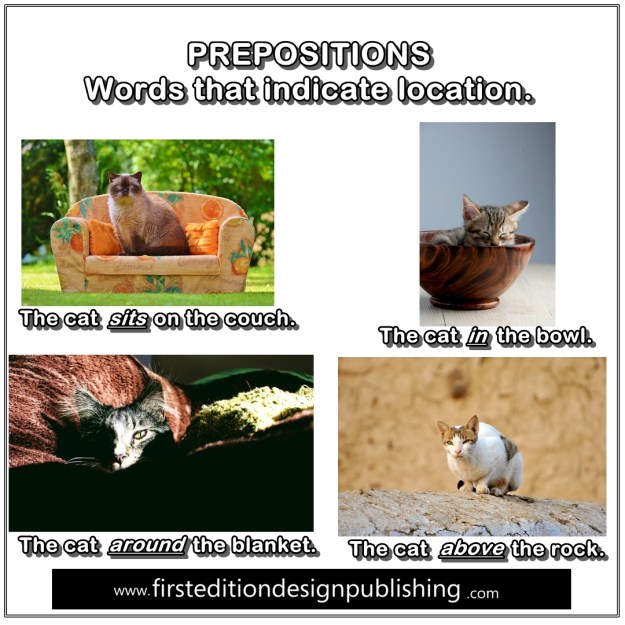
First, a quick review: what is a preposition? These cats explain it pretty well.

cats

To sum up:

The prepositions above show the cats’ locations in space. Let’s add to the fun with these prepositions that show location in time:

I fed the cats at seven this morning.

Pamela will clean the seven litter boxes in the evening.

After you pet the cats, wash your hands before you eat, please.

Is Ending a Sentence With a Preposition Bad?

Recently, we talked about the “rule” that you shouldn’t split infinitives and why it’s really okay.

The bottom line: a few centuries ago, when our grammar was a murky mess, some outspoken grammarians decided to apply Latin rules to English, regardless of whether that was a sensible choice.

In this case, dramatist John Dryden was the first to take up the pen against ending sentences with prepositions, way back in 1672. He claimed that since you can’t end a sentence with a preposition in Latin, you shouldn’t do it in English, either.

The Problem With Following the Rule

English isn’t Latin, though, and we structure our sentences very differently. It’s easy to construct perfectly logical and grammatically sound sentences whose only “fault” is that they end with prepositions.

Plus, when you try to “fix” these sentences, you can end up with some pretty crazy twists, like this quote often misattributed to Winston Churchill:

“This is the sort of nonsense up with which I will not put!”

And as we recognize how arbitrary and baseless this rule was to begin with, we’ve moved away from strictly adhering to it. So if you’ve ever written yourself into a corner fretting over the preposition rule, breathe deep.

It’s okay to end a sentence with a preposition.

That being said, there are a few caveats.

When It’s NOT Okay to End a Sentence With a Preposition

If the meaning of the sentence is still clear without the ending preposition, then remove it.

In my hometown in the hills of western PA, it’s not uncommon to overhear someone on the phone asking, “Hey, where are you at?” “Where are you” doesn’t need any clarification, so cut that “at.”

Then again, it’s also not uncommon to overhear someone refer to a group of people as “yinz guys,” so I’d hardly claim my hometown as a beacon of good grammar and usage.

However, if the preposition is key to the sentence’s meaning, and moving it would cause unnecessary written acrobatics, it’s fine to end your sentence with the preposition. For example:

Carla wanted to run, but her feet refused. What was she waiting for?

Rewriting that last phrase would completely convolute the prose. No one asks, “For what was she waiting?” Come on now.

Ditch Dryden (Or Don’t)

Is it okay to end a sentence with a preposition? Yep.

Is this claim controversial? You bet.

Still . . . maybe it’s time to rethink how much we pay attention to those Latin-obsessed 17th century introverts.

Have you heard the “rule” (*cough* myth) that ending a sentence with a preposition is a grievous error? Do you ever end sentences with prepositions? Let us know in the comments section.

By Alice Sudlow and Liz Bureman
Source: thewritepractice.com

Visit us at First Edition Design Publishing