Tag Archives: tips

9 Quick Fixes For Short Story Writers Who Run Out Of Ideas

It is Short Story Africa Day on 21 June each year! It is the shortest day in the southern hemisphere.

To celebrate, we’re sharing ways to find ideas for your stories. If you are a short story writer and you’re looking for a quick fix, try one of these.

1.  Find Out What Lies Behind The Lyrics

Choose a date. What song was number one on that day? Do some research about the song. Who wrote it? Why did they write it? Who inspired it? Use what you find out as inspiration for your short story.

2.  Use A Writing Prompt

Sign up for a daily writing prompt. Follow people who share them on social media. ‘A prompt can be anything. A word, a line from a poem or a song, a name or even a picture. Anything that gets you writing. Find ones you enjoy.’ (via) Your daily prompt could inspire your short story.

3.  Rewrite A Fairy Tale

Take a fairy take and write it as a modern day story. Change the sexes of the main characters. Choose a random setting. If the tale is too long for a short story, write the beginning or ending as your short story.

4.  Rewrite A Myth

A myth is an ancient story involving supernatural beings, ancestors, or heroes. It is used to explain aspects of the natural world or to show the psychology, customs, or ideals of a society. Examples: The Myth of Creation, Arthur and Camelot, The Rain Queen. Write a myth using one of our 20 Myth Prompts as a short story.

5.  Obsess Over Details

Find one thing that interests you. Keep a file and save these items in it. It can be in a photograph or something you’ve heard. Research it and use it as inspiration for a story. Use this random first line generator to start your story.

6.  Hashtags On Instagram

Choose a topic that interests you. Visit Instagram and click on a hashtag related to the topic. Look at the posts and choose an image that inspires a story. Use this ‘What if?’ generator to enhance your scenario.

7.  Ask Your Followers

If you have a social media following, ask your fans what they want you to write about. Create a poll of some of the ideas you get and write about the one that gets the most votes. Use easypolls or pollcode or pollmaker. Use the embed code to share it on your blog or link it to your social media platform.

8.  Use A Holiday

Which public holiday is next on the calendar. Write a short story about someone who is planning for this holiday, or a story that centres around the holiday in some way.

9.  Write About The Day Your Parents Met

Rewrite the story of your parent’s first meeting. Write it from the perspective of a stranger watching them. Change names, swap the sexes of the characters, change locations. Go!

By Amanda Patterson
Source: writerswrite.co.za

Visit us at First Edition Design Publishing

Why a Serial Might Be a Good Move for Your Writing

Most of us are aware that there’s a strong audience for serial fiction out there. It’s not new. Serial fiction was published in newspapers in the Victorian age, in magazines, and consumed regularly on radio and television. Any series that has a continuing story is, in essence, serial. And the written word serial is gaining ground these days. Some of those authors are famous, some brand new, some indie, some trad-published, and some hybrids. Essentially, authors across the board have jumped on this stage.

If you’ve seen any of the serial outlets, like Serial Box, Wattpad, and Tapas, then you know that there are a range of authors out there supplying this niche with ever new stories.

(Here’s a great article from Den of Geek about some of the best serials out there.)

There are different platforms for this sort of fiction, as well. I’m going to break it into three big divisions: paid, free, and self-hosted.

Paid those big heavy-hitters like Serial Box (Born to the Blade and Tremontaine, for example), Belgravia, and Bookshots (James Patterson’s production). In these, the authors (or groups of authors) are paid for their regular segments.

The next layer down is the sites hosted by a third party, such as Wattpad, Tapas, or Radish. These allow writers of all stripe to post pieces of their fiction, and often allow readers to interact with them (which can be good or stressful.)

There is also the option of hosting your own serial, via a personal web-site or blog. (A good example of this in the Innkeeper Chronicles by Illona Andrews.) I have friends who are on Serial Box and Wattpad, but most of my experience comes from running serials of my own. I currently have three running. Yes, three… and it’s awesome.

First, let me talk about the three I’m doing.

The first of my serials is for my Patreon. Once a month I post a segment from a book that I’m working on (The Truth Undiscovered), usually a chapter of about 3000 words. To keep this one limited to my Patrons, I password protect the pages on my website, and forward the password to my Patrons. The second serial is from a completely different book (In Dreaming Bound) that I’m working on but is posted on my Patreon blog FREE every month, so that anyone who wants to follow that can do so. And the third serial (The Black Queen) is hosted free on my website.

Although I do receive funding via my Patreon serial, I am unpaid for the other two. So why would I do that? Why give away my work for free?

Well, since I started doing this serial work (back in 2016), I’ve had time to analyze what value it has to me. And I have some strong reasons to continue doing it.

1. The serials challenge me to produce regularly.

In the time that I’ve been doing serials, I’ve managed to get the Patreon out on time every month. This means often setting aside my other WIP and digging in for a couple of days to produce and edit those 3000 words, but the fact that my patrons are waiting for it keeps me working. To a lesser extent, the free serials keep me bustling, too. I’ve been publishing two chapters a week on The Black Queen, and that means I have to be sure they’re ready to go up. (Now, these are drafts and will be edited again later, but I do try to get them into readable states before hitting “Publish”.)

2. The serials allow me to connect with readers from different ‘worlds’.

The Patreon series is related to my Golden City novels (a prequel), the Patreon freebie is the sequel to my Dreaming Death novel, and the online freebie is the next book in the King’s Daughter series, following The Amiestrin Gambit and The Passing of Pawns—both of which were also serialized. This keeps me actively engaged with different worlds I’ve created, and with those readers who liked each one.

3. The serials allow me to experiment a little.

Now some people who write serials plot and outline, but others don’t. My two free serials are plotted out, but my Patreon series has been pantsed from one end to the other. It was a choice I made up front—to try something different—and I’ve enjoyed that a great deal. And it’s taught me a lot about chapter structure and planning that I can use in the future. I’m learning some craft in doing this.

4. I get to connect with new readers.

Although my readers don’t often communicate directly with me (as is common on a platform like Wattpad), I do get input. On my webpage, I get to see when the regulars check in on the weekend…there’s Poland, there’s Norway, there’s Germany, there’s UK and Singapore…. I recognize those hits, and I know they’re coming back every week to read.

5. I get to publish my serials as books when I’m done.

Back when I first started my Patreon, I wrote a serial novella for that called “After the War”. It took about seven months to get all the chapters up, but this is the one that hooked me on serial writing. Once it was complete, I edited the manuscript, sent it off to my editor/formatter, and got my illustrator to make a cover. And then I had a book, a nice resolution at the end of the cycle.

But surely there are some downsides, right? Yes, of course there are. Here are some of the things that can crop up.

1. A serial, when published as an entire product, can have overall pacing issues.

There may be chapters that are slower than others. (Have you had a beloved TV series with those two or three episodes per season that you never re-watch?) And when you’re writing in serial fashion (particularly in monthly installments rather than weekly) it’s easy to miss those.

2.  Continuity can be a bug-bear, particularly on the once-a-month schedule.

If you have gaps between writing sections, you may forget a description, a person’s name, and what day of the week it is. For my serials, I usually put the date and location at the top of each chapter (I don’t necessarily include those in the final product, though.) I keep a running Cast of Characters, and when I’m worried, I’ll go back and reread pertinent passages. It’s easy to make a mistake when you’re switching between WIPs.

3. Sometimes life knocks you off schedule.

When my dog had surgery recently, I ran a bit short on my Patron chapter. I published only 2/3 of the chapter, but I explained the situation to my patrons and they were very supportive. When I’m not going to get one of the free serials in on time, I’ll leave a note on my webpage.

4. You worry about plagiarism.

Well, as authors we have to worry about this all the time. It’s the backdrop against which we work. People will steal things off your website and repackage them as their own. So keep your posts with the appropriate dates on them, and make sure you have old copies of your files so that if there’s any problem, you will have those files as proof of your authorship.

Why Ebook Piracy Matters – Jana Oliver

How to Protect Against Plagiarism If You Post Fiction Online

For me the serials have been part of my over-all effort to write faster and to incorporate some new craft into my writing. I will be publishing five 90-100K novels this year, all of which will have been at least partially serialized. I will then start on 3 new serials (again, one for paid Patreon, one for free Patreon, and one for my website) and hopefully keep that ball rolling!

It never hurts to give new things a try.

By J. Kathleen Cheney
Source: blog.janicehardy.com

Visit us at First Edition Design Publishing

History for Fantasy Writers: Pirates

Everyone knows about the pirates of the Caribbean. Let’s talk about other pirates. Since I’m a medieval historian, I’ll stay firmly in the European world.

Before we get started, a general comment: the lines between pirate, merchant, and rebel were blurry and ever-shifting. If you had a ship, it was sort of like having a pickup truck—you could use it for any number of enterprises.

Few pirates were exclusively that. The real interest lies in the variations on our standard idea of piracy.

Who were pirates? Given the comment above, pretty much anyone with a ship and a few followers could engage in piracy at one time or another, but there were a few places notorious for the practice of robbing other ships.

Frisian Pirates

Frisians were one. They lived along the coast of northeastern Netherlands; the region is still called Friesland. The Frisians were their own people, with their own language. Their land is made up of a complex of islands and marshlands that were rarely the object of ambition from other peoples, so they rarely were under the foot of invading armies.

The Frisians were constant raiders, not all that dissimilar to the Vikings, save that they did not try to invade and conquer. They were content to loot and go home. It just so happened that they were as content to do their looting at sea as on land.

Frisians are a fine example of the muddy lines between pirate, merchant and rebel. Under the Carolingians, their ports flourished and Frisian ships traded as far as England, France, Denmark and into the Baltic Sea. This trade was largely ruined by the Vikings, who hit this part of Europe hard. By the 14th century, we encounter them as pirates preying on ships from Hamburg and Bruges, calling the Vitalienbrüdern. Eventually, they annoyed the neighboring Germans and Danes enough that they were conquered and their sailing skills were put to use by others.

Cilician Pirates

Pirates were a constant problem in the ancient world as well. The pirates of Cilicia (southern coast of modern Turkey) once captured Julius Caesar. They later regretted that. The Great Pompey was given the task of clearing what Romans called Our Sea (the Mediterranean). He did so with Roman efficiency. He deployed a fleet and an army. Working in tandem, they moved along the coast from one end of Cilicia to the other. The navy destroyed their ships and the army destroyed their ports. Few kingdoms in later centuries had the resources to pull off an expedition of that scale.

The Sea Beggars

These fellows fall at the rebel end of the pirate spectrum. When the Spanish waged war in the Netherlands in the later 1500s, a number of ship owners decided to use their ships to harass the Spanish. They were sometimes effective, sometimes not, but they fairly consistently pocketed their prizes, arguing that they needed to cover expenses.

Whenever peace broke out, the brave, patriotic rebels became pirates. When war returned, they were once again patriots. Their most famous exploit was the raising of a Spanish siege of the town of Leiden in 1574.

River Pirates

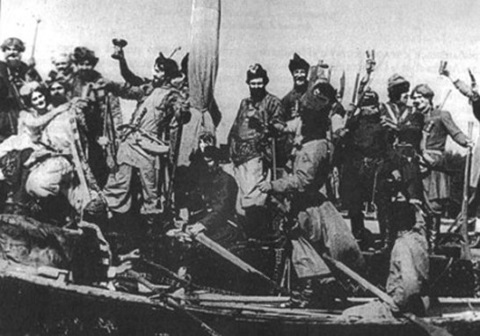
River pirates could be found on the Thames in England, the Ganges in India, and the Yangtze in China (the Yangtze Patrol was made famous in the book and movie, The Sand Pebbles).  There were even Cossack pirates, such as Stepan Razin.

Once, Razin was surrounded by a Persian fleet in the Black Sea. The Persian commander put his ships in a circle, chained together, to keep Razin from escaping. The pirate ships were smaller and lower, completely vulnerable to the Persian cannon fire. But Razin attacked anyway. A lucky shot set off the powder magazine in the Persian flagship, sinking it almost instantly. When it sank, it dragged the other ships down with it and only three Persian ships survived. Razin sailed away unscathed.

He rained terror and death along the Volga, the Don and into the Caspian Sea. He sacked Astrakhan and Samarra. At the height of his career he commanded several thousand followers and whole fleets of ships.

Other Cossacks also took to rivers. The most famous of these were the Ushkuiniks, who operated in northern Russia, around Novgorod. Their ships were remarkably slim and light (uisk in Russian means snake). Although they could hold as many as thirty men, the ship could be carried overland between rivers. Ushkuinik ships were frighteningly swift.

There was Alfhild, the pirate princess. Daughter of Siward, King of the Goths. Beautiful, of course, but she went about hooded and cloaked so men would not be provoked to passion. She was to be married to the handsome Viking Alf, who himself was a great hero at sea. But she refused to marry. She and some friends dressed as men and commandeered a ship, then embarked on a career as pirates. According to legend, all her crew were women.

Alfhild operated in the Baltic Sea and the North Sea, not on rivers, so technically she doesn’t belong here. I just like her story.

Many so-called pirates were at least part-time merchants, glad to engage in peaceful trade when that was profitable, and equally happy to engage in piracy when that was the easier course. Stepan Razin’s pirates would enter as merchants and live in a place for weeks or months before turning on the population, stealing everything. In one case, forty of them entered as pilgrims. They went to the shrine, killed the guards, and opened the gates. In another case, the pirates posed as merchants bringing jars of wine. The weapons were hidden in the jars.

River pirates could form whole flotillas. They typically had an island or swamp as refuge. It’s rare to find river pirates operating at sea, and vice versa, mainly because the ships and techniques are quite different.

Pirates in Fantasy

River pirates would make a great target for an expedition of heroes. Ship to ship battles are always colorful, and the climax could be the assault on the pirates’ island fortress. Also, your readers are less likely to know the details of non-seafaring ships.

Since this is fantasy, why not add magic to the mix? River pirates might command currents, summon river monsters, or even be the ripuarian equivalent of mermen.

Even if river pirates are not the focus of your book, they could make a colorful side-quest or could provide a rich secondary character or two.

I don’t know of any fantasy tales that make use of river pirates. If you do, please let me know. I’ll update this article and give you credit!

As for sea pirates, I don’t think anyone needs encouragement there. All I’ll add is that there’s room for a story about the moral ambiguity of a pirate’s career. The pirate could see himself as a defender of his people, while his enemies see him as a … well, as a dread pirate (with apologies to Mr. Goldman).

How about you? Have you used pirates in any of your stories? Read any good fantasy pirate tales? The clear leader in that last category is Tim Powers (On Stranger Tides). How about any others?

References

E.L. Skip Knox is the creator of the fantasy world called Altearth, a place where magic is real, monsters roam the land, and the Roman Empire never fell.

By
Source: mythicscribes.com

Visit us at First Edition Design Publishing

Here’s How to Protect Yourself Against Social Media Trolls Now

I’m not sure how you’re feeling about social media right now, but it’s hard out here for many of us. I’ve never seen a nation so divided or divisive, and I observe this daily on Twitter and Facebook (more than other channels), particularly as a sexual abuse survivor with a large author and advocacy platform.

I fully realize, and accept, that by being vocal about my stories, experiences, and beliefs on public channels, and sharing content on controversial topics (gasp: violence against women, sexual assault, rape, and the F-word: feminism) puts a huge target on me and I take the good with the bad (more on that in a moment). Oftentimes, it’s men in particular who have Something To Say about what I’m supposed to say or should do or present myself a certain way. It’s pretty comical.

Until it becomes threatening and scary AF.

I follow who I want to follow, I unfollow, mute or block who I don’t want to interact with. Sometimes, though, that’s not enough. I’m often attacked by others who don’t approve of the way I’m sharing my stories, or even by others who want me to do things for them and when I decline, I’m somehow the bad guy. I also see so many survivors are consistently harassed, stalked, doxxed, and even threatened — it’s become seriously disgusting.

We must protect ourselves.

Social Media Trolls

Twitter and Facebook agree (finally), and have given us ways to cut down on interaction with these trolls. Because my business (as BadRedhead Media) is doing social media, I realized I’m maybe a bit more aware than others on how to maximize these options so I want to share some of these tips with you today.

Why? I still believe in the many wonderful benefits of social media: forming community, finding support, learning, connecting, building bridges, camaraderie, a laugh when we need it, the brilliant commentary, and the many forces for good.

Social media is what you make it, so mold it to be the experience you need it to be, and disregard the rest.

Here’s how.

Twitter Trolls

Change Your Settings on Twitter 

Most people don’t know how to or don’t bother doing this, yet Twitter has made it soooooo easy and you have many options as well.

First, look at your toolbar, click on the Notifications tab and you’ll see a Settings tab. Looks like this:
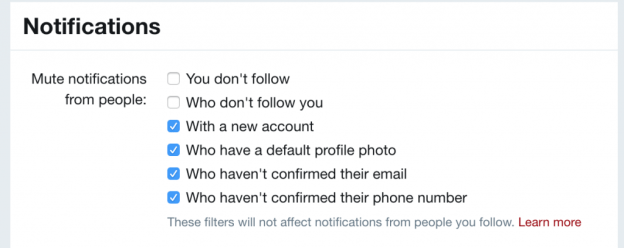
Screen-Shot-2018-06-11-at-1.25.48-PM-1024x407

Click on the Settings hyperlink, and you go to this screen. You can see how I have set my Notifications right now on my @RachelintheOC Twitter account:

Here's How to Protect Yourself Against Social Media Trolls Now by @RachelintheOC

Another option here is the Advanced QUALITY FILTER, which allows you to mute specific words or phrases from showing up in your notifications. For example, if you’ve just had it with Trump, you can add that as a word that will always be muted, regardless of the tweet, and you will not see it (whether it’s from followers, news articles, quotes, trolls, whatever).

Screen-Shot-2018-06-11-at-1.28.52-PM-1024x235


Reminder: all of these settings are changeable, so if you’re having a bad day, do what you need to do and then change it back the next day. If you want to make it a permanent thing, that’s also your choice. These are options for people you DON’T follow.

Note: You do not have to give Twitter your phone number. You don’t have to give any social media channel your phone number unless you want to sign up for two-step log-in verification (something I highly recommend — and even then you can use email instead of text if you prefer). This is to prevent hacking of your account. Again, totally your choice.

Why is this an option then? Bots, spammers, and trolls who create numerous accounts to troll from don’t have numerous phone numbers — Twitter knows this. It’s simple to create a new email and Twitter account in a few minutes — it’s altogether different to get a new phone number to go with each of these accounts. So this option isn’t about you giving your phone number — it’s about protecting you from interacting with bots, spammers, and trolls you don’t follow. 

Some people argue that removing words or notifications is akin to putting ourselves in a bubble or echo box, where we only interact with people who agree with us; others say we are censoring others. I say: bullshit. You create and curate your own Twitter experience, and if you feel bothered or upset by what people are sending you, then it’s within your power to cut them off.

You are not obliged to interact with haters or trolls. You are not censoring them, as they will argue (which always tickles me). They are still free to spread their hate and vitriol — you simply do not need to be their final destination.

And on that note, Twitter has made a change to their algorithm: it will use behavioral signals – how users react to a tweet – to assess if an account is adding to or detracting from conversations. If it feels it’s exhibiting troll-like or bot behavior, the tweet will be removed or shoved down to the ‘show more replies’ graveyard. I think this is a great and needed change — what do you think?

Facebook Trolls

Oh, Facebook. What a disaster you have become. If you’re still there (I am. I love my Street Team — click to join! — and survivor group), you have your reasons. Pages are different and important if you’re an author or small business for the sole reason that you cannot advertise your books or services on your personal wall (if you are, stop it. You’re violating the TOS – terms of service) and they have every right to shut you down.

I find it’s almost impossible to post practically anything without someone making a political comment on it — in fact, I posted an article the other day about the legal difference between the terms sexual harassment, sexual misconduct, and sexual abuse, and some guy posted on my wall about why he changed political parties and “deep state” political conspiracies. I was like, dude, seriously? Sigh. (For what it’s worth, I kindly asked him to delete his comment. When he refused, I kindly deleted it for him and blocked him as well.)

I do think it’s possible for us all to disagree about politics and still like and respect each other, and have conversations about it if that’s what the designated topic is. Here, it was not. Anyway, I digress.

Managing Your Newsfeed

Did you know you can do that now? Before, you had to put people on lists and it took hours and hours. Days, even. And then you had to keep it all updated as you friended or unfriended folks. So most people didn’t bother. Now you don’t need to. Here’s how:

Click on your toolbar (top right by your face), where the little upside-down arrow is:

news-feed-pref-

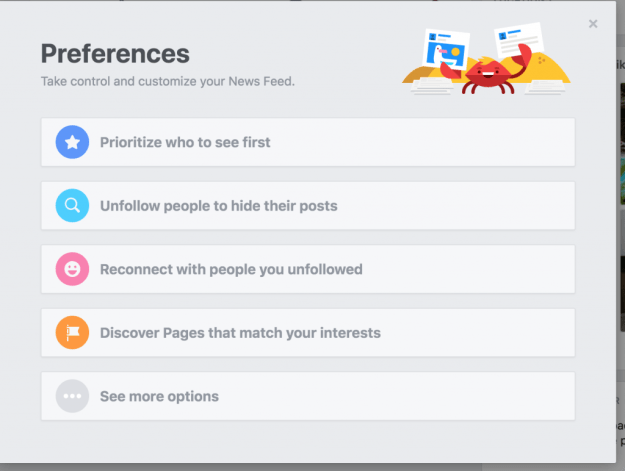
Once you click on that, a drop-down list appears. Click on News Preferences:
Screen-Shot-2018-06-11-at-1.52.07-PM-1024x772


Now, you just click on this handy box with the weird crab (I don’t get it but whatever). My kids don’t get it either. Can someone explain the crab to me? It’s just weird.

Click on each tab and do your thing. What’s important here is the light blue tab: you can UNFOLLOW people and they don’t know. You don’t see their vitriolic, ranting, or weird, crab-filled posts anymore and they have no idea.

Personally, I have zero issue with blocking folks and find a kind of sinister glee in it, yet I know some of you feel bad about that because you have hearts and stuff. Again, do what makes you feel good.

A Bit of Advice

If I choose to engage with someone who comes at me — because what’s the point of having this platform if I don’t use it, right? — I have The One-Reply Rule: I reply once (if at all). If that person comes back at me with ad-hominem attacks, circular logic, straw-man arguments, or are just plain ridiculous, etc., they’re gone. If, however, we can engage in some kind of discussion that is educational, beneficial, and all that, cool.

Listen, I get that people have feelings and need to feel their feels. Most people in this world just want to be heard.

None of us needs to be the target of someone else’s hate, though. Do not feel obliged to engage with anyone on social media, ever.

Final Thoughts

When all else fails and it becomes too much, turn off social media. Walk away. Turn off all your notifications. Your mental health is far more important than social media.

If it helps, here’s what I do with regard to social media (and remember, this is my business, too):

  • No phone notifications, ever.
  • No desktop notifications, ever.
  • I keep Twitter and FB open when I’m working on social media scheduling or interacting with people, otherwise, they’re closed
  • I always have Hootsuite open because I’m always scheduling or looking for great content to schedule
  • I definitely recommend using a SMM (social media management) tool as well as the coordinating browser extension (in this case, the Hootlet)
  • I never have social media open when I’m writing (blog posts or my books)
  • If I’m working on client deliverables, social media is off.

Some people enjoy the arguments, some people take things personally, and the overall experience can go sideways quickly. Practice compassion with others and importantly, with yourself. If silence is the best answer for your self-care, do that for you.

I hope this post helps you figure out ways to find your peace.

By
Source: rachelintheoc.com

Visit us at First Edition Design Publishing

Write Fictional Characters as Complex and Realistic as You Are—The MBTI for Writers Series

What’s the secret to writing fictional characters readers fall in love with? What makes us reread our favorite novels, revisiting the same characters through the years like old friends?

Some writers are naturals at it. Lifelong people watchers, they seem to “get” how other people work without trying. So of course their fictional characters are complex and realistic. Of course their characters leap off the page.

But not every writer is an expert in people.

That doesn’t mean your characters are doomed to be cardboard cutouts. There’s hope for the writers who have something to say but aren’t sure yet how to create characters realistic enough to say it.

If you struggle to create characters who are complex and distinct. If you find yourself scratching your head at every plot turn, unsure of what your character would say or do or think next—then you know the struggle.

You know what it’s like to want your character to become so real, she takes over the story—but every word you write just reminds you she’s still a stranger.

So how do you flesh out a character who falls flat? How do you fix cliched, unlikable characters? How do you define characters who are too predictable or distinguish the ones who act just like every other character in the story?

There’s a tool for that.

It’s called MBTI. And it’s your new secret weapon for creating fictional characters as complex and realistic as you are.

This is The MBTI for Writers series.

Fictional Characters Made Easy: What We Cover in MBTI for Writers

  • What exactly MBTI is (the quick and dirty version for writers)
  • A simple overview of the 16 MBTI personality types (i.e. what’s really going on inside the heads of each personality type)
  • Quick tips for getting into each type’s head so you can see the story through their eyes—even when the character is NOTHING LIKE YOU (Because what better way to know how they would act and respond to the plot than to see the world how they see it?)
  • How to use each of the 16 MBTI types as a character mold to build out an endless cast of truly unique, surprising, and ultra-realistic fictional characters your readers will love (and love to hate)
  • What so many people get wrong about MBTI and how writers can use it to their advantage
  • Ways to build out each personality type so each one is new and unique—no matter how many times you’ve reused the mold

Series Contents

Out Now:

Coming Up:

  • See Through Your Character’s Eyes: How to ‘Experience’ the 8 MBTI Functions Like Your Fictional Characters Do
  • How to Make Each Character Type Unique—Even If You’ve Used That Type Before
  • 11 Smart Reasons to Create Your Next Fictional Character Using MBTI
  • Do You Really Understand Your Character? Cheatsheets for Writing Each of the 16 MBTI Types
    • ENTJ Character Design Cheatsheet
    • INTJ Character Design Cheatsheet
    • ENTP Character Design Cheatsheet
    • INTP Character Design Cheatsheet
    • ENFJ Character Design Cheatsheet
    • INFJ Character Design Cheatsheet
    • ENFP Character Design Cheatsheet
    • INFP Character Design Cheatsheet
    • ESTJ Character Design Cheatsheet
    • ISTJ Character Design Cheatsheet
    • ESTP Character Design Cheatsheet
    • ISTP Character Design Cheatsheet
    • ESFJ Character Design Cheatsheet
    • ISFJ Character Design Cheatsheet
    • ESFP Character Design Cheatsheet
    • ISFP Character Design Cheatsheet
  • Common Arguments against MBTI (And Why They’re Dumb)

Source: mandywallace.com

Visit us at First Edition Design Publishing

How To Survive Being A Writer

Writer PAIN

Being a writer is hard, who knew?? Well, all writers you know!! check out some of these fun pics this weekend … They’re funny ‘cos they’re true my friends! See you on the other side 😉

Recognise this??

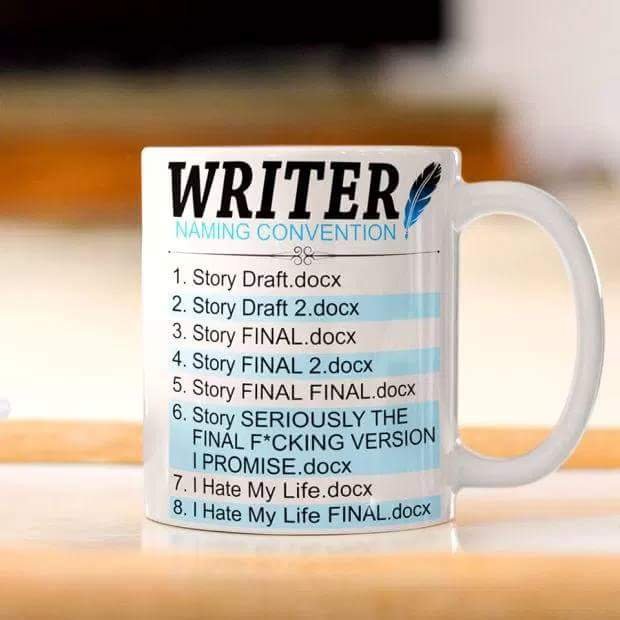
So I’ve been writing, writing, writing this week … and it would seem I now have forty billion versions of essentially the same document on my hard drive. And in my Dropbox. And in The Cloud. Plus I’ve emailed it to myself.

Because you JUST CAN’T BE TOO CAREFUL, OKAY! It’s the only way to survive the horrible moments you get that ‘wheel of doom’ when your laptop crashes. Which it will!

fb_img_15225130071581302991133

… Or this?

I love weekends, evenings, holidays because I get to relax. And by ‘relax’ I mean go on my phone and write stuff on there, instead. What???
fb_img_1522493086842300050198

How About This?

I have kids, which means I get asked to make food, hear songs or watch ‘jungle dances’ (whatever they are!) every thirty seconds. It’s a miracle I have any focus whatsoever, but then I do have some really great noise-cancelling headphones. Get some!!!

image_8f077e85-ca1f-43fd-9fad-b81b9694f7d520180308_0907161019903840

I’m sure you get this …

If you’re a writer this happens to, I’m actually jealous. I’d have to actually go to sleep for this to happen to me!

fb_img_1522596631211508152407

Or Maybe This …

There is never a good time to write a book, okay. Or a screenplay. In fact, just be an accountant or a hairdresser or a chef.

Oh but wait — I’ve had the greatest idea!

Damn. Too late. Looks like I can’t stop myself even if I wanted to (I want to — waaaaah!).

fb_img_15215298698951323735161

And definitely this!!!

Don’t you just love it when you’re a writer online and one of THESE asks your advice … Then doesn’t follow it? OMG.

fb_img_1522597292783135201208

So you no doubt need this …

Give me all the coffee. The End.

fb_img_15130725148671283359900

So you can do THIS:

Well there have to be some perks of the job when you’re a writer … After all, if you did it for real, you’d go to jail.

img_20180321_070826351497155

Good luck out there!

Source:bang2write.com

Visit us at First Edition Design Publishing

Basic Plot for the Beginning Writers

If, like many people, you labor under the idea that for “real” writers, plot comes effortlessly, dismiss that illusion now. While some writers were born with a sense of how to tell a story effectively, more of them do study the elements of plot and pay serious attention to how other writers successfully construct a narrative.​

Playwrights have this stuff drilled into them, but fiction writers often get away without basic instruction in what makes something dramatic.

It’s not magic. The elements of a good story can be studied and learned.

In fact, you’ve probably already studied them in your high school literature classes. It doesn’t hurt to review them now, from the perspective of a writer and not a student. They may seem simple, but without them, your other skills as a writer — your ability to imagine believable characters, your talent with dialogue, your exquisite use of language — will come to naught.

Start, of course, with a protagonist, your main character. The protagonist must encounter a conflict — with another character, society, nature, himself, or some combination of these things — and undergo some kind of change as a result.

“Conflict” is also known as the “major dramatic question.” Gotham Writers’ Workshop puts it this way in their guide Writing Fiction: The major dramatic question “is generally a straightforward yes/no question, one that can be answered by the end of the story.” What will happen to King Lear when he divides up his empire and estranges himself from his one faithful daughter?

Will Elizabeth Bennet of Jane Austen‘s Pride and Prejudice get to marry for love, and will she or one of her sisters marry well enough to save the family from financial humiliation?

What sorts of changes do these conflicts bring about? Elizabeth Bennet learns the dangers of letting prejudice interfere with judgment.

King Lear acquires humility and learns to recognize superficiality and sincerity. Both are wiser at the end of the story than they were at the beginning, even if this wisdom, in Lear’s case, comes at a dear cost.

Elements of Plot

A story will hit various landmarks on its way from the story’s beginning to the fulfillment of the dramatic question. The introduction presents the characters, the setting, and the central conflict. Involve your protagonist in that conflict as early as possible. Today’s readers will generally not wade through pages of exposition to get to the point. Don’t make them wonder why they’re reading your story or novel. Hook them in the first page or pages.

From there, the character will face various impediments to the achievement of his or her goal. Known as rising action or development, this is part of the story’s satisfaction. Readers like to see a struggle, like to feel as though the payoff at the end is deserved.

Again, Pride and Prejudice provide an excellent example. If Elizabeth Bennet and Darcy liked each other immediately, and their friends and family immediately approved, their marriage would be much less satisfying, and nothing much would have been learned along the way, except that it’s great to fall in love.

Note how other writers build dramatic tension during this part of their narrative. How do they keep us interested in the outcome of the story? How many impediments are necessary to make the reader feel satisfied at the end? None of these decisions are necessarily easy. Part of your growth as a writer entails developing a feel for a successful story arc.

The rising action leads to the climax, the turning point in the story, which in turn leads to the resolution. The central dramatic question is solved one way or another. Peter Selgin provides a good example in his book By Cunning & Craft:

Climax is the resolution of conflict, the point of no return beyond which the protagonist’s fate — good or bad — is secured. Romeo’s suicide is the climax…not because it’s the most dramatic moment, but because it seals his fate and determines the resolution by preventing him and Juliet from ever living happily ever after.

In the denouement, the author ties up all the loose ends. Elizabeth and Jane Bennet get to live close to each other. Lydia stays far away in the North, where she can’t bother them much, and Kitty’s better qualities are drawn out by frequent visits to her sisters. Everyone we like lives happily ever after, and in a matter-of-fact three pages or so, we get all the necessary details. Likewise, the denouement for Lear takes only part of one scene: all the players of the main plot die, but under Edgar, England is reunited.

Two Disclaimers

First, much successful fiction does not follow these rules exactly. But even works like Virginia Woolf’s Mrs. Dalloway, which seem focused more on language than action, introduce dramatic questions to keep us reading. (Will her party come off? What’s up with her and Peter Walsh?) A lot of fiction that doesn’t necessarily seem plot-driven turns out, on closer scrutiny, to depend on tried and true strategies we can trace back (in Western literature, at least) to Aristotle’s Poetics.

Second, these basic elements may not occur in the order listed above. Try to identify them in your reading. Question why the writer decided to tell the story the way he or she did. Note the dramatic decisions. And, of course, think about all of this as you craft your own stories. At the end of the day, something has to happen. It seems elementary, but it can be quite complicated. By all means, experiment, but spend some time on the basics, too.

By
Source: thebalancecareers.com

Visit us at First Edition Design Publishing

The Joys of Writing Tragedy

Tragedy is one of the oldest and most fundamental forms of story-telling. It’s a mode that focuses on suffering, that connects its central character to the wider world, and that is deliberately designed to make audiences consider the fragility of their own lives. It can be a powerful tool for writers in any genre.

In this article, we’ll be looking at what tragedy is, what defines its protagonist, and how to make use of it in your writing.

Defining Tragedy

Tragedy as we now know it emerged from Greek plays around 2500 years ago. It reached its classical golden age in 5th century Athens, but our understanding of its form is most shaped by a book from a century later. In his Poetics, the philosopher Aristotle explained the origins of the form, as he understood it, and its defining features. The points he singled out shaped tragedy from then on, as it was kept alive by the Romans, revived in the Renaissance, and used and adapted by authors, poets, and playwrights ever since.

Tragedy is built around a downward arc. The protagonist experiences an unhappy transformation, ending in death or at the very least disaster. This is how many people identify a tragedy.

But there’s more to a traditional tragedy than this.

For the reader, a tragedy should be an unsettling experience. The story highlights the uncertainties of the world by showing that even the most powerful can fall due to events outside their control. In classical theatre, those events were usually driven by supernatural forces. In modern writing, they are more likely to be about the structures and injustices built into our society.

At its best, tragedy draws a mixture of emotions from the reader. There’s pity for the character experiencing the downfall, but there’s also fear. This fear is partly for the protagonist, but it’s often also fear of them. The rage of Shakespeare’s Hamlet or Hardy’s Mayor of Casterbridge creates a mixture of emotions, as the audience is torn between empathising with the character and worrying for the people they harm. It’s a deliberately unsettling experience.

The arc of the story should also evoke mixed emotions. It should feel both unavoidable and unacceptable. This undermines the audience’s sense of the world as a just place.

The character’s fall connects in with a wider sense of destruction. Hamlet’s tragedy is also that of the Kingdom of Denmark, as the royal house and by extension the nation goes into decline.

The face of tragedy has changed in recent centuries. Some of the features that Aristotle considered essential are no longer evoked, and the focus has moved away from supernatural interventions in human lives. But the core of tragedy remains the same – evoking emotions through injustice and the suffering of a central character.

The Tragic Character

If you want to write a tragedy then, as with so much of fiction, you need to start with the central character.

The tragic protagonist is normally a noble figure, one who clearly has good intentions, at least at the start. Walter White from Breaking Bad is a great modern example. He just wants to look after his family and his own medical bills. It’s the path he follows to do this that leads to somewhere far less virtuous.

Even if they aren’t noble, the central character needs to be sympathetic. For the tragedy to work, the audience has to care about your character and want them to avoid their approaching doom. They have to keep caring about them, on some level keep liking them, even as they do terrible things. If we didn’t like Hamlet, then we would stop caring for him as he kills Polonius and drives Ophelia mad.

This draws attention to another important feature of a tragic character – the fatal flaw.

All characters should have some flaws and failings to make them relatable. But for the protagonist of a tragedy, a powerful, fundamental flaw is vital. This is the characteristic that motivates much of their actions and that eventually leads them to disaster.

For Shakespeare’s Macbeth, this flaw is unchecked ambition. He is willing to do anything to achieve power. This leads him to destroy his support base by betraying those closest to him, to offend people more powerful than himself, and to behave so badly that he loses all hope of redemption. The fatal flaw drives his downfall.

It’s the fatal flaw that binds together character and plot in a tragedy, preventing the story from being something that just happens to the character.

The character arc that emerges from a fatal flaw can’t just be that the character ends up dying. In the right circumstances, a character’s death can be noble and heroic, which would rob a tragedy of its unsettling negative emotions. Most tragic characters die, but this isn’t the sum total of their downfall.

In a tragic arc, the character suffers, both physically and emotionally, through the course of their downfall. They lose the things that are important to them, most critically their sense of identity. Hamlet loses his mind, his family, even his reputation. Macbeth descends from national hero to hounded villain. Michael Henchard loses his hard-won position as mayor of Casterbridge and the respect of family and friends. Only when you’ve robbed the tragic protagonist of everything that made them who they were, when you’ve flattened all their achievements and left them in despair, does the time come to kill them off.

To give your character’s arc real tragedy, it should feel inevitable. The way that their fatal flaw interacts with the world means that they cannot avoid disaster. Hamlet’s inaction prevents him from fixing the problems at court but won’t let him step away. Henchard’s pride drives him to success but also to disaster, as he cannot compromise to the needs of others in his life.

But while the character’s downfall should feel inevitable, it should also feel unacceptable. However much we might hate Macbeth, we have followed him for so long, come to feel his fears so much, that we still feel a pang of remorse at his death. When Hamlet falls, we aren’t left feeling that justice is served, but that a greater injustice has been done.

Writing Tragedy

When preparing to write a tragedy, much of your attention should be on the tragic protagonist. But what else can you do to evoke the tropes and tone of tragedy?

Strange as it might sound in a story where defeat is inevitable, uncertainty should also be a feature. Tragedy whips the rug out from under the feet of both the protagonist and the reader. If the world worked the way the protagonist believed then they would be able to thrive despite their tragic flaw. If it was as just and reasonable as readers expect, then tragedy would not unfold.

Uncertainty can also be achieved through varying the outcome of individual situations. Small, unexpected successes create hope rather than a slow grind towards disaster. They help to keep the outcome uncertain, and so increase the impact as disaster looms. A character’s occasional wins make their losses more distressing by contrast.

It’s in the tension between uncertainty and inevitability that tragedies achieve their unsettling effect.

Try to tie the character’s downfall into a broader sense of destruction and despair. If your setting is the modern world, you might set their story against a backdrop of inequality or government failings. In an epic fantasy, it might be the collapse of an empire.

It’s vital to engage readers’ emotions. They need to feel the loss and despair of the character on their way down, as well as the sense of injustice overwhelming them. Think about how you can show this through he protagonist’s actions, through the view from inside their head, and through the way you describe the world around them. At the start, you need to engage the audience’s sympathy. After that, it’s their sense of despair.

This can lead to some unfortunate clichés and toxic tropes. It’s particularly important to avoid falling into these traps. Killing of the female love interest of a male protagonist can increase the sense of disaster around him, but it also perpetuates a world view in which women are robbed of agency and our stories are all about men. Could you find a way to ruin that relationship that is still heart breaking but shows the woman making her own choices? Can you make the people around the protagonist more than just props in his disaster? Showing their lives, feelings, and decisions will make it all he more tragic when the world falls down for them as well.

Tragedy is one of the most powerful tools in a writer’s arsenal. It can be used in any genre or setting. Its structures help you to create a compelling character and a story that will hit readers hard. If you can start from a fatally flawed character, build a wider disaster around them, and avoid tired old clichés, then it can be your path to something compelling.

Just ask Aristotle.

By Andrew Knighton
Source: refiction.com

Visit us at First Edition Design Publishing
How to Show and not Tell Intelligence

Although the concept of intelligence and what exactly it means for a person to be intelligent are the subject of considerable controversy and debate, it’s widely accepted that intelligence is valued in our society. In fact, if you’re a sapiosexual, you find intelligence as the most sexually attractive feature in a prospective partner. I’m not going into the evolutionary theories for this (including that intelligent men have a higher sperm count and women intuitively understand this and so are drawn to them), so you’ll have to take my word for it. Intelligence is attractive, and a trait we see in many a hero (and villain in fact). In the landscape of writing, this is a trait you can harness to add layers to your character.

Although every psychologist who has endeavoured to define intelligence has come up with their own definition, intelligence is broadly understood as the ability to perceive or infer information, and to retain it as knowledge to be applied towards adaptive behaviours within an environment. The key as a writer is to create a character who presents as intelligent in a plausible manner. Sure, you can slip in their above average IQ scores as they munch over breakfast, or point out they have seven PhD’s, but what if your character is an adolescent? Or what if they live on the planet X where IQ tests aren’t used because the sentient species have acknowledged the limitations of cognitive testing?

What if you want to show, not tell?

Well, you’ve come to the right blog post. I undertook some research, and along with my professional understanding of intelligence (IQ testing is a regular part of my practice in schools), I considered it in terms of character development. If you’re looking to craft an intelligent character, then check out the following traits (quick caveat: they don’t all have to be present for a person to be considered intelligent, but each of these traits are understood as strong indicators of above-average cognitive capacity):

High Verbal Functioning

People with a high IQ have strongly developed verbal skills. Your character is likely to be able to verbalise meaningful concepts and express themselves articulately and maybe even eloquently. This means dialogue, internal and external, is going to be important in representing an intelligent character.

Strong Reasoning Capacity

A person with high intelligence is able to detect underlying concepts and relationships, and use reasoning to identify and apply rules. Abstract thinking is a strength, as is attentiveness to detail. Many detectives in crime novels demonstrate strong reasoning capacity, and every time they solve the murder by linking the dots that seem to live in different postcodes we’re wowed by their intellect.

Good Memory

Intelligent people not only notice this nuanced information in life, but they also maintain this information in conscious awareness. This process, which requires attention and concentration, allows them to manipulate and play with said information in their mind. I’d rather not recollect the amount of times I’ve looked like I’ve lost valuable IQ points because I can’t remember the of age of my firstborn child!

Fast thinking

Smart people are fast thinkers. They can do all of the above, and they do it quickly. They are able to scan information accurately, make decisions, and implement those decision rapidly. These characters will drop one-liners in the blink of an eye, or be the first to recognise that the name of their victim isn’t on the list of missing people following the earthquake that levelled New York.


But it’s important to note that high intelligence doesn’t necessarily mean your character is any of the following;

Emotionally Intelligent

Emotional intelligence; the capacity to be aware of, control, and express one’s emotions, and to handle interpersonal relationships judiciously and empathetically, is quite different to cognitive intelligence. Whilst people who do well on standardized tests of intelligence tend to be more successful in the classroom and the workplace, emotional intelligence is correlated with better social relations, better family and intimate relationships, and better psychosocial wellbeing.

Think of Sheldon in Big Bang Theory—with his borderline autistic tendencies, he’s an accomplished physicist, but he’s socially inept and emotionally naïve, which has been mined over 11 series of hilarious interactions. It’s worthwhile to consider whether your character has both of these qualities.

Wise

You’ve probably heard the saying there’s knowing that a tomato is a fruit…and understanding a tomato doesn’t belong in a fruit salad. In the same way, intelligence (knowledge of information and using it adaptively) isn’t necessarily wisdom (the ability to think and act using knowledge, experience, understanding, and insight). Your character may have acquired the knowledge (impressively and quickly), but wisdom is the proper use of that knowledge. Whilst trawling the internet I found this little nugget: Intelligence is knowing that Frankenstein was the doctor. Wisdom is knowing that Frankenstein was the monster.

Nice

Just because your character is smart, it doesn’t mean they’ll be nice. In fact, intelligent people can be less trusting and less compliant with rules (think of Tony Stark in Ironman; he’s brilliant, but socially irreverent to the point of egocentrism). Intelligence can give rise to suspicion (and if were to extrapolate that, to conspiracy theories), selfishness (you just need to read Richard Dawkins The Selfish Gene to know selfishness is smart), and subversiveness (which could be a good thing in your story, but also may make them unlikeable).

Emotionally Stable

Intelligence doesn’t equate with emotional stability, in fact, it’s possible that higher IQ is linked with higher incidents of some mental health diagnoses (including anxiety, depression, bipolar disorder, and schizophrenia). Although the link isn’t clearly understood, it’s probably not important to our story building motivations. What is important, though, is to understand that your character may be in the top two percent of the IQ bell curve, but their physiology and environment (e.g. a traumatic childhood) will also play a factor in their emotional life.

By Tamar Sloan
Source: psychwriter.com.au

Visit us at First Edition Design Publishing
How to Become a Writer: Where to Start

If you want to become a writer but feel uncertain how to begin, you are not alone.

Writing, and especially fiction writing, can seem like a mysterious art, even to those who practice it. So if you’re starting from nowhere, it may take some work to convince yourself you can do it. Yet, in all honesty, becoming a writer is not a difficult matter. To become a best-selling novelist or win the Booker Prize may be difficult. But to become a writer or even a published writer is relatively easy.

Recently, I received three emails from people, each of whom want to become a writer. They all expressed very typical concerns. Below is what they said and how I would answer them.

Incidentally, I don’t pretend my advice on this subject is brilliant or original. There are no magic answers to these questions, only the same simple answers that have worked for most beginning writers.

The Student Writer

Here’s what the first person wrote in an email:

I found the articles on this site educative and inspiring. I am hoping to be a writer too but am still in school. please advice me on what to do.

I’m not sure whether this person is in high school or university. But it doesn’t matter. Here’s what to do if you are in a similar situation. Simply put, the best thing to do if you want to become a writer, regardless of your age, is to write regularly. Even if you write for just 10 minutes a day or one day a week. Even if you have to get up an hour before everyone else to get some quiet time.

The hard thing in the beginning is to make yourself devote time to writing. Yet writing is something you can only learn by doing – just like riding a bicycle or skiing. Some people have theorized that it takes 10,000 hours to master any skill. Writing is like that. And the more you write, the better you get at it—the greater your sense of how words should flow as they express thoughts, observations, and feelings. There are no shortcuts here. You just have to keep doing it until it becomes as natural as walking.

Remember too that a writer is simply someone who writes. If you are writing, you have already become a writer. The readership comes later.

The second thing that will help you become a writer is to read a lot. To some extent, it doesn’t matter what you read – anything from comic books to popular magazines is more grist for the mill. However, it cannot hurt to delve into the classics. There is a reason the great poets and authors are revered. The more of their language you can get into your head, the better.

When you feel ready and have a small body of work you feel good about, seek out other writers who can help you. Share your work and get their comments. If all they do is criticize and tear your work to shreds, don’t give up. Take their advice to heart and try to do better. Eventually you will get more compliments than criticism.

Once you reach the stage where you are getting positive feedback, look for places where you can publish. Maybe you start with a blog or a student newspaper. Today there are many more places online than ever before where you can publish your words. Eventually, you may find people who will pay you.

Bonus Video from ClueTV: Neil Gaiman

Stuck at the Idea Stage

This person is in the grip of an idea, but not sure what to do with it:

i want to write a book and i have a title but don’t have any clue at all about how to get started. i need some advice badly.

The person didn’t say if they want to become a writer of fiction or nonfiction. A title isn’t much to go on either, but if it’s an idea that won’t let go, it is a good starting point.

If you’re at this stage, I suggest you try to flesh out that idea. Play the part of an objective observer and start asking yourself questions about the title. Any questions will do. Invent answers that feel right.

After doing this for a while, you should have a better idea what this book will be about. At that point, I recommend you make some kind of an outline. If this will be fiction, perhaps start with the 8 Elements of Plot. If the book is to be nonfiction, try to come up with a one paragraph summary of your topic and the core message of the book. Decide who will be your audience. You want to tell them something they will be glad to know. Then decide on the arguments, evidence, ideas, information, etc. you need to prove your thesis. Those may become chapters. Doing some research on your topic will give you more ideas.

Once you have an outline you are happy with, you just have to start writing. Maybe the first draft won’t be any good. That’s all right. Just keep writing until you have a complete draft. Then go back and revise, rewrite, add new chapters, cut ones that don’t work, etc. Share your words and ideas with other people and get their feedback. Maybe it will take you ten drafts to get it right. That’s okay. It’s a learning process.

When you work on your second book, you will have an easier time because you already know what has to be done and that you can do it.

Bonus Video:
Important Advice from Ira Glass On How to Become a Writer

Child Writers

The third email came from a professed child:

hiya, I’m 11 yrs old and I really want to write a novel, even if I do get it finished, do you think that the publisher will except me as I don’t want to do self publishing.

Sometimes our most profound dreams and ambitions come to us at 11 years of age, before adolescence overshadows them. I myself first wanted to become a writer when I was 11. I taught myself to type on my father’s old manual typewriter and spent many evenings churning out science fiction short stories. It was a much more rewarding activity than many others I could have pursued at that time.

My advice to anyone this young who wants to become a writer is that, if possible, you should follow that dream. You’ll be very glad you did. Even if you never become a professional writer, you will become a better writer. And writing is a skill that is more valuable than most people realize, no matter what your profession.

It’s also important to remember that getting published isn’t everything and that writing a novel can be a fun activity even if it never gets published. Artists often make hundreds of drawings and paintings before they sell one. Great actors often start in amateur theatre. Similarly, writers often have to write several “practice novels” or short stories in order to develop their skills.

Besides, some people have published books at a young age, so who can say what will happen? Whether a book gets published depends on many factors, including the quality of the writing, the subject matter, the publisher’s preferences, what’s popular at the time, etc. Luck plays a big role too.

So if your dream is to become a writer, start by writing for your own enjoyment. Later on, you can look for a readership.

Also, you and your parents should check out the Young Writers Program at NaNoWriMo. It’s an annual fun challenge in which you try to write a novel in 30 days. You decide what length of novel to go for. They have a great workbook full of helpful advice on planning. You can challenge your friends to see who can write the most words before the contest is over.

You don’t have to show anyone what you’ve written unless you want to, so no one will criticize your novel. It’s all about quantity, not quality, and having fun.

And the best part is that you will become a writer over the course of the month.

So grab the pen. The empty page is waiting. You have nothing to lose, and much to gain…

By By Glen C. Strathy
Source: how-to-write-a-book-now.com

Visit us at First Edition Design Publishing