Tag Archives: Writers Write

Stumped for Story Ideas? Try This One Tip

In a recent episode of Jane the Virgin, the main character, Jane, is stumped for story ideas. She already published one book, but that was inspired by her dramatic telenovela-like life. She’s convinced that she has no other story to tell.

one tip 2

When she shares her dilemma with her fellow writing-class students, they assure her that what she described is not a problem at all. She doesn’t need new story ideas. Why?

Because she can retell the same story.

Follow the Heat

Cheryl Strayed calls this “following the heat.” Her most famous book is Wild, a memoir about the hike that help her deal with her mother’s death.

But she wrote about that period of her life and the loss of her mother repeatedly. She wrote personal essays about it and fiction inspired by it. She told and retold her story as many times and as many ways as she could.

That’s following the heat.

There are so many examples of authors rehashing the same story ideas and telling stories about the same thing over and over again. Philip Roth is one of the most prolific American writers ever—somehow Newark, NJ manages to find its way into most, if not all, of his books. In the show, Jane’s fellow classmates astutely point to Jamaica Kincaid and John Updike and their tendency to return to the same themes or characters.

Tell and Retell

So, do you feel like you’ve already told your one great story?

No problem. Tell it again.

Tell it from a different perspective (e.g, a side character). Zoom in on a specific moment or zoom out to show how it fits into something bigger. Try telling your great story in a different format: perhaps a personal essay instead of a novel, or vice versa.

It’s OK to take the same story ideas and tell your story again and again and again.

Can you think of other writers who have told and retold the same story? Let us know in the comments.

By Monica M. Clark
Source: thewritepractice.com

Visit us at First Edition Design Publishing

The Surprising Truth About Split Infinitives

Here’s a secret: I’ve never been explicitly taught not to split infinitives (or to not split infinitives?). Surprise!

If that statement’s a shocking pronouncement, or if it makes no sense at all, never fear. Let’s take a step back and look at the long, illustrious history of split infinitives.

What is an infinitive?

First off: what’s an infinitive?

When you use a verb in a sentence, you conjugate it—that is, you change its form to match the subject and the tense. The infinitive, though, is the original form of the verb, before it’s changed to fit into a sentence.

Here’s an example:

Infinitive: to snuggle
Conjugated: I snuggle, you snuggle, he snuggles, she snuggles, we snuggle, they snuggle

The funny thing about the English language is that the full infinitive of a verb is always two words: it always includes the word “to.” Without the “to,” it’s called the bare infinitive.

And that’s where all this trouble starts . . .

What is a split infinitive?

It’s exactly what it sounds like:

Want some examples? Try these:

I want to really understand what you’re saying.

She got a new alarm clock because she’s trying to not oversleep every morning.

Or this famous example:

To boldly go where no man has gone before. —Star Trek

Why shouldn’t you split infinitives?

There’s a long-standing, often-repeated rule in English that thou shalt not split infinitives. It’s generally taught in schools and many grammar nazis uphold it with unswerving fervor.

It’s a pretty archaic rule. Most scholars trace it back to the early 19th century, when modern English grammar was still being invented. Some guy named Henry Alford (who wrote the book The King’s English) decided that since you can’t split infinitives in Latin, you shouldn’t be splitting infinitives in English.

Here’s the thing: infinitives in Latin are just one word. It’s impossible to split a Latin infinitive because there’s nothing to split.

It may be an old, oft-cited rule—but it’s also pretty baseless.

When should you obey the rule?

Before we abandon the rule completely, let’s talk about the times when it’s helpful. There’s no need to throw the baby out with the bathwater.

Take a look at this example:

He’s going to nicely, sweetly, and unexpectedly ask her to the prom.

That’s four words between “to” and “ask.” By the time you get to “ask,” you’ve almost lost track of the sentence completely. Let’s move some words around:

He’s going to ask her to the prom nicely, sweetly, and unexpectedly.

Beware of cramming too many words into your infinitives. That can get clunky, messy, and confusing fast.

On the other hand, let’s take another look at our original examples. If we were to rephrase them, we’d lose some meaning:

I really want to understand what you’re saying.

Sure, you might really want to understand, but that’s different from really understanding. One means to have a true desire to understand; the other is to want a deep, thorough understanding.

She got a new alarm clock because she’s trying not to oversleep every morning.

“To not oversleep” puts firm emphasis on her action, which we lose with this arrangement. She’s trying to NOT OVERSLEEP, okay?! Stop giving her a hard time about her mornings!

To go boldly where no man has gone before.

This loses the elegant ring of “to boldly go.” Would “to go boldly” ever have become such a famous phrase? We’ll never know.

To split or to not split? Don’t worry

Splitting infinitives doesn’t generally hinder comprehension unless you’re trying to cram fifteen words in (don’t do that!). So split away!

Enjoy being able to slowly chew your dinner! Take time to really think of your fabulous story ideas! Make it your mission to boldly go where no man (or woman!) has gone before.

And if grammar nazis or English teachers give you trouble, feel free to confidently whip out your knowledge of the history of the English language and defend your split infinitives.

Do you feel passionately about split (or not-split) infinitives? Let us know in the comments.

By Alice Sudlow and Liz Bureman
Source: thewritepractice.com

Visit us at First Edition Design Publishing

Poetry: Rhythm and Meter

Rhythm is everywhere: we hear it in the hum of vehicles and appliances. We feel it when we walk or run. We see it in the very rising and setting of the sun. Even our hearts beat to a rhythm. Rhythm is built into the way we experience and perceive the world.

Merriam-Webster’s Dictionary offers several definitions for rhythm:

  • an ordered recurrent alternation of strong and weak elements in the flow of sound and silence in speech
  • the aspect of music comprising all the elements (such as accent, meter, and tempo) that relate to forward movement
  • movement, fluctuation, or variation marked by the regular recurrence or natural flow of related elements 

Poetry encapsulates all of these definitions of rhythm. But what about meter? 

The words rhythm and meter are often used interchangeably, but their meanings are slightly different in the context of poetry. Perinne’s Sound and Sense describes this difference clearly and simply: “rhythm is the flow of sound; meter is the patterns in the sounds.”

Scansion

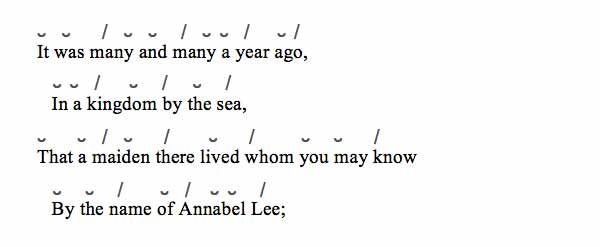
In poetry, meter is determined by accented (stressed) and unaccented (unstressed) syllables. Silence (or pauses) also contributes to a poem’s meter. Scansion is the practice of marking up a poem to reveal its meter. Here is a traditional method of marking up a poem, using Edgar Allan Poe’s “Annabel Lee” as an example:scansion annabel leeThe character that looks like the bottom half of a circle is called a breve. The breve indicates unstressed syllables, and the slash indicates stressed syllables. You won’t find the breve on your keyboard, but it is available in Microsoft Word by using the Insert –> Symbol function.

However, working with breves and slashes on a computer in this manner is tedious and time consuming. Fortunately, there are some other methods available to us.

Some dictionaries include pronunciation guides, which indicate stressed and unstressed syllables. Dictionaries often use quotation marks for stressed syllables and apostrophes for unstressed syllables: PO”e’try’. This isn’t easy on the eyes. Another option, which is much clearer, is to use all caps for stressed syllables and all lowercase letters for unstressed syllables: POetry; and we can add hyphens to further denote each syllable: PO-e-try. Ah, that’s more like it: easy to read and easy to type.

Metrical Units

We now know how to show meter with scansion, but we also need to know how to talk about it. Here is some special terminology that helps us communicate when discussing meter:

A metrical foot is a unit of metrical measurement that includes stressed and unstressed syllables. Here are a few types of metrical feet:

  • Anapest: Two unstressed syllables followed by a stressed syllable (da-da-DA). Example: un-der-STAND.
  • Dactyl: One stressed syllable followed by two unstressed syllables (DA-da-da). Example: PROM-i-nent.
  • Iamb: One unstressed syllable followed by one stressed syllable (da-DA). Example: be-LONG
  • Trochee: One stressed syllable followed by one unstressed syllable (DA-da). Example: O-ver

We also use special terminology to refer to the number of feet in a line of poetry:

  • 1 foot: monometer
  • 2 feet: dimeter
  • 3 feet: trimeter
  • 4 feet: tetrameter
  • 5 feet: pentameter

Let’s return to the first line of “Annabel Lee” and show its metrical feet:

it was MA|ny and MA|ny a YEAR | aGO ||

This line consists of three anapests followed by an iamb, or a combination of anapestic and iambic feet.

But what about the number of feet? How do those factor into the language we use to talk about meter? Let’s look at a line from Shakespeare’s “Sonnet 18” (please note that I have changed the capitalization to accommodate scansion):

shall I | comPARE | thee TO | a SUM | mer’s DAY? ||
Thou ART | more LOVE | ly AND | more TEM | perATE:

Each line consists of five metrical feet, so this poem is written in pentameter. Each line also includes five iambs, one stressed syllable followed by one unstressed syllable. These lines are therefore written in iambic pentameter.

Silence (Rests, Pauses)

In poetry, line breaks, stanza breaks, white space, and punctuation provide cues for pauses. We’ll pause a little longer between stanzas than we will between lines. We’ll hold on a period longer than on a comma. Sometimes breaks and punctuation are part of the aesthetic design of a poem, but their placement will almost always affect a poem’s meter and rhythm, because they instruct the reader to pause.

End-stopped lines contain a complete grammatical phrase (or clause) or terminate with a period, closing parenthesis, colon, or semicolon. Enjambment occurs when a line break occurs in the middle of a complete phrase or clause or when terminal punctuation marks are absent. The first two lines of “Annabel Lee” (above) are enjambed; the first two lines of “Sonnet 18” (above) are end-stopped.

Let’s Get Back to Rhythm

Rhythm is best understood as the flow of sound, whereas meter is a pattern of sound. If we mistakenly equate rhythm and meter, we might assume that free verse poetry lacks rhythm because it doesn’t use metrical patterns. Let’s look at the first stanza of “Spelling” by Margaret Atwood, which is written in free verse:

My daughter plays on the floor
with plastic letters,
red, blue & hard yellow,
learning how to spell,
spelling,
how to make spells.

There’s no discernible pattern in the meter, which is why the poem is called free verse. Yet the poem still has a flow, a rhythm. If the rhythm isn’t coming from the poem’s meter, where is it coming from?

Even though there aren’t repeated patterns, the accented and unaccented syllables still inform the rhythm. But so do the pauses. Consider the pause after “spelling” and before “how to make spells.” This pause influences the musicality of the poem. But the poem uses some other tricks to create rhythm. Look at the rhyme of “yellow” and “spell” (not a perfect rhyme, but a rhyme nonetheless). And look at how it echoes into the next two lines with “spelling” and the repetition of “spell” in the final line. There’s a pattern of sound there, which creates rhythm.

As we can see, meter is not the only contributing factor to rhythm.

How Rhythmical is Your Poetry?

If meter is a pattern of sounds and rhythm is the flow of sound, which of these elements is more important in poetry? When you write poetry, do you check for meter or rhythm? Do you prefer metrical poems or are you drawn to poems with vivid rhythm? Share your thoughts by leaving a comment, and keep writing poetry!

By Melissa Donovan
Source: writingforward.com

Visit us at First Edition Design Publishing

37 Questions to Ask Your Character

Pretend you are an interviewer for a newspaper, a secret agent, or a novelist, and you are interviewing, or interrogating, a character for your story. Imagine the character is sitting in front of you, you have a new fifty-sheet yellow writing pad and your favorite pencil your cat chewed, and you are about to ask them a list of questions.

Create a character by conducting an interview. Interview your character before you start writing so you can immerse yourself completely in who they are and what they stand for. Interview them and find out who they are.

Why Interview Your Character Before You Start Writing?

When you completely know your character before you start writing, you will have a better understanding of how they will react in different situations. Your character will be more three-dimensional if you know who they are before you start writing.

Your character will be three-dimensional and not flat if you spend time thinking about how they think and feel about life. If you know your character’s worldview it will be easier to keep their personality consistent throughout the story, and you will have a better understanding of how your character will grow and change as they deal with conflict.

37 Questions to Ask Your Characters

These questions will help you find out if your character is kind, honest, loyal, or trustworthy. These questions focus on how your characters think, not what they look like. We will develop their appearance later when the photographer arrives to photograph your characters.

10 Questions

  1. What did you eat for breakfast? Did you make it yourself? What time do you eat breakfast? Do you wash the pan after you cook the eggs or do you leave it for the maid to clean? Do you have a maid?
  2. Do you have a cat? How many cats do you have? Do you wish you were a cat? How many litter boxes do you have? Do you clean the litter boxes every day? Or does your maid clean the litter boxes?
  3. Do you go our for lunch or bring a sack lunch? Do you
  1. take an extra long lunch break and charge the company?
  2. Are you an only child? How many siblings do you have? Are you close or are you estranged?
  3. If you are adopted, do you know your birth parents? Do you want to find them?
  4. Do you call your mother every day, or only on her birthday, Mother’s Day, and Christmas? Are your parents alive?
  5. Do you like to cook? Do you use recipes or make up your own recipes? Do you eat out every night?
  6. Do you put both socks on first, or one sock, one shoe?
  7. Do you have a dog? Is the dog a rescue dog or bought from a breeder?
  8. Or perhaps a hamster? Or do you have any pets?

11 More Questions

  1. Do you iron your clothes? Who does your laundry? Do you do it yourself or do you send it out?
  2. Are you married? Are you divorced? How many times have you been married?
  3. Do you brush and floss your teeth before you go to bed? Do you use an electric toothbrush and a water pick?
  4. Do you have any cavities?
  5. Are those your real teeth, or are they dentures, or are they all capped?
  6. What do you throw into the garbage? Do you recycle?
  7. Do you live in an apartment or a house?
  8. Do you own your own home or rent?
  9. Do you mow your own lawn or use a landscape service?
  1. Have you ever had a garden?
  2. Have you ever eaten a carrot right out of the ground?

16 More Questions

  1. Do you pick your nose?
  2. Do you bite your fingernails? Do you have any bad habits?
  3. What is your earliest memory?
  4. Do you hold the door open for the person behind you or do you let it go and slam in their face?
  5. Do you take chicken soup to your elderly neighbor when they are sick?
  6. If you had a dog, would you pick up your dog’s poop when you go for a walk or sneak off and hope no one saw your dog poop on their lawn?
  7. If your boss asked you to cheat on your invoice and bill your client for extra hours, would you do it?
  8. On Monday morning, are you excited to go to work, or are you sad?
  9. If you could go back in time for one day, where would you go?
  10. You can cure one disease. Which one would you cure?
  11. Do you honk at the car in front of you if they didn’t see the light turn green?
  12. Do you exercise or are you a coach potato?
  13. If a Boy Scout comes to your door selling popcorn, do you hide in the kitchen or buy popcorn?
  14. Have you ever served in the military?
  15. What is your greatest fear?
  16. Would you like me to get you a glass of water? Or would you rather have soda? Wine? Whiskey?

Know Your Characters

Questions like these can help you know your character better. If you’d like even more, read this famous list of 35 questions French novelist Marcel Proust was asked by a friend when he was fourteen years old.

Think of other questions you would like to use in your interview. What questions will help you understand your character’s personality, motivations, and goals?

I wonder how your characters in your current story would answer these questions?

What questions would you want to ask your character in an interview? Let me know in the comments section.

By Pamela Hodges
Source: thewritepractice.com

Visit us at First Edition Design Publishing

Writing Prompt: How to Choose Your Own (Writing) Adventure

When I was a kid, I loved reading Choose-Your-Own-Adventure novels that had alternate paths written into the story. If you aren’t familiar with them, they were elementary or middle grade chapter books that begin a story and at key moments, offer the reader a choice: “To go through the portal, turn to page 37. To run away, turn to page 45.”

I loved seeing the story change with the choices, and I reread the books making different choices each time to experience a new story. I’ve channeled my inner adventurer to put together a fun writing prompt.

The Choose Your Own Adventure Writing Prompt

Today, I have a writing exercise that puts some choices in your hands. Have fun with it. If you get stuck, go back and swap out one of the elements and try again. The joy is in the journey, not in the destination (although a finished story is an accomplishment, too).

To build your own writing prompt, begin by making choices from categories. I teach my students to write a simple premise before they begin writing a draft, even if they haven’t outlined before. Here are the key components, and they should look familiar if you’ve been following Sarah’s great series on writing and publishing a short story:

A character {usually with a problem}
wants {goal}
But {obstacle / conflict / complication}
So {action he or she takes to overcome obstacle to get goal}

Build Your Writing Prompt

Now, here are the choices. Choose one thing from each category and make your character act to get what he or she wants!

Characters

Choose one and decide whether you want them to be a hero or anti-hero. (A too-reductive hint: hero — admirable; anti-hero — not so admirable.)

  • A sailor
  • A bartender
  • A teacher
  • A musician

Goals

  • To contact an old friend / partner / lover
  • To become anonymous
  • To avoid arrest / detection
  • To accept an inheritance

Obstacles

  • A flat tire or bus / car malfunction
  • Missed an important meeting or rendezvous
  • Exposed secret or miscommunication
  • Attacked by villain / bees / bears / barracudas

Action

No choices here; let the action follow the other choices you made!

Two Sample Writing Prompts

I’ve put these elements together to show you what a premise might look like. Try these out for size:

Sample prompt premise: A bartender wants to become anonymous but her ex-boyfriend exposes her real name, so she quits / seeks revenge / runs off to . . .

Swap it out: A hometown hero bartender wants to avoid arrest after he’s caught in a drunken brawl, but he accidentally overhears his boss on the phone reporting him. He . . .

As you can see, there’s incredible variety to be found even in these short lists of characters, goals, and obstacles. You’ll likely come up with something completely different. And even if the elements you choose are the same as mine, the actions that follow will make your story unique.

Sometimes working from a few choices gets the creative juices flowing. Where will your Choose Your Own Adventure writing prompt take you?

What’s your favorite combination of the elements above? Share in the comments.

By Sue Weems
Source: thewritepractice.com

Visit us at First Edition Design Publishing

How to Publish a Short Story: Get Feedback and Edit Your Final Draft

A month ago, I urged you to come on a publication journey with me, one where I walk you through the process of planning, writing, and submitting a short story. This is the third post in the four-part series on how to publish a short story. By the end, you’ll have a story ready to send out to publications!

If you’ve been following along week by week, by now, you have a complete first draft. Just getting started? Look back at part one and part two to find your publication and draft your story. Then, rejoin me here.

This week, we’re going to concentrate on getting feedback and completing your last edit.

NOTE: Throughout this series, DO NOT post your work in the comments. I’m going to ask you to submit to a publisher at the end of this series, and posting it here would be considered publishing it. Our Becoming Writer community is a great place to workshop your story before you submit it.

Almost Done

By now, you should have a second draft. We’re in the homestretch now! Wipe your brow, pat yourself on the back, have a little dance party. Celebrate. A lot of writers don’t make it this far.

Ready to dive back in? Here’s what to do next:

6. Get Feedback

Stephen King has what he calls a “closed door” policy up to this point, meaning he writes his first couple drafts just for himself. Then he opens that door and lets others in to read it.

It’s time for you to open that door!

I know you’re all cringing right now. You mean I actually have to show this to someone? Yes. You do.

Feedback is the most important part of writing. Seriously. There is no substitute for getting someone else’s eyes on your work. You can go over it a hundred times and you’ll still miss things. Trust me. I see it all the time with pieces I post in our Becoming Writer community.

Whether it’s something simple like a missing word or misplaced comma, or something glaring like a character snafu or a world-building misunderstanding, your beta readers will catch it. But they can’t catch it if you don’t show it to them!

I recommend finding people other than family and friends to read your work. People who know you are less likely to give you any real criticism. Mostly you’ll just hear, “Oh, I like it!” and that’s it.

This isn’t only because they’re afraid of upsetting you, but they’re also probably not trained as an active reader. They might like or dislike your story, but can’t find the words to tell you why they feel that way.

If you can’t find a writing group, that’s fine, but make sure you try to push your beta readers to give you useful feedback. If you’re not sure how to ask for useful feedback, try taking a look back at the short story musts and mistakes I listed in the first post to get ideas on what questions to ask your betas. Specificity helps here, so don’t go with something simple like, “Did you like it?”

Pro tip: Don’t watch them while they read. I know it’s tempting (Are they going to laugh at that funny line? Are they going to tear up when that character dies?), but don’t. That’s too much pressure on them, and WAY too nerve-racking for you.

During this stage, just like I suggested between drafts one and two, you need to put your story away. You’ll be tempted to rewrite as your feedback comes in. A quick word change there, a sentence deleted here, and then you feel like you’ve got a whole new draft. Which makes you want to send all your friends your “new” draft.

Don’t.

There is nothing more annoying than having to start reading something from the beginning when you’re in the middle of critiquing. Sharing every little edit is a great way to lose beta readers. Let it lie.

Whether you have a writing community like Becoming Writer or you just have friends and family read your work, you MUST open that door.

7. Edit (Yes, AGAIN)

You’ve lived through the torment of waiting on betas. Congratulations! Now it’s time to take a look at all that feedback.

Your first instinct is going to be to get defensive and do a lot of groaning about how stupid your friends are and how they just “don’t get it.” Get that out of your system. Throw a toddler fit and jump up and down in frustration if you must. Then reread their feedback.

I’m going to tell you something you probably don’t want to hear: Your betas are most likely right.

Remember you’re writing for people to read it. That means your readers have to like it. If they don’t, you’ve got a problem.

Reread their feedback with an open mind and apply it as needed. This is often a frustrating and disappointing time for writers, but try not to let it get you down. (Again, your writing does not suck!) You’re learning, and feedback will only make you better in the future.

8. Final Draft: Line Edit

After you’ve implemented all the beta feedback, it really is down to the final stages. Your third (and final!) draft needs to be as clean as possible. An editor will let minor mistakes slide, but the story as a whole needs to be readable.

We’re not all grammar know-it-alls, and in truth, we don’t need to be. But you do need to work on the basics.

Now it’s time to get down to the nitpicky edits. You’re going to look for things like misplaced commas, split infinitives, icky dialogue tags (i.e. too many words that aren’t “said”), -ly words, -ing words, and passive writing. I like to print my stories out at this stage so I can make editing notes and highlight until it looks like a sick and bleeding rainbow. I think it makes this tedious process more fun.

Run the story through Grammarly and Hemingway. Don’t just change everything these programs tell you to, though. Think about what they want you to change and then decide if the suggestion is right for your story.

For example, Hemingway loves to point out sentences that are hard to read. Those sentences aren’t necessarily wrong, though. You have to decide if you want to simplify the wording or leave it as-is.

Read your story aloud. Read it backward. (My editor sister swears by this one.)

Reading aloud can help you pick out missed words, weird wording, and where commas (a.k.a. pauses) should go. Reading it word-by-word backward is something I admit I don’t do, but my sister says it helps her take the words out of context so her brain doesn’t get tricky and fill in things that aren’t there while she’s reading.

Try it backward if you want to, but definitely read it aloud forward.

Finis!

You’re finished writing! Now it’s time for another celebration! I prefer dancing maniacally (read: badly) to overloud 90s music, but you do you.

Your story is now ready for publication. Two weeks from this posting you’re going to send that baby out! (I expect most of you have been waiting with bated breath for that post on how to publish a short story.) I’ll take you through all the crazy formalities of the submission process next time, so spend the next two weeks getting that manuscript to shine!

Do you have a writing group? Will this be the first time sharing your work? Let me know in the comments.

By Sarah Gribble
Source: thewritepractice.com

Visit us at First Edition Design Publishing

Grammar Rules: Capitalization

Proper capitalization is one of the cornerstones of good grammar, yet many people fling capital letters around carelessly.

Not every word deserves to be capitalized. It’s an honor that must be warranted, and in writing, capitalization is reserved only for special words.

Most of the grammar rules are explicit about which words should be capitalized. However, there are some cases (like title case) in which the rules are vague. 

Capitalization of Titles

There are several contexts in which we can examine capitalization. When writing a title (of a blog post, for example), almost all the words in the title are capitalized. This is called title case.

Title case is used for titles of books, articles, songs, albums, television shows, magazines, movies…you get the idea.

Capitalization isn’t normally applied to every word in a title. Smaller words, such as a, an, and the are not capitalized. Some writers only capitalize words that are longer than three letters. Others stretch it to four.

There is an exception to the rule of using lowercase for short words in a title: Words that are important should remain capitalized, even if they are shorter than three or four letters. For example, the word run is only three letters, but if it appeared in a title, it would be capitalized, because it would be the verb (or action) within the title: “Would You Run for Office?” Similarly, important nouns (subjects of objects of a title), such as me, would retain capitalization: Marley and Me.

There’s no fixed grammar rule for which words aren’t capitalized in a title, although they tend to be smaller and less significant words; you should check your style guide for specific guidelines to ensure that your capitalization in consistent.

Capitalization of Acronyms

Every letter in an acronym should be capitalized, regardless of whether the words those letters represent start with capital letters:

  • The acronym for Writing Forward would be WF.
  • WYSIWYG is an acronym that stands for what you see is what you get. Although the words in the original phrase aren’t capitalized, every letter in the acronym is capitalized.
  • Most people use acronyms heavily in text messaging and online messaging. In common usage, these acronyms are rarely capitalized: omg, btw, nsfw. However, if you were using these acronyms in a more formal capacity, they would be entirely capitalized: OMG, BTW, NSFW.

First Word of a Sentence

As I’m sure you know, grammar rules state that the first word in a sentence is always capitalized.

Capitalization of Proper Nouns

To keep things simple here today, we’ll refer to a noun as a person, place, or thing. You need not worry about the other parts of speech because only nouns are eligible for perennial capitalization.

There are two types of nouns that matter in terms of capitalization: proper nouns and common nouns. Proper nouns are the names of specific people, places, and things. Common nouns are all the other, nonspecific people, places, and things.

When considering whether to capitalize, ask whether the noun in question is specific. This will tell you if it’s a proper noun, which should be capitalized, or a common noun, which remains in all lowercase letters.

Proper Noun Capitalization Example

The word country is not specific. It could be any country. Even if you’re talking about the country in which you live, which is a specific country, the word itself could indicate any number of nations. So keep it lowercase because it’s a common noun.

Conversely, Chile is a specific country. You can tell because Chile is the name of a particular land in which people reside. When you discuss the people of that land, you won’t capitalize the word people. However, if you’re talking about Chileans, you definitely capitalize because Chileans are a very specific people, from a very specific country, Chile.

Hopefully that makes sense. If not, keep reading because I’m about to confuse you even more.

Capitalization of Web and Internet

Have you ever noticed the word Internet capitalized? How about the word Web? The linguistic jury is still out on these newfangled technology terms, but generally speaking, the Internet is one great big, specific place. The Web is just another word for that same place.

Wait — what about websites? Do they get capitalized? Only if you’re referring to the name of an actual site, like Writing Forward.

Capitalization of Web and Internet is not a hard and fast grammar rule. Lots of people write these words in all lowercase letters. If you’re not sure about whether to capitalize these words, check your style guide.

Common Capitalization Errors

Folks often think that capitalization should be applied to any word that’s deemed important. Here’s an example:

We sent the Product to the local Market in our last shipment. Have the Sales Force check to see if our Widgets are properly packaged.

It’s not uncommon, especially in business writing, to see nouns that are crucial to a company’s enterprise capitalized. This is technically incorrect but could be considered colloquial usage of a sort. Unless it’s mandated by a company style guide, avoid it.

Here’s correct capitalization of our example:

We sent the product to the local market in our last shipment. Have the sales force check to see if our widgets are properly packaged.

Now, in a rewrite of the example, some of the words will be again capitalized, but only if they are changed to proper nouns (names or titles of things and people).

We sent the Widgetbusters (TM) to WidgetMart in our last shipment. Have Bob, Sales Manager, check to see if our widgets are properly packaged.

What about Capitalization for Job Titles?

Ah, this one’s tricky. Job titles are only capitalized when used as part of a specific person’s title:

  • Have you ever met a president?
  • Did you vote for president?
  • Do you want to become the president?
  • Nice to meet you, Mr. President.
  • I read a book about President Lincoln.

Again, this has to do with specificity. “The president” or “a president” could be any president, even if in using the phrase, it’s obvious by context who you mean. However “Mr. President” or “President Lincoln” are specific individuals, and they call for capitalization.

Grammar Rules!

Do you have any questions about grammar rules regarding capitalization? Any additional tips to add? Leave a comment!

By Melissa Donovan
Source: writingforward.com

Visit us at First Edition Design Publishing

From 101 Creative Writing Exercises: Haiku

Today’s writing exercise comes from my book, 101 Creative Writing Exercises, which takes writers on an exciting journey through different forms and genres while providing writing techniques, practical experience, and inspiration.

Each chapter focuses on a different form or writing concept: freewriting, journaling, memoirs, fiction, storytelling, form poetry, free verse, characters, dialogue, creativity, and article and blog writing are all covered.

Today, we’ll take a peek at “Chapter 7: Form Poetry” with a poetry exercise simply called “Haiku.” Enjoy! 

Haiku

Although haiku appears to be one of the simplest poetry forms, it’s actually quite complex. To truly understand haiku, you need to know a little bit about the Japanese language, or more specifically, some key differences between Japanese and English. Also, traditional haiku adhere to a few pretty strict rules regarding form and content.

A haiku consists of seventeen moras or phonetic units. The word mora can loosely be translated as syllable.

A haiku is a seventeen-syllable verse. Traditionally, haiku were written on a single line, but modern haiku occupy three lines of 5-7-5 syllables.

Haiku also use a device called kireji (cutting word). This word breaks the haiku into two parts, which are distinctly different but inherently connected. The kireji is not a concept used in English, so poets writing haiku in English often use punctuation marks instead of kireji, usually a hyphen or ellipses.

The kireji provides structure to the verse and emphasizes imagery used on either side. It may not always be easy to identify the kireji in a haiku, but if you look for a word or punctuation mark that abruptly breaks the train of thought and severs the haiku into two parts, you’ve probably found it.

Another basic element of haiku is the kigo (season word). A true haiku is set in a particular season and is fundamentally concerned with nature. The kigo might be an obvious word like snow (indicating winter) or it could be vague as with a word like leaves (which can be present in any season).

Contemporary Haiku

There is much debate (and some controversy) over what technically qualifies as a haiku. Some poets merely adhere to the 5-7-5 syllabic and line structure and disregard the kireji and kigo elements. Purists insist that a poem is not haiku if it does not meet all of the traditional requirements.

Additionally, many modern poets do not write haiku that exclusively focus on nature. Contemporary haiku explore just about any subject imaginable.

The Exercise

Try your hand at writing a few haiku. For this exercise, focus on writing a poem that is seventeen syllables on three lines with the following meter: 5-7-5.

Tips: The most captivating haiku are quite lovely and use imagery that is almost tangible. Many haiku have an element of surprise or use turns of phrase that are clever, reminiscent of puns.

Variations: Write a few haiku that follow stricter, more traditional rules. These haiku are concerned with nature and include the kireji (cutting word) and kigo (season word).

Applications: Haiku remain popular and can be found in literary and poetry journals. They are also ideal for social media (especially Twitter) and are fun and quick to write. They promote clear, concise writing and can help you cultivate the art of using vivid imagery.

Give it a Try

Feel free to write a haiku and share it in the comments. Don’t forget to pick up a copy of 101 Creative Writing Exercises, available in paperback and ebook.

By Melissa Donovan
Source: writingforward.com

Visit us at First Edition Design Publishing


How to Write a Book in 100 Days

Let’s start with the obvious: You don’t know how to write a book. I’ve written seven books, and I don’t really know how to write a book either. I have a process that works, sure, but with writing, as with many things in life, it’s always when you think you know what you’re doing that you get into trouble.

So let’s just admit right now, you don’t know how to write a book, and definitely not in 100 days, and that’s okay. There, don’t you feel better?

How to Write a Book in 100 Days 2

There’s this one moment I think about all the time. I had just finished work—I had this horrible desk job at the time—and as I was getting ready to go home, I felt this urge come over me to become a writer. I had felt like I wanted to become a writer before, for years actually, but in that moment, it was all-consuming. Have you ever felt like that before?

And so, instead of going home, I got out a blank piece of paper, and I stared at it. I stared at that blank piece of paper for a really long time. Because I was looking for a book. If only I could come up with the perfect idea, if only I could write a book, then I’d finally feel like a writer.

But I couldn’t think of anything, or at least nothing worthy, and after staring at that blank piece of paper for an hour with nothing, I gave up. In that moment, I felt like I was further from my goal to become a writer than I ever had be. I was so discouraged.

I was discouraged because I didn’t know how to write a book.

Honestly, I might still be there today if I hadn’t had a few lucky breaks and several mentors to teach me the process of how to write a book.

13 Writers Who Finished Their Books in 100 Days

You might say you’re not able write a book in 100 days. You might worry that you’re not able to write a book at all. But I don’t believe that. I honestly believe that everyone can write a book, and I’m not just saying that. I believe it because I’ve done it.

In fact I wrote my first book in fewer than 100 days. I wrote my latest book in just sixty-three days.

I’m not alone, either. I’ve worked with hundreds of other writers to write their books, too. Here are just a few:

Fall 2017 Cohort

These writers are just a few who finished their books in our Fall semester of the 100 Day Book program.

Stella Moreux had been “marinating” on an idea for her “southern fried” fantasy novel for more than three years, but it wasn’t until she signed up for the 100 Day Book program that she seriously started writing it. “I won’t mince words when I say this was hard,” Stella says in her post about the writing process. “However, I would not trade this experience for anything. I survived and finished! The 100 Day Book Program is a challenge but worth it!”

Jodi Elderton had written short stories, but never a novel, and with almost two jobs and young kids, she worried she never would. But she says, “This program made it doable, if you stick with it.” By the end, she finished her novel and said to her writing community, “We made it!” Read Jodi’s full story here.

Rita Harris had an incredibly hard year. After committing to writing her novel, she says she had a marriage breakdown, sold her house and moved, and then had a health scare. Any one of those things could have derailed her writing process, but she kept going, motivated by the writing team she had surrounded herself with and the accountability she agreed to. Despite everything, she finished her book, “something which I doubt I would have had even without the life challenges I faced during the course of my writing if I had not enrolled in the program.” Read her story of determination here.

Karin Weiss‘s novel, A Roaring Deep Within, had been languishing half-finished for years. When she began the process, she thought it would be easy, mostly rewriting, but the process proved much more difficult than expected. What saved her was the writing community in the 100 Day Book program. “I found there a ‘writer’s community,’” she says, “that was available night and day that gave me support and motivation to keep going when my energy dragged, or when I felt discouraged at a tough point in my writing.” Read more about how Karin finally finished her novel-in-progress here.

Spring 2017 Cohort

These writers are just a few who finished their books in our Spring semester of the 100 Day Book program.

Sef Churchill decided to write her book in 100 days “on an impulse one Thursday night.” She followed our process, and by Sunday had committed to an idea. How did it go? “Now I have a book,” she says, “a book which before that first Sunday, I had not even dreamed of.” Check out the 10 lessons she learned about the book writing process.

Ella J. Smyth wrote two of her Romance novels (two novels!) in a little over a 100 days. She talks about her experience, and the power of accountability, here.

Nathan Salley set aside one day a week to write his book, and in that restricted amount of time he was able to finish his book in less than 100 days. You can read about Nathan’s experience (and his next steps into publishing) here.

When Margherita Crystal Lotus told me her sci-fi/fantasy mashup novel was going to be over 100,000 words, and that she was going to do it in 100 days, I had a few doubts she would be able to finish it in time. But she did finish in time, a few days early in fact. And now she’s about to publish the finished book. You can read more about her novel The Color Game here.

Kira Swanson rewrote her novel, which she finished in NaNoWriMo, expanding it from a 70,000-word first draft into a 100,000-word second draft. She recently pitched it to agents and had five of them ask to see the finished manuscript. You can read more about her novel revision experience here.

100 Day Book Challenge Performance

Sandra Whitten was feeling lost and unprepared in the midst of her first book. But after she signed up for our course, she began writing every day for the first time and finally finished her book. You can read more about Sandra’s experience here.

Fran Benfield said that before she signed up for our program, she was “drowning in a sea of words” (I can relate to that feeling!). But she did finish, and found her voice through the process. You can read about how she wrote her memoir here.

Uma Eachempati had been wanting to write about her father’s experience as a prisoner of war during World War II for years. She finally finished it in August, writing it in less than 100 days!

Doug Smith told me he had been thinking about his idea for a novel, Phoenix Searching, “for more years than I care to admit to.” By following our process, he finally finished his novel in May! “What I thought was a long shot,” he says, “turned out to be totally doable.”

These writers have finished their books in less than 100 days, and the reality is you can too. You just need to have the right process.

How to Write a Book in 100 Days: 5 Steps

What did these writers do differently? How do you actually write a book in 100 days? There are five steps:

1. Commit to an idea.

Having an idea is easy. Committing to an idea isn’t, especially if you’re like most writers I know and have dozens of them!

The first step to writing a book is to commit to executing—no matter how you feel about your writing during the process, no matter how many new ideas you come up with in the meantime, no matter what other important things come up. You have to commit to finishing no matter what.

2.  Create a plan.

I’ve found that the people who have planned are much more likely to finish their books. A plan doesn’t have to look like a detailed outline, though, so if you’re not into plotting, that’s okay.

Here are a few things your plan should include:

  • Word count. How long will your book be? (Here’s a word count cheat sheet.) Divide that by how many days you have to write: e.g. there are about 71 weekdays in 100 days.
  • Intention. Where will you write each day? How long will you write each day? Visualize yourself writing there for that long.
  • Publishing and Marketing process. Not because you need to know that now, but because by thinking about it and visualizing it, you improve your chances of actually getting there.

If you think through each step of your book, from your initial idea through the writing process to the publication and marketing of your book, you’ll be much more prepared when the writing goes wrong (because it will).

3. Get a team.

Most people think they can write a book on their own. Most people think they don’t need support or encouragement or accountability to write a book. And that’s why most people fail to finish their books.

That was me. I used to think that I could do it own my own. Honestly, I thought I had no choice but to do it on my own. And I failed again and again and again.

Don’t be most people. The great writers throughout history wrote in the midst of a community of other writers. You need a community, too.

A team might look like:

  • A writer’s group
  • A writing course or class
  • An editor or mentor

When you get stuck, as you inevitably will, it’s your team who will help you get unstuck. Don’t start writing your book without one.

4. Write badly every day.

Your first draft will not be perfect. Far from it. You may not be able to stand how bad your writing is. Your sentences might come out as deformed monsters. Your story or logic might go off on strange tangents. You may feel like everything you write is stupid, shallow, and boring.

Write anyway.

It always starts out like this. Writing is iterative. Your second draft will be better than your first. And your fifth draft will be better than your second.

Write badly all the way to the end. You can fix it later.

5. Get accountability.

I had been writing my latest book for two years, two unproductive years of feeling bad about myself all the time for not writing. This was my seventh book. I should have known how to write a book by now. I didn’t.

It took two writing friends calling me out (see step 3) for me to finally realize I needed to take drastic measures.

And so I wrote a check for $1,000 to the presidential candidate I disliked the most (this was during the 2016 election), and gave it to a friend with orders to send the check if I missed my deadline. I’ve never been more focused in my life, and I finished my book in sixty-three days.

Pretty good accountability, right? Most writers need deadlines and accountability to stay focused and do the hard work of writing.

You Can Try to Do This on Your Own, But You Probably Won’t

Have you ever tried to write a book and failed? I have. Many many times over. My biggest mistake was trying to do it alone.

Honestly, it wasn’t until I hired a coach and found a writing mentor that I finally finished my first book.

If you want to write a book, I would love to help you. Right now, for a limited time, you can join the 100 Day Book program. Over the course of 100 days, I’ll guide you through the writing process, and by the end of the 100 days, you’ll have a finished book.

So many writers have finished their books in this program (including the writers above), and so can you. If you want to join the program and finish your book in 100 days like the writers above, you can sign up here.

Have you finished writing a book? What was the most important thing that enabled you to finish? Let us know in the comments!

By Joe Bunting
Source: thewritepractice.com

Visit us at First Edition Design Publishing

How to Use Foreshadowing Like a Master Storyteller

Foreshadowing is a task writers have to approach with the same careful precision they use when threading a needle. It’s not always easy, but when done right, you’re in business. Hinting at a future revelation is necessary for authors of mystery novels, for example, but it’s useful for all writers looking to include a killer twist—no pun intended. Not sure how to use foreshadowing? Not to worry — today we’re covering techniques you can use to thread that needle.

2 Ways to Use Foreshadowing Like a Master

Foreshadowing is a delicate balancing act. You have to toe the line between throwing a random plot twist into your story and making the surprise too predictable for the reader. The trick is to leave a trail of bread crumbs. Here are two techniques you can try for how to use foreshadowing:

1. Drop hints

At first glance, it may seem like a near-impossible task to communicate to your reader that whatever you’re mentioning is going to be important later. How will they know what to look for? After all, there are so many elements to a story, some of which won’t matter at all for your twists.

Is there something significant about that green dress the heroine wears in chapter four? Does it matter that the neighbor walks his dog at three o’clock every day? Luckily, there are a couple of useful ways to clue your reader into the fact that something is important.

This is one of those ways.

See what I did there? By setting that sentence apart from the rest of these paragraphs, I made you pay attention. Now, all of a sudden, you had to insert a pause before and after those few words.

If something critical happens in your story that is going to come up again later, make sure it stands out in the crowd. Start a new paragraph, insert a break in your chapter, whatever you have to do.

A simple formatting technique can make things a little too easy, though. If your hints are hammered into the reader’s head instead of being gently dropped, the magic and mystery vanishes. Decide if there is a better way to get your point across.

2. Repetition is key

Repetition is another trick you can use to send your reader the mental message that they should be paying attention. Think of this as the technique teachers use in their classes. Though some might say, “Write this down; it’s important,” all most teachers have to do is repeat a certain point in various ways throughout the class and their students will make sure that information is in their notes.

Don’t tell your reader to “write this down,” but do rephrase and repeat the key points of your plot.

For example, in one of my sci-fi stories, two of my characters have different habits when it comes to how they put their coats away when they get home: Astrid always tosses her coat across the back of the couch and Dawn always hangs hers up. Every time Dawn and Astrid return to their apartment, I make sure to point out in some way that Dawn’s coat ends up on her hook and Astrid’s is tossed aside.

Later on in the story, Dawn is kidnapped and replaced by a doppelgänger. Though I don’t come right out and say it, it’s obvious that Astrid becomes suspicious of “Dawn.” Why? She doesn’t hang up her coat. It ends up thrown onto the couch along with Astrid’s.

This clue is essential to figuring out that “Dawn” is not who she claims to be, and if the reader is as perceptive as Astrid is, they’ll pick up on that.

Walking the Tightrope

Like with every aspect of writing, foreshadowing gets easier with a little bit (or, I should say, a lot) of practice.

Write with the mindset of a reader. Try to think how you would react to your own story. Is it too easy to figure out? Too out of the blue?

You’ll know what feels right in the end.

Do you have more suggestions for how to use foreshadowing? How do you approach your plot twists? Let us know in the comments!

By The Magic Violinist
Source: thewritepractice.com

Visit us at First Edition Design Publishing