Tag Archives: writing career

Grammar Rules: Fewer vs. Less

It’s a battle between words: fewer vs. less. Are they interchangeable? Do these words have different meanings? How can we use them correctly?

Many people don’t realize that these two words do not share the same meaning and therefore cannot be used interchangeably. As a result, both fewer and less are often used incorrectly.

The difference in meaning may be subtle, but it’s significant and remarkably easy to remember. Let’s see what Dictionary.com has to say about these two words:

fewer: adjective 1. of a smaller number: fewer words and more action.

less: adjective 1. smaller in size, amount, degree, etc.; not so large, great, or much: less money; less speed.

The grammar rules are clear; let me break them down for you.

Fewer vs. Less? Which is Correct?

Fewer and less respectively refer to a number of items or an amount of something. The easiest way to remember which of these adjectives to use in a given situation is this:

Fewer should be used when the items in question can be counted:

He has fewer books than his best friend has.

Less is used when the amount of something cannot be counted:

He has less interest in reading than his best friend has.

Note that books can be counted item by item. However, interest is not a thing that can be counted, although we can discuss how much of it someone has.

The basic difference here is countability. Use fewer for countable nouns like individuals, cars, and pens. Use less for uncountable nouns such as love, time, and respect.

Do note, however, that there are some sticky spots to watch out for when determining whether you should use fewer or less. For example, you might need less paper but you will need fewer sheets of paper. You have fewer pennies but less money. You want fewer chocolate bars but less candy.

Fewer or Less

Now you know how to tell the difference between fewer vs. less.

Do you have questions about correctly using fewer or less or any other word
pairs? Maybe you have something to add to this linguistic look at tricky adjectives. Share your thoughts by leaving a comment, and let’s discuss.

By Melissa Donovan
Source: writingforward.com

Visit us at First Edition Design Publishing

36 Tips for Writing Just About Anything

There’s a lot more to writing than typing words.

Writing well takes years of study, practice, and experience. It requires diligence, attention to detail, and dedication to the craft. Each project has a unique set of requirements and different types of writing have different rules.

For example, when we’re writing fiction, we have one set of concerns (character, plot, and setting, to name a few), and when we’re writing poetry, we have en entirely different set of issues to deal with.

Writing becomes natural with practice, but there are countless elements to deal with in any given project.

Tips for Writing

Here are thirty-six tips for writing just about anything. You can use this as a checklist when you start a new writing project and refer back to it whenever you get stuck. However, keep in mind that these tips don’t address the specifics of fiction, poetry, or nonfiction; they’re general tips for writing anything rather than specific tips for form and genre.

  1. Start with a plan. To reach a destination, you must know where you’re going. We can freewrite in our journals and jot down ideas on scraps of paper, but bigger projects will go more smoothly if there’s a plan in place.
  2. Be prepared. What do you need in order to complete this project? Set up a space and schedule time to work on the project. Gather any supplies, materials, and resources you’ll need.
  3. Eliminate distractions. It’s impossible to write if you’re interrupted or distracted every few minutes. Turn off your phone, close your browser, and let others know you’re working.
  4. Know your audience. This is one of the most common tips for writing, and while it’s not mandatory, it means less revising once you’ve completed your first draft. Are you turning in this piece to an instructor? Submitting it to a magazine? Self-publishing? Who will read it?
  5. Be familiar with your genre. Sci-fi fans don’t want to read a book written by someone who’s never read any sci-fi books. If you don’t know your genre, you can’t possibly know your audience. Besides, if you don’t read a particular genre, why would you want to write it?
  6. Choose a style guide. There’s one style guide for journalism, one for medical writing, and another for everything else. If you’re submitting this project to a target publication or an agent (or if you’re self-publishing it), make sure you know which style guide you should follow.
  7. Brainstorm and outline. Nothing ruins a good writing session like realizing you have no idea what you’re trying to accomplish. Take a few minutes to jot down all ideas related to the project, and then spend some time drawing up an outline. You don’t have to follow it to the letter, but it will come in handy as a kind of road map.
  8. Conduct credible research. Most writing projects require some research. Whether you need the population of a city or the distance to another planet, check your facts and make sure your logic lines up. Also, make sure your sources are credible.
  9. Take breaks and stay healthy. If you’re writing for long periods, take a ten-minute break every hour. If you’re working on a long-term project, make sure you stay healthy by eating nutritious foods and getting plenty of exercise. It might take time away from your writing, but it will also make your writing better.
  10. Don’t procrastinate, and reward yourself when you reach goals. Writing requires a tremendous amount of discipline. It’s easy to procrastinate if there isn’t a boss hovering over your shoulder and pointing at the clock. Establish milestones for your project and reward yourself whenever you reach one.
  11. Stay inspired. Passion ebbs and flows, and so do ideas. But you can keep yourself motivated by figuring out what inspires you and regularly imbibing in it. Maybe books on the craft of writing keep you excited about your project. Reading or watching movies in your genre might help you stay motivated and inspired.
  12. Think about voice. In writing, voice is the tone of a piece — the author’s unique style. A children’s book shouldn’t sound like it was written by a college professor, and an academic essay shouldn’t sound like it was written by a child. Is your narrative dry, witty, humorous, self-depreciating, or cocky?
  13. Complete a rough draft. While you’re drafting, turn off your inner editor and don’t scrutinize every word or sentence. Let the ideas flow and let the scenes and ideas move forward. You can fix it up later.
  14. Keep it simple: Use clear, concise writing. For some audiences, you might ignore this rule, but keep in mind that the simpler and more accessible your writing is, the more people it will be able to reach.
  15. Use the active voice. Passive voice sounds old-fashioned and outdated. Apply the subject + verb + object construction to your sentences so they are clear and direct.
  16. Use vivid language. Avoid boring, meaningless words (like nice and very) and opt instead for words with pizazz. For example, don’t write very good. Write excellent.
  17. Know when to show and when to tell. The most important parts of a story should be shown. Don’t tell the reader the character was tired if her exhaustion is critical to the plot; show her yawning.
  18. Choose the best possible words. Vivid language helps readers visualize the narrative. You should also choose the most precise, accurate words possible. Don’t say dark red if you mean burgandy.
  19. Let it sit. Once you complete a draft (and after every revision), let your project sit for a while. Short pieces can sit for a few hours. Longer pieces (like a book) may need to sit for a few weeks. Then you can revise with fresh eyes.
  20. Read what you’ve written. Before you revise, save a copy of your original draft and read through the whole thing once. If it’s a book-length manuscript, take notes about major changes that you need to make.
  21. Chop it up. You may need to move large portions of text around. The opening scene might work better at the end. Your thesis statement could be misplaced somewhere in the middle of your paper. Use cut-and-paste with total abandon. Tip: open TextEdit or NotePad in the background and use it to store large chunks of text that you need to move around.
  22. Delete the excess. You may need to delete entire scenes if they are not relevant to the plot. In fact, you may need to delete some of your favorite sentences and paragraphs. Get rid of anything that isn’t essential to the project’s thesis, objective, or plot.
  23. Insert. You may find gaping holes in your draft. Be prepared to add new sentences, paragraphs, even entire chapters.
  24. Rewrite. Depending on how messy your first draft is, you may need to do multiple rewrites. A lot of writers get worn out by this process, but remember — your writing improves with each revision. So dig in and keep rewriting until it feels right.
  25. Edit. Once you have the main structure and concept down, you can edit for detail. This is where you make your sentences clear and concise. Look for grammatical errors, awkward wording, and vague phrasing.
  26. Eliminate unnecessary words. If you can delete a word without affecting the meaning of a sentence, then delete it. Often, articles (a, an, the) can be deleted as can pronouns.
  27. Get rid of the clichés. Better yet, don’t use them in the first place. However, when you’re editing, do your best to weed them out.
  28. Look it up! If you’re not sure about a word’s meaning or spelling, look it up. If you’re not sure whether you’ve structured a sentence correctly or used proper punctuation, look it up. Do not rewrite to get around the rules. Just learn them.
  29. Review the transitions. Each paragraph focuses on a different idea, but each paragraph should also flow naturally from the paragraph that precedes it.
  30. Check for repetition. There’s good repetition and bad repetition. Using the same word or phrase over and over, unnecessarily, is bad. Repeating themes, symbols, and images can be powerful.
  31. Make sure the sentence structures are varied. Sentences should vary in length and structure. Don’t start every sentence with “I” (a common mistake that young and new writers make). Follow long sentences with shorter ones.
  32. Read for flow. After editing, read it again. Does everything make sense? Does the entire thing flow naturally and smoothly? If not, go back and edit some more.
  33. Format your document. Formatting can be done at the beginning or toward the end. I usually format at the beginning, except when writing a long project, like a book, in which case, I wait till the end. Tip: don’t just learn how to format documents; instead, become a master of formatting. For example, if you use Word, learn how to use the Styles feature. You should know how to set spacing, indentations, font face and size, how to align text, and apply bold and italics.
  34. Proofread. No matter how strong your writing skills are, typos will slip past you. When you proofread, you’re looking for basic mistakes and typographical errors. Recommendation: proofread each piece until you can’t find any typos at all.
  35. Get a second opinion. Even though you proofread until you couldn’t find any typos, there are probably a few lingering around. There’s a scientific reason for this, but it doesn’t matter. What does matter is that you get someone else to check your work. If necessary, hire a professional.
  36. Final polish. Ideally, you’ll read through it one last time (after letting it sit again) and you’ll find it squeaky clean. This means it’s done and ready to be served.

And that’s not all…

This list might seem overwhelming, but it covers only the basics. If you’re writing fiction, there is a whole other set of things you need to do. If you’re writing for business or academia, there are additional rules to follow. Remember, there are many considerations for each form and style of writing. That’s why knowing your form and genre is so important.

But these tips for writing are a good start. Not only will they help you write, they’ll help you write well.

Do you have any tips for writing to add to this list? Share any tips that writers can use by leaving a comment, and keep writing!

By Melissa Donovan
Source: writingforward.com

Visit us at First Edition Design Publishing

Do You Need a Creative Writing Degree to Succeed as a Writer?

Young and new writers often ask whether they need a creative writing degree in order to become an author or professional writer.

I’ve seen skilled and talented writers turn down opportunities or refuse to pursue their dreams because they feel their lack of a creative writing degree means they don’t have the credibility necessary to a career in writing.

Meanwhile, plenty of writers with no education, minimal writing skills, and scant experience in reading and writing are self-publishing, freelance writing, and offering copywriting services.

It’s an oft-asked question: Do you need a creative writing degree to succeed as a writer? Is it okay to write and publish a book if you don’t have a degree or if your degree is in something other than English or the language arts?

Before I go further, I should reveal that although I did earn a degree in creative writing, I don’t think a degree is necessary. But there is a caveat to my position on this issue: While I don’t think a degree is necessary, I certainly think it’s helpful. I also think that some writers will have a hard time succeeding without structured study and formal training whereas others are self-disciplined and motivated enough to educate themselves to the extent necessary to establish a successful writing career.

Do You Need a Creative Writing Degree?

First of all, a degree is not necessary to success in many fields, including writing. There are plenty of examples of individuals who became wildly successful and made meaningful contributions without any college degree whatsoever: Bill Gates, Abraham Lincoln, and Walt Disney, to name a few.

In the world of writing, the list of successful authors who did not obtain a degree (let alone a creative writing degree) is vast. Here is a small sampling: Louisa May Alcott, Maya Angelou, Jane Austen, William Blake, Ray Bradbury, Mark Twain (Samuel Clemens), Charles Dickens, Ernest Hemingway, Jack London, Edgar Allen Poe, Beatrix Potter, and JD Salinger.

So you obviously do not need a creative writing degree. After all, some of the greatest writers in history didn’t have a degree. Why should you?

A Creative Writing Degree is Not a Bad Idea

On the other hand, the degree definitely won’t hurt your chances. In fact, it will improve your chances. And if you struggle with writing or self-discipline, then the process of earning a degree will be of great benefit to you.

A college education might indeed be necessary for a particular career, such as a career in law or medicine. In fields of study where a degree is not a requirement, it often prepares you for the work ahead by teaching you specific skills and techniques and by forcing you to become knowledgeable about your field.

However, there is an even greater value in the the process of earning a degree. You become knowledgeable and educated. You learn how to learn, how to work without close supervision, and you are exposed to the wisdom of your instructors as well as the enthusiasm and support of your peers. College is a great environment for development at any age or in any field.

Earning a degree is also a testament to your drive and ability to complete a goal without any kind of immediate reward or gratification. College is not easy. It’s far easier to get a full-time job and buy lots of cool stuff. It’s more fun to spend your nights and weekends hanging out with your friends than staying in and studying. A college degree is, in many ways, a symbol representing your capacity to set out and accomplish a long-term goal.

Know Yourself

If you possess strong writing skills and are somewhat of an autodidact (a person who is self-taught), then you may not need a degree in creative writing. For some such people, a degree is completely unnecessary. On the other hand, if your writing is weak or if you need guidance and would appreciate the help of instructors and peers, maybe you do need a creative writing degree.

If you’re planning on going to college simply because you want to earn a degree and you hope to be a writer someday, you might as well get your degree in creative writing since that’s what you’re passionate about. On the other hand, if you hope to write biographies of famous actors and directors and you already write well, you might be better off studying film (and possibly minoring in creative writing).

You may be the kind of person who needs the validation of a degree. Maybe you’re an excellent writer but you’d feel better putting your work out there if you could back it up (even in your own mind) with that piece of paper that says you have some expertise in this area. Or you might be the kind of person who is confident enough to plunge into the career of a writer without any such validation.

You might find that time and money are barriers to earning a degree. If you have responsibilities that require you to work full time and if you’re raising a family, obtaining a degree might not be in the cards, either in terms of time or money. You might be better off focusing what little free time you have on reading and writing. But there are other options if you’ve got your heart set on a creative writing degree: look for accredited online colleges, find schools that offer night and weekend classes, and open yourself to the idea that you can take ten years rather than four years to complete your higher education.

Finally, some people have a desire to get a degree but they feel they’re too old. I personally think that’s a bunch of hogwash. You’re never too old to learn or obtain any kind of education. When I was just out of high school, I attended a college with many students who were middle-aged and older. I had tremendous respect for them and they brought a lot of wisdom to our classes, which balanced out the youthful inexperience of my other, much younger classmates. I don’t care if you’re eighteen, forty-two, or seventy, if you have a hankering to do something, go do it!

Making Tough Decisions

Ultimately, the decision rests with each of us. Do you need a creative writing degree? Only you can answer that question.

If you’re still not sure, then check with a local school (a community college is a good place to start) and make an appointment with an adviser in the English Department. If you’re in high school, get in touch with your school’s career counselor. Sometimes, these professionals can help you evaluate your own needs to determine which is the best course of action for you. But in the end, make sure whatever decision you make about your education is one that you’ve carefully weighed and are comfortable with.

And whether you earn a degree in creative writing or not, keep writing!

By Melissa Donovan

Sources:

Most Successful People Who Never Went to College
Famous Autodidacts
 

Visit us at First Edition Design Publishing


Writing Sleuths – Pet Detectives

In a recent fiction novel, a neophyte private investigator (PI) grudgingly took on pet cases, from finding an African Helmeted Turtle to looking for her neighbor’s nasty-tempered dog. Tracking down these lost pets provided funny subplots, although a writer could also build a more serious story starring a PI who specializes in finding animals. This article defines the role of a pet detective, their skill set and tools, and techniques writers can apply to develop such a character.

What Is a Pet Detective?

Pet detectives are trained to find (or enhance the chances of finding) lost or missing pets. They use a mix of profiling, search-and-rescue, surveillance, even grief counseling techniques. They often use high-tech tools, from night-vision binoculars to motion-activated surveillance cameras. Their strategies have reunited thousands of lost pets with their human companions. There are even professional organizations, such as Pet Hunters International and Pet Detective University, that train PIs to become certified pet detectives.

Bloodhounds and other dogs can also be trained to assist pet PIs. Just as trailing dogs like German Shepherds, bloodhounds, and Border Collies can follow a human scent, they can also follow the scent of a pet from something like the cat’s bed or a dog’s favorite chew toy. Also, some search dogs are trained to detect specific animals, such as cats, while others
serve to attract other canines.

Tips for Writing a Pet Detective

If you’re writing a story with a sleuth who finds lost pets, think about the following questions:

  • Does he/she own a search dog?
  • What tools does your pet PI use? For example, night-vision binoculars, motion-activated surveillance cameras, a bionic ear to amplify sounds?
  • In real-life, a pet PI can make a lucrative living, from set fees of $300 to $1,000 a day. Does your character charge similarly? If so, his/her lifestyle will reflect a high income (unless they’re not very good with money or they have other financial obligations).
  • What investigative traits does your fictional pet PI use? As with other PIs, they might rely on their reasoning, analysis of physical evidence, interview and interrogation, and surveillance techniques to recover lost pets.
  • Where did your fictional pet PI learn about animal behavior-for example, in college, in a veterinarian’s office, or while growing up on a farm?

There’s one last point about writing a pet detective: he/she probably has a big heart. After all, animals possess all that is best in humans.

About the Author:

Colleen Collins-Kaufman is a professional PI and multi-published author. She and her business partner also teach online classes for writers developing sleuths and detective fiction. For more information, go to http://www.writingprivateinvestigators.com

Source: freelancewriting.com

Visit us at First Edition Design Publishing

9 Quick Fixes For Short Story Writers Who Run Out Of Ideas

It is Short Story Africa Day on 21 June each year! It is the shortest day in the southern hemisphere.

To celebrate, we’re sharing ways to find ideas for your stories. If you are a short story writer and you’re looking for a quick fix, try one of these.

1.  Find Out What Lies Behind The Lyrics

Choose a date. What song was number one on that day? Do some research about the song. Who wrote it? Why did they write it? Who inspired it? Use what you find out as inspiration for your short story.

2.  Use A Writing Prompt

Sign up for a daily writing prompt. Follow people who share them on social media. ‘A prompt can be anything. A word, a line from a poem or a song, a name or even a picture. Anything that gets you writing. Find ones you enjoy.’ (via) Your daily prompt could inspire your short story.

3.  Rewrite A Fairy Tale

Take a fairy take and write it as a modern day story. Change the sexes of the main characters. Choose a random setting. If the tale is too long for a short story, write the beginning or ending as your short story.

4.  Rewrite A Myth

A myth is an ancient story involving supernatural beings, ancestors, or heroes. It is used to explain aspects of the natural world or to show the psychology, customs, or ideals of a society. Examples: The Myth of Creation, Arthur and Camelot, The Rain Queen. Write a myth using one of our 20 Myth Prompts as a short story.

5.  Obsess Over Details

Find one thing that interests you. Keep a file and save these items in it. It can be in a photograph or something you’ve heard. Research it and use it as inspiration for a story. Use this random first line generator to start your story.

6.  Hashtags On Instagram

Choose a topic that interests you. Visit Instagram and click on a hashtag related to the topic. Look at the posts and choose an image that inspires a story. Use this ‘What if?’ generator to enhance your scenario.

7.  Ask Your Followers

If you have a social media following, ask your fans what they want you to write about. Create a poll of some of the ideas you get and write about the one that gets the most votes. Use easypolls or pollcode or pollmaker. Use the embed code to share it on your blog or link it to your social media platform.

8.  Use A Holiday

Which public holiday is next on the calendar. Write a short story about someone who is planning for this holiday, or a story that centres around the holiday in some way.

9.  Write About The Day Your Parents Met

Rewrite the story of your parent’s first meeting. Write it from the perspective of a stranger watching them. Change names, swap the sexes of the characters, change locations. Go!

By Amanda Patterson
Source: writerswrite.co.za

Visit us at First Edition Design Publishing

How to Make Your Sentences More Descriptive

Today’s guest post is by Jordan Conrad.

The purpose of writing is to communicate information. This is true for writing of all types—for fiction and nonfiction, for creative and technical, for business and legal.

A work of fiction communicates information by telling a story, while an email to an employee communicates information in a much more direct way.

In either case, the author accomplishes the goal of information sharing by using descriptive language to convey detail.

Here is a passage that isn’t very descriptive:

  • Beth first met her spouse in California.

The sentence is fine grammatically, but it isn’t very interesting. What were they doing in California? How did they meet? Did they fall in love head over heels, or did their relationship grow over time as they got to know one another?

All of these details are interesting—and possibly important.

I will include a caveat, though. You don’t want your sentences to be too descriptive, or they will be equally as boring, like this sentence:

  • When Bethany first met Elijah at a rooftop cocktail party at the Standard Hotel in downtown LA, he was wearing polished leather penny loafers with beige argyle socks, dark-blue jeans from GAP that looked brand-new and a crisp, a white cotton dress shirt that he accentuated with a 1970s-era stainless-steel Tissot Chronograph watch that made him look like an off-brand Bond villain from a film that had been disowned by its director and credited to Alan Smithee.

Who needs all that detail? At some point, you probably thought, Stop telling me what Elijah is wearing; I don’t care anymore.

Good writing is about balance. It is possible to be too descriptive, and your writing will suffer just as much as if you aren’t being descriptive enough. With that cautionary tale in mind, here are a few tips for making your writing more descriptive.

Tools of Description

Verb choice. Selecting colorful verbs is one of the easiest ways to make your writing more interesting. You don’t even have to add extra words; your sentences need verbs anyway, so just choose good ones.

  • Did someone walk across the room, or did they stumble across the room (maybe in a drunken haze)?
  • Did someone laugh at a funny joke, or did they giggle, or chortle, or guffaw?

English is full of descriptive verbs, and they can make your writing more colorful. Be careful, however, not to use verbs that are too uncommon or strange, or you run the risk of losing description and creating distraction.

Eliminate adverbs. One of the oft-cited rules of fiction is that you should never use adverbs. Stephen King once said, “I believe the road to hell is paved with adverbs.”

The thinking is that adverbs modify verbs, but your verbs should be strong enough by themselves such that they don’t need to be modified. In other words, to say eliminate adverbs is just another way to say use strong verbs.

Consider this example:

  • A deer ran across the road furiously, and I hit the brakes immediately.

In this sentence, the adverbs are being used to create the effect of descriptive verbs. They act as sprinkles on an otherwise mundane sentence.

Let’s try eliminating them:

  • The deer sprang across the road. I smashed the brake pedal and swerved to avoid it.

The verb choice here puts more detail back into the sentence.

Adverbs also have the tendency to weaken writing by adding unnecessary qualifiers, such as usually, generally, mostly, and oftentimes. In many cases, these words are used to obscure writing, not make it clearer or more descriptive.

Intentional use of adjectives. Whereas adverbs modify verbs, adjectives modify nouns. This is probably the most direct way to make your writing more descriptive, since adjectives exist for the express purpose of being descriptive.

This is where many writers fall into the trap of being too descriptive, though. The cautionary example sentence above contains eighteen adjectives, which is at least fourteen too many.

Stick to one adjective per verb most of the time. Stick to a maximum of five or six nouns per sentence too—any longer than that, the sentence should be split.

Analogies and Metaphors. Comparative language is incredibly powerful in its ability to describe. By comparing one thing to another, you bring to mind everything associated with that subject or idea you’re comparing—and these feelings can be powerful.

Analogies and metaphors are the standard-bearers of comparative language. Analogies help clarify complex topics and make them relatable, and metaphors can add a bit of elegance or flair to your writing.

Consider a famous metaphor from Picasso:

  • “Art washes away from the soul the dust of everyday life.”

The imagery that this evokes in the mind of the reader is deep—in some sense literally. It brings to mind waves crashing over a shore and is much more descriptive than it otherwise could be, as shown in this example:

  • Art makes life more interesting.

In some sense, this sentence says the same thing as Picasso’s quote, but it’s obvious which is more descriptive and meaningful.

As with any bit of description, metaphors can be overused, and they aren’t always helpful. In everyday business communication, it’s probably better to eliminate unnecessary metaphors and other figurative language.

Conclusion

The beauty of descriptive writing is that it bridges genres and mediums. Being descriptive can benefit your business communications just as much as it can benefit your next novel.

Remember, however: good writing and good description is about balance. If you are too descriptive, your readers are likely to get bored or overwhelmed. If you aren’t descriptive enough, you risk boring your readers.

Source: livewritethrive.com

Visit us at First Edition Design Publishing

The Satisfaction of Excellence: The Growth Mindset for Writers

If someone had asked me in my early days as a book coach what quality was most critical to a writer’s success, I would have said perseverance. It was the thing that most obviously separated the writers who made it from those who didn’t. After all, in order to succeed, you have to finish, and in order to finish, you have to stick with it, day after day, month after month, year after year, whether the writing is going well or not. Perseverance trumps procrastination and doubt – the two things that tend to derail a great many writers.

While I still consider perseverance to be paramount, another quality has risen to the top of my list of qualities critical to a writer’s success: the ability to receive feedback.

In my early interactions with a potential client, I can tell what their general stance is on feedback. They fall somewhere on the spectrum from closed and defensive on the one side and open and willing to learn on the other.

CLOSED/DEFENSIVE OPEN/WILLING TO LEARN

Someone who is closed and defensive thinks they already know it all. They are hyper protective of their idea and their vision and if they seek help at all, it is under the guise of wanting confirmation that what they have written is already great. They don’t really want feedback; they want a quick “win.”

But winning is not a place you arrive; it’s a way you behave. And the most successful writers behave with a growth mindset.

That’s the term coined years ago by Dr. Carol Dweck, a Stanford professor of psychology and author of the book, Mindset. A growth mindset is the opposite from a fixed mindset. It means you are flexible and open, always willing to learn:

“The passion for stretching yourself and sticking to it, even (or especially) when it’s not going well, is the hallmark of the growth mindset. This is the mindset that allows people to thrive during some of the most challenging times in their lives.”

Here’s what a growth mindset tends to look like in writers:

  • The writer is open to improving. They are not afraid to look at their skills and to assess them. They acknowledge the areas where they could be better. They welcome honest feedback.
  • The writer is willing to learn. They read in their genre to see how writers they admire approach a character or a scene or a structural element. They read books and blogs about writing to learn from wise teachers. They go to lectures, partner with other ambitious writers, seek out a coach to help them get strong.
  • The writer wants to know how their work impacts their readers. They want the outcome to be effective and make an impact. They consider the end-goal of the work, not just how it makes them feel as they write.
  • The writer works hard to bring their vision to life, focusing on the work and not on external measures of success. One of my clients recently finished a draft of a novel; it is her second, and her first did not sell. She was starting to feel closed and fearful about the new book, until she recognized that feeling, and made a switch. She began to focus on what she calls “the satisfaction of excellence.” The satisfaction of excellence has nothing to do with landing an agent, getting a big book deal, or making a lot of money. It has to do with mastering the craft.
  • They are grateful for the chance to write, the time to write, the space to write. They are grateful for the people who support them and for their readers, no matter how small or large the number.

Good writing takes a very long time to develop – 10,000 hours spent trying to spin a tale or an argument, trying to find your voice. Having a growth mindset means that you don’t just sit alone during those 10,000 hours, banging away and ignoring the rest of the world. You seek to get better every time you write. You seek the satisfaction of excellence.

By Writing Coach
Source: writershelpingwriters.net

Visit us at First Edition Design Publishing

15 Marketplaces to Publish Your Poetry

Since there are hundreds of publications in the US and abroad that publish poetry, finding the perfect fit for your verses may seem a bit overwhelming. If you’ve been writing and submitting for a while now, then you already have a list of publications on-hand. If you’re yet to publish your first poem or collection of poems, then you’ll want to start conducting targeted market research.

While you may want to aim for your favorite professional-level publication, sometimes it may take a while to get into its print – or cyber – pages. It’s important to remain positive and continue to focus on your craft by attending workshops, reading articles, creating – or joining – a critique group, and so forth.

The 15 Top Marketplaces to Publish Your Poetry


5 Markets for Mainstream Literary Poetry

5 Markets for Minimalist Poetry

5 Markets for Science and Speculative Fiction Poetry

What to Do Before Submitting

In general, many submission guidelines encourage you to send three-to-five poems at a time. So, once you have a completed file of poems to submit, here are just a few questions to ask before submitting your work:

  • Do you know the type of poetry this publication tends to publish?
  • Are you familiar with the editors’ likes, dislikes, and pet peeves?
  • Have you checked, double- checked, and triple-checked the guidelines and followed them to the letter?
  • Have you proofed and edited your poems? Read them out loud?
  • Have you workshopped the poems, and do they represent your “best” work?

If you responded, “yes,” to the questions above, then submit your poems with a nice cover letter, when requested, and be sure to note the guidelines for these as well.

Keeping Track of Your Submissions

One way to maintain awareness of your progress and success is to create a submissions log. If you’re a prolific poet that submits work on a weekly basis, for example, then a log is a valuable tool. If you’re new to being published, then you have a visual and interactive display to note the cumulative results of your actions.

Here are just a few reasons why it’s a good to keep track:

  • You are aware of which poems are being considered and by whom.
  • You know when they’ve been submitted, which is particularly important when noting how long you need to wait before querying.
  • You don’t inadvertently simsub (i.e., submit simultaneous submissions).
  • You don’t resubmit a revised poem(s) to a publication that indicates not to do this unless invited.
  • You will be able to note which publications you’ve considered for your work, thus determining if it’s a good market fit.

While some people may use Excel or another type of software, I create tables in a Word doc. Here are the categories in my current submissions log:

  • Date submitted
  • Publication and poem titles
  • Date accepted and specific issue
  • Date rejected
  • Payment amount

Since I set up my tables to allow for additional information, I also make note of the editors’ names, website URLs, and other information, such as editor comments, which are always appreciated. In addition to my regular submissions log, I also have a month-to-month table where I track the total number of submissions, rejections, and payment.

Visualize Success

One of my favorite motivational sayings is this: “What we focus on, grows.” I keep this in mind when writing, and yes, when opening my email to an acceptance or thank-you-for-submitting-but-it’s-not-a-good-fit-for-us letter. It’s also important to stay focused when, or if, those rejection notes seem to pile up. One of my early writing mentors told me that while I may be a good writer, it would be my dedication to craft and persistence that would make a significant difference. He was right.

Here’s to your success as a poet or with any other form of writing in which you choose to engage.

Source: freelancewriting.com

Visit us at First Edition Design Publishing

Why a Serial Might Be a Good Move for Your Writing

Most of us are aware that there’s a strong audience for serial fiction out there. It’s not new. Serial fiction was published in newspapers in the Victorian age, in magazines, and consumed regularly on radio and television. Any series that has a continuing story is, in essence, serial. And the written word serial is gaining ground these days. Some of those authors are famous, some brand new, some indie, some trad-published, and some hybrids. Essentially, authors across the board have jumped on this stage.

If you’ve seen any of the serial outlets, like Serial Box, Wattpad, and Tapas, then you know that there are a range of authors out there supplying this niche with ever new stories.

(Here’s a great article from Den of Geek about some of the best serials out there.)

There are different platforms for this sort of fiction, as well. I’m going to break it into three big divisions: paid, free, and self-hosted.

Paid those big heavy-hitters like Serial Box (Born to the Blade and Tremontaine, for example), Belgravia, and Bookshots (James Patterson’s production). In these, the authors (or groups of authors) are paid for their regular segments.

The next layer down is the sites hosted by a third party, such as Wattpad, Tapas, or Radish. These allow writers of all stripe to post pieces of their fiction, and often allow readers to interact with them (which can be good or stressful.)

There is also the option of hosting your own serial, via a personal web-site or blog. (A good example of this in the Innkeeper Chronicles by Illona Andrews.) I have friends who are on Serial Box and Wattpad, but most of my experience comes from running serials of my own. I currently have three running. Yes, three… and it’s awesome.

First, let me talk about the three I’m doing.

The first of my serials is for my Patreon. Once a month I post a segment from a book that I’m working on (The Truth Undiscovered), usually a chapter of about 3000 words. To keep this one limited to my Patrons, I password protect the pages on my website, and forward the password to my Patrons. The second serial is from a completely different book (In Dreaming Bound) that I’m working on but is posted on my Patreon blog FREE every month, so that anyone who wants to follow that can do so. And the third serial (The Black Queen) is hosted free on my website.

Although I do receive funding via my Patreon serial, I am unpaid for the other two. So why would I do that? Why give away my work for free?

Well, since I started doing this serial work (back in 2016), I’ve had time to analyze what value it has to me. And I have some strong reasons to continue doing it.

1. The serials challenge me to produce regularly.

In the time that I’ve been doing serials, I’ve managed to get the Patreon out on time every month. This means often setting aside my other WIP and digging in for a couple of days to produce and edit those 3000 words, but the fact that my patrons are waiting for it keeps me working. To a lesser extent, the free serials keep me bustling, too. I’ve been publishing two chapters a week on The Black Queen, and that means I have to be sure they’re ready to go up. (Now, these are drafts and will be edited again later, but I do try to get them into readable states before hitting “Publish”.)

2. The serials allow me to connect with readers from different ‘worlds’.

The Patreon series is related to my Golden City novels (a prequel), the Patreon freebie is the sequel to my Dreaming Death novel, and the online freebie is the next book in the King’s Daughter series, following The Amiestrin Gambit and The Passing of Pawns—both of which were also serialized. This keeps me actively engaged with different worlds I’ve created, and with those readers who liked each one.

3. The serials allow me to experiment a little.

Now some people who write serials plot and outline, but others don’t. My two free serials are plotted out, but my Patreon series has been pantsed from one end to the other. It was a choice I made up front—to try something different—and I’ve enjoyed that a great deal. And it’s taught me a lot about chapter structure and planning that I can use in the future. I’m learning some craft in doing this.

4. I get to connect with new readers.

Although my readers don’t often communicate directly with me (as is common on a platform like Wattpad), I do get input. On my webpage, I get to see when the regulars check in on the weekend…there’s Poland, there’s Norway, there’s Germany, there’s UK and Singapore…. I recognize those hits, and I know they’re coming back every week to read.

5. I get to publish my serials as books when I’m done.

Back when I first started my Patreon, I wrote a serial novella for that called “After the War”. It took about seven months to get all the chapters up, but this is the one that hooked me on serial writing. Once it was complete, I edited the manuscript, sent it off to my editor/formatter, and got my illustrator to make a cover. And then I had a book, a nice resolution at the end of the cycle.

But surely there are some downsides, right? Yes, of course there are. Here are some of the things that can crop up.

1. A serial, when published as an entire product, can have overall pacing issues.

There may be chapters that are slower than others. (Have you had a beloved TV series with those two or three episodes per season that you never re-watch?) And when you’re writing in serial fashion (particularly in monthly installments rather than weekly) it’s easy to miss those.

2.  Continuity can be a bug-bear, particularly on the once-a-month schedule.

If you have gaps between writing sections, you may forget a description, a person’s name, and what day of the week it is. For my serials, I usually put the date and location at the top of each chapter (I don’t necessarily include those in the final product, though.) I keep a running Cast of Characters, and when I’m worried, I’ll go back and reread pertinent passages. It’s easy to make a mistake when you’re switching between WIPs.

3. Sometimes life knocks you off schedule.

When my dog had surgery recently, I ran a bit short on my Patron chapter. I published only 2/3 of the chapter, but I explained the situation to my patrons and they were very supportive. When I’m not going to get one of the free serials in on time, I’ll leave a note on my webpage.

4. You worry about plagiarism.

Well, as authors we have to worry about this all the time. It’s the backdrop against which we work. People will steal things off your website and repackage them as their own. So keep your posts with the appropriate dates on them, and make sure you have old copies of your files so that if there’s any problem, you will have those files as proof of your authorship.

Why Ebook Piracy Matters – Jana Oliver

How to Protect Against Plagiarism If You Post Fiction Online

For me the serials have been part of my over-all effort to write faster and to incorporate some new craft into my writing. I will be publishing five 90-100K novels this year, all of which will have been at least partially serialized. I will then start on 3 new serials (again, one for paid Patreon, one for free Patreon, and one for my website) and hopefully keep that ball rolling!

It never hurts to give new things a try.

By J. Kathleen Cheney
Source: blog.janicehardy.com

Visit us at First Edition Design Publishing

Here’s How to Protect Yourself Against Social Media Trolls Now

I’m not sure how you’re feeling about social media right now, but it’s hard out here for many of us. I’ve never seen a nation so divided or divisive, and I observe this daily on Twitter and Facebook (more than other channels), particularly as a sexual abuse survivor with a large author and advocacy platform.

I fully realize, and accept, that by being vocal about my stories, experiences, and beliefs on public channels, and sharing content on controversial topics (gasp: violence against women, sexual assault, rape, and the F-word: feminism) puts a huge target on me and I take the good with the bad (more on that in a moment). Oftentimes, it’s men in particular who have Something To Say about what I’m supposed to say or should do or present myself a certain way. It’s pretty comical.

Until it becomes threatening and scary AF.

I follow who I want to follow, I unfollow, mute or block who I don’t want to interact with. Sometimes, though, that’s not enough. I’m often attacked by others who don’t approve of the way I’m sharing my stories, or even by others who want me to do things for them and when I decline, I’m somehow the bad guy. I also see so many survivors are consistently harassed, stalked, doxxed, and even threatened — it’s become seriously disgusting.

We must protect ourselves.

Social Media Trolls

Twitter and Facebook agree (finally), and have given us ways to cut down on interaction with these trolls. Because my business (as BadRedhead Media) is doing social media, I realized I’m maybe a bit more aware than others on how to maximize these options so I want to share some of these tips with you today.

Why? I still believe in the many wonderful benefits of social media: forming community, finding support, learning, connecting, building bridges, camaraderie, a laugh when we need it, the brilliant commentary, and the many forces for good.

Social media is what you make it, so mold it to be the experience you need it to be, and disregard the rest.

Here’s how.

Twitter Trolls

Change Your Settings on Twitter 

Most people don’t know how to or don’t bother doing this, yet Twitter has made it soooooo easy and you have many options as well.

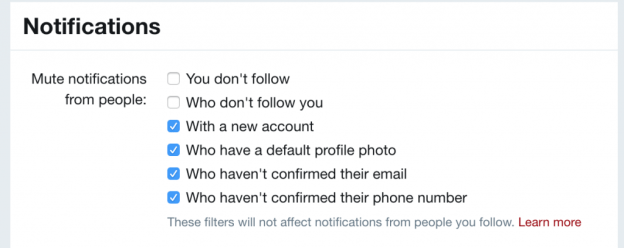
First, look at your toolbar, click on the Notifications tab and you’ll see a Settings tab. Looks like this:
Screen-Shot-2018-06-11-at-1.25.48-PM-1024x407

Click on the Settings hyperlink, and you go to this screen. You can see how I have set my Notifications right now on my @RachelintheOC Twitter account:

Here's How to Protect Yourself Against Social Media Trolls Now by @RachelintheOC

Another option here is the Advanced QUALITY FILTER, which allows you to mute specific words or phrases from showing up in your notifications. For example, if you’ve just had it with Trump, you can add that as a word that will always be muted, regardless of the tweet, and you will not see it (whether it’s from followers, news articles, quotes, trolls, whatever).

Screen-Shot-2018-06-11-at-1.28.52-PM-1024x235


Reminder: all of these settings are changeable, so if you’re having a bad day, do what you need to do and then change it back the next day. If you want to make it a permanent thing, that’s also your choice. These are options for people you DON’T follow.

Note: You do not have to give Twitter your phone number. You don’t have to give any social media channel your phone number unless you want to sign up for two-step log-in verification (something I highly recommend — and even then you can use email instead of text if you prefer). This is to prevent hacking of your account. Again, totally your choice.

Why is this an option then? Bots, spammers, and trolls who create numerous accounts to troll from don’t have numerous phone numbers — Twitter knows this. It’s simple to create a new email and Twitter account in a few minutes — it’s altogether different to get a new phone number to go with each of these accounts. So this option isn’t about you giving your phone number — it’s about protecting you from interacting with bots, spammers, and trolls you don’t follow. 

Some people argue that removing words or notifications is akin to putting ourselves in a bubble or echo box, where we only interact with people who agree with us; others say we are censoring others. I say: bullshit. You create and curate your own Twitter experience, and if you feel bothered or upset by what people are sending you, then it’s within your power to cut them off.

You are not obliged to interact with haters or trolls. You are not censoring them, as they will argue (which always tickles me). They are still free to spread their hate and vitriol — you simply do not need to be their final destination.

And on that note, Twitter has made a change to their algorithm: it will use behavioral signals – how users react to a tweet – to assess if an account is adding to or detracting from conversations. If it feels it’s exhibiting troll-like or bot behavior, the tweet will be removed or shoved down to the ‘show more replies’ graveyard. I think this is a great and needed change — what do you think?

Facebook Trolls

Oh, Facebook. What a disaster you have become. If you’re still there (I am. I love my Street Team — click to join! — and survivor group), you have your reasons. Pages are different and important if you’re an author or small business for the sole reason that you cannot advertise your books or services on your personal wall (if you are, stop it. You’re violating the TOS – terms of service) and they have every right to shut you down.

I find it’s almost impossible to post practically anything without someone making a political comment on it — in fact, I posted an article the other day about the legal difference between the terms sexual harassment, sexual misconduct, and sexual abuse, and some guy posted on my wall about why he changed political parties and “deep state” political conspiracies. I was like, dude, seriously? Sigh. (For what it’s worth, I kindly asked him to delete his comment. When he refused, I kindly deleted it for him and blocked him as well.)

I do think it’s possible for us all to disagree about politics and still like and respect each other, and have conversations about it if that’s what the designated topic is. Here, it was not. Anyway, I digress.

Managing Your Newsfeed

Did you know you can do that now? Before, you had to put people on lists and it took hours and hours. Days, even. And then you had to keep it all updated as you friended or unfriended folks. So most people didn’t bother. Now you don’t need to. Here’s how:

Click on your toolbar (top right by your face), where the little upside-down arrow is:

news-feed-pref-

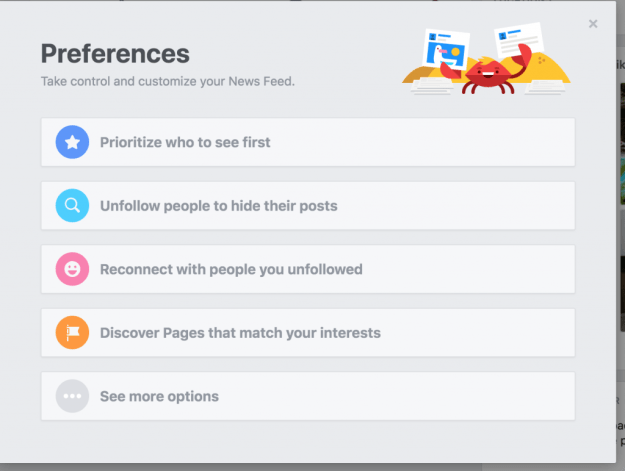
Once you click on that, a drop-down list appears. Click on News Preferences:
Screen-Shot-2018-06-11-at-1.52.07-PM-1024x772


Now, you just click on this handy box with the weird crab (I don’t get it but whatever). My kids don’t get it either. Can someone explain the crab to me? It’s just weird.

Click on each tab and do your thing. What’s important here is the light blue tab: you can UNFOLLOW people and they don’t know. You don’t see their vitriolic, ranting, or weird, crab-filled posts anymore and they have no idea.

Personally, I have zero issue with blocking folks and find a kind of sinister glee in it, yet I know some of you feel bad about that because you have hearts and stuff. Again, do what makes you feel good.

A Bit of Advice

If I choose to engage with someone who comes at me — because what’s the point of having this platform if I don’t use it, right? — I have The One-Reply Rule: I reply once (if at all). If that person comes back at me with ad-hominem attacks, circular logic, straw-man arguments, or are just plain ridiculous, etc., they’re gone. If, however, we can engage in some kind of discussion that is educational, beneficial, and all that, cool.

Listen, I get that people have feelings and need to feel their feels. Most people in this world just want to be heard.

None of us needs to be the target of someone else’s hate, though. Do not feel obliged to engage with anyone on social media, ever.

Final Thoughts

When all else fails and it becomes too much, turn off social media. Walk away. Turn off all your notifications. Your mental health is far more important than social media.

If it helps, here’s what I do with regard to social media (and remember, this is my business, too):

  • No phone notifications, ever.
  • No desktop notifications, ever.
  • I keep Twitter and FB open when I’m working on social media scheduling or interacting with people, otherwise, they’re closed
  • I always have Hootsuite open because I’m always scheduling or looking for great content to schedule
  • I definitely recommend using a SMM (social media management) tool as well as the coordinating browser extension (in this case, the Hootlet)
  • I never have social media open when I’m writing (blog posts or my books)
  • If I’m working on client deliverables, social media is off.

Some people enjoy the arguments, some people take things personally, and the overall experience can go sideways quickly. Practice compassion with others and importantly, with yourself. If silence is the best answer for your self-care, do that for you.

I hope this post helps you figure out ways to find your peace.

By
Source: rachelintheoc.com

Visit us at First Edition Design Publishing